jayc89
-
Posts
1389 -
Joined
-
Last visited
-
Days Won
1
Everything posted by jayc89
-
It's a 33kw Baxi Platinum+. It's certainly a condensing boiler but I'm led to believe it's not the most efficient out there. 21c is where the family feel most comfortable. I certainly want to make changes to reduce our energy usage but I'm not sure dropping the temp will fly with the boss
-
Good point, I should have mentioned that. According to my, fairly basic, heat loss calc, it looks like our radiators were spec'd for delta t50 so with a flow rate any lower the rooms don't warm up suitably. I plan to spec my own for the extension, and they'd be overspec'd for something along the lines of t30 (I've not really put too much thought into that yet)
-
Downstairs UFH is set to 21 throughout the day (6am - 9pm) and setback to 18 overnight. Upstairs radiators are set to 21 from 6am to 9am and 4pm to 9pm (basically whilst the kids are awake and likely upstairs somewhere). The rest of the day it's set to 19. The upstairs radiators are on constantly during those "peak" times, but the downstairs UFH rarely comes on at all during the day. I don't think I've ever seen either call for heat during the setback hours.
-
~1880s solid brick detached house. Approx 220sqm. 3m high ground floor ceilings (~2.4 first floor) 300mm rockwool in loft 1970s upvc windows, no trickle vents. Wet UFH downstairs mixer set to 35, but in reality the flow is more like 40. 100mm PIR below screed. Approx 420m total pipe length. Radiators upstairs Unvented Cylinder (set to 55c) 33kw gas system boiler set to 75c flow (for upstairs rads) Planning a two storey extension which will likely increase the footprint ~ 140sqm Likely 175mm cavity (EPS beads) Likely 200mm EPS below slab The house never struggles to reach temp (i.e. 21c) but it never feels "toasty". No signs of damp (other than where the old cellar was), so I'm suspecting this is air leakage. Over the past 12 months we've apparently used 31,000 kWh of gas and 4,000 kWh of electric. I've heard the saying "AIM before APE" which I'm trying to follow as near as reasonably possible. Working on airtightness, the house was fully stripped, air bricks removed (when suspended floor was replaced with slab), holes were plugged when they were found, all walls are wet plastered. We don't want to install EWI and hide the lovely brick work and it's too late to install IWI to ~140sqm of the existing house. We plan to fit it to the remaining ~ 80sqm of the existing house as we extend. When we extend we'll likely have a reasonable size south facing roof, perhaps 12x6m, so I'm really planning for what we should be using at that point. Ideally we'd reduce our reliance on gas, as our current usage is just crazy high. Perhaps some hybrid approach using an ASHP to power the UFH and maybe PV to feed the ASHP and/or heat the unvented cylinder, leaving the gas boiler for the upstairs rads and topping up the hot water when required. What would you do?
-
We used Longfloor IntegraCure. 60mm over ~ 65sqm. UFH was commissioned 7 days after pouring and we tiled after that. It's been down around 6 months now, over the depths of winter and we've had no problems.
-
The house has certainly been tweaked although the cellar was always damp, which was a driving force in decided to block and beam over it. There’s certainly heat in the area, the cupboard you can see to the right houses are UFH manifold. It’s ventilation that’s currently lacking. Even with the cupboard door constantly open, it helps a bit, but it’s no where near drying it out fully. A French drain has been a consideration for a while now, although this section of the house is pretty much dead central so I’m not sure how useful a French drain around the perimeter would be for this situation.
-
We're currently with Ovo, pay £168/mo and our deal is coming to an end next month. We use approx. 31000 kWh gas and 4000 kWh electric per year. Gas usage seems crazy high, but that's for another thread. The price cap calculator suggests that staying on the variable plan will cost approx £308 from next month, potentially rising to £397 in October. The only fixed term deals Ovo currently offers are; £488/mo for 2 years £506/mo for 1 year It's all pretty grim. Any suggestions? (Other than to do away with gas, of course )
-
Paying tips to delivery drivers
jayc89 replied to Omnibuswoman's topic in General Self Build & DIY Discussion
I've worked on both sides and never expected a tip, nor would I ever tip now. Many moons ago I delivered a caravan to a customer, probably 200 miles away, and they offered us some home made spag bol and ice cream for pudding, that was the best tip I ever got -
That's right, where the wall steps out is ground level. It's probably 0.5m below ground level at its lowest. Other than in the hight of summer the floor's never dry there. Would you avoid even breathable floors inc. Limecrete? If so, why?
-
Limecrete's a good call. I suspect 80mm of the finer grained foam glass would be suitable for such a small area, finished with 50mm of lime screed? I'd want to try limit the build up and/or how much I have to excavate as it'll be a faff getting material in/out of there. If I was to go the lime route, I'd expect to knock all the old render off first. I did this in the section beyond the wall in this pic, so I know it's stuck on pretty well
-
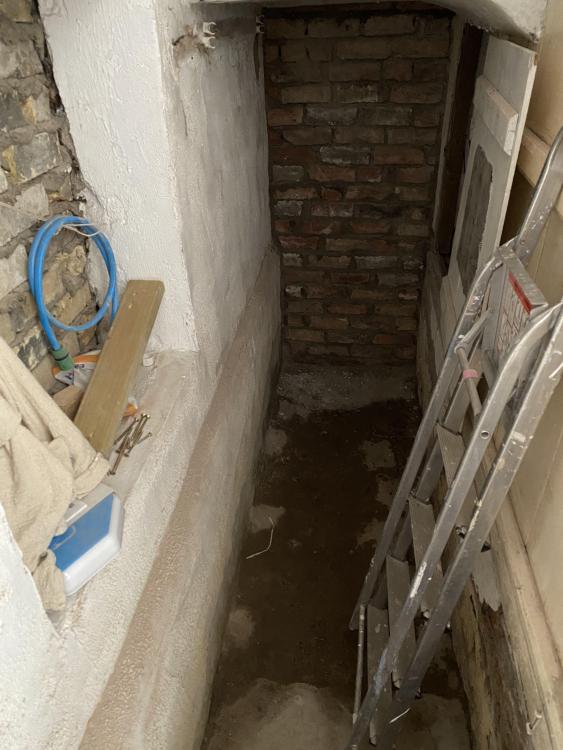
We have an approx 3 x 1m understairs cupboard. The floor tiles are laid direct to soil so are always damp. The walls look like they were at one time covered in some sort of tanking that's just flaking away now (beneath a sort of pebble dash coating it's incredibly chalky). To the left is our kitchen, the right is the staircase and hallway, directly in front is a brick wall and beyond that a ventilated void beneath a beam and block floor. I've thought about cutting a couple of bricks out of that wall and fitting air bricks to allow for some circulation which should help (keeping the cupboard door open has reduced the humid feeling down there) but it's not really an ideal solution as we're just encouraging a draft. Whilst we'll never achieve modern airtightness standards, I would like to avoid making it any worse. Ideally I'd dig out the existing tiles and relay the floor, incorporating some sort of DPM. The main concern is, with the property being 150 years old, we don't have a DPC for that to lap over so by doing so will I just move the moisture elsewhere? Given it's next to our staircase I don't particularly want to encourage the moisture up towards that. Any ideas/suggestions would be greatly appreciated.
-
The water pipe should be lagged as it comes up through the drain bend. I shoved a load of wire wool down it and finished it off with expanding foam, capping the bend with a 32mm drain connector (link) (as our supply was 32mm MDPE)
-
Our UFH and upstairs radiator zones all use Heatmiser NeoStats (v2). I'm considering getting a NeoHub so I can use the API it exposes to track things like temperature difference and demand frequency per zone throughout the day/week etc. Before I write something from scratch I wondered if anyone had already done anything similar?
-
Does anyone have any ideas?
-
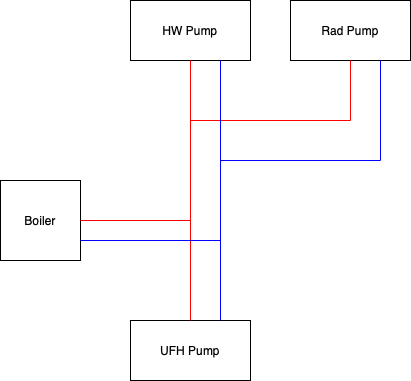
3x UFH zones downstairs, each with their own stat. 1x Rad Zone and the Hot Water upstairs. Something like this; There's also a bypass valve after the first tee from the boiler towards the HW and Rad pumps.
-
I have a Baxi Platinum 33kW boiler (running in system mode) powering the downstairs UFH, upstairs radiators and unvented cylinder. Around November, I had to pump the boiler temp up from 60 to 70 to keep the upstairs warm enough for the wife and kids. The long term solution is better insulation and airtightness, I know and is certainly not lost on me, but that's by no means a quick fix. From what I can tell the tech within the Baxi Platinum range is pretty old and the off the shelf Baxi weather compensation kit is not supported (load compensation would have been ideal for my use case - i.e. when only UFH is on, requiring 40c flow). Short of replacing the boiler, is there anything else I can do to more intelligently set the flow temp?
-
No support for the "warm batten" method? PIR direct to the wall, taped, batten over fixed with concrete screws to form a service void on the warm side and plasterboard over the battens.
-
Best cable for connecting Openreach fibre to LAN switch
jayc89 replied to cbk's topic in Networks, AV, Security & Automation
Go for somewhere central. For me that was the cupboard under the stairs. It really depends on the space you have and whether that's better suited to one over the other. I generally prefer wall mounted, assuming cables are dropping from above. For a home set up it really doesn't matter. Go with whatever combination you can get the cheapest. Just make sure they're unmanaged switches, unless you fancy getting intimate with individual port configuration. Given the number of cables you're running, I'd get a couple of Cat 6 reels to pull multiple runs through at the same time. I assume you'll be getting a set of cable testers to confirm they've been terminated correctly, you can use them to match up the ends and then label them. You could also use different coloured boots for different rooms/spec cable/whatever makes the most sense to your set up. -
The idea is they always maintain the desired delta-T, regardless. Do you have a standard actuator you can stick on one of the loops to test with?
-
For me it’s been a real struggle finding an architect who had their own ideas rather than providing an initial bland proposal and then just making the changes I suggest. As a consumer, I don’t want that. Just because something makes sense in my mind, doesn’t mean it will work in practice, and it’s their expertise that I’m paying for. We did find a really good architect a few years ago now who produced some plans for our previous house, but unfortunately he’s since retired. The last couple I’ve worked with have been a real struggle.
-
Connecting New Water Supply Plumbing Quote
jayc89 replied to thefoxesmaltings's topic in General Plumbing
Mine was similar, 30m x 32mm MDPE to the house and 20m x 25mm MDPE teed off to the garage. Cheapest I was quoted was £2200, so I did it myself and just got the plumber to make the connections. -
Try reducing the flow rate and see if the return temp lowers, it should. FWIW, I've always gone on a delta-t of 11c for flow temps > 35c and a delta-t of 7c for flow temps 35 and below.
-
Which parts did you DIY?
jayc89 replied to BadgerBadger's topic in General Self Build & DIY Discussion
So far, I've only renovated the existing house, I've; - Removed downstairs floor boards and joists, dug out and poured new slab, insulated and laid UFH pipes (pro company came in and screeded) - Replaced existing water mains with 32mm MDPE - approx 35m trench. - Fixed drains I broke digging that trench - Fitted beam and block over original cellar (I say cellar, it was basically a big cupboard under the stairs) - Mostly relocated a bathroom to what was a bedroom after the bathroom fitter let us down When we get rolling with the extension, I plan to; - Dig and pour foundations - Dig and pour floor slab - Dig and lay drainage Clearly I just like digging... I have a builder lined up to build the structure (walls and roof) but I'll do most of the 1st fix, all the stuff that can be hidden by the 2nd fix, which I'll also get done by the pros. -
Its fitted with a cowl. We decided that made sense as soon as we found hailstone on the carpet last year So there’s no problems from filling the opening and bricking up as long as the top is still open?
-
It is, the north facing wall so arguably the worst from a damp perspective.