SteamyTea
-
Posts
23273 -
Joined
-
Days Won
187
Everything posted by SteamyTea
-
I am a bit of a fan of, um fan heaters. They heat the air quickly, are cheap to buy and cost the same to run as any other resistance heater. But there is a problem. They are usually controlled by a mechanical, bi-metalic, thermostat. This can either switch the whole unit off, or just switch the heating element off. If the whole unit is switched off when the desired temperature is reach, it is easy to forget it is actually on. This is a bit annoying if I go out for the day as it costs a bit as it is using day rate on the E7. What I would like to do is fit a timer, which is easy enough, but also control the temperature better. So what would be a reliable, cheap and fairly easy was of controlling not just the power of the element, but also the fan speed. Reducing the fan speed, in proportion to the output power woudl keep the noise down. I don't mind the speed and power being high when it is first switched on, but it would be usefully if it reduced power as it comes up to a set temperature. And be always being on, there would be some fan noise as a reminder to switch it off.
-

MVHR newbie.. help needed
SteamyTea replied to Savage87's topic in Mechanical Ventilation with Heat Recovery (MVHR)
With all the energy to drive that lot, be better off just opening a window. -
These were a water saving idea. They should have been a soap saving idea as you learnt the first time that there was not enough water to wash it all off.
-
MVHR newbie.. help needed
SteamyTea replied to Savage87's topic in Mechanical Ventilation with Heat Recovery (MVHR)
Then can I go around and change them for 100 quid, they cost about a quid each. -
MVHR newbie.. help needed
SteamyTea replied to Savage87's topic in Mechanical Ventilation with Heat Recovery (MVHR)
Are they DHT11s, these are rubbish. The DHT22s are a lot better. -
Are these the ones that use the mains water pressure to draw the hot from a vented cylinder. The sort the cheapskate don't buy as we get the cheapest pump from Screwfix. Or the ones that pull in air?
-
Yes as part of the MCS yield estimate. Also, if modules are fitted on a flat roof, the the angles can be changed. You get less module area ratio on flat roofs, do increasing yield is more important.
-
I have seen these, what happens when you manually slide the lever over?
-
Ground floor for bungalow: joists better than a slab?
SteamyTea replied to Dreadnaught's topic in Timber Frame
I kind of get it, but this may help more. https://www.researchgate.net/post/What_is_the_difference_between_piled_raft_and_pile_group2 -
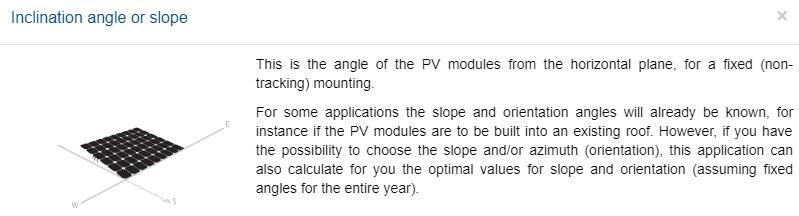
Though not clear, this is what PVGIS has to say , and show, about slope angle.
-
Also the modules may be getting the optimal amount of sunlight to reach peak efficiency. Too much light just turns into thermal energy, and you don't want that.
-
Just what would building control do if they found out?
SteamyTea replied to ProDave's topic in Building Regulations
My neighbour, the slum landlord, was fitting some new windows the other day. Noticed there was no safety tag on the scaffolding, eventhough a proper company put it up. I think he found some windows as they don't match, and in one instance, don't even fit. Just wonder what it means when he comes to resell? I had to take out some indemnity insurance as the people selling could not find the FENSA certificate for the front door. -
Possibly. Though the majority of the generation will be in summer, so may make less difference than you think. Go and play about on the PVGIS site and see what the numbers show.
-
Engineering and lecturing. And catering and dropping out of the rat race at a decent age. I could have invented the term FIRE, but I was too busy dropping out of mainstream work.
-
Ground floor for bungalow: joists better than a slab?
SteamyTea replied to Dreadnaught's topic in Timber Frame
Heard that too, and remember some old cottage gardener saying he used potatoes to break up his soil. -
They have a way of dealing with that, nothing, apart from pain management and a bed was going to happen before £8000 was deposited. I suspect that as my Aunt is British, she could have had it for free anyway, but the insurance gave her a room to herself.
-
Here is an interesting challenge for you (I am a bit busy right now). Does that change for an equal latitude in the Southern Hemisphere? I am wondering how much difference the weather makes? I could get posh and start talking about seasonal turbidity, but cloudiness is a better word. The UK is particularly cloudy, but never looked at similar positions in the Southern Hemisphere (as it is mostly water), but maybe places in Russia and Canada that are at a similar latitude have very different figures.
-
Probably covering his arse, I would do the same if I was not paying the bill.
-
Ground floor for bungalow: joists better than a slab?
SteamyTea replied to Dreadnaught's topic in Timber Frame
I think they would be a relatively quick way of drying up, and breaking up, some boggy land. Would need to be chopped down after about 5 years or so, then more interesting things done. -
Yes, or 10 300 W loads for an hour, or a 30 W load, like the security light I have just fitted for my Mother, for 100 hours. More interesting is how much water and air you can heat up. Water takes 4.2 kJ.kg-1.K-1, air is easier to remember as it is 1 kJ.kg-1.K-1, but oddly, stone, concrete and brick are less at about 0.8 kJ.kg-1.K-1, pine is 1.5 kJ.kg-1.K-1. Taking just water as an example, and 100 litres (or kg as it is the same) of water at 40°C and an incoming mains water temperature of 10°C That would be: 4.2 [kJ.kg-1.K-1] x 100 [kg] x (40 - 10) [ΔK] 12,600 kJ To convert from kJ to kWh multiply by 0.00027778 3.5 kWh So today, your PV has given you a free bath. (If you take the reciprocal of 0.00027778, you get 3,600, which is the number of seconds in an hour)
-
This is why kWh can seem a bit confusing to a lot of people. It is Power x Time, so even a lower power in the summer can produce a greater amount of energy. Energy can be measured in kWh, though is really MJ (Mega joules). There is a direct conversion between MJ and kWh, basically the time cancels out. This is because a W is a J.s-1 and an hour is 3600 seconds.
-
Makes a big difference, so you are comparing probably 14 hours of productive daylight with about 8 hours today.
-
I am up at my Mother's as after a month, my Aunt, who broke her leg while staying, is just fit enough to travel back to Canada. The bill is large as she had to have her hip replacement, replaced, again. So at about £35,000 from her insurance company, the NHS have done quite nicely out of it (one of my Cousins is a GP and she think the bill in Canada would be about the same, but in $C, but one of my other Cousins lives in the USA, a CAT scan starts at $35,000)
-
Are they actually doing that, or just seem to. Modules are rated at a particular light intensity i.e. 800 or 1000 W.m-2. In summer, levels may be higher than that. Basically yes, and the sun has to travel through more atmosphere before it hits the module. Go and find your nearest WeatherUnderground weather station that has a PV monitor and look at the historic data. It is measured in the horizontal, rather than the optimal angle. Then go and look, and play about with PVGIS and see what changing the azimuth and altitude of modules would do to production. Also, is the 6 kW and 3.5 kW really that, or kWh. If kWh, then that is partly down to shorter hours of daylight.
-
Ground floor for bungalow: joists better than a slab?
SteamyTea replied to Dreadnaught's topic in Timber Frame
Get those willows, poplars, eucalyptus and Leylandii planted.