SteamyTea
-
Posts
23848 -
Joined
-
Days Won
200
Everything posted by SteamyTea
-
When I go for a £2.85 coffee, I am paying about 30 times the price of the 'materials'. What do I get for that huge markup? Well to start with I get a nice girl or boy making it for me. I also get a seat, at a clean table. Toilets are are not too unpleasant. Car parking (that costs a few quid here in the summer). All the cafes have got 5 star ratings, the staff are properly trained,, and not just in making coffee, also in customer services. I also know that if I go to one of the other branches of the chain, I will get the same service, in similar surroundings. The product is consistent (I like the coffee they serve me, though cannot comment on any of the other products they serve). So I accept that I can make a coffee at home, for 10p, but that is not the point. I think you will find it is from fixed costs, not lost profit. High fixed costs will usually reduce profitability. Profitability is not absolute profit. Edit: Bit of a cross post with @saveasteading about profits/overheads/fixed costs.
-
Quite simply, if the storage heaters are overheating first thing in the morning, and are not heating during the late afternoon and evening, they are undersize (either though wrong usage of controls or actual physical capacity). Yet again, temperature is being mixed up with power and energy. They are different things. Learn the difference, it is three things to learn, not difficult.
-
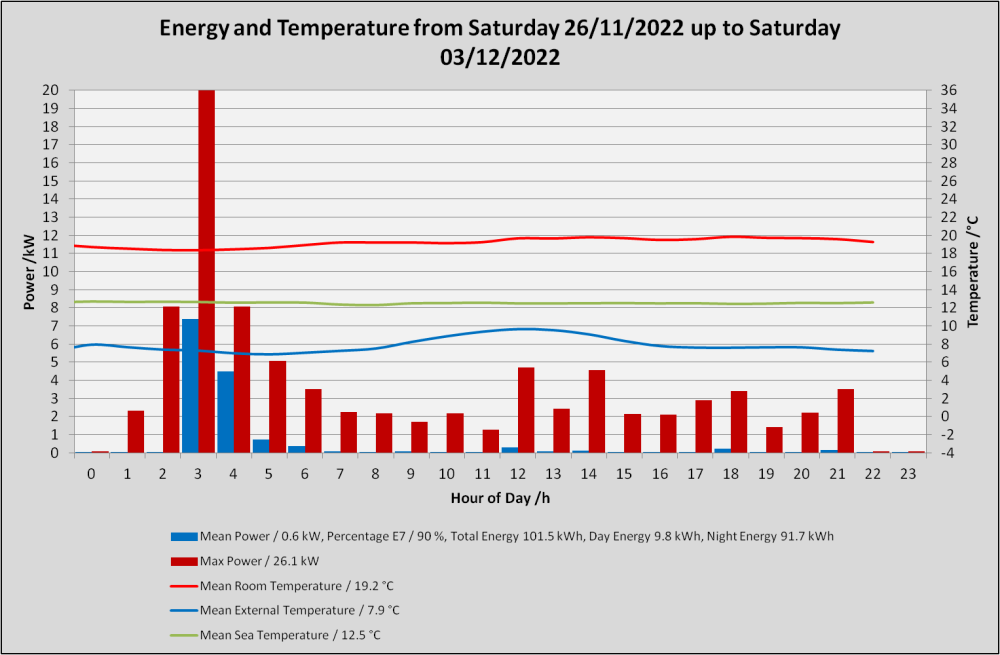
Basically what @TerryE does automatically, and I do manually on my timers. Blue Columns
-
 The legionella cycle is going to take up that difference I would have thought. If I 'overheat' my cylinder, it lasts about 3 days (200 lt at ~50°C usually, up it when friends stay to 65°C, then forget to turn it down again). My total mean water usage is 150 lt/day.
 -
Look up Newton's Law of cooling, it is not linear. So to get usable thermal energy delivery later in the day, the stating temperature has to be high. The timing is nothing to do with the storage heaters, it is the time that the National Grid had deemed the most useful to them, and the power generators, to deliver cheap power. They can always have a heat pump fitted, I am sure they are eligible for a free one.
-
The world would be better without oxygen. No planning restraints on the moon.
-
Are you suggesting that gold plating and liquid nitrogen dipped leads are no better than copper.
-
So I got my EDF bill today. The new rates on it are as follows: Meter Rental Day Charge 56.28p/day Day rate 44.04p/kWh Night rate 15.37p/kWh Then they take off the £66/month, which actually leaves me in credit on my usage so far. I was paying, until 01/10/2022 Meter Rental Day Charge 55.10p/day Day rate 33.33p/kWh Night rate 17.68p/kWh So day up, night down and a penny of the meter. Now going back to the new rates they sent me a while back by letter. Meter Rental Day Charge 59.10p/day Day rate 64.99p/kWh Night rate 33.99p/kWh The update that @Nick Thomas posted up Meter Rental Day Charge 59.10/day Day rate 54.16p/kWh Night rate 13.01p/kWh So it seems to me that the EDF don't have a clue what they are charging.
-
Can anyone recommend an ultrasonic fox deterrent?
SteamyTea replied to Adsibob's topic in Infestation
-
How many philosophers does it take to change a lightbulb? "The bulb wants to be changed"
-
I have had diesels since the mid 1980s. Been 30 years since it was cheaper than gasoline. It was to do with the tax banding more than anything else. Still cheap at 18p/kWh.
-
Self build mortgage rate increase
SteamyTea replied to Barryscotland's topic in Self Build Mortgages
Keep an eye on bond prices, thy are the inverse of interest rates. https://tradingeconomics.com/united-kingdom/government-bond-yield -
Except some A/C units do not recycle cooled air. Many are work just the same and just use external air only for the thermodynamic cycle. It always has been, I hate it when an ASHP is referred to as a 'fridge in reverse. Really a case of asking your venting architect to do some sums and show that the unit will have sufficient airflow without affecting performance. She will probably only believe her own figures. Check her homework though.
-
I can tell you that wind and solar are currently producing about 20% of the UKs power. Almost twice what nuclear is. We are currently consuming about GW of power, twice what we do in a hot summer. Oddly though, we do not dismantle the 'extra' 20 GW of capacity in the spring and rebuild it in the autumn. We also have at least another 30 GW of capacity not currently being used. There is a huge difference between total capacity and management of that capacity. We could easily put (capacity wise) another 7 million EVs on out roads.
-
Used a lot in environmental surveys. https://www.bbc.com/news/uk-scotland-highlands-islands-49495145
-
Reinforce or replace ceiling joists?
SteamyTea replied to retrophit's topic in Lofts, Dormers & Loft Conversions
Very useful. Thanks. -
Here is the MCS spreadsheet. Not looked at it in detail, but it is what official installers have to use here. https://mcscertified.com/wp-content/uploads/2021/04/MCS-Heat-Pump-Calculator-Version-1.10-locked.xlsm
-
Help with proposed new flat roof - EPDM or Fibreglass
SteamyTea replied to merc's topic in Flat Roofs
Take more that a bit if rubbing down, really need to remove all the top/flow coat. Top or flow coats usually have a wax additive in them. That has to be removed. Large, slow speed angle grinder with a sandling pad would be my tool of choice. Same as above, then make up a polyester filler mix, spread and sand, recover with some GRP and then flow coat. Both jobs will make you itch. I still itch, but then have been involved with the shit since 1975. -
You can get split ASHPs. The fan unit should have less mass than a monoblock, and the 'pump' unit can go in the shed/outbulidling.
-
Self build mortgage rate increase
SteamyTea replied to Barryscotland's topic in Self Build Mortgages
They used donkeys back in the 1990s, who would have thought the Olympics would end up there. -
Outside toilet, very retro.
-
Self build mortgage rate increase
SteamyTea replied to Barryscotland's topic in Self Build Mortgages
Yes, was when the slump was at its worse. Could have bought cheaper on Portland, but then have to put up with Portland people. Well when I say people..... -
Got to add the two together to get the total, then dived into the day or night.
-
Self build mortgage rate increase
SteamyTea replied to Barryscotland's topic in Self Build Mortgages
Was higher in the early 1990's But we did only borrow 3 times our wages and you could by a 3 Bed, with garage, in Aylesbury for £37,000. Or a two bed cottage, in Weymouth, for £36,000. -
So roughly 75% on the night rate, that is actually pretty good. 7 kWh a day is pretty good as well. So say you use 2 kWh during the day. That is about £1 to £1.30 a day. A battery system would have to be around 5 kWh to give it a decent longevity, and be able to reliably power a decent size inverter, around 6 kW so it could cope with kettle, oven and a cooking ring (hopefully you have an induction hob as they are just better all round). Now I would think you would be looking at around £8,000 to have something like that installed, and it should last 10 years, so £800/year, plus the running costs i.e. the night rate electricity. If your night rate is around 15p/kWh, and you can get 80% efficiency on the charge/discharge cycle, that is 54p/day, £200/year. Not looking good. But you will save on the high daytime rate, that is between £365 and £475 a year, a real saving of between £165 and £275. Not looking good at all as it cost approximately £800 a year, a you are in the red somewhere between £525 and £635. You could probably save more by showering for 1 minute less each day, or 1 inch (25.4mm) less bathwater.