


SteamyTea
-
Posts
23838 -
Joined
-
Days Won
200
Everything posted by SteamyTea
-
You know the thickness and surface area as well, so starting with the thermal conductivity, k = W.m-1.K, and resistivity R = L / k (where L is thickness in metres) you can rearrange to make W the subject. Once R is known, U-Value can be calculated U = 1/R, losses then calculated by incorporating the area A. Marks will be deducted for failure to show your workings. (and I did say, as I always do, that I may have made an error)
-

What's more important for comfort U value or 'thermal mass'
SteamyTea replied to Gone West's topic in Boffin's Corner
Hardly, more tears of disappointment, for our education system. Our old mate @DamonHD once told a story about his Father being told, by a youngster, that one of his science programs was a 'bit sciency'. And Stephen Hawking: 'Someone told me that each equation I included in the book would halve the sales.' -
Stuart Milne have gone bust - BBC
SteamyTea replied to Ferdinand's topic in General Self Build & DIY Discussion
"I believe one of the bids could have delivered a comparable, financial return to administration and, crucially, allowed the business to continue to operate, safe-guarding hundreds of jobs and protecting livelihoods." Should be able to pick up the best bits, without debt, from the receiver. -
@TerryE designed his heating system to incorporate the following days weather. Maybe he will join us here and explain what he has actually done. I understand it (as he is using a resistance heating system) that he calculates the expected energy for the next day, from the MET Office forecast, then adjusts the time he heats up his slab. After some time, his program looks back at the past data and adjusts for fine tuning. With an ASHP based system it is really a matter of juggling the main variables of optimal CoP and run time. Run time is pretty easy, but optimal CoP is the hard one. If the RH does up, that can cause the defrost cycle to kick in, possibly taking energy back out the system. The probability of frosting should be able to be calculated statistical, as could the SCoP. That may be worth looking at first to see if there are any meaningful gains to be had. A while back @Ed Davies and myself looked into the probability of one sunny day following another, we got negative results, which is a result in itself (I can't remember the P Value now). I do seem to remember that the best fit to sunshine was wind direction, but we have so little northerly winds (where I am) that it was statistically insignificant. Apart from the technical challenge, which is fun, more energy could be saved by driving a very economical car.
-
House volume is often used as a proxy for heat loss, and I have known a salesman that just counted the number of windows and used that (500W per window I seem to remember). Take two houses with the same volume, one terraced over 3 floors and the other a detached over 2 floors. The thermal losses will be very different.
-
What's more important for comfort U value or 'thermal mass'
SteamyTea replied to Gone West's topic in Boffin's Corner
This is often said, but I have not seen any evidence that it is more breathable than OPC based pointing. -
Need to reduce costs of running Water Source Heat Pump
SteamyTea replied to MKF's topic in Introduce Yourself
Seems very shallow, even allowing for the high water table (read recently that it is even higher at the moment). What sort of filters are used to get the grit out of the water? Could they be blocked up? -
Yes, why I commented. It was pretty cheap as well. Got it from Curries, and managed to get out without being bullied into buying an extended warrantee.
-
I had a Goldstar telly in the 1980's, it was very good. Gave it to my Grandmother in the mid 90's and she used it until she died in the early 2000s. So it lasted 20 years. The sound was brilliant (all her neighbours said so), just as well as she was a deaf as a post in the end, just like my mother is now.
-
What's more important for comfort U value or 'thermal mass'
SteamyTea replied to Gone West's topic in Boffin's Corner
Here is what has happened today down here.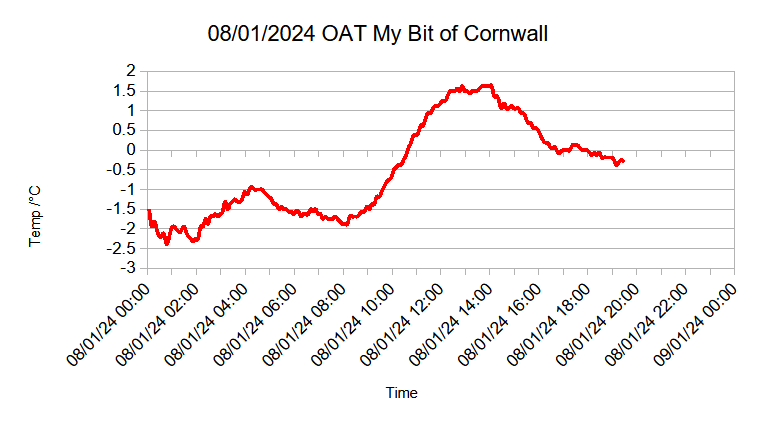
-
What's more important for comfort U value or 'thermal mass'
SteamyTea replied to Gone West's topic in Boffin's Corner
Where is that then? -
What's more important for comfort U value or 'thermal mass'
SteamyTea replied to Gone West's topic in Boffin's Corner
I have a feeling it is beyond repair. Asked the garage to see if it is anything simple, but they are two men down, so no idea when they can look at it. I am not pushing them as they have been so good to me this last couple of years and they are the nearest place to my house. I may go looking for a small, economical runabout, as I am still clocking up silly annual mileage. Two months mileage is over what my sister does in a year. Just a shame I spent so much on it the last few months, but in all fairness, I should have spent that money 2 years ago. -
What's more important for comfort U value or 'thermal mass'
SteamyTea replied to Gone West's topic in Boffin's Corner
Umm You just winding me up now. Actually, pumping cloud condensation nuclei into the local atmosphere may make it snow more. More snow reflects more radiation back into the atmosphere, reducing the ability for the ground to reflect IR radiation to interact with the historically high levels of atmospheric CO2 molecules. But is also insulates the ground, trapping in extra energy that can be released later. So probably no net benefit at the local level. A quick look at my outside thermometer and it is showing -0.3°C air temperature. The paving slabs (all 'thermal mass) are at -0.4°, the outside of the wall is at 0.2°C (little 'thermal mass') and the corresponding inside wall is at 16.5°C. Inside air temperature is 21°C, RH is at 43% (lovely). No snow though, but I don't care as I don't have to drive at the moment. -
That is my understanding, and a sensible thing to do anyway. Best place to start.
-
What's more important for comfort U value or 'thermal mass'
SteamyTea replied to Gone West's topic in Boffin's Corner
You do get a film of air that moves upwards along the wall. There is a general figure for this, outside is R = 0.04, inside is 0.13 m2K.W-1 (here). I am not sure how much a fixed air gap behind plasterboard will change thing. I suspect it changes it for the better. I seem to remember that the energy to dry out a building is very large. It is to do with the phase change of water. Water usually has a SHC of 4.18 kJ.kg-1.K-1 while changing to vapour it is 2477.2 kJ.kg-1 at a starting temperature of 10°C (283K) (note that there is no K as the temperature does not change. That is 0.688 kWh per kilogram of water. I can't remember what value we used for the fraction of the mass of the structure was water, was not very high, 8% springs to mind (some stuff here), but realistically that will be very variable for rubble walls and really needs to be tested (cut a section out, weigh it, then bake in an oven overnight, weigh it again). Most stone and brick has a SHC of 0.8 kJ.kg-1.K-1. That is a factor of 5 different for liquid water and nearly 600 as it turns to vapour. So a significant amount of energy to dry out a wet house. I have just turned on my living room storage heater as we are in for a few cold days. I notice that all the windows get condensation on them as the liquid water is turned to vapour and re-condenses on the coldest surfaces. I now have windows open a little bit, which really hurts me, but it is better than mould forming. -
I think the government want to treat them as business. If you get small business rate relief then it is clear cut.
-
What's more important for comfort U value or 'thermal mass'
SteamyTea replied to Gone West's topic in Boffin's Corner
Is that because the asthma is so bad you are gasping from breath. -
What's more important for comfort U value or 'thermal mass'
SteamyTea replied to Gone West's topic in Boffin's Corner
Insulation is more important for stability. It is in the units. W.m-1K As it has a W (J.s-1) in it, that includes the time element, and it is the time that describes the stability. The heat capacity (J.kg-1K-1 or J.m-3K-1) just describes the instantaneous amount of energy and has nothing to say about how it moves. -
What's more important for comfort U value or 'thermal mass'
SteamyTea replied to Gone West's topic in Boffin's Corner
J/m3K, could be a typing error or getting confused with W √s / (m2 K) Speed is a scalar, so only has magnitude i.e. m.s-1 or in this instance J.s-1, which we know as a watt. Kind of, but not really. As soon as it becomes volumetric (as in fixed in place rather than floating anywhere in space), as opposed to specific, shape becomes important as that affects the exposed surface areas. It is those surfaces that have a temperature difference. It is the thermal conductivity that governs the "velocity" of thermal energy transfer. Velocity has speed and direction. It can be modeled as simple harmonic motion (close enough), if the limits are known. The biggest problem is that in the UK (and other islands especially, above/below Latitude 40°), we don't have evenly spaced hours of daylight, or stable weather systems. This makes it hard to actually use a dynamic model as the energy forcing happens way to rapidly i.e. thermal changes in hours, not days. The materials do not have enough time to react much. It is often quoted that if wine is kept in caves in the South of France, the temperature is quite stable, but way below what is comfortable for people i.e. 12°C. Now you could add some energy into the cavern, but I then think you will agree that you will not like the bill and as soon as you turn the heating off, the air temperature will quickly equalize with the core rock temperature. Even after doing my BSc project in just this area, with the twist that the experiments also included active and passive solar gain, I still find it very hard to actually describe what happens (10k words and ten pages of calculations still only got me a 2.1, but my cataracts were so bad I could not read, so shall put it down to that). Terminology, and using the correct SI units, becomes quite important in thermodynamics. The is T and t (temperature and time), K and k (absolute temperature and 1000), e and e (effusivity and Euler's number), m, m2 and m3 (distance, area and volume), then the horrible ones kg, h and H (mass, hours and inductance), j and q (flux as a scalar and the flux integral sum) and finally s and S (time and electrical conductance). And people wonder why I am a pedant about the correct usage. Get them wrong and formula soon stop making sense. And that is why the universe is shaped like a saddle. -
What's more important for comfort U value or 'thermal mass'
SteamyTea replied to Gone West's topic in Boffin's Corner
I should really have added in 'and glazing area and angles'. But in modelling you start with the easy bits then add in the complicated bit. -
What's more important for comfort U value or 'thermal mass'
SteamyTea replied to Gone West's topic in Boffin's Corner
Is it bollocks. Where did you get that from? They think they know what it means. Trouble is, it gets confused in peoples minds. What it really is is thermal inertia which is defined as the ‘property of a material that expresses the degree of slowness with which its temperature reaches that of the environment’ (Ng et al. 2011) or the ‘capacity of a material to store heat and to delay its transmission’ (Ferrari). Thermal Inertia has the units W √s / (m2 K) -
Can that mean 'back at the consumer unit' though.
-
What's more important for comfort U value or 'thermal mass'
SteamyTea replied to Gone West's topic in Boffin's Corner
Insulate and airtightness. Thermal stability is more to do with ACH than anything else. Keep them low, and recover the energy, and the temperature will be quite stable enough. -
Don't they have battery back up and just reconnect and pick up the schedule again. If not, this smart is not very smart.
-
What's more important for comfort U value or 'thermal mass'
SteamyTea replied to Gone West's topic in Boffin's Corner
Find a derived SI unit for it and I am happy to change my mind. Stable at a lower mean temperature for the same energy input. Did the calculations on that years ago. Ideally what you want is an airtight box made from insulation. Then clad it in your favourite coating. If a brick/block is 100mm wide, that is 100mm less insulation.
