SBMS
-
Posts
1075 -
Joined
-
Last visited
Everything posted by SBMS
-
Protek structural warranty quotation
SBMS replied to Amateur bob's topic in New House & Structural Warranties
Self build warranties are specifically designed for self builders and those builders that don’t necessarily have a primary contractor for them to go after. Would be worth checking your warranty but that’s kind of the reason why self build zone market their products - and ask you from the outset if you have a primary contractor (and if you do who they are). If you don’t I suspect the premium is more as you’re a higher risk but they would cover you in your example. -
Ah sorry didn’t realise you were using that.
-
It gets blown into every nook and cranny so reduces the dependence on skilled labour to fit. It also gets blown in between the metal web which would be tricky to do with rafter roll. When I priced up both they were very similar priced.
-
Yep. That’s exactly what we are doing - architect didn’t draw it but we will be counter battening the entire inner surface of the smartply, running services/spots in that and then plasterboarding on top. You can get 50mm flat MVHR ducting but you could also do wall outlets (or even floor outlets).
-
Have you asked your insulation provider to model it for you? Ours did it for free as they had in house thermal modeller that did it for clients.
-
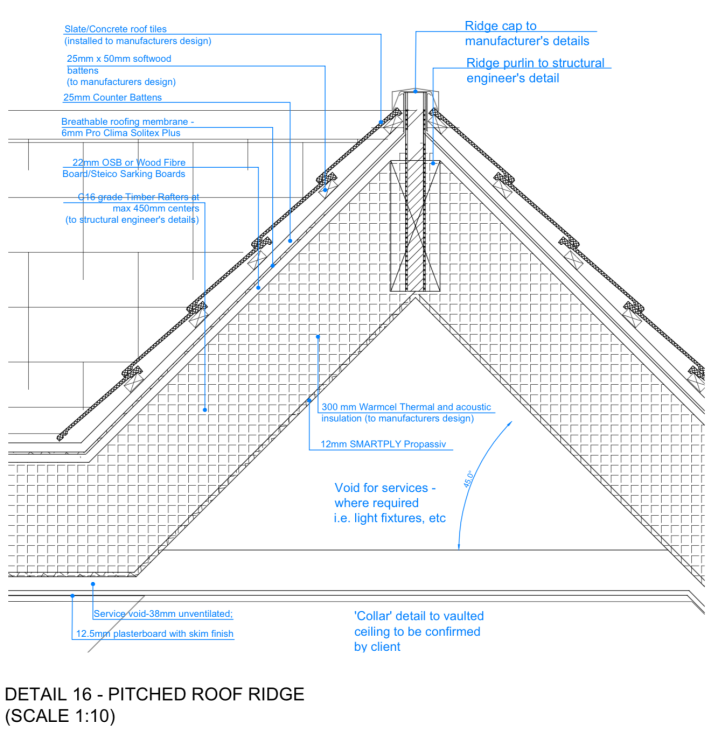
Here is our design. We probably won’t even put the collar detail in and keep it vaulted as high as possible
-
Do it! We are using 304mm engineered posi rafters filled with cellulose, right to wall plate, hanging off a steel ridge beam. Really simple and maximum floor space with no purlins required. I would have no idea why you’d be putting pipes in your roof to be honest. Mvhr doesn’t have to be ceiling bound (especially if a bungalow?). Counter battening 50mm below allows you to run electrics and spots fairly easily. Mitek or similar will do you a design for free - obvs you’d need SE to ensure walls are supporting, specify beam sizes etc.
-
You could always ply all the way over first then put your firrings on whichever direction you want then ply on top of them to form your sub deck.
-
Cheaper than putting in steel maybe.. you could do a reduced depth joist (maybe an 8 inch) with larger chords to beef it up. If you want larger spans without a steel you’ll have to get something engineered… don’t think you’ll get away with anything less than 7 or 8 inches tall anyway spanning that much?
-
Engineered posi rafter could do a 5.8m span.
-
Thanks will look at that rating 🤔 Did people register as a partner on loxone’s site to buy the kit or source some other way? Can we buy as self builders?
-
Is that the updated Intercom or the old style 80s silver one? What did you use instead?
-
One of the really attractive options with Loxone is its intercom and NFC touch controls. I set aside a budget for automation at our gates, and Loxone would be able to provide the intercom/NFC for this.. The OCD in me wanted to keep everything inside one place, but that might not be possible. If I went loxone, was planning on mounting an iPad on the wall as a home hub - @Kelvin, @Thorfun - do you know if this works well? @Pocster, is there something similar for Home Assistant?
-
I am a tinkerer but I also have two very young kids so my time Is severely limited..! Ive got loads of stuff to sort tbh but I do think I can try and first fix in such a way as to leave options open.. Luxone’s visual designer does look pretty good and I think there’s plenty of scope for tinkering. I do hear you though… I wanted - for example - to link motion on the external reolink cameras to a floodlight via luxone which I don’t think is possible.
-
Did you consider a third party relay/dimmer such as whitewing? Or did you want to stay loxone native?
-
Think I’ve got it. So each relay out output has 230v live fed from the CU and then the live from The lighting circuit is fed into second relay contact?
-
So does power go into the loxone PSU then into the relay? So when the relay is activated it is providing power to the lighting circuit (rather than simply closing a switch)?
-
How would the loxone be able to control the white wing mains relays? Is this via the dmx extension (ie does the mains relay present the channels to the loxone via dmx)?
-
I assume that if you ever needed to revert to standard switches, you put a standard switch in the wall and then make the connection between that switch and the lighting circuit in your central cabinet then (rather than at the switch itself?) Are these wires provided by CAT6, or are you running additional T&E from each switch back to the central cabinet and then using some of those wires for your Tree connections into the switches? Don’t suppose you have an example diagram to illustrate how to support both the Loxone switch and a potential reversion to a traditional setup if done later?
-
Thanks @Kelvin. Did you bring these back to your Loxone cab and then use 4x relay outputs from the mini server/extension? If that is the case - and get ready for a massive knowledge gap here in circuitry - how does that circuit receive power? So assuming there’s a T&E cable string coming back to your cabinet, how does that get wired (a) into the relay and (b) into mains power?
-
Thanks @Thorfun. I saw some discussion on your mega-thread around the Whitewing box.. Can you summarise exactly what it is and how you used it? With your lighting did you go for 230V light fittings powered separately, and then add drivers to lights, or power centrally?
-
OK, so just getting to lid on, on our second build. Have started thinking about home automation and am realising what a minefield it is! Am hoping the community can help me out here. As some background - am a software engineer by trade (don’t do much coding anymore) but have build software etc so reasonably proficient with technology. I am not, however, electrically gifted from a wiring point of view, so this is where I am coming unstuck at points. I have read a lot of @Thorfun’s mega Loxone thread and started to get a bit lost. I’ve also trawled the hub reading @Pocster’s encounters with Home Assistant. The background - I would like to have the house pretty well automated. So Reolink local camera system, lighting, audio, blinds, irrigation system, door locks etc. I’ve narrowed it down to Loxone and Home Assistant as the two options. I’d rather not run both (although I think @joth from some of your comments, you do?). I think there’s a higher cost for Loxone, but it has some neat features, the wall switches look lovely, and its ecosystem looks really well integrated. On the other hand, Home Assistant looks infinitely flexible with more support for a wider area of devices. First question - anyone have any recommendations of which route to go down? Second question - can the ecosystem question be deferred to second fix? i.e. wire in a ecosystem agnostic way back to the plant room and then decide to either stick Loxone relays, or Shelly relays later? Or.. even better… if I went in on Loxone, but then decided in 5 years that it wasn’t right, I could flip it out without ripping any cabling out? Third question - is it possible and/or advisable to wire lighting conventionally as well (i.e. cable for a lighting circuit back to a switch in the wall, and back to plant room) in the event that I wanted to revert back to conventional light switches etc? Is this a waste of time and money? And, fourth question - this is probably a bit of a wiring-lighting specific one, but hopefully will help give me some clarity of exactly how it’s supposed to work…. This is going to show my naivety in electrical wiring but I think once I get it everything else will click into place…. Say that I have 10 downlighters that are a single ‘zone’ in a ceiling. I assume that they wouldn’t be individually addressable (overkill?), but would be formed in a single ring. If using something like Home Assistant, they’d be wired back to the plant room and connected to a Shelly relay (or they could be connected locally in the room I guess, but same principle). In a Loxone setup how does this work? I don’t really understand the principle of powering 24v devices from the Loxone unit - would this circuit come back to a Loxone relay in the plant room? Do the lights still need independently powering at the light itself, or are they be powered from the Loxone relay itself? Thanks in advance.
-
Did he install it (did you do all your first fix lighting via Loxon Tree?)
-
Just to be clear, we wouldn’t be doing lots of second fix unless it didn’t require BR sign off. Anything that we did do at second fix the sparky would still be testing to ensure compliance. FYI - father in law is a retired commercial electrician, so simply can’t sign off anymore, but wants to help with all things second fix. I can ask the electrician - I just wanted to understand if anyone had a ‘regs-view’ of this. Is a Loxone tree installation treated as an ‘appliance’?
-
Am currently looking at Loxone for lighting circuits and other automation bits for our self build. We have an electrician that will be doing most of the first fix cabling. My question is - if we ran all our lighting circuits via Loxone Server via tree, does this need ‘sign off’/installation by the electrician, or are they just responsible for wiring to the Loxone server and then I could self install the rest?