


Mr Blobby
-
Posts
616 -
Joined
-
Last visited
Everything posted by Mr Blobby
-

Recession + building trade = ?
Mr Blobby replied to DazRave's topic in General Self Build & DIY Discussion
It's an interesting question. Fixed rate mortgage lending has increased over the last year because people expect interest rates to rise so they are borrowing more to get the best deals before they are gone. Over the same period, credit card debt is being paid down. Apparrently these two things rarely happen simultaneosly and is a bad omen. The conclusion is that this temporary increase in mortgage lending has the effect of artificially inflating house prices but that lending will come to an abrupt stop once those 5yr 1.75% deals come to an end. That is the when the experts predict the housing markiet will likely crash. Will it? Maybe. I don't want inflation baked into my contractors tenders that may not be there in 6 months. If I only I had a crystal ball. Whatever happens to the housing market stagflation is here and is not going to get any better. -
We are planning to use Kilshall Sill supports. This allows for smaller sills in the cavity, properly supported without any thermal bridge. https://killeshal.com/window-sill-supports-providing-thermal-isolation/
-
To watertight only, or go all the way?
Mr Blobby replied to Mr Blobby's topic in Project & Site Management
Should have explained, personal circumstances are ok. We rent a house round the corner from the site and have done so for many years so no rush to completeion of build. Also I'm lucky enough to only work part time so I can be on site every day quite easily. Its interesting what you say about control, and I think that's important. When previously I had an MC (only one prev. build experience) I felt like I was standing in front of a train that was going full steam ahead to final destination and deaf to anything I had to say. I ended up threatening to sue builder and architect to get them off site. Turned out I was vindicated, the architect was suspended a couple of months later for misconduct (signing off builders work not done) and had been under invetigation for a few years, all of which I knew nothing about, despite calling RIBA with concerns. (ARB are conveniently seperate to RIBA who can claim ignorance of any misconduct... lesson here... if you have architect concerns contact ARB not RIBA) I guess my previous experience of being ripped off by a crooked architect and builder has left me with trust issues to give an MC full control while I stand back, especially for passive build, right through to completion. Once the contract is signed, it's out of my hands I guess. brrrr. I think I will need an easy termination clause 🤔 -
Yes that's what I think. And yes he is a member of RICS.
-
With interest rates rising and clouds of recession on the horizon I'm naturally reluctant to fix a price for the whole build in mega-inflationary times just before the money-go-round stops and we fall off an economic cliff. Or maybe the forecasts are wrong and we don't have a recession, but they are the forecasts. Anyhow, crystal ball to one side, and without having sight of the tender responses yet, but expecting some big inflation margin built-in, I am naturally attracted to having a main contractor to watertight as phase 1. And then re-tender for phase 2 (or get the trades myself) when things become a little clearer and the crystal ball can go away and pricing will be more accurate. My QS and Architect think I've totally lost my marbles to want to phase the build like this. Have I? Is it a recipe for disaster to tender for the Main Contractor to get up to watertight only? (house is block cavity passive build)
-
Me neither. He's doing sweet FA for me right now.
-
but if I'm paying a QS thousands already, shouldn't he be giving me a cost estimate in pounds and pence?
-
So my quantity surveyor sent out the tender package a number of weeks ago. I'm paying him several thousand pounds for his services. Whenever I ask him for an estimate of the build cost he tells me he doesn't know and looks at me like I'm a fool for asking. I suspect that when the tenders come back he will say the cheapest is about right, saving himself a couple of spreadsheet hours working it oout for himself. I could have done that myself and saved a lot of cash. Am I missing something here? A cost estimate would be very useful. Surely that's what the QS is for, to give some cost guidance so that the tenders can be assessed. Without a cost estimate from the QS then I'm struggling to see what value the QS is adding to the project. Should I insist on a cost estimate from my QS?
-
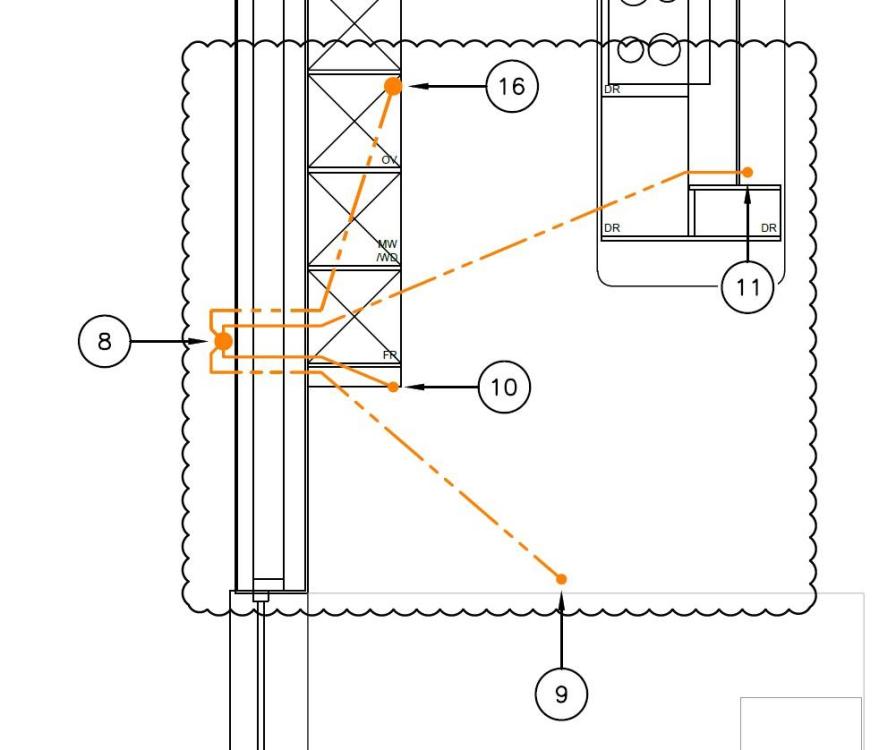
So, to round this off, here's the first floor plumbing into the same external SVP: All pipes into the SVP are from the first floor bathroom and run through the ceiling void above the kitchen that can be seen in the image. 16:WC 11: Shower 10: Bath 9: sink All fairly straightforward. The drawing appears to show, however, that each pipe penetrates the wall seperately to connect to the SVP externally, which seems bonkers to me. I assume this is just a drawing convention, and in reality the pipes will connect in the ceiling void for a single penetration through the wall to the SVP. Am I correct to expect the pipes to connect internally to give just one wall penetration? If so then should the diagram be amended to make this explicit to show a single penetration in the wall?
-
To answer your question properly..... ... roof is warm roof construction.
-
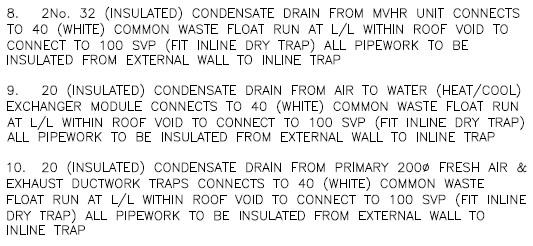
We did look at this and an internal SVP is more difficult here as it would need to run through the kitchen below. This pipe needs to vent outside as furthest from sewer, where the other soil pipe in the house vents internally to AAV. Also this side of the house is on the blind side next to the boundary and not visible from anywhere unless you go look for it. Thanks all for your input. It's good to know I wasn't imagining the proposed changes to the layout as being a bit, well, carp. Internally routed condensate drains it is then.
-
MVHR design questions
Mr Blobby replied to Mr Blobby's topic in Mechanical Ventilation with Heat Recovery (MVHR)
Thanks, pretty much my thoughts. Sorry, was typing at speed and not clear in my original post. There is a linen room and a seperate comms room, an extract in each. -
I started reading through the protocol documents and lost the will to live. I'll email my QS and ask him about goods from the South. He's paid to know about this stuff but my guess is he'll be as clueless as me. I'll report back if I get a reliable answer. Before Brexit, did self-builders reclaim VAT paid on goods bought from EU companies?
-
No to claiming VAT back in the normal way? What about main contractors in the North? Do they pay VAT on construction goods and services from companies from the South? I know that non-construction is zero-rated still on goods between limited companies over the border. I'll need to go and read those emails I've been getting from HMRC 😕
-
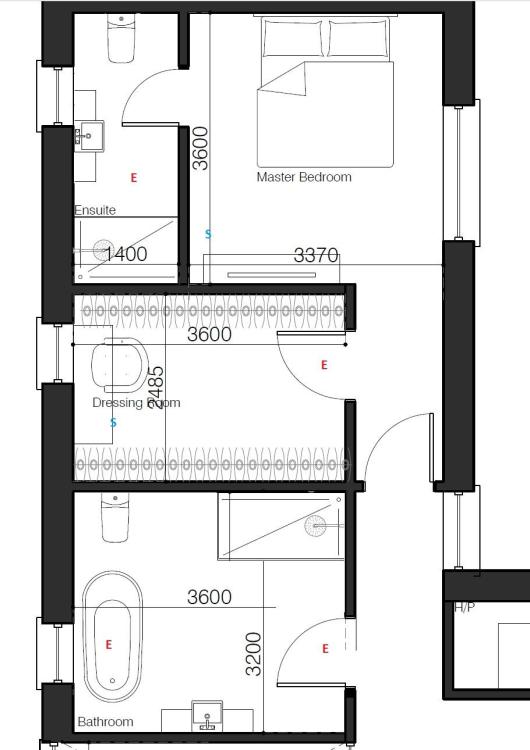
The proposed ventilation layout my designers have put forward is generally OK but I'm not so sure about the first floor bit around the bathrooms here: My concerns are: 1. The main bathroom has two extracts in line, which seems odd as the second extract will be 'behind' the first at the door. 2. The dressing room has a balanced loop, which is ok I guess, except my wife has never closed a door. Ever. 3. Why is the master bedroom supply duct not in the top right corner, away from the door? Is it bad practice to place vents above beds for noise reasons? All comments most welcome. Should I relocate the vents of concern to get a better airflow? (The remainder of this first floor has three more bedrooms, each with their own supply vent. And comms/linen with 2 extracts, so 5 supply, 6 extract in total)
-
Yes, I'm anticipating the same refusal, in which case can I claim the VAT back in the normal way? And, if VAT reclaim is the same as within the UK, then supply and fit is easier to claim the VAT back on?
-
I meant Irish Sea border of course 🙄
-
In the post-Brexit protocol world, where NI is sort of part of the EU with a North Sea border then how does self-build VAT exemtption work for goods and services from the South? If an Irish company (like KORE) supplies me goods, and charge VAT, do I claim it back in the normal way? If an Irish company provides installation services, should it be VAT free, like a UK builder would be expected to do? If an Irish company does supply and fit, then how does that work? 🤔😕
-
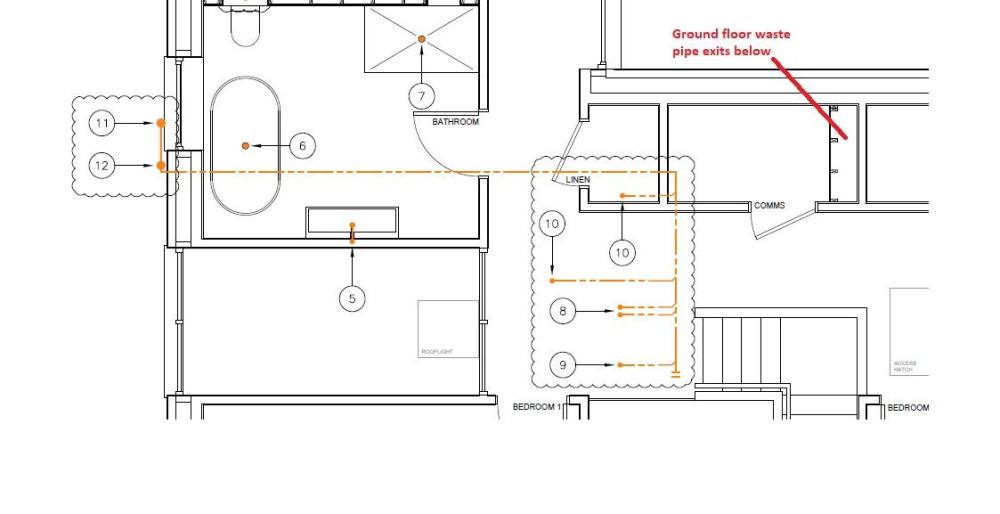
In the following diagram, 8,9 and 10 are condensate drains in the loft: The diagram suggests that these condensate drains should connect to a commonn 40mm pipe to exit the wall to connect to the external SVP at 12. On the ground floor where indicated there is a cloakroom waste that exits under the slab and a service void to the loft for the MVHR ducts. Would it be better to connect the condensate drains to a common pipe running down through the service void to the cloakroom waste below? That would save a penetration through the wall to the external SVP, which in a passive build I am trying to keep to a minimum. Is there a vertical drop limit for a condensate drain? Would the dripping of condensate be too noisy in the cloakroom below? Is running the condensate drain to the external SVP the best approach?
-
I've just noticed our M and E spec includes "automatic air vents to be installed at the highest point to discharge externally" in the same section as the heating/cooling flow and return that services the single MVHR heat exchanger in the loft. House is passive build hence I am trying to keep external penetrations to a minimum. Obviously I have limited knowledge about all this but am suprised to see automatic air vents discharching externally. What do the M and E consultants mean and do I need to vent externally?
-
Just for some background, the house is detached, no asbestos, service disconnected. Easy access. Stripped inside. Easy job, low risk. That's what I would have thought but one of the demo firms visiting the site offerred to give me a quote to do it directly. Interesting. I looked through the tender documents and couldn't find any detail on the demolition, which is odd. One of the demo guys who visited the site said the tender requires the harcore to be crushed and remain on site, which is news to me as I have no idea where they expect to put all that material. In the tender documents I have seen there is no demo spec that specifies hardcore crushed and retained. Odd. I must ask the QS if I have all the documents. And if not why not. The tender documents I do have do highlight concerns over cables running over the corner of the site. This was queried by demo contractors onsite because, FFS, I had openreach insall a new pole and transfer those cables over a year ago and told my architect at the time. 🙄 Whatever the QS has put in the tender for the demo, it looks like its wrong and the QS, for whatever reason, doesn't want me to see it.
-
Is there a curing time for KORE insulated slab before laying masonry blocks on it? How long, roughly, should I insert into the plan for this curing time?
-
My QS wants the demolition of the existing dwelling on my site to form part of the tender going out to the main contractor. I want to be buildng this summer so would like to save time by getting a demo firm in directly before the tender responses come back. Any main contractor is only going to go to the same demo firm to get the same job done (I know because demo firms have come to site to quote MCs) so why wait for the same job to be done and probably pay a slice to the main contractor for appointing the demo firm? I can't see any down side in getting the site cleared in June and take the demo outside of the main contract. My QS is strongly advising against. Why? What's the downside of clearing the site now? AM I missing something?
-
.. I meant of course zone of influence 🙃 ... and how wet does the cement slurry need to be?
-
So can I put more than 1 rod through the bottom of the "kiosk" or do I need to worry about the 'sphere of influence' and space then out?


