


Moonshine
-
Posts
2094 -
Joined
-
Last visited
-
Days Won
6
Everything posted by Moonshine
-

Splitting a single dwelling electrical supply to three houses
Moonshine replied to Moonshine's topic in Power Circuits
Interesting as i didn't know the name for it, from my 5 minute google of them, it seems that the looped service has to come from the meter of the host house, which would mean the cable would branch out from the existing house meter, rather than being patched at a location along the service line. -
Splitting a single dwelling electrical supply to three houses
Moonshine replied to Moonshine's topic in Power Circuits
what made me think that this is actually possible is the below is shown on one of neighbours with the same service line serving two houses. All other houses in the immediate area have a dedicated service line.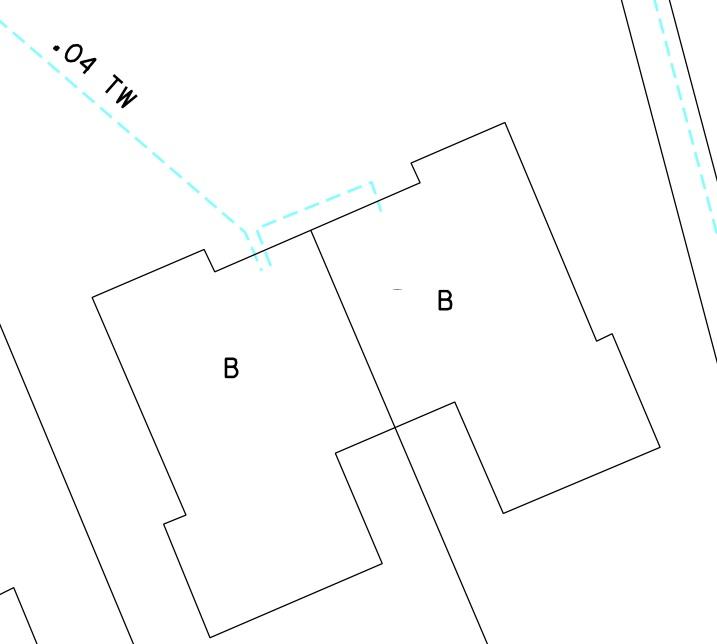
-
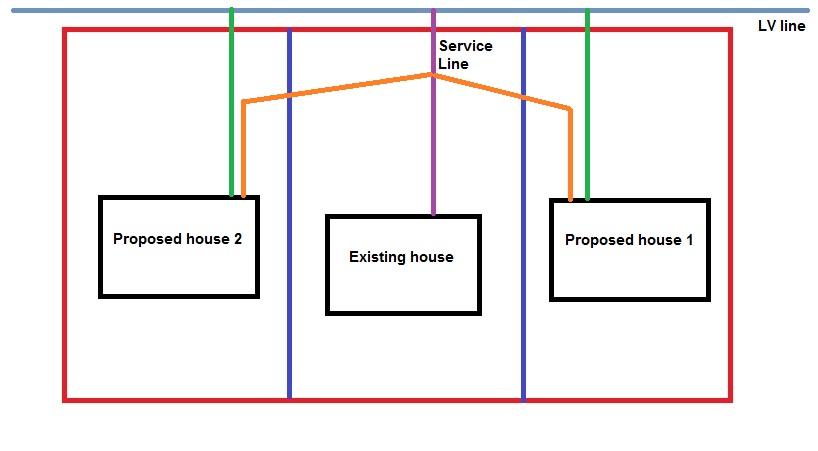
This is purely speculative and i don't know if its even possible, but..... There is electric supply (purple below labelled 'Service line' on the distribution drawing i have) which is patched from a 'LV' line in the pavement directly in front of the plot. I am proposing two additional houses either side of the existing (as below). To try and save the cost of two new electrical connections (currently unknown how much these would be) and the hassle of digging up the pavement / road outside, instead of two new connections (green) to the LV line, could the two new houses be "patched" into the existing connection (orange)? If this was actually possible, i presume the electric company would have to confirm that the cable that feeds the existing house could take the load of the additional two houses, and also that the local network could take it. How could i get them to confirm it could? The patching does potential cause a few more legal considerations, and may be worth it.
-
Very interesting, as if that is the site that i am thinking of, its a awesome tucked away location, and i can see why its £45k to connect to. I presume the permission has an agricultural tie to it. I am still in the planning stage but pretty local, and it will be interesting to see how you get on.
-
Week 9 - The Big Pour
Moonshine commented on Red Kite's blog entry in Self Building two in North Wiltshire
@Red Kite nice one on the pour very interesting times! Would you be willing to share the structural engineers design for the retaining walls? I am really curious of what the recommendations were, especially those really thin sheet piles for the temporary works. Cheers -
Plastic vs Copper pipes for radiators
Moonshine replied to Raks's topic in Central Heating (Radiators)
+1 to the copper on show (or painted) -
thanks for that as it gives an insight into what a structural engineer calculates, shame i can't read his hand writing.
-
I had a quote recently from a structural engineer who has the bar bending schedule as a separate unspecified cost, so i am intrigued, to know what one actually is, and what the typical costs are.
-
The size of the splay will be dependent on the speed of the road and current visibility. My local authority has guidance on it, but don't know how common it is, and applicable in Scotland.
-
I hadn't seen they do half boards, be in interesting to knows which size (1500 x 1000 mm or 1200 x 1200 mm) offers the best in terms of wastage.
-
At 14.38kg/m2 for 12.5mm its almost double the density of 12.5mm wallboard! 41.5kg per 2.4 x 1.2m sheet. I presume its a 2 person job to line a room.
-
Yeah with a relatively small area of pitched roof, I don't think the extra thickness of the 'acoustic' roof would impinge on the space. Wood frame is better as more mass there, assuming it's sealed correctly. But as long and the window and frame meet the required Rw then no real problem. The shutter will add a bit acoustically but I would say just base it on the windows.
-
I would be interested in the outcome of that
-
Sage advice, especially as it's not your dream plot due to the noise.
-
No noise condition indicates to me it may not actually be that noisy, in the general scheme of things, however wanting to have good acoustical environment is important still. A lot of the advice i am about to give is generic as i don't know the build, internal and plot layout, and importantly the noise levels on the site. From your description, you have indicated that there are rooms in the roof, with noise coming in via the pitched roof. The construction of the existing pitched roof maybe very different from what the new constructions are going to be. The advice on reducing the noise in the existing spaces (if you really want to) is highly dependent on what the existing construction is, as if the house is from the 1930's it could well be just timber rafters with tiles on battens, with lathe and plaster underneath. This would need a fair amount of renovation to increase the acoustic performance. For the new pitched roofs you could construct something like the attached metac pitched roof, which achieves a sound reduction (Rw) of 49 dB which is very good for a roof construction, but could be overkill for your plots depending on the noise levels. however this roof needs to be thicker than a standard pitched roof using PIR insulation, as the mineral wool is not as effective as PIR thermally for the same thickness. In relation to the other aspects of the build, assuming standard block wall layout (e.g. 100mm block / min 100mm cavity / 100mm block), the noise intrusion isn't' going to be too affected by if you choose dense, lightweight or an internal skin of aerated blocks. Denser blocks will give better acoustic performance but all of these will give a sound reduction (Rw) of >50 dB, and its the glazing and ventilators which really need the focus as these are the acoustical weak areas. Interesting that you have decided to go for the wall vents already rather than trickle vents, and agree you this give a better performance that trickle vents (max in frame trickle vent performance is ~Dn,e,w 45 dB). If you can locate the wall vents on the quieter facades this helps. A Greenwood MA301 (https://www.greenwood.co.uk/product/199/ma3051) is touted as the best performing wall vent with a Dn,e,w of 55 dB again this could be overkill for your plots depending on the noise levels and how the plots layouts (e.g. rooms with windows facing away from the road will be a lot quieter). Windows will be double glazed as standard, and having a laminated glass arrangement will help the acoustics, and the Optiphon will achieve that. In generally terms the higher the sound reduction (Rw) value the better the sound insulation will be, but i am unable to give advise on what spec to have as don't know the noise levels. What i would say is do a bit of a cost benefit analysis on how much higher sound reduction (Rw) glazing will cost you, and also maybe up spec just the bedroom windows (if that is where you have issues) isover_metac_brochure_-_pitched_roof_solutions.pdf
-
We have the same thing and are hopefully just about to get planning for two houses retaining the existing. One thing you will need to factor in is CIL as you will only be exempt on the house you are going to live in. I can help you out with the noise issues as it's my job. The council may put on a planning condition for a noise assessment.
-
Thanks, iirc its a 200mm radius bend (ADH)
-
stop it you will give me flash backs of the BCA!
-
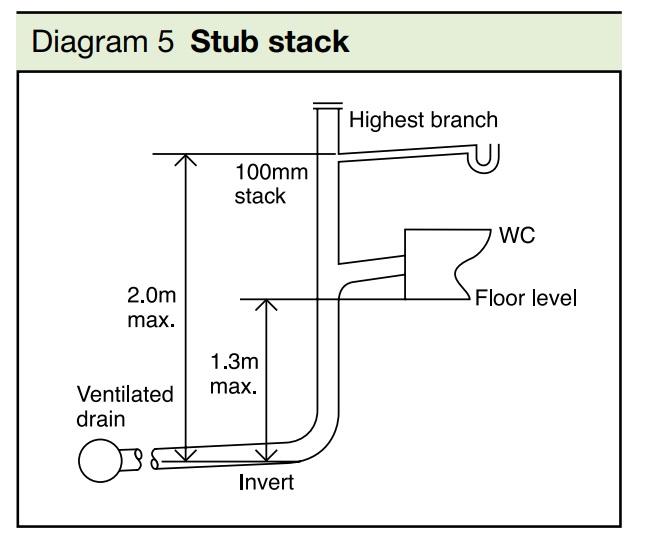
fair enough, i probably didn't explain it correctly, see the figure below, this is the maximum value invert level, is there a minimum value?
-
correct, typing quickly and d.p in the wrong place. Thanks for your response very helpful
-
GIA ~175m2, that's £1,250 per m2 Looks like you will need to do a fair bit of work yourself.
-
I am thinking about the practicalities of getting foul drainage from a new plot on my land to the existing foul drain of the existing house, a distance of about 25-30m. This would go under the existing houses lands new drive, so in effect it will become a sewer. For this i want to know if the invert levels can be accommodated under the topo accounting to level changes and the invert level of the existing drain it would feed into. The reason for this is that it would save a lot of cost and hassle connecting to the sewer under the road as its a busy road. I want to understand/confirm; Is the best/only design resource needed Approved document H. The vertical distance below the FFL of the house that the foul drain can start moving to the side from the stack location (ADH has this at 1.3m in some situations). The minimum internal diameter of the pipe (75mm?) required. The minimum fall of pipe (ADH seems to have this at 1:80 / 12.5cm every 1m) required. minimum depth of pipe under ground level (ADH seems to 150mm from the crown of the pipe) Man hole covers at every junction point rodding access points? Cheers
-
It could be a lot cheaper than that! send me a PM if you want some advice on your drawings
-
Community Infrastructure Levy on sheds
Moonshine replied to peter2703's topic in Planning Permission
something like that, something that will cost a lot less than the £18k that you are on the hook for. -
Community Infrastructure Levy on sheds
Moonshine replied to peter2703's topic in Planning Permission
lose 5.1m2 ?


