


Moonshine
-
Posts
2094 -
Joined
-
Last visited
-
Days Won
6
Everything posted by Moonshine
-
How is a UFH circuit practically taken from the manifold to a separate floor? Is the circuit taken to a riser, cut at the riser, a 90 bend attached and then pipe again in the riser, with another 90 degree bend put on? Or is the pipe flexible enough for a 90 bend on a short radius. I would be concerned of this kinking
-
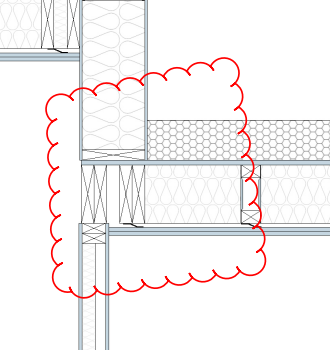
I have been throwing a load of thoughts around about how i can build the house i am planning, and how it may be build. I started to sketch a few things out, which then ended up turning a much more detailed drawing of a section through the house from the front, as attached. Would anyone be so kind as to look through this drawing, and give any comment on the detailing and any particular nasties? For one i really don't like this detail below, seems like a week spot to get water ingress. Also has anyone got a detail of the windows on a modern contempory house, as i couldn't find anything suitable. Edit: found the window details from velfac. House_section.pdf 13361.pdf 13359.pdf V200i.W1.03.B.C.001 - Cill screwed.pdf
-
only if you want to insulation from the workshop to the rooms above in the same house, which you have said isn't an issue. In the external walls the kingspan is needed for the thermal properties.
-
no "mass" reflects sound, insulation absorbs sound
-
 If it was something that i could do outside my 9-5 i would put it in the 'free' category. I hadn't seen that thread, and to get round the 'T' shape issue i like the use of two thicknesses (100mm and 50mm) however i would probably think some sort of mechanical fixing (plastic) would be needed rather than just glue.
 -
I have just look a little at foam cutters and there are some DIY heated element cutters powered by a car battery. Potentially as long as you use a source with enough amps you could hear up a piece of wire at right angles to cut the recess. The issue would be the wire being firm enough to keep its shape but also thin enough to have high resistance for the heat. I guess you could use a metal angle behind the cutting element for rigidity. Worth some testing if the costs are as high as you say they are. The sections could be cut in free time before the build
-
The garage part of the basement is unheated so it's needed above there. The other area of the basement is the entrance lobby / atrium, and probably won't need b&b there, probably a small section of timber floor as it is a void above to the main part. @Patrick I would be interested to know what you ended up finding out, and if you where planning to shape them to the beams, e.g. the bottom 50mm would need to be cut in by approx 15mm either side, labour intensive, but could be quick with a circular saw with a good blade to cut the eps (would need to think how to minimise tear out / foam dust.
-
Acoustic property of large tiled area
Moonshine replied to Lots2learn's topic in Floor Tiles & Tiling
yep, a perforated panel (min 25% open area) with mineral wool behind it will act as a decent absorber, in fact without the mineral wool there is a bit of absorption there too. The panel can plasterboard, ply, OSB etc Have a look at some perforated plasterboard to see if that fits the bill https://www.british-gypsum.com/product-range/acoustic-ceiling-systems/gyptone-acoustic-ceiling-boards If you have been into some new build flats, you will usually find perforated plasterboard in common areas such as the stairs as its a requirement from building regs (ADE) -
if you are just doing it for limited time and in normal hours, then i can't see them having a valid complaint, and doubt that an EHO from the council would come knocking
-
Which direction is the neighbours you don't want to disturb, through a wall, window or garage/workshop door? The block in the wall is doing a decent job, weak points acoustically are windows, doors, vents
-
Acoustic property of large tiled area
Moonshine replied to Lots2learn's topic in Floor Tiles & Tiling
This has been a professional pain in bum for me when architects started making mimalist and hard surfaces the norm. It's always fun explaining to them why it will be bad acoustically. If you build it and it is too harsh acoustically, try some acoustic absorbers, you can get some with pictures of your choice on -
I may have missed what are you are after, noise reduction to rooms upstairs or to the outside?
-
Kingspan does bugger all acoustically. Use mineral or glass wool, who will you be disturbing upstairs?
-
Thanks, from the drawings i think that the longest span is about 4.4m, so may need to put a dwarf wall in the middle of that span (its not over the basement area). @jamiehamy Do you know where i can get an idea of costs from, as i would be interested to see who it stacks up
-
On various searches and review of construction methods, i think that i would do a block and beam floor between a basement and ground floor, and as a standard ground floor. I have come across EPS blocks that form an insulation layer as part of the beam and block construction as below; Has anyone come across this type of product before as if it isn't too expensive, it seems like it would be a good solution of saving space, costs, and labour of not having to manual handle 100's of blocks in the floor.
-
Cheers, and good shout on the breaker, it looks like it's the original render from the 1930s and onto smooth brick. It has survived 90 years, and render on facades not exposed to the elements seems sound. Any product you would recommend for the slurry coat? I am thinking I can do that myself before a pro does the scratch coat and rough render.
-
Check out wet wang
-
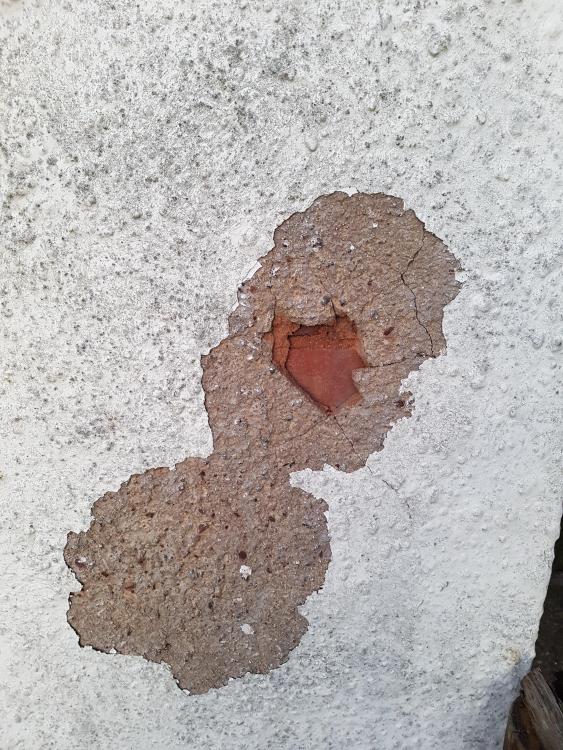
I have a 1930's house which on the most exposure facade water has got in, and the rough render has blown and cracked in sections. I probably need to get it sorted in the spring when it's dryer, but need some advice on the best way forward to plan the work. I am quite happy to get on and get the old render off with a hammer drill and cheisel attachment, however I am wondering if where there are areas of sound render how to leave this in place. Ideally looking to do as much as possible DIY, but with anything plaster the finish will likely be done by a pro. Any idea of the costs of rough rendering an exterior wall (ground floor, and pitched roof wall end)
-
treatment of existing leaking / cold lintel
Moonshine replied to Moonshine's topic in RSJs, Lintels & Steelwork
Looked at the wall in a bit more detail and it looks like the render in parts has blown and cracked on places allowing the water ingress. Looks like a job for the spring! -
So if you were to do it again what would you do differently?
-
What you are proposing to build there is more akin to the party floor between flats in a conversion project, and it's likely to meet ADE requirements for that (DnT,w + Ctr >=43 dB / LnT,w <= 64 dB). For internal floors of a house it will be pretty much as best as you can do without independent ceilings, and way over Rw 40 dB. A couple of key construction considerations - don't screw the resilient floor boards down to joists. - make sure the floor flanking strips are installed and only cut off once the skirting is installed. - make sure your dry liners use two lengths of screws for the resilient bars, as too long on the upper board can go through and screw in and bridge to the joist. In terms of mineral wool 50mm / 24kg/m3 would likely be fine. If you find that floor or two layers of board is too much in terms of thickness, you could use resilient joist caps (for impact isolation) and one layer of 18mm floor board, thought may have a slight derogation in airborne acoustic performance.
-
Thanks and really good to see how it all comes together, especially in the picture in your next blog entry with the biscuit mix in. Out of interest do you use the ufh much?
-
No it doesn't, building regs min requirement for internal walls and floors is Rw 40 dB, nothing specific about what you build. Rw 40 dB can be achieved on standard timber floor with 15mm wallboard and no insulation (as attached). However if you are trying to get anything like a decent acoustic separation I would strongly suggest against this construction. C106029.pdf
-
Minimum Reasonable wall width for good U values?
Moonshine replied to puntloos's topic in Heat Insulation
Ah I see, that makes sense and the plasterboard only fixed to to battens rather all the way through to studs. I presume that if something heavy was fixed to the wall (e.g kitchen wall cabinets) they would have to penetrate all the way through the pir though to the studs. -
Minimum Reasonable wall width for good U values?
Moonshine replied to puntloos's topic in Heat Insulation
Thanks, but the build up I am thinking of has mineral / glass insulation in the timber cavity not pir. Is that a software to do the calc?

