Moonshine
-
Posts
2094 -
Joined
-
Last visited
-
Days Won
6
Everything posted by Moonshine
-
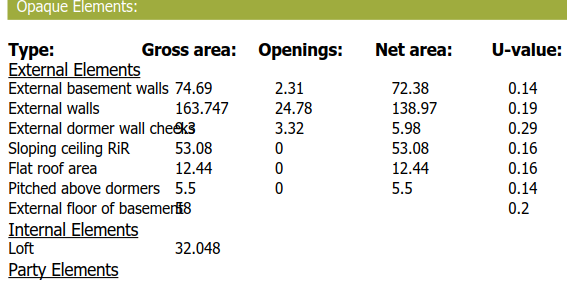
Plan is External walls - rendered 100mm block, 150mm full fill (0.032) batts, 100mm aerated block (0.011), dot/dab plaster board: U-value ~0.17 Roof - warm roof with 150mm PIR insulation (0.022): U-value ~0.13 Majority of floor - block and beam with 150mm PIR insulation (0.022) under screed: U-value ~0.12 Not sure of U value of windows but 1.4 seems to work to get a SAP of 85 among other things I want to make sure that this is insulated enough to use a ASHP with UFH. I see what you mean about the waste water heat recovery, adding one for two showers bumps the SAP up by 1 point.
-
Any in particular stand out? to me floors and roof seems to be too the weak areas? basement at 0.2, and roof at 0.16?
-
Checked both of those but no joy for the main planning page which has all the info on (summary / further information / important dates) has gone. However the related documents are all stored on a different webpage, and they are all still there! I have added the related documents to the way back machine for today.
-
"the drawings are inconsistent and not accurate.", seeming about some sections and elevations. They are pretty much the same drawings submitted on the last application, with a different case officer. The architect is going to chase today / talk directly to find out what the issue is. Unfortunately the application has been taken off the planning website and i didn't take a screenshot of it (lesson learnt) There was a determination date on the website 23/09/20 so i don't know how they can invalidate it, Architect hasn't received one. All chasing has been done via architect and he has been able to speak to the officer during the 8 weeks and there was no issue, with the indication that the consultation letters were going out 3 weeks ago. My feeling is the officer has seen the 8 weeks is nearly up, found a technicality and invalidated (even though the system said validated) the whole thing so the clock resets.
-
So I have re-applied for a concented scheme for my development, which now has some amendments. The case officer has changed but the development hasnt changes that much. Tomorrow is the decision deadline, as is was apparently validated and on the planning lpa website. We have not heard much from the case officer and i was not expecting it to meet the deadline. However we got an email from the case officer last night to say that they could not validate the application, and looking at the planning website it has been taken off. This is a bit of a smack in the mouth and waste of 8 weeks, and seems like the planning officer is playing games to buy more time. Annoyed to say the least!
-
Would anybody be willing to share their building regulation submission / drawings for their site? Or know of some good examples on line? Ideally it would be for a masonry cavity wall build. Not trying to directly copy but to understand the flavour / level of info needed. Cheers
-
 I have a rather stupid question and VAT and claiming it back. Let's say I am building a 100m2 house and it's £1,500 + VAT per m2. So £150,000 not including VAT, and £180,000 including the VAT. What happens to paying the VAT, do I have to pay the builder inc the VAT and then claim it back at the end? Or do I pay not including the VAT. The reason I ask is that effectively if i have to pay the VAT throughout i would need to borrow £30k extra, only for it to be paid back. How does it work, and how do you manage the VAT extra amount?
 -
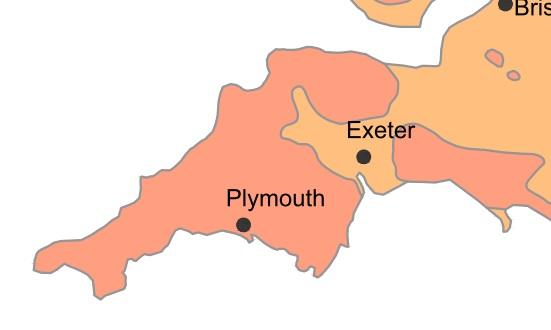
Aren't you in the very severe exposure zone?
-
Following on from this thread I am have a dilemma and keep going round in circles to which one to build. Build a masonry cavity wall (rendered) with PIR and a residual cavity (125mm total cavity), or fully filled 150mm cavity. Both have the same U value, and I am in a severe wind driven rain area. Which one would choose and why?
-
Architect Fee - Is this expensive
Moonshine replied to Internet Know How's topic in Surveyors & Architects
Is that price still valid? As you have pretty increased by 50%. It seems like a good price. Btw what are you building? An oligarch residence? -
That is probably pretty close to what I am thinking, minus the insulated plaster board. The question I have is if the pit and ufh would take the weight of a car in future?
-
There I was thinking you had a sleeping mistake but no.... https://www.spinaclean.com/skyscraper I used a wallpaper scrapper taped to and extendable pole from a ladder ?
-
So fluffy insulation batts vs PIR - Easier to install / less to go wrong - similar u value as pir for same cavity thickness, fully filled cavity compared with a residual cavity of 50mm used for pir. - Cheaper - Easier to cut (?) - uses recycled materials Downsides - could be irritating to install / itchy, mitigated by weather correct protection - potential water issues, mitigated by water resistant covering and external skin - doesn't let the building 'breathe'
-
how about the ones that have tongue and groove fixings?
-
I might have to give that a go for my own sanity.
-
i am down that way and you can get some small plots for £60-100k, though you would have to do loads yourself to build a small house for the remaining.
-
i am sort of coming round to the full fill cavity, and the recycled element is a plus. The main concern is the water ingress potential....maybe rendered, at 150mm thick, and water repellent it may solve that issue.
-
Good to know, if it was thermalite block internally you are probably in the realm of a U value of 0.14. i was looking at the Dritherm 32 as an alternative to the Superwall 32. So here is a question, is the 50mm gap between PIR and external skin an actual set in stone requirement, as here is a product with a 10mm gap. https://www.insulationsuperstore.co.uk/product/recticel-eurowall-plus-full-fill-cavity-insulation-90mm-54m2-pack.html could you not have a 125mm cavity, with 100mm PIR and 25mm gap to keep separation? Edit, it seems that the BBA cert requires a design of 50mm residual cavity, but could be down to 25mm on site. https://www.bbacerts.co.uk/uploads/files/CertificateFiles//53/5343ps4i1a03042019.pdf
-
Or.... i could ditch the PIR all together and use something like full fill Superglass Superwall 32 (£9.20 /m2 ex VAT), and fully fill the cavity at 150mm (https://www.roofingoutlet.co.uk/products/superglass-superwall-32-cavity-wall-insulation-batt-150mm) Plasterboard on dot and dab 100mm thermalite block 150mm Superglass Superwall 32 (0.032 W/mK) Rendered 100mm dense block This also gives a a U value of 0.17. So over 250m2 75mm Kooltherm K108 Cavity Board - £5,250 ex VAT (125mm cavity) 100mm Celotex CW4000 - £3,925 ex VAT (150mm cavity) Superglass Superwall 32 - £2,300 ex VAT (150mm cavity) not sure what the pitfalls are of having a full filled cavity with glass wool (handling would be an issue), but also not having a clear cavity to allow any water that gets in to get to the bottom of the cavity
-
I have been looking at potential constructions of masonry cavity walls and getting a decent U value (circa 0.17). I have been going on the basic wall with a 125mm cavity as below; Plasterboard on dot and dab 100mm thermalite block 75mm Kooltherm K108 Cavity Board 50mm cavity Rendered 100mm dense block This gives a U value of circa 0.167, however the Kooltherm K108 is expensive (75mm £21/m2 ex VAT https://insulationhub.co.uk/product/kingspan-kooltherm-k108-75mm-cavity-board/) with a premium performance thermal conductivity of 0.018 W/mK, where as standard PIR seems to have a thermal conductivity of 0.022 W/mK. If the Kooltherm K108 is swapped out for standard PIR of 0.022 W/mK (e.g. Celotex CW4000) to get a U value of 0.17, the PIR would need to be 90mm, and the resulting cavity 140mm, or 150mm if a standard thickness of 100mm was used. Celotex CW4000 can be brought in 100mm for £15.70/m2 ex VAT (https://www.insulationexpress.co.uk/celotex-cw4000-cavity-wall-insulation-board) Also by going to a standard PIR there is more competition, and a better chance of getting a deal. That is a saving of £5 a m2, which over 250m2, saves ~£1,250 for the same performance thermally. The downsides i can think of are..... loosing internal floor space harder to cut 100mm vs 75mm Increased lintel sizes increased tie sizes What other issues / cost implications are there? I am not sure its worth it for a ~£1,250 saving
-
Self build design - sound insulation
Moonshine replied to BrianWg's topic in New House & Self Build Design
As it is a detached property the only element that affects you to meeting the minimum requirements of the reqs is that internal walls and floors need to achieve an Rw 40 dB, have a look at table 0.2, also look at requirement of E.2 on page 8, and specifically the exceptions to E.2. Those wall types (Diagram 5.1 - 5.3) are example constructions which should achieve an Rw 40 dB. Also it should be noted that an Rw is a lab measurement and you don't need to do any testing in your property as its detached. In fact achieving Rw 40 dB is pretty straight forward. For walls, one layer of plaster board either side of a stud with some mineral wool in the cavity. Floors are also straight forward as they have a larger cavity than walls (Diagram 5.7) . Bear in mind though that the minimum requirement of Rw 40 dB is not actually that good, and i would advise on trying to better things where possible, dependant on practical / cost constraints, things like increasing the number of layers of plasterboard and its density, using metal framing rather than wood studs, using resilient bars, or even independent / staggered studs if noise is a real concern. -
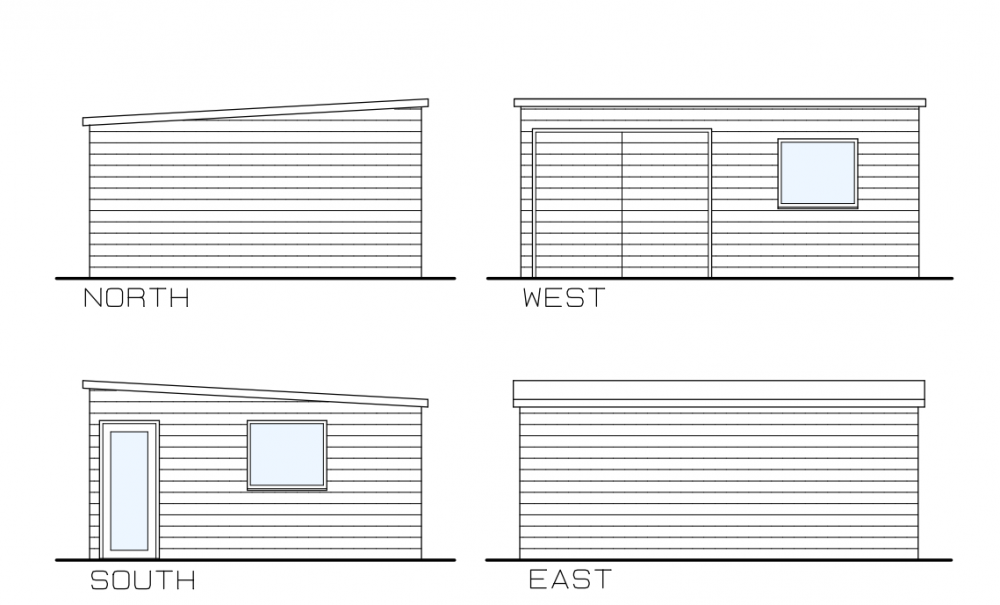
I am looking at the option of a new build detached garage / garden room, as below; When this is a garden room the garage door would be a proxy door, though may be converted to a garage at a later date. As a garden room it will need power, heating and insulation. I am looking to build as circa 100mm timber stud, with timber cladding insulation in the cavity, plaster on the inside. The main question i have is what to do with the foundations / slab. I was initially thinking of a concrete slab, with PIR laid down on top, electric UFH, and Ply / OSB + flooring above that. However the main issue i can see is in future is that if it becomes a garage would this build up take weight of a car, particularly the UFH and PIR (i guess the UFH could be pulled up, but the PIR? How would you approach this issue?
-
looks like a good bit of discussion here https://forum.buildhub.org.uk/topic/4924-edpm-or-grp/ cheers
-
I am looking at various roofing options for a new build with a flat roof, i don't know how these systems stack up against each other. Could anyone give me a run down of the pros and cons of each?
-
I have an existing wall which is about 15m long and .8m high. I want to put a fence long the top of the wall to make it 1.8m high, so it will be a 1m high feathered edge, using with 150mm feathered planks. Based on the wall (blockwork laid flat) it's going to be best to bolt the fence uprights to one side of the wall, and have the horizontal pieces and boards just on the top leaving the majority of the wall seen from the other side. Like this (viewed from my side) but with feathered boards The main questions I have are.... - what sized uprights should be used 50x50mm or 75x75mm? - what spacing should the uprights be? - how long a section of upright should be bolted to the wall? - what bolts should be used to fix the uprights to the wall, and how many fixings per upright?
.jpeg.3a323808333b80e0047c592208a33e8b.jpeg)