


saveasteading
-
Posts
11094 -
Joined
-
Last visited
-
Days Won
98
Everything posted by saveasteading
-

Open Book (cost +) vs Fixed Price
saveasteading replied to charlieroper's topic in Costing & Estimating
1. There are very formal methods so that nobody can argue about clarity. That could be hundreds of pages and thousands of items. A QS puts that together for the client, from the drawings provided, at great expense. 2. Anyone can do their own system Build house as drawing Quantity 1. Rate. £300,000 Total £300,000. Flippant, sorry. But that's the principle. From a drawing a builder will work out materials, labour and plant schedules and price it their own way, or get an Estimator or QS to do the graft. They can present it how they choose. Eg Clear site Build foundation Walls Etc Allow for overheads Allow for profit Total In your case, this is what to expect. If you engage multiple contractors, then you must expect interface costs which neither allows for. -
Alternative Water Supply Connection
saveasteading replied to MortarThePoint's topic in General Plumbing
1. The question. I dont think the bco cares about the ownership. 2. Re private supply: For the steading we had to provide a water quality test. The water is sourced at a spring about 1km uphill, then rigorously treated. -
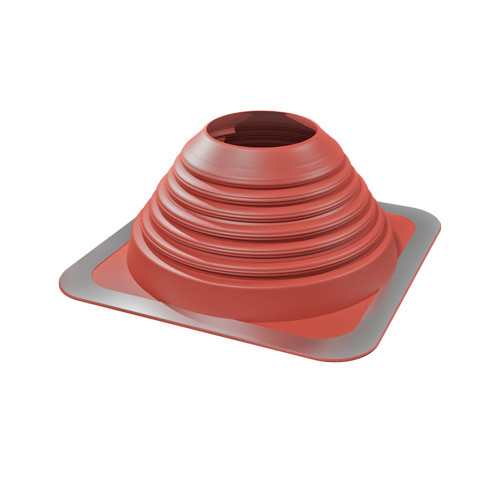
Exactly so. Using double-beaded flexible mastic tape, and self-tap screws through it. This is how steel clad roofs (1mm thick) are sealed, and no other material has to go over it. Red for hot pipes, black for others. The corrugations allow for the slope. I must have 100 of these out in the world. It needs skill to fit on a steep slope, then they work without issues.
-
Open Book (cost +) vs Fixed Price
saveasteading replied to charlieroper's topic in Costing & Estimating
What do you mean by 'right'? It is a list of work with quantities. That should be reasonably accurate. If you expect them to forecast the build cost then that is rather different. 4,5, or 6 builders could prepare estimates using the identical boq and present dramatically different quotations. Which one is right? -
It's fun to think of ideas, but there is a more fundamental issue. If you put all that load on one half of the bottom flange, it puts a rotation into the beam. A beam out of plumb becomes very much weaker. So this is likely to be 'knocked back'.
-
No. About 25%. BG and Knauf can charge more because they can provide test certificates. And often they will be a client requirement because of this certainty. The competition don't need to pay for laboratories and boffins They just bend metal. But not double the cost. Try a different supplier. Unless you have to get bco approval.
-
The big other name is knauf. Then there is another uk manufacture who's name I can't remember. Based Midlands. BUT I suggest you contact a specialist merchant such as CCF. They will not be tied to one supplier. You will need their sales person, not the counter server. They will have access to all suppliers and may have own-brand for what you want. Do not ever mention a maker's name or a product name. Use generic terms such as wall stud or ceiling channel. It isn't cheap: much the same price as in timber is a guide.
-
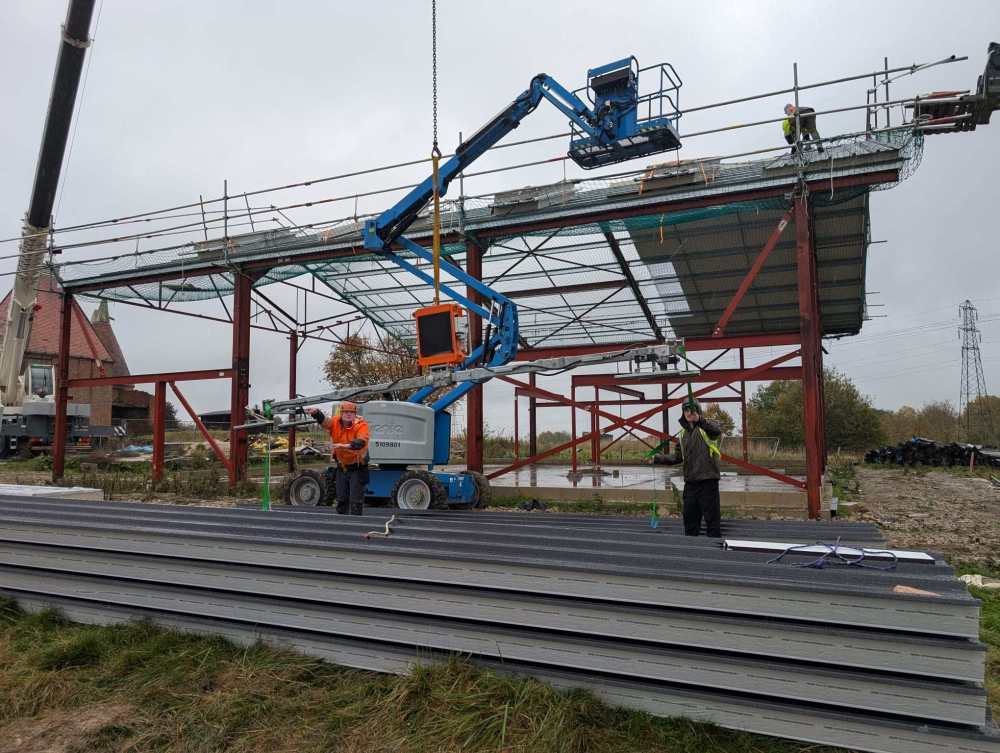
Apologies, I was anwering an imaginary question. "Why a telehandler as well as big crane?" The one forklift, but a telescopic one. And I was just simplifing the vocabulary over-casually. I shall endeavour to be more precise. For clarity, no telescopes or televisions were handled.
-
-
Tiles? I’d expect a caravan to have a thin steel sheet with some polystyrene under it, and then ply for some strength. But I see your photo, so perhaps otherwise. I'm guessing, but that would need care. You have to consider if a hot flue could cause a fire. An insulated flue would be essential as a minimum. There are special flashings for flues to metal roofing or any other product, so it is doable.... with great care.
-
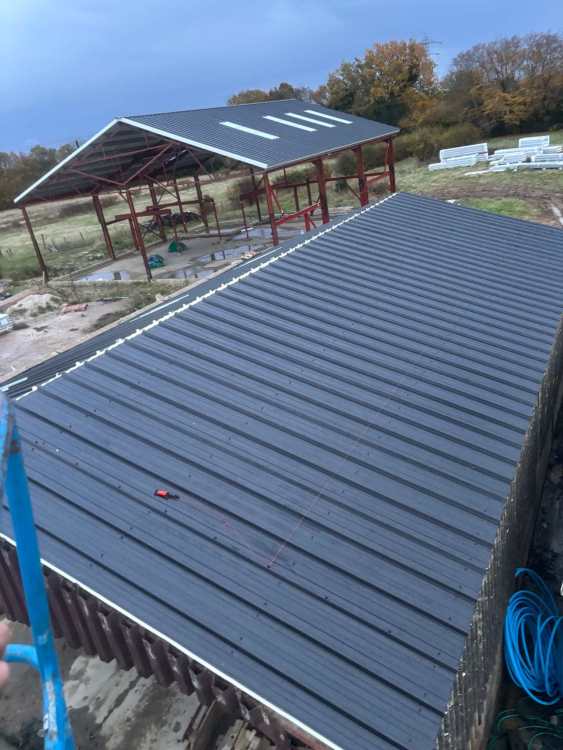
I thought it was OTT at first too but it's an agreed price for the work so can't argue. They've clad another smaller roof too ( 15 x 12) and I suspect the crane had gone and the handler was used for that. Plus the garage roof had to be stripped first and there's other steel to do too. I'm on hols so missing this fun: my favourite bit of any steel job. Overall that's impressive in 4 days of wet weather on a steep roof. We can now take away the buckets that were under the holed garage roof. note the string line for fixings precision, and the ridge filled with foam.... nice.
-
sweet chestnut cladding - opinions please
saveasteading replied to marmic's topic in General Joinery
As I've often said on here. I prefer tanalised pine with a stain. Neutral stain locks in the colour. A fraction of the cost and can be repaired/ replaced / adapted at any time. That's just me and my experience on commercial work. The family projects use cedar which goes grey, because I'm not in charge. -
That's going to be OK. There is no bending stress at the end of a simply supported ( not built in) joist. But be sure to cut neatly and not extend the horizontal cut. There's another option though: to counterbarten under the joists, or add another layer of plasterboard.
-
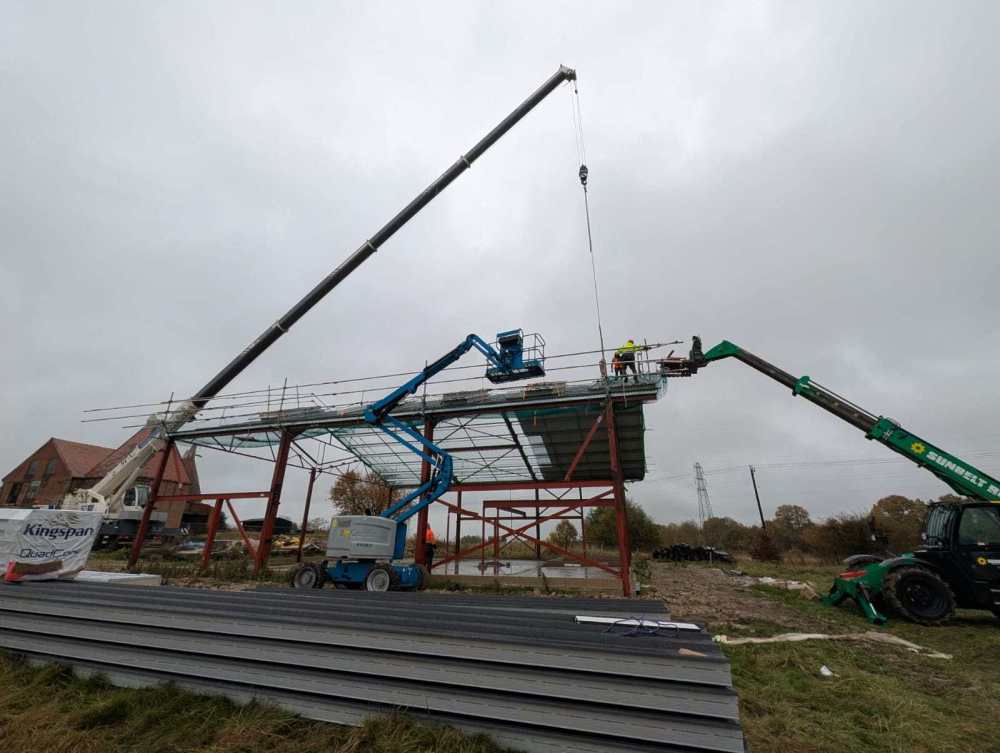
This pic makes the scale clearer.
-
Car Port - Concealed Roof Restraint Straps?
saveasteading replied to Mulberry View's topic in Brick & Block
Good plan, and take photos as it won't be visible. -
After a dry summer and minimal progress, we are getting a roof on at last... in foul weather. Fortunately the cladder doesn't mess about and has hired in this very serious kit. Hence 350m2 on plan was clad in 2 days. Huge crane with panel clamp, big mewp and don't forget the forklift off to the right.
-
The caravan steps at Argos are good. But you'll need a slab base first to get up to your floor height.
-
@webbythewebsterI'm seriously impressed with your research. You must have come across lots of promotional material, with the criticism difficult to find. Is science or research your skill? @SteamyTea if I recall, superfoil had their own way of assesssing insulation properties, thus getting improved numbers. Something to do with heat escaping from a box.. I'm wondering if your example of the greater area of slope may explain their trick.
-
You have understood and explained beautifully. As has @JohnMo It is highly marketed, stopping just short of untruth. Bubble wrap for sheds or greenhouses. In case he needs further convincing... reflective surfaces need to reflect back to an air space to perform. Squeezing lots together doesn’t work. And condensation could cause problems. Interesting that it has dropped in hype from 'the most amazing development,' to the Aldi aisles.... For more insulation, add more fibreglass to the loft floor, perhaps the opposite direction to what is there.
-
Building internal block walls directly on slab?
saveasteading replied to flanagaj's topic in Floor Structures
To me these are normal things and not complicated. More importantly the same applies to any builder. Rafts are expensive. Not to be confused with a simple slab. There is nothing wrong with bearing your structural walls on a standard slab IF it offers the same resistance as as the deeper footings. That is for your SE to agree and then for you to impose strict quality control. Is the exposed ground undisturbed and compacted? Is your sub base properly compacted? Concrete thickness, reinforcement and quality of course. The slab will likely be thicker too, and I'd forecast, more expensive than with footings. -
Building internal block walls directly on slab?
saveasteading replied to flanagaj's topic in Floor Structures
In what way? It's standard construction and means all your structural walls are sitting on the same strength of ground. The only issue I can see is if you wanted a power floated slab. But it's a house not a warehouse. What am I missing,? -
Galvanising is not essential steel only corrodes if wet. Yours should never be. Paint it with an expensive product made for the purpose. As it will be concealed it doesn't have to look good. Beneath the base plate is the highest risk. Make sure all detailing keeps this dry. If it is on grout then bitumen paint it.
-
It's for your Principal Designer to resolve. Their only excuse is if design detail and changes have not been presented to them. I think you must fit as thick layer of foam board on the outside, as works. May only be 10mm but do it. As @Nickfromwales. Then also insulate thre inside face later. Filling the box section is pointless. That will fall far short of any target U values but is much better than nothing, and the area is small. To help tick a box, use the U values for windows as your comparison. Then add more indulation somewhere else. But ask the PD.
-
Self build exhibition
saveasteading replied to saveasteading's topic in General Self Build & DIY Discussion
Names please? -
Roller blinds.
saveasteading replied to Russell griffiths's topic in General Self Build & DIY Discussion
OK so that is simpler. The only problem is that 3m span. I've got one in our kitchen that must be close to 3m wide. The blind concertinas up on a string. It was made specially from an adapted kit, and the fabric part was specially made by a friend. It felt expensive at the time. Then I fitted it. Shop around.





