


saveasteading
-
Posts
11094 -
Joined
-
Last visited
-
Days Won
97
Everything posted by saveasteading
-

when is a screed dry enough for flooring?
saveasteading replied to saveasteading's topic in General Flooring
Agreed, but it will be treated with the official blue primer and we might even preprime it with diluted unibond (myst remeber to give it tomd to dry) , and it will no longer be a porous, potentially dusty surface, but a very compact and tight surface I've never seen tiles or timber flooring float off the floor as gravity is useful. Might be otherwise with vinyl. I do realise why the floorers want this. Screeding contractors aren't always very skilled. Screed is overworked producing the laitence. Often there are tram lines and dimples, hollows and humps. Often the screed is recent or otherwise damp. Floorers don't know the difference between gypsum screed and concrete. Treating is added business. I'd be cautious too if it was my trade. But I've had this discussion on maybe 30 projects, and I've signed a disclaimer when required. My risk but several £k x 30 on the right side of the margin. My risk, my money. Lucky 30 times? No, it has always been a considered decision on a quality floor. If it was my client's money I'd make the same decision. -
when is a screed dry enough for flooring?
saveasteading replied to saveasteading's topic in General Flooring
Show me please. "Should" is not a requirement. The 'trade' saying it is required doesn't count either. I'm not doing it anyway because it is very hard and would be an utter waste of money. -
I'd be surprised. Clay should dig neatly so the concrete goes in efficiently. Also there are usually nasty extras with piling: mobilisation cost, hardstanding, muck arising from some methods, pile caps. Small fruit trees and pines don't need 2m deep trenches. Plus the closest distance does not apply to the whole building so can all be different depths.
-
Conifers at 10m are unlikely to be an issue but your designer will confirm that formally for the bco.
-
Well done. End of story.
-
when is a screed dry enough for flooring?
saveasteading replied to saveasteading's topic in General Flooring
I know but it satisfied the floor people. I know it's dry enough. My post was kind of to demonstrate your point. The latest is that the floorers have caused unease in our team. So caution prevailed and they were asked to grind the surface.... to which they respond that it will be too hard after so long and needs heavy industrial grinders. Qed as far as I'm concerned. If it is so hard then it doesn't need grinding at all. In order: Too wet, needs 80/ 60 days , we need to tank it. Needs to be under 45% Alright 55% Needs weak laitence ground off. Needs industrial grinder as is too hard. Ignorance or chancers I can't tell. Unfortunately the BS says it 'should be ground', hence our team's caution. BS tends to be cautious. Not "must" I note. So for now we return to the blue treatment with full family agreement. -
It depends how much you risk a row with the neighbour. Have they got permissions? If so, you could ask SW why theirs is allowed and yours not. If not.... there may be flak.
-
Yes. But wet clay will expand back into the spaces and the amount of wood in roots is surprisingly small. as you say, it is the effect of the tree drinking the water from the clay that causes it to shrink. Then in winter or when it becomes a former tree, the clay will expand again when wet and stay that way. Not a lot. Obv you wouldn't build on top of right next to a dead tree trunk, and would do something about big surface roots for stability. Houses are built assuming that no inappropriate tree planting will ever occur, and you can't stop a neighbour doing it, but that is just one of life's risks.
-
Yes. The average house with cross-walls is sufficiently braced. In big open spaces this changes. You can see in warehouses that the wind bracing is provided by diagonal bars or angles on the outside walls which take the wind load out in simple tension, plus some compression struts at the top. In a gale it is sometimes possible to see the bars tensing up. In an extreme wind I've seen them 'snap' tight and make a noise. There will be similar crossed rods in the roof to transfer loads to the walls then down to ground. But if there is no space for these bars because of movement paths or glazing etc (eg car showroom), then a post is used. Also in an enormous shed with intermediate columns and no walls. It can be a post on its own, or more usually adapted on the sides of an existing column, making it into a Maltese cross shape. The forces at the ground can be enormous so it nearly always needs a very big concrete footing (I think we once put about 6m3 of concrete in the one base.) They are expensive so sometimes worth 'designing out' with client approval. So a house with very big rooms or large areas of glazing might need individual posts or 'goalposts. But these are seldom considered at preliminary stage where space and appearance come first.
-
Yes that's way ott for a house. That's a commercial floor spec. Having reread I agree in principle you work to SE1. But why did you engage a different one?
-
Me too, but language should be clearer and I was being flippant. But how does anyone know there was tree there last year or whether 2 or 10 years ago matters. In my opinion a normal year's weather cycle will likely allow the clay ground to come to stability.
-
I don't think we are in any position to say that. More likely is that it is a result of switching Engineers. The continuity of logic may be broken and the reasonable assumptions of one, not picked up by the other. Going back to the first one could now be awkward... what if it becomes a dispute? I might be uncomfortable and be "too busy".
-
I'm intrigued by the term " former tree". Presumably intending that there may once have been a tree there, not a fence or bench seat. Also the phrase " highly susceptible to degradation in water". I think that means it might get muddy if wet and disturbed. I prefer plain English, which would have concerned you much less. Are there any "current" trees within 25m? Is there a slope? Why are they so concerned about seepage? Is it a very wet area?
-
Garage floor paint/resin/epoxy resin
saveasteading replied to BotusBuild's topic in General Flooring
Or single sheet and you can insulate underneath when funds allow. Lighter panels by a long way. -
That's good ground. No piling required.
-
Garage floor paint/resin/epoxy resin
saveasteading replied to BotusBuild's topic in General Flooring
I have an aversion to spray foam. It has ruined many a house. The people who do it used to be opportunists without knowledge of thd harm it can cause.. maybe that has changed. Think of it as a temporary fix at best. A Proper Job will cost more than you are wishing for. But in perspective, Stripping the roof will only take 2 days, recladding in 40mm composite about 4 days. -
when is a screed dry enough for flooring?
saveasteading replied to saveasteading's topic in General Flooring
Explain please? Btw our gauge has now risen to 55%. It increased when the rains came, demonstrating that it is registering the atmosphere and presumably the immediate effect on the screed surface. Still below the magic 65%. -
Wind posts have large overturning forces so there is a big footing too. So it's too late for that. Alternatives are racking panels as @ProDave suggests, and the cost and inconvenience are low. Or a structural goalpost utilising the existing structure. Can't comment on why one SE thinks it necessary and another doesn't.
-
Garage floor paint/resin/epoxy resin
saveasteading replied to BotusBuild's topic in General Flooring
I've done many an over-clad. The cement roof stays on, fix omega shape brackets over, then rails. Then you overclad with or without insulation. The downside is that the old cladding is still there, affecting value. Is it asbestos or innocuous fibre cement? The risk of asbestos(2% of the toatal) is overstated unless the material is crushed and sniffed. Against under-cladding is that the roof may leak onto it. -
I generally used a piling company that had several technical options ( driven, auger, vibro) ( end bearing, surface friction, ground inprovement) so that they could help decide on the best solution. But this involves 2 way trust which takes time to form. And they aren't likely to suggest another method of construction with no piling. Looking forward to your info.
-
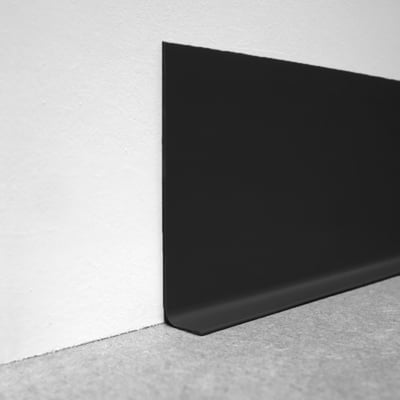
The easy option would be stick on plastic like this
-
Do you have access to the borehole logs? Just a statement that piling is required is of little use. Is there hard ground at 5m depth or 50m? How soft is the clay? Does only the structure require support but not intermediate floor areas?. That said, a starting point of "about 30 or 40k" lets you start on feasibility. But there are lots of piling techniques too. By considering that and the method of construction you could be saying "allow 20k to 80k". I've probably done about 20 piled buildings and often used a different method to that suggested in initial reports. But never for clay... yours must be very soft indeed. Any chance of seeing a borehole record? And what about the house? Big/small/ conventional or huge rooms, 1 or 2 storey?
-
Bottom line? If you want a natural wood finish then it needs to be natural wood. On the surface as a veneer at least. Even then , there may be some extreme knots that should havd been discarded or have been replaced with epoxy. But a good engineered timber costs about £60/m2.
-
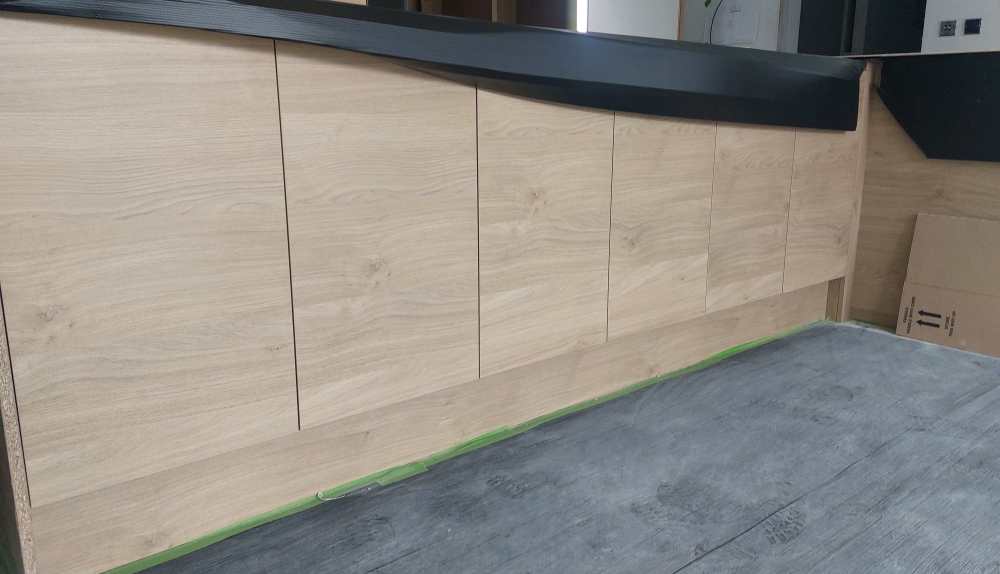
Maybe this will ease your pain... a problem shared and all that. Here is our new kitchen island showing the blank side. You may notice the " feature " knot that repeats and repeats.... and there was no way round this other than rotation. Again it shows that the manufacturer doesn't register this as an issue/ doesn't care. To be fair I don't suppose many kitchens have so many in a row, and at least the pattern is staggered. Would it sell more kitchens if they had several patterns and marketed this virtue? Probably not. I have though noticed some tile manufacturers advertise that their wood effect has 22 or whatever, individual patterns. There will be a table in front of this.
-
Plinth/Skirting - How should this get finished ?
saveasteading replied to Spinny's topic in Kitchen Units & Worktops
What make of kitchen? We've just found that howdens have provided one section as just lots of panels and fittings, and we have to manufacture it. So they are used to providing panels. Maybe your supplier can provide more blanks for that end that should be longer.



