


George
-
Posts
699 -
Joined
-
Last visited
-
Days Won
1
Everything posted by George
-
The foil backing was the vcl. For me it showed the issues trying to retrofit a vcl to an old building. If a building is completely stripped back then it may be possible, but for me, vapour permeable options are more forgiving with no real failure mode.
-
It was actually an internal wall but was into a boot room/porch which is unheated so effectively like an external wall but without the driving rain. So the source was condensation. Water vapour is everywhere but if it hits a cold surface below the dew point it'll condense. So the foil backed plasterboard (dry lined over gypsum) wasn't allowing water vapour to disperse so the humidity went up and up until the dew point was room temperature (with no CH, room temperature was pretty low). Ripped it off an replastered in lime. I've got some salts crystallising on the surface now but is dry and warmer for it. Assuming the salts are from the gypsum so just vacuum them up and I'll repaint in a few years.
-
I renovated a Victorian farmhouse! I went with wood fibre - didn't much fancy degassing PIR and there were issues in the house where foil backed plasterboard had been used (literal water dripping off the back of it when removed). I also didn't do a complete gutting of the house so I knew I'd never get a complete VCL, but I did put in MVHR, a ASHP (new CH - well, there wasn't one before) and an extension.. For interstitial condensation, if you have MVHR and you're able to put in a decent VCL then you would think the risk is much reduced.
-
Isn't that the same thing?
-
ASHP installer recommendation West Midlands/Staffs
George replied to tomdc's topic in Air Source Heat Pumps (ASHP)
Msc heating -
Securing wall plate to existing solid wall
George replied to jayc89's topic in General Construction Issues
Agree entirely. (If it was a cantilever (ignoring non-shear forces), if the anchor fails in any way then it is falling out of the sky. But for a floor confined and bolted to walls on either side, it isn't actually going to fall, it's going to locally crack the masonry but the bolts themselves and the resin will be fine, which will hold it in place. So there will be movement, cracking and possibly a loss of restraint on the wall. But it won't look like a catastrophic failure and no-one is going to die. Which is probably why builders happily put a single anchor every 600mm. That plus safety factors plus unlikely to see full live load means they get away with it.) -
ASHP vs Gas Boiler - crunching the numbers
George replied to Indy's topic in Boilers & Hot Water Tanks
I partly agree - while you're right, corporations and government need to be at the forefront, there's no reason individuals can't also decarbonise when at these decision moments. Induction is better than gas anyway for almost everything. It can certainly be financially beneficial to move to full electric household if you also get PV, battery storage and an EV. An ASHP fits nicely into that plan. However, if only considering heating systems and nothing else, kWh for kWh, mains gas wins on price. But you'll never be able to make your own gas. -
ASHP vs Gas Boiler - crunching the numbers
George replied to Indy's topic in Boilers & Hot Water Tanks
Mains gas is cheaper and will be for the foreseeable future. But in a passive house, the heating value will be so low it's not worth worrying about. Add solar and a desire to minimise fossil fuel usage and ASHP is looks better. However - if it is a choice between a gas boiler but we can afford more insulation OR a ASHP, then choose the gas + insulation. Design the system for low flow temperatures (which you should be doing anyway to get maximum efficiency out the condensing boiler) as this will mean a simple switch to ASHP in the future. For people without access to mains gas, in my opinion ASHP is already the better choice. Oil and LPG is up and up and very volatile and can't be supplemented with solar PV. -
Securing wall plate to existing solid wall
George replied to jayc89's topic in General Construction Issues
Probably a fair few more bolts than that. Your SE will need to look at the load rating for the fixings when put into the wall type you have. I'd happily bolt a ledger plate direct to the wall - but I assume in that photo they had internal wall insulation to run down behind. -
Because of the different way in how piles and trench foundations work there would almost certainly be some level of differential settlement. In large commercial buildings the extra expense of a movement joint is worthwhile, but will be a headache in a domestic house. Once foundations get atypical, what should be driving the design is a ground investigation. If the existing design is based on estimates and typical details, it may be worth spending a grand in getting a ground investigation done.
-
I've only ever seen reinforcement earthed in electrical substations!
-
+1 for team re-circulation. The grease filters get pretty grotty so it does work as intended (but are easy to wash). I did add carbon filters too but haven't concerned myself with them too much - the MVHR will draw away smells as well as moisture. I also have wood burners left insitu so had an additional reason to not want to create any negative pressure situations.
-
It might be they've accidentally used B14 & B15 references twice. From what I can see, at GF B14 is a catnic lintel and B15 is a steel beam spanning from C1 to masonry wall. The next B14 and B15 steels are in the ceiling at roof level. They're probably there because the ceiling joists can't span and they wanted the ceiling joists to align through in the same direction as the rafters. I can't quite work out the roof structure but it might have been subcontracted to a roofer. The additional beams may help support there. 3 courses of engineering brick under lintels is a bit OTT but no reason not to in a new build. If the windows are ~2m+ wide then sensible enough.
-
Post drawing extracts and your main questions. We can't do the work itself but might be able to suggest whether it is worth getting that second opinion. Although with steel on site, there is likely to be a cost for changes.
-
OK - well I'd still get an engineer to look. Just something to check - I think if you have sleeping accommodation in the building then the 30sqm exemption can't be used. But I'm not 100%
-
Single Story kitchen extension/Party Wall dispute.
George replied to RH122's topic in House Extensions & Conservatories
Just do a Party Wall Agreement anyway? She can't stop the works and the PWA is to protect you and her if any issues arise. Edit - indeed, if you start work, then find out you will be going deeper than the foundations (trial hole will only give a single point) then you'd have to stop, issue a notice, then wait a month. I think I'd rather issue a notice setting out the intended plan and what to do if that's not possible. -
I have never heard of foam or adhesives for attaching coping stones. It's always been bedded in M12 mortar (plus DPC), with stainless steel fixings for any exposed/high risk locations. https://uklintels.com/product-category/coping-clips/
-
I don't intend to touch the FIT installation at all. And I was intending to keep FIT - while SEG is good at the moment I'd rather the long term certainty. I would want the battery to know when the existing FIT solar panels are exporting and instead charge. But I assume all retrofit batteries have the capacity to do that.
-
I went with wood fibre boards and lime plaster. Calculated a u-value of 0.5, may well be performing better than that but only have 1 year of numbers to look at and it'd be a very very rough estimation (calculated heat losses vs actual heat demand).
-
For the walls you may be able to use a rubble trench foundation (https://en.wikipedia.org/wiki/Rubble_trench_foundation) - you'll likely need an engineer to sign it off to satisfy building regulations. For the floors, either a suspended timber floor or a leca insulated limecrete slab.
-
Yeah, it's a 4kW inverter and MCS. I believe in 2014 it would have been done on the notification route. OK, so it is equally complicated with a battery or additional solar in terms of having to apply for a G99 or G100. I'm pretty set on a battery if possible because I'm pretty sure I'll get 95% utilisation and it'll pay for itself fairly soon. The panel payback time would be a bit worse but they should last 25 years and payback eventually. Like I say, it might be that they can accept more than 16amps because there's only two houses on this transformer. The slightly ridiculous bit is that I don't actually want to export more than 16amps - I imagine given the FIT there's no way to get SEG only for new solar panels - so it would be imperative to self consume directly or charge the battery.
-
No you're quite right, it's not necessary. But the location to be able to access the power cable meant it'd be easiest to have it in the east-west barn. That is what then led to considering adding extra as it saves £1k in VAT and adds in better timed power for self consumption.
-
Thanks. OK, so it sounds like my basic understanding was correct. It might be that they accept it if we paid for a study - my connection is only me and my neighbour and our transformer is stepped straight from a HV wooden pole line. It's not something that was looked at before - in 2014 they just gave the nod and when we added the heat pump they initially refused based on the 16kW headline figure, before again agreeing when it was pointed out it was actually a peak 4.3kW draw and was inverter driven. My fallback position is just to install the battery and take the hit on VAT. Because I would essentially be using the solar for self consumption I was hopeful a supplier may bend the rules a tad. It's not like cheating a FIT agreement, just offsetting the install time (in fact, the repairs would only take a few days so may just be able to get it all sorted in one scaffold). (On a more general point, at some point all these solar panel covered houses will need their roofs replacing. Presumably you can disconnect the panels, remove them and fix things without impacting on the FIT agreement. So surely in principle you don't have to have everything installed in one go.
-
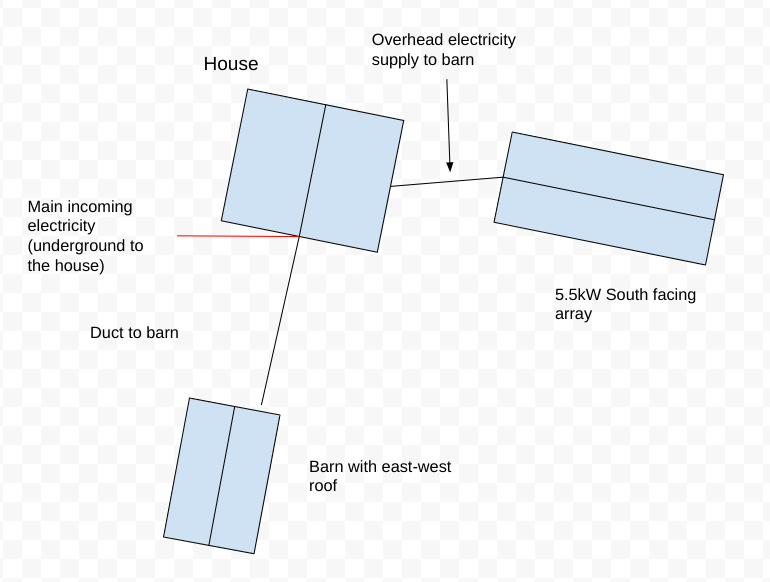
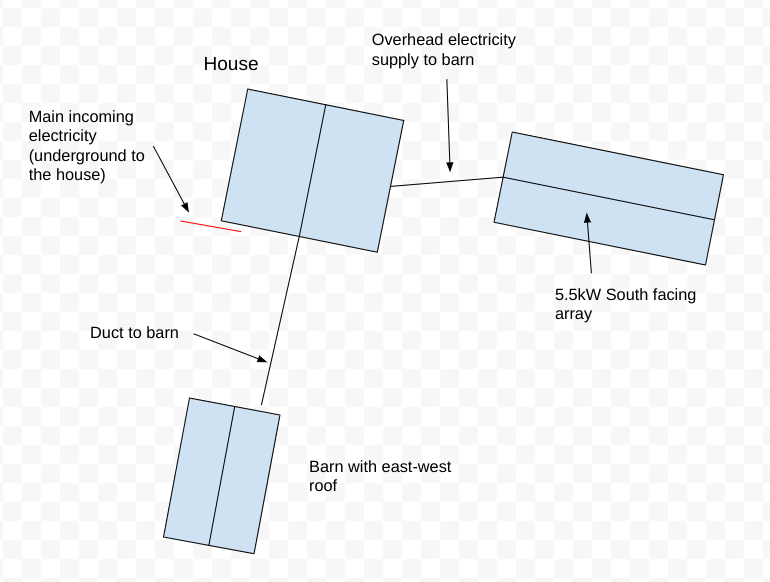
Hello, I've got myself confused and would appreciate a steer before any installers quote. I've got a 5.5kW PV array, which is on the 2014 feed in tariff. It's pretty much due south, with no shading and has performed very well. Due to the electricity prices rising and now we are a much higher demand household (added ASHP, two young children - laundry!), I would like to add a battery to make the most of the solar array. Discussions with installers said that a data cable needs to go back to the main incoming electricity supply. The supply is single phase and runs underground until it gets to the house. This makes the data connection difficult to do for the 5.5kW array (I mean, anything is possible but it is difficult). So this led me to think about a different barn, which I put a future proofing duct to. This other barn has an East-West roof (East-Southeast and West-Northwest). I have drawn a schematic: So.... the plan is to put a new solar array on the east-west barn, with a AC battery inside. An AC battery will allow both arrays to charge it during the day, with the east-west array providing good time of day self consumption and the south array doing the heavy lifting to charge the battery for overnight. My confusion is... As it's single phase, will I be able to export limit? (We currently have no export limitation for the 5.5kW (4kW inverter) array so presumably I can just have something to monitor the main outgoing cable and throttle the east-west array and battery.) I have looked at a Powerwall 2, Powervault and a Givenergy. My preference is currently with the Givenergy for price and control. Does anyone know of unbiased reviews of these batteries? As the roof on the east-west barn needs work, can I buy all the equipment upfront VAT free, but only have the battery installed and install the solar at a later date? As the east-west array will largely be self-consumption, do I max out the array size and to make best use into the future, add additional batteries? Any help or correction or other ideas gratefully received.
-
What comes after EPS 400 and before click LVT?
George replied to Niall's topic in Underfloor Heating
Are the UFH pipes going on top of the floorboards? I'd thought they go beneath, in between the joists. Then the floorboards (chipboard, ply, planks etc) is the structural floor for the floor covering.
