Andrew
-
Posts
198 -
Joined
-
Last visited
Everything posted by Andrew
-
They've just got back in touch unprompted to say they are going to double check with their accountants, so fingers crossed it won't be a fight. I think this is probably the real answer here. To be honest I took the risk as they could start immediately and were £5,500 less than the other quotes I'd had. If I had to pay the £500 VAT I'd still be a long way ahead of the other quotes.
-
I have an invoice from a company who have carried out some site clearance for us, which includes standard rated VAT. I have explained (and linked to notice 708) that this activity should be zero rated as it's closely related to the construction of the building and is not ruled out by paragraph 3.3.6, as planning permission is granted. I've had a pleasant reply explaining to me that as they are VAT registered they have to charge VAT on everything and I may be able to claim it back directly from the 'government'. Obviously this incorrect but I'm struggling a little to strike the right tone in my reply. I'm imagining I will need to send this email many time through the build, so I wondered if anyone had standard form of words they had used which had been effective in getting suppliers to zero rate their invoices? Thanks
-
That’s really helpful, thanks Russell. Good to know I’ve got a decent quote on the table. The variation in piling quotes is massive. Got one today for piling only which is 4x the best quote I’ve had. They clearly didn’t want to do the ground beam.
-
Thanks for the response. I've spent the morning ringing round and have found another couple of companies to quote, so hopefully they will be better.
-
Looks like we are going to have piled foundations with a ring beam and an insulated block and beam floor. I've been gathering quotes for the piling, which has been challenging as there doesn't seem to be any local piling contractors. The only quote I've had which wasn't clearly a 'we don't want to do this' price seemed fine for the piling (at about £220 per pile + £900 mobilisation) but the price for the ring beam was higher than expected at almost £9k. The length of the ring beam is approx. 85 linear meters and the cross-section size is 350mm by 450mm. I make that around 14 m3 of concrete which SPONS tells me should be around £150 per m3 - £2100. There's the cost of the rebar, which SPONS prices per tonne, but being really conservative with my estimates that's an extra £1.5k. Which leaves £5.5k of labour. I should also mention the quote specifically says it assumes the concrete can be poured into a neatly dug trench (prepared by others) without the need for any temporary formwork (formwork is an extra £2,210 if required). So with that in mind, I'm looking for any thoughts on whether my feeling that the ring beam quote is expensive is valid or not. I'm trying to get more quotes but it's difficult in the piling black hole of South West Cheshire.
-
This is the perspective the builder is providing - he knows what's been built locally and it's all strip foundations. It feels like science (investigations and engineers) vs the builder's nose.
-
I’ve found that the consultants our architect ‘knows’ tend to be on the expensive side. Always worth getting an independent quote for this sort of thing.
-
Normally concrete ground bearing but I think he'd do either.
-
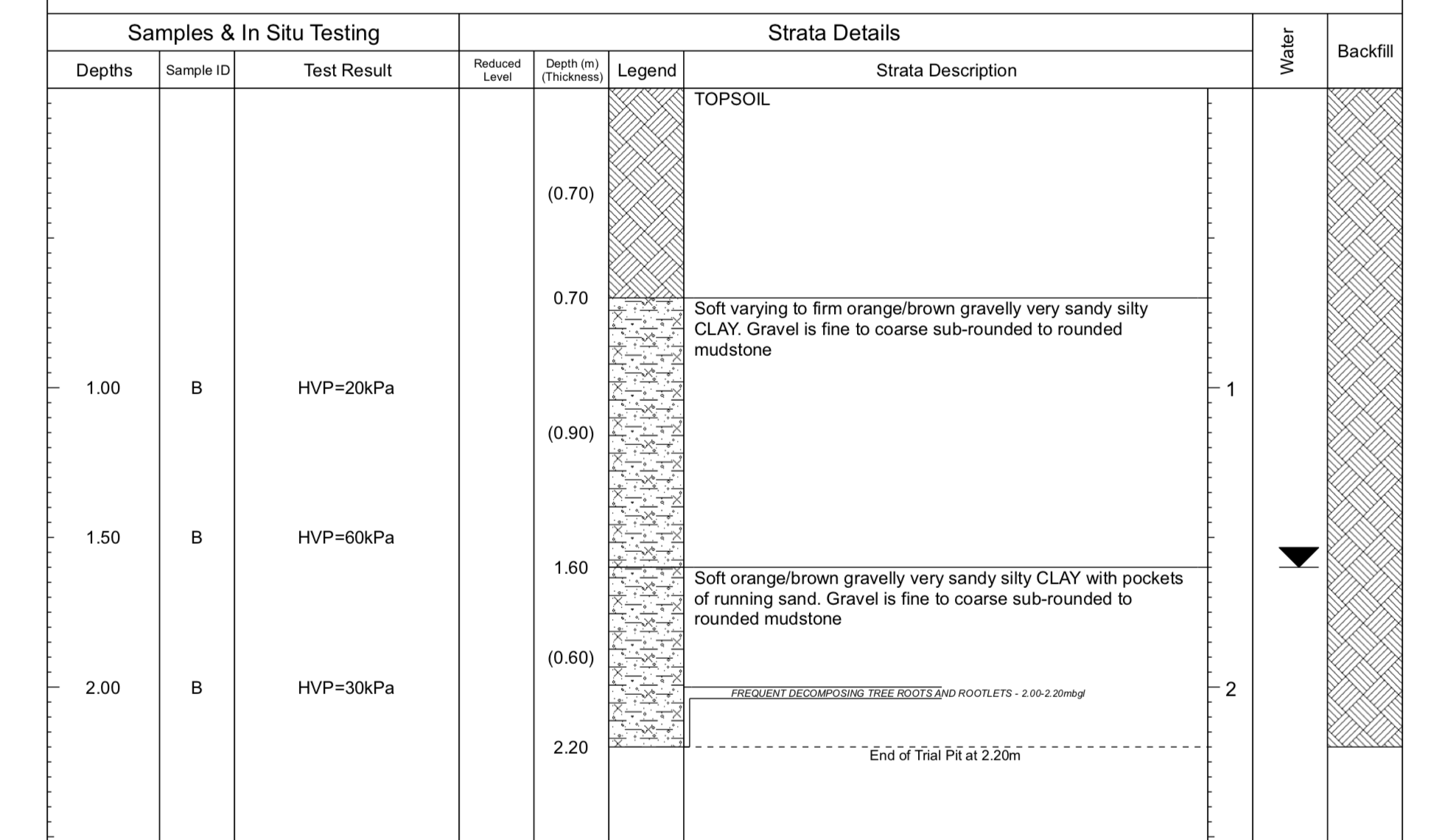
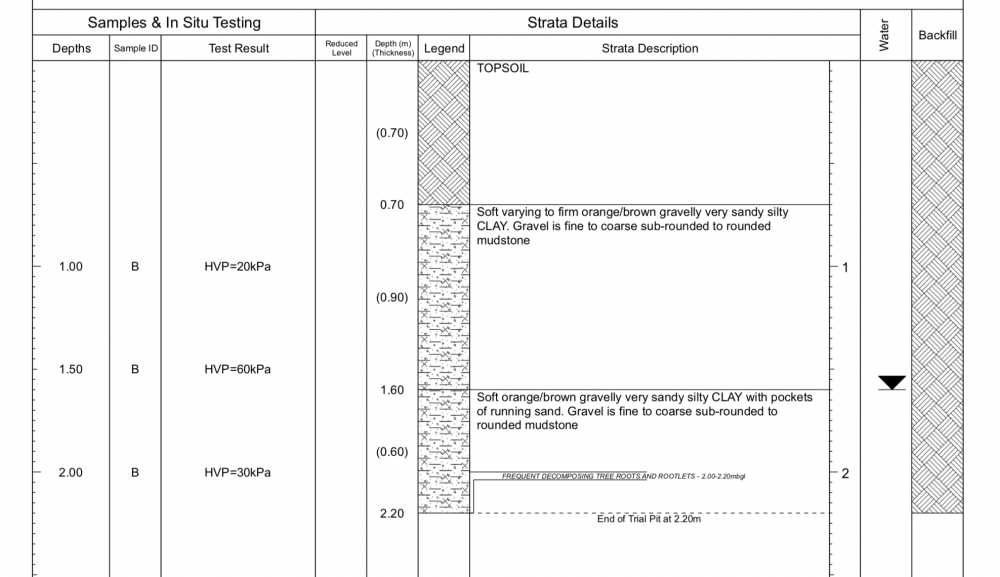
This was one of the four trial pits.
-
We've finally received our soil investigation report (wish we'd have done it much earlier) and it's not great news. The ground is mainly soft sandy clay with low bearing capacity. This is what the soil investigation report said :- Our structural engineer has reviewed the report and this is their comments I've also spoken to a local friendly builder, older chap, seen and done it all, constructed most of the houses in the village built in the last 50 years. He's just finished the foundations on a house a few hundred meters down the road. His view is why waste your money on a raft or piling, I'll do some lovely strip foundations for you, building control will check them out. it'll be fine. My preference would be a raft foundation but there's some conflicting advice above. I'm pretty sure the local builder can be discounted but the SE seems to have some reservations. Would welcome any thoughts on the above and specifically the SE's concern regarding tilting of the raft. We are using timber frame mostly timber clad if that makes any difference. Thanks.
-
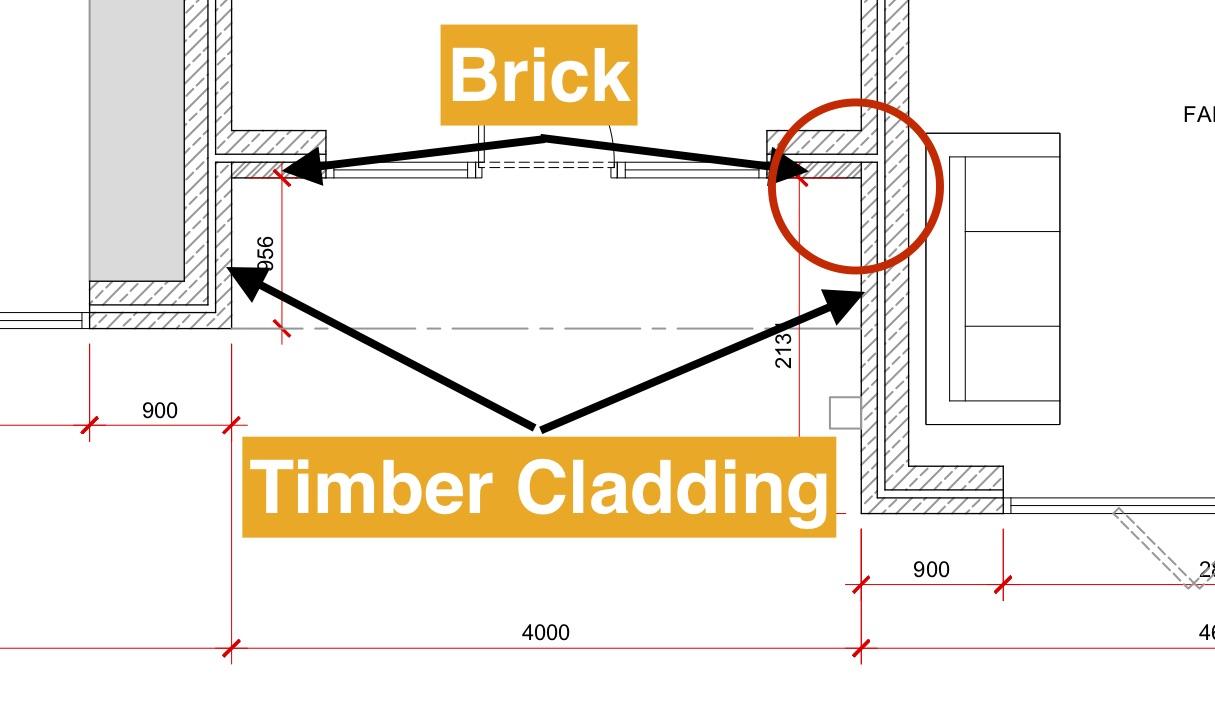
Timber cladding abutting brick inside corner detail
Andrew replied to Andrew's topic in General Construction Issues
Thanks for going to the trouble to post this - really appreciated. -
Thanks for the responses. I think the main difference in depth comes down to wether the downlight is fire rated or not - all of the really slimline ones seem not to be fire rated. Same goes for dimmable - I haven't been able to find a 20mm or so deep one which is dimmable. With regards to the fire rating - I can't find a definition of when a downlight needs to be fire rated. I've had a read through of the building regs and I'm none the wiser. Is there an easy to understand set of rules around when a downlight needs to be fire rated? The ones I'm concerned with are upstairs rooms with only the roof above.
-
Timber cladding abutting brick inside corner detail
Andrew replied to Andrew's topic in General Construction Issues
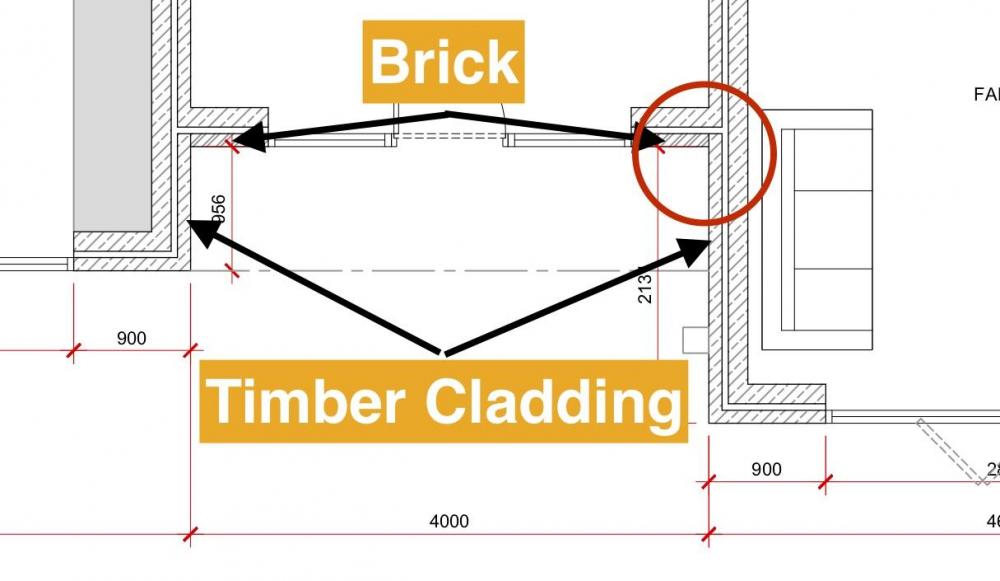
Thanks for the response. Nothing is built yet. The cladding is being fixed to 25mm vertical battens which are attached to the studs in the frame. The cladding is std Siberian larch. -
Does anyone happen to have a detail for an inside corner where timber cladding meets brick? Architect seems a little unsure and I'm slightly concerned about rain penetration into the timber frame where they meet. We're just attaching the cladding onto the outside of the frame. The cladding is horizontal over vertical battens. Brick work will have a 60mm cavity from the frame. I've attached a simple image showing the area in question - this is just for illustration.
-
Our build has mostly vaulted ceilings upstairs and I'm just trying to finalise the spec. with the timber frame supplier. Our roof build up includes mineral wool between the rafters and then 50mm of PIR on the inside across the rafters, the vapour control layer and then 35x45mm battens to form a service void which will then take the plasterboard on top. I recall reading here about difficulties installing down lights due to the service void being too shallow (unfortunately I can't find the post again) and this got me thinking as to what is a suitable size for the service void. Looking at low profile down lights, they seem to need 60-70mm of clearance and even taking into account 12.5mm of that depth is going to be through the plasterboard, I don't think the 35mm we currently have specified is going to be enough. I wondered what others had done for the sloping ceiling service void. I'm thinking 2 x 25mm deep battens may be enough but would love to hear any real-world experience in this area.
-
SUDS drainage design quote? High?
Andrew replied to Dreadnaught's topic in Rainwater, Guttering & SuDS
Just as a data point our SE is doing the foundation design, drainage design, highway access design and SUDS / surface water design for a total of £1680 + VAT. That's not broken down, so I'm not sure what part of that is the SUDS / surface water work. I don't think it's particularly challenging on our plot but I haven't had the design yet. Plot is in the North West and approx. 1000 sq. meters in size. -
MVHR Duct Routing
Andrew replied to Andrew's topic in Mechanical Ventilation with Heat Recovery (MVHR)
I did see the oval stuff and wondered if it would go through stud walls fairly easily. Thanks again - I can see how this could work now. -
MVHR Duct Routing
Andrew replied to Andrew's topic in Mechanical Ventilation with Heat Recovery (MVHR)
Thanks Jeremy - it's the getting up through the floor into the wall bit I can't visualise. Are those internal or external walls? Is it just a case of drilling through the centre of the stud attached to the floor and then taking the duct up through the internal wall? -
I'm trying to get my head around how the MVHR ducting should be routed. We're planning to have the MVHR in a downstairs plant room. Running the ducting into the first floor trusses (these are 253mm metal web joists) is straightforward and I guess the ground floor can be easily covered with ceiling terminals. Most of our upstairs rooms have fully vaulted ceilings and I'm struggling to work out how the ducting would make its way to the appropriate sloped ceiling. Do the terminals need to be in the ceiling? Is it possible to route the ducting up through stud walls and terminate in the stud wall? I'm really not a fan of boxing in, so would really like to find a way to route the cables through the fabric of the building. These are probably stupid questions and I confess I'm not fully up to speed with MVHR yet. I've asked for quotes from a couple of the MVHR suppliers which will hopefully give me a bit more to work with. Thanks.
-
We had an aqualisa visage digital mixer in our last house. It broke down twice in 3 years. Perhaps we were unlucky. To be fair to aqualisa they came out and fixed it under warranty both times, no quibble. But we were without a shower for a week waiting for the engineer. We’ll be having Grohe bar mixers in the new house.
-
MVHR for single room studio
Andrew replied to Andrew's topic in Mechanical Ventilation with Heat Recovery (MVHR)
Thanks both, I'll take a look at the Fresh R. As @JSHarris says there are several single room units and actually they are quite good value - e.g. https://www.blauberg.co.uk/en/blauberg-komfort-ultra-d105-a-single-room-heat-recovery-unit. If an extract in the bathroom and a supply in the main office is able to meet building regs then this would be quite a neat solution. The ceilings are vaulted but there will be some storage in the eaves which I'm sure could accommodate a single room unit and ducting. -
Sage advice I think. It's the £25k CIL liability that terrifies me, especially with the stories you hear of councils ferociously chasing self-builders for huge sums because they forgot to file a form in time. Btw this hedge is an absolute state - I don't anticipate any backlash but you never know.
-
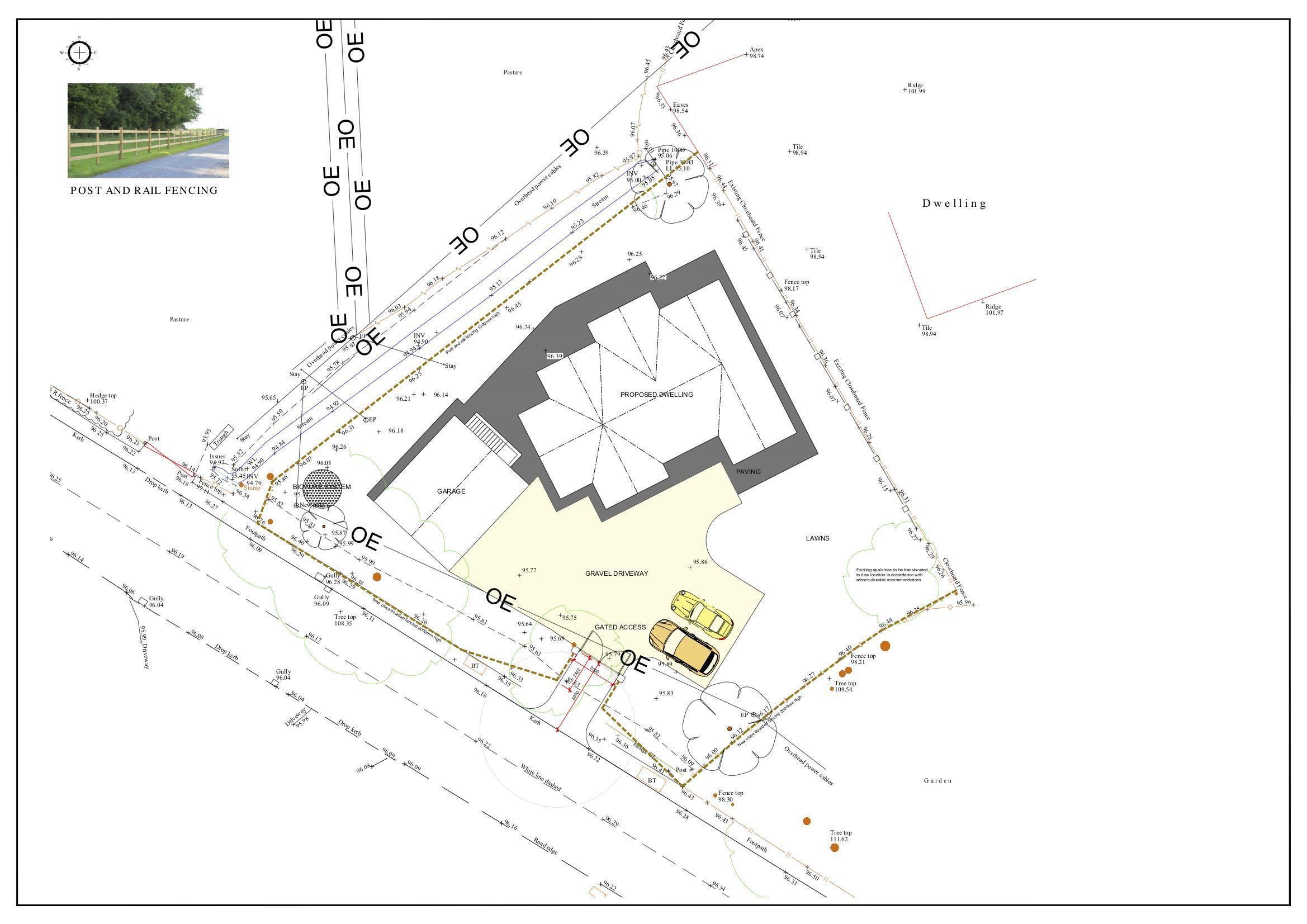
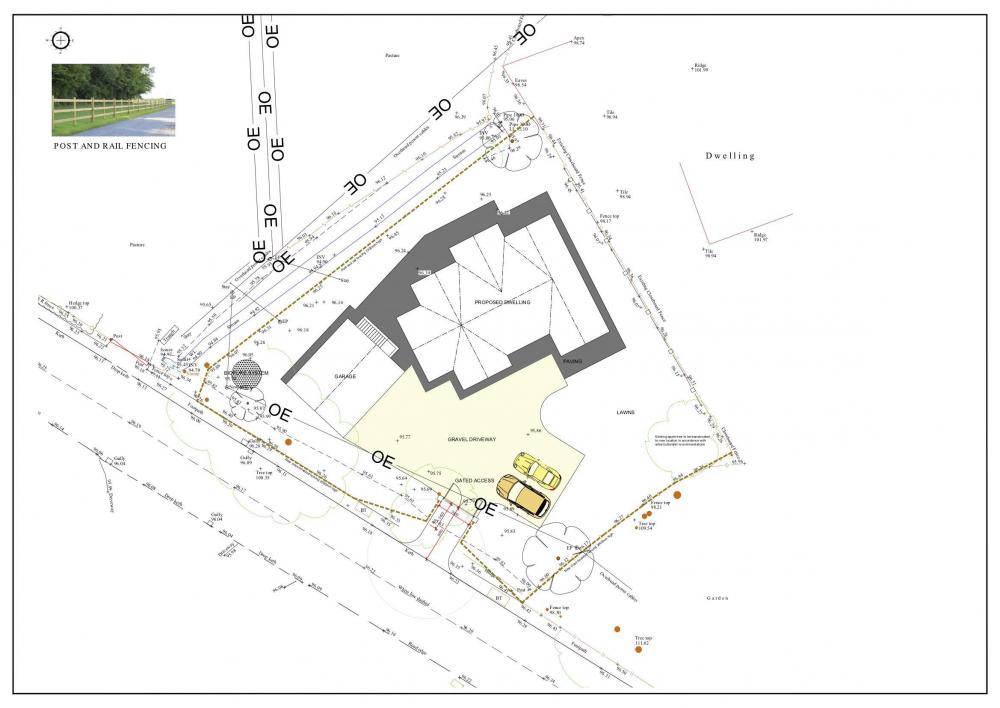
We have a large detached double garage planned as part of our build with a 42m2 studio space in the roof above. This is mostly an open room but there's a small toilet and shower room in there too. I work from home two or three days a week and the idea is this will be my office so will be used quite frequently - it can also double up as extra guest accommodation if needed (sofa bed). Due to the frequent use the plan is to insulate it and make it as airtight as the main house. It's only approx 3-4m from the plant room in the main house at its closest point (as shown on the plan, obviously longer to run the pipes underground and up into the studio) so the plan is to bring the services from the house in terms of UFH and DHW. However I don't think it's practical to run MVHR ducting underground to service the room above the garage? So, is there a small MVHR unit that would be suitable for the studio space or perhaps some other solution? Or perhaps there's no point with such a small space and I should have trickle vents? I've attached a site plan for context.
-
Thanks for all the replies and suggestions. I think I will play it safe and contact the CIL people / planning officer with what I propose to do and get it in writing that it's okay. Wonder how many weeks it'll take for them to reply to my enquiry. I also think it's best to avoid putting in the fence that's on the plans - a Heras fence for the boundary would be fine for now.
-
I have a real dilemma on our build. We received planning permission late last November which had a few conditional attached. These include some prior to commencement conditions, specifically submitting detail plans for the access + visibility splays, a noise mitigation scheme (the plot is fairly near a trunk road) and a surface water drainage scheme. These are all being working on currently but are probably a few week from being done. Our site is also liable for CIL. We have assumed our liability and have received confirmation of our self build exemption. We have not yet submitted the commencement form 6 but when I suggested that I might do it now to ensure I don't forget later I received a response reminding me of my planning conditions and copying in the planning officer who oversaw our application. So the dilemma is that the site is quite heavily overgrown with vegetation, including some mature but very poor condition hedges that follow the boundary. I'm acutely aware that bird nesting season is about to start and I would like to clear the site in the next couple of weeks. This would be done with machinery and the vegetation taken away. On the boundary with the poor condition hedge I would like to replace this with a wooden fence except for where the access will be which I'll use Heras fencing. The wooden fence is shown on the approved plans. I'm concerned that if I do clear the site we will be seen to be starting on site before our planning conditions are discharged. I'm even more concerned that doing the clearance and putting up the fence will be seen as commencement from a CIL point of view and as we've not submitted form 6 then we will end up in a long and potentially very expensive (our CIL liability is approx. £25k) dispute with the council. On the flip side if we wait until the planning conditions can be discharged there's a risk that we'll find a bird's nest and that will stop progress for 6 months. What would you do?