


mike2016
-
Posts
647 -
Joined
-
Last visited
-
Days Won
4
Everything posted by mike2016
-
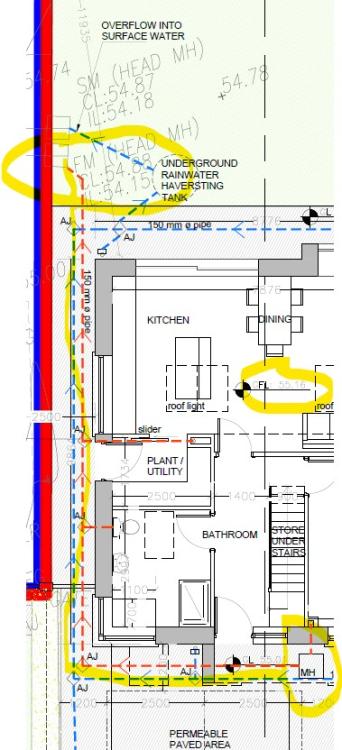
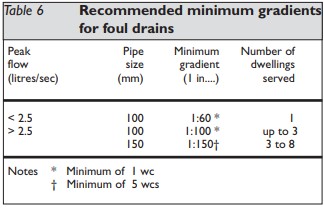
My Finished Floor Height is 55.16 and my invert level is 54.15 so I have a meter fall to play with. The Foundation buildup is 550mm to the hardcore where the pipes will be laid so a 150mm sewer pipe would have an invert level 300mm above the drain it will ultimately connect to. The longest run would be 5m + 10m + 5m (Front of house, side of house, to foul drain) so 20m. With a 1:60 fall that should work ok shouldn't it? I can decrease the foundation depth to get more drop but wanted to sanity check if this looks ok here before I commit to the foundation design in a couple of weeks time. Thank you!
-
I had an almighty row with my proposed window supplier yesterday and I wanted to fact check their statements to me a bit. We're in a standoff over this issue and I'm having to pivot and find a new supplier as a result. I won't mention who it is but from the general experience of the forum members - who specifies the window installation & fixing details based on weight / wind loads etc? Is it an Architect or the Window Supplier or other? The Window Sales Rep insists its always the Architect, they've never supplied any windows without the Architect supplying the installation detailing / fixing details. I tried arguing what happens in a retrofit with no Architect, they pivoted to well a deep retrofit would always have an Architect..... I asked my Architect and they said no, they never do this. The window installers look after that. They will inspect the work and point out if something looks "off" like a single window strap per side instead of 2 or 3 etc but that's all. So, unless a Structural Engineer provides this information but my builder says this is standard detailing and no they don't do this either. I'm at a loss - the price was great, performance good enough and we were working through some insulation detailing which is a bit unusual perhaps to them (thermal buck in the window openings) but I provided detailed drawing sections and photographs of what I was after, easy to coordinate and I would be happy with the window suppliers recommendations for fixing locations but they refused to work with me on this point blank. Anyway, what happens out in the real world, do you just provide the rough opening measurements with a 10mm wiggle room and the installers work out the fixings onsite as they are meant to or does everyone have fixing details provided by their Architects? Thanks!
-
Assistance with Soil/Waste pipes penetrations through foundations
mike2016 replied to mike2016's topic in Waste & Sewerage
Wow, greatly appreciated! Thank you! -
Assistance with Soil/Waste pipes penetrations through foundations
mike2016 replied to mike2016's topic in Waste & Sewerage
the orange is very close to yellow, apologies. The Architect originally showed just the WC drains. Just wondering how the shower/ wash basin drains fit into this scheme?
-
Assistance with Soil/Waste pipes penetrations through foundations
mike2016 replied to mike2016's topic in Waste & Sewerage
Thanks - I think that drain I hooked a right angle into was just done that way to avoid obscuring the yellow markup of the fixtures above it. Surprised there are that many drain penetrations needed to be honest, was hoping some might hook up / converge internally but as that's likely to happen within / underneath the EPS of the raft anyway, probably not much difference in the end! Just need to consider air admittance valves and see where the upper stacks go and how to route that bottom right WC vs the structural wall. -
I've been trying to get a plumber to help me with the pipe penetrations all week but need to make some progress on this before the end of the month for the structural engineer. So I'm throwing this out to the BuildHub community and humbling asking for assistance once again!! I need to know where I'll need to install waste/drains through the foundations (Kore Raft) I've overlaid the upstairs WC/Shower/Wash hand basins in yellow so drains can be joined up where it makes sense. I've added the provisional house sewer line around the outside in orange, draining to the left and up to the top of the image where the fall runs Main Bathroom - will all these need their own independent connections to the outside drain? So they head to the outside wall by the shortest path as I've shown? Can any be combined? Utility Room - drain required for washing machine/dryer/mvhr and ideally I'd like one in the center floor in case of appliance flooding / failure Kitchen Island - drain required for sink and possibly dish washer Above Utility is an ensuite - shower, sink and WC - do these require their own connections / can they join any others below them? Above and behind stairs is a WC/Sink only. The issue is there's Pozi joists in use going from top to bottom, but the red line is a structural wall and this will be solid. The SVP might need to be on the other side in the hallway for this to work? I'd appreciate any insights / help so at least I have a rough idea what can connect to what and what direction it should go. I'll ring around plumbers again next week but having some insight on the quantity & direction of foundation penetrations would be awesome! Thank you so much!

-
So I'm in the middle of the sales cycle for my Home. The first buyer pulled out but after a month I lined up another. The market is doing well enough despite % increases. So I had the estate agent around today to perform a valuation, the Surveyor comes around on Monday for 90 minutes to inspect the property and I'll be ringing the solicitor to get an update on where the contracts are at! I'll feel a lot better with them signed and a move out date to close the deal (hopefully!). In the meantime I've been looking at my timeline. The main constraint is I've to be up at wall plate level by the End of July. Working back that meant getting deposits (through borrowing) to the Timber Frame Company now to do drawings to get line loads so I can supply them to the structural engineer for the Kore raft foundation system. They want a soil bearing test which doubles their fee but another structural engineer I was hoping to use is booked out for several weeks and I can't wait. I sent a deposit to the first one and yesterday finally get a quote from the second and their lead times are actually ok! Too late as I've deposits down but a few K wasted perhaps but what can you do. Time is money and hopefully I can recoup later on. Can't get a plumber for love or money to agree exact drainage penetrations through the foundations which I need soon. Might have to resort to posting plans on here to the plumbing section to get some answers, thank goodness for buildhub! Talked to a heating engineer today and was going for underfloor heating and ASHP with an option for fan coils (cooling mainly) but now am switching to Air to Air in the open plan area and the 1 bedroom I'll use as an office. Then get a dedicated Hot Water heat pump - the built in ones like Ariston Nuos / Dimplex. That'll be 4 x 200mm holes in the wall when I include the MVHR. But at least I'm confident removing the underfloor heating pipe work is not going to bite me and this should halve my heating system costs from 20K to 10K which is a major plus. The issue is ensuring DEAP/SAP software doesn't rule this out and it seems it's very hard to find anyone who can install/service it. The distributor is a few minutes away but they may not have anyone qualified to service it! Oh, the joys!! I've cleaned up the site and it's almost ready for action, once contracts are signed I'll take down the old side fence and gate and pull up the roots / dispose of the remaining soil by renting a digger & skip. Job done! Main learnings: I am going to wake up at 4am throughout this process while I grapple with various decisions and problems but it's only for 18 months (hopefully!) Simplify things where you can - no underfloor heating loop pausing foundation pour and no integrated PV means the flow of trades is easier (doing standard PV instead) Research as much as you can but a lot of the stuff I've learnt has been by accident - I've had an hour session with my Architect (despite not using them for the build), a famous media personality for a general pep talk (Harrison Gardiner) and the heating engineer today. I've to check fire ratings for plasterboard on ceilings and exterior walls and probably take a read through ALL the building regs for good measure. Have some fun! I might work 2 out of 3 nights on this but I definitely need to take time off or I'll burn out too fast. There are breaks here and there for builders holidays, waiting on windows etc I can use to prep for the next stages. Anyway, the fun is hopefully just around the corner!
-
I think the internal diameter of the chamber gulley is smaller than the 110 pipe diameter that each junction then connects out to. Good idea about the cement. I think this run actually is meant to connect to the washing machine drain but no pipe was ever laid. Builder shortcuts so it's probably all draining into the ground or there's a slight chance its cutting over to the kitchen basin outlet but I'm doubting it. Thats about 5 meters of concrete to dig up to fix if I was of a mind to. Anyway, best seal it I think so concrete it is! Thanks.
-
I've an inspection chamber with two inputs, 1 of which isn't connected to anything but keeps tracking stones/rubble into the junction. I bought a few 110mm stoppers but these are too big to fit, I think it's a smaller size just under 4" in diameter. Is there an older standard around or what size should I be aiming for that would be common from around 25 years ago? Thanks!
-
Seated / Japanese style bath pros and cons
mike2016 replied to Gill's topic in Bathrooms, Ensuites & Wetrooms
Tell them you want a picture of a mannequin sitting in the bath holding a beer before you purchase! -
Seated / Japanese style bath pros and cons
mike2016 replied to Gill's topic in Bathrooms, Ensuites & Wetrooms
Some GRP ones here: https://www.essentialbathing.co.uk/deep-soaking-baths/ I'm sure there are more affordable ones around. Also: https://www.omnitub.co.uk -
Insulated Slab Installers Northwest Ireland/ Northern Ireland
mike2016 replied to Shaun McD's topic in Foundations
You'll see EPS (U 0.37) used to package some heavy electronic items, it's very dense and doesn't dent easily, stands up well to compression. PIR (U 0.22) uses a foam with foil either side and is very brittle, dents easily and while it has a better U Value wouldn't be my choice to withstand 150mm of poured concrete! And as depth is just the cost of excavating and muckaway, digging a little deeper makes getting the required U value achievable. I've used PIR in my two metal shed floors but with plywood over it. They all have their use cases. -
Insulated Slab Installers Northwest Ireland/ Northern Ireland
mike2016 replied to Shaun McD's topic in Foundations
And I'm going 400mm Silver EPS - I guess the house will float if we ever flood....!! Chasing 0.07 floor U values.... -
Insulated Slab Installers Northwest Ireland/ Northern Ireland
mike2016 replied to Shaun McD's topic in Foundations
I'd agree - if push comes to shove a strip foundation is fine. That's what my Architect specified as its cheaper and it still meets PHPP requirements with about 280mm of phonelic insulation in it. Although we can't get K107 in ROI any more from Kingspan last time I checked. Once it's down and performs you probably won't think about it again, focus on the things you can control and ensure you get a suitable floor U value using the foundation methods available to you. I'm going Raft as that option was open to me but Raft was my fallback.... -
Seated / Japanese style bath pros and cons
mike2016 replied to Gill's topic in Bathrooms, Ensuites & Wetrooms
Discussion here about temperatures and someone linked to aquatica which has a lovely range (pricey though!): My go to will hopefully be here: https://bartokdesign.com Also pricey but the real deal. There are cheaper fibre glass options out there you've probably found via google. I'll have a seat at my shower to wash myself before using so I can keep using the same water all week and a recirculation system to boost the temperature each day running off a flat plate heat exchanger from my air to water heat pump. Then I get to soak every day! In Japan they use the waste water at the end of the week for washing as their washing machines have a hose you put into the bath and uses the hot water to do the wash! Can't find that over here though! -
Insulated Slab Installers Northwest Ireland/ Northern Ireland
mike2016 replied to Shaun McD's topic in Foundations
I'd say insulated slab would be more, didn't get any clear quotes as headed for preferred method, that was just anecdotal talking to groundworks guy. Might close the gap after September when concrete levy kicks in.... -
Insulated Slab Installers Northwest Ireland/ Northern Ireland
mike2016 replied to Shaun McD's topic in Foundations
I'm in Dublin and hoping to use BrazPlant for groundworks and foundations combined. They preferred to do strip but have also done Raft in the past so I steered them that way. Everyone is more comfortable with Strip from quotes, was hard to get anyone doing raft. Wish MBC still built in ROI! The soil bearing tests are costing as much as the structural details for the raft, but I've a May deadline so can't wait for cheaper options. Everyone seems to be very busy! -
Insulated Slab Installers Northwest Ireland/ Northern Ireland
mike2016 replied to Shaun McD's topic in Foundations
Are you using the Kore System? If so they will have a local Sales Rep and he'll have contacts for companies he could point you at and drop some names you can contact. You'll need a Structural Engineer to do the design and feed back to Kore, 4-10 weeks, 2 weeks to manufacture, give yourself plenty of time to line this up. You'll need line loads from TF supplier. If using Castleforms / other try same although I've never got through to them on the phone. I'm going with separate groundworks / foundation installer, Kore system and separate TF supplier. -
Sure - I've used this in my shed before to power a wireless camera that's POE only when I didn't have a nearly DC supply - use-ip did them for my Hikvision camera - have a look at the range below and see if this is what you are after then look for same in other local places: https://www.use-ip.co.uk/level-one
-
New Build ASHP Outages: Once or Twice per year, I'll put a filter in as they flush a lot of sludge when they turn things on again. I'm urban so outages are rare enough and usually planned. We have had water treatment pump failures with the council but they have been rounded on for single points of failure etc so hopefully less common in future This is a new system design, just considering if I need rafters or not to hold a tank in the loft. I've never lived in a house without a gravity tank so not used to the idea, did live in an apartment once with a pumped system which was interesting & a bit noisy. Just curious with new builds what's the simplest solution and it sounds like a tank is old school or at least overkill. Thanks!
-
So, no tank, no accumulator. Unvented hot water system. no buffer?
-
The only issue I'm fixing is keeping an onsite buffer when they turn the water off for faults / maintenance. Don't like the idea of having no water reserve at all when that happens.
-
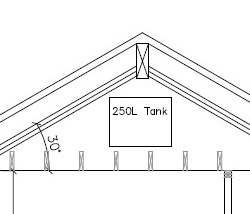
Just approving drawings for the timber frame and wanted to ask about where to put the water tank. They have squeezed one into a tiny attic (warm roof), the alternative is to have a vaulted ceiling in the upstairs bedrooms. Another alternative is a tank under the stairs with a submersible pump (noise). I've 3-4bar mains pressure but I was thinking of using an accumulator as a buffer in the plant room. So - stupid questions: Can unvented hot water systems use a gravity tank in the attic? Is using an accumulator as a cold water buffer a daft idea? Do I just go with the attic tank with a drip tray and keep things simple? Much appreciated! Only 2 showers and a bath in the property, the swimming pool was cancelled....!
-
ASHP: is my installer talking sense about his design?
mike2016 replied to HandyAndy's topic in Other Heating Systems
Ouch! One of the reasons I'm getting an independent design for my new build in advance and that's what the installer will have to deliver. Try a heatgeek / their youtube channel for some videos and see if there is one in your area you could chat to? There's excellent knowledge here as always too. Just confused about the expected SCOP - if it's a 9kW heat pump and the heating load is 9kW - surely with a COP of 2 or 3 it should be able to ramp up more than enough heat to warm up the rooms? I wonder what size / model the Gas boiler was? Was any grant forthcoming, if so you should be entitled to the paperwork from someone and hopefully access to the figures used? What is the flow and return heat showing on the controller, does it have a big drop, what length of run is it / how many rads? Anyway, sorry to hear it's struggling and hope you get to the bottom of it soon -
Considering this question for my own house - it's going to be a new build, quite small only 100m2 and I can get a Daiken with a 90l/120l hot water cylinder water heating option too. I think A2A works best in a retrofit though. Another primary benefit is direct cooling. I could live with the slight noise and draught, in an ideal world I'd get A2A for the bedrooms / office and A2W for the ground floor! Still heavily leaning on A2W for my house as it's a 3 bedroom with a bath and I'm not sure the smaller A2A tanks would work well on the hot water side and take too long to recharge. An A2W is better suited for my situation. The other con though is cost, the A2W is closer to 20K all in with the underfloor heating loop. An A2A would be much cheaper. Treated floor area 101.0 m² Heating demand 14.91 kWh/(m²a) Heating load 11.06 W/m² I could run refrigerant pipe, Electrical & Drains to all the proposed locations so it's easy to retrofit later but would I ever use it? https://www.daikin.ie/en_gb/product-group/air-to-air-heat-pumps/multiplus.html What do people think about using the heat pump manufacturers integrated cylinder vs getting a separate one? Any advantages / benefits there? Thanks!





