


J1mbo
-
Posts
333 -
Joined
-
Last visited
Everything posted by J1mbo
-
Presumably you have the heat pump controller and VRC700?
-
What system do you have @Dan F?
-
Electric shower will be 11kW best, combi shower is probably 30kW. The rate of flow with electric will be basically 1/3rd. Standing losses with heat pump cylinders are about 2kWh per day for a 200l cylinder (approx 18p per day at current electricity prices with a COP of about 2.5) when stored at 60°C. If the water is lower temperature so the losses will also be lower (maybe 12p).
-
Well, the reason the combi can provide DHW without a storage tank is that it’s likely 30kW or more. Running a good shower or filling a bath will use all of that. An air source Heat pump connected to a single phase supply will be at best 15kW and the outdoor box for such a unit is physically large. It also takes some minutes to “get going” whereas the gas combi can fire in seconds. A buffer tank will probably also be needed for the heating side unless there is a lot of water in the heating circuit.
-
IMO 20 minutes to recharge the buffer is probably OK. The system is probably near peak efficiency at 50% load.
-
Optimizing LG Therma V Controller settings
J1mbo replied to Hogboon's topic in Air Source Heat Pumps (ASHP)
If you are looking to monitor the consumption, have a look here: Heating & Cooling Degree Days – Free Worldwide Data Calculation This will be essential in monitoring performance. Look for a weather station somewhere vaguely local, select heating, Celcius, 20°C, Daily, Past Month. This will provide a CSV. The first two columns are date and degree-days. One degree-day would mean that for the 24 hours in question, the outside temperature was an average of 1 degree less than the heating temperature, presumably 20°C. So similarly, 20 degree-days would mean on average it was 20°C less than 20°C, i.e. 0°C. The heat pump energy consumption will be directly proportional to the degree-days for any particular day and this will enable you to monitor any changes you make. Bear in mind, it needs some time to build averages as the previous day impacts the energy demand the following day to some extent, especially where there is a swift change of temperature overnight. It occurred to me that tracking total energy demand (compressor energy consumption + environmental yield) and plotting this against average temperature, knowing the desired compressor run-time the exact weather curve can be determined for the property by plotting the required radiator surface temperatures against each day to produce the energy demand. November is a good month as the temperature varies so much. This is the analysis I've done on my own system: I'd broadly gotten to 28-45°C by spending far too much time with trial and error but maybe this might help somebody else trying to work out what the weather compensator curve settings should be.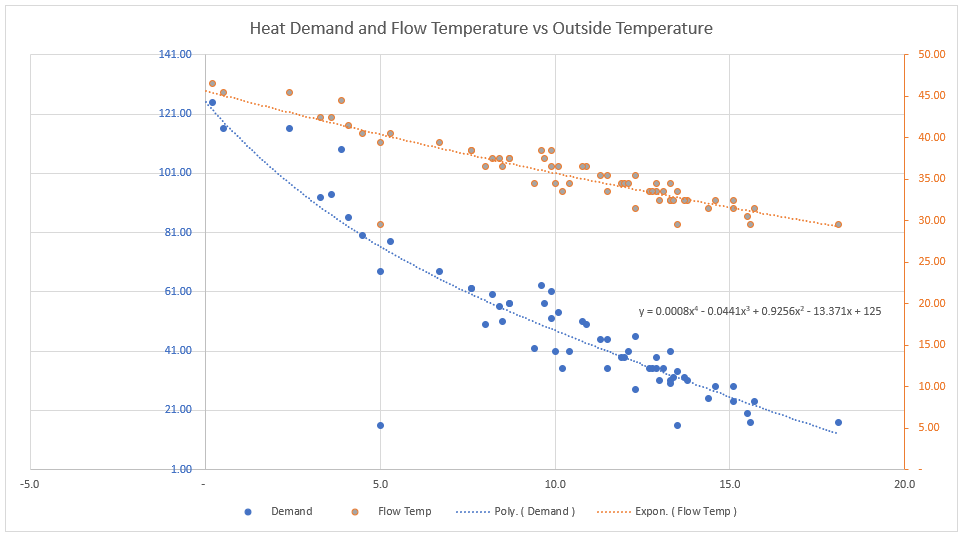
-
Daikin heat pump convectors - R32 - BLUEVOLUTION - VRV - SKYAIR - SPLIT - Daikin Spares - Altherma (thenaturalenergycompany.co.uk) They look to be fan-coils and accept refrigerated water down to 7°C so presumably must have a drip tray.
-
Sounds like the HP is oversized or the circulation speed in the house is too low, meaning the HP rapidly exceeds the set point (by circulation through the buffer) and so uses up the 60 degree-minutes pretty quickly. That said 20 minutes compressor run-time is hardly short cycling. Is the house warm enough?
-
Optimizing LG Therma V Controller settings
J1mbo replied to Hogboon's topic in Air Source Heat Pumps (ASHP)
Modeling the way the room temperature changes is complex. Presume the radiators are set to and do reach a specific flow temperature - say 50°C - relatively quickly (i.e. low water content system). When the room temperature is 16°C the output of the radiators is nearly 20% higher than when the room temperature is 20°C. So the radiator output is reduced somewhat as the room temperature rises if the flow temperature remains constant. Secondly the thermal mass of the structure will absorb more heat as the air temperature rises further away from the general temperature of the structure, increasing the resistance to further rises (by absorbing and storing the heat). And as the structure temperature rises so does it's heat loss to the surroundings. So basically we end up with the temperature rise curve being like a car acceleration curve: starts quite steep in 1st gear (16°C) and then rate of change tends to fall off until eventually it's flat where supplied heat = heat loss. -
Optimizing LG Therma V Controller settings
J1mbo replied to Hogboon's topic in Air Source Heat Pumps (ASHP)
Partly - I've shown the heat loss impact but not the COP impact. The latter is far more difficult to model. Clearly on the occasion that it's -2°C then 12°C the following lunchtime it's better to wait. But the software for these units is all quite limited and really meant to configure a 'best average' use-case. If it's an R290 or R32 based product it will pump out 70°C water all day long (except defrosts) but it will cost a fortune to do so. There's a direct trade-off between system responsiveness and running cost with outdoor unit noise and room temperature stability all in the mix as well. -
Optimizing LG Therma V Controller settings
J1mbo replied to Hogboon's topic in Air Source Heat Pumps (ASHP)
The controller has a noise reduction setting, see page 38, "Low noise mode time". -
Optimizing LG Therma V Controller settings
J1mbo replied to Hogboon's topic in Air Source Heat Pumps (ASHP)
Maybe "SuperChips" will move into ASHP remaps since the ICE chip market is presumably evaporating -
Optimizing LG Therma V Controller settings
J1mbo replied to Hogboon's topic in Air Source Heat Pumps (ASHP)
@Hogboon, I've put together an hour-by-hour energy model based on 6.5kW heat loss as per the other thread and a hypothetical cold day with two operating scenarios: The first, on the left, assumes the heat pump is run between 7am and 10pm - 15 hours. The second, on the right, assumes the heat pump is run 24x7. The house loses heat to the outside whether it's being heated or not. The model shows that that allowing the house to cool overnight (by not running the heat pump) reduces the overall daily energy requirement of the house as would be expected. In this example on this made-up day it would need 147kWh. Substantially all of that energy - 147kWh - has to to come from the heat pump. Because the heat pump is being asked to provide 147kW with only 15 hours of run time, the radiator surface temperature must be increased from 50° to 60° to provide an extra 50% output to nearly 10kW (15 hours x 10kW = 150kWh), instead of the 6.5kW the system was designed and sized to provide. So, to have the house warm with only 15 hours run-time will need bigger radiators or a higher flow temperature. Compare that to a steady-state 20°C target. Over the same 24 hours, very obviously the overall heat demand is higher, in this case 158kWh for the 24-hour period. This is where things get interesting. If the heat supply was a gas boiler then of course it will be cheaper to heat it for 15 hours. It will use less energy and cost less. However, the heat-pump muddies this because it will harvest less energy from outside when supplying higher temperatures. The ratio between electrical supply and heat provided to the heating system is the COP. A COP of 3 would show that 3kW of heat are delivered to the water in the radiator circuit with 1kW of electrical input. The other 2kW are recovered by cooling the air outside. Because of the shortened operating time of 15 hours, the radiator temperature must be increased by 10°C. This reduces the COP, all else being equal. The datasheet for my particular product shows a reduction from 2.39 to 2.07 at -3°. Therefore, the amount of electricity required is actually more when operating the shorter heating period than just leaving it on 24 hours, in case about 7% more electricity to heat the house for 15 hours compared to heating it for 24. TL;DR: 15 hours is not enough time to heat your home with the radiators you have. Mid-season this can be achieved by increasing the flow temperatures to compensate but this will ultimately cost you more to run than leaving the system running 24x7. Run the heat pump 24x7 or change the radiators to achieve 50% more output.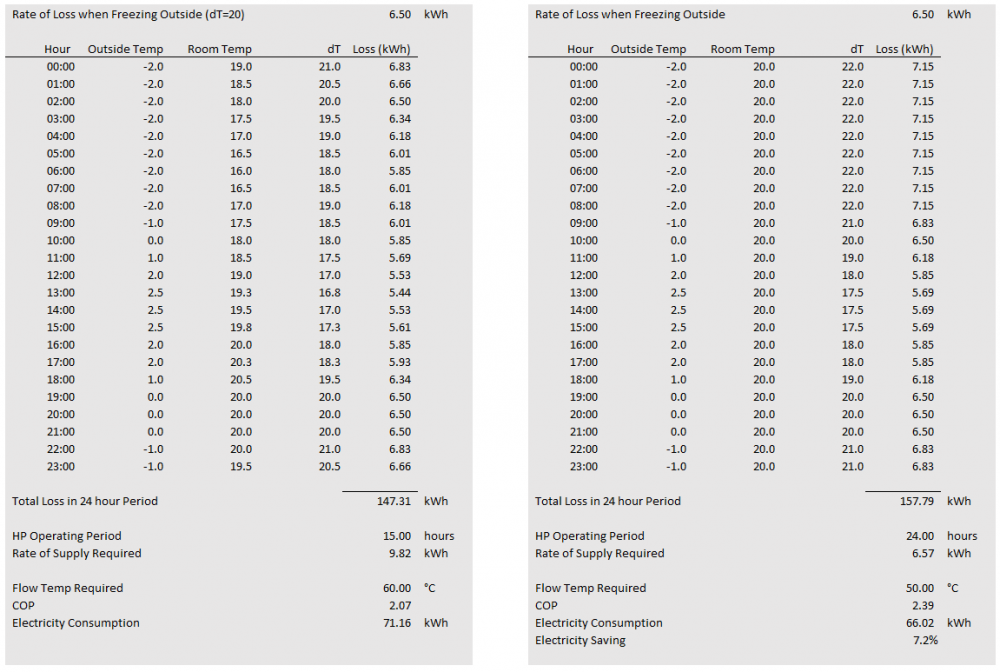
-
Optimizing LG Therma V Controller settings
J1mbo replied to Hogboon's topic in Air Source Heat Pumps (ASHP)
LWT = leaving water temperature = the temperature of the water leaving the heat pump, i.e. the radiator circuit flow temperature. It's calculated by the weather compensation curve configured based on outside temperature and adjusted also by the +-1/+-2/+-3 setting in the controller. -
Optimizing LG Therma V Controller settings
J1mbo replied to Hogboon's topic in Air Source Heat Pumps (ASHP)
The + 1/2/3 are a user offset for the target room temperature. The house is being allowed to cool too much. Set the hive, if you must use that, to 18 degrees between 10 and 7. Set the Hive also to 25 degrees in the day. It seems that the heat pump sensor should be water leaving temperature as you have third party thermostat. If the hive is replaced with manufacturer controls then it would be air plus water, air being the room temperature. Spend a few quid on an infrared thermometer if you don’t already have one as the radiator surface temperature is one aspect that needs to be determined. The overall energy demand of the structure in 24 hours at freezing outside is the total heat loss x time, ie 6kW x 24 hours = 144kWh per day. This is reduced somewhat by the night set back. Assume there are 9 hours at an average of 18 degrees then the fabric loss is reduced to 139kWh per day in my example. The heat pump has to supply all of this in whatever operating window it’s run. If it’s run for 15 hours it needs to produce an average of 9.2kW instead of 6kW. Both those numbers are within the capability of the unit fitted but the radiators fitted simply don’t have 9kW of output at 50*C. Therefore, the heat pump operating window has to be increased or the flow temperature increased, and the latter will increase the running cost per kWhr input to the house as the COP will likewise be lower. There is an optimisation trade off between flat 20 degrees inside 24 hours a day (lowest flow temperatures and highest COP as a result) vs night set back amount (lower total fabric loss but higher flow temperatures and so reduced COP). Finding that takes time. -
Would a bigger pump compensate for small pipes?
J1mbo replied to Hogboon's topic in Air Source Heat Pumps (ASHP)
You don’t need a bigger pump - the difference between flow and return is already 5 degrees as per the controller. -
Did you buy the equipment to get the glycol in the system or manage to hire a pump?
-
It would also need planning permission if it’s really 65dB
-
Wire through wall for weather-compensation sensor
J1mbo replied to Dreadnaught's topic in Air Source Heat Pumps (ASHP)
@Dreadnaught If you're running wires for this, I would consider giving yourself a couple of options for the controller. I started with the controller in the utility but later moved it to the lounge as it happens. It connects over eBus and needs to be cited clear of thermal influence such as direct sun, heat from the ASHP system itself, and so on. The outdoor sensor needs to connect to the heat-pump interface (the brains of the whole system, and also the wiring centre for the 3-port valve, sensors, eBus etc), as does the VF1 buffer tank sensor and the DHW cylinder sensor, if you are having one. On that, the ASHP will be cheaper to run than using E7 and resistive heating for DHW. You can of course use the ASHP on E7 to heat the cylinder really hot at a COP of >1. I get about 2, heating it to 65°C. It can achieve much more at lower set points, the issue being that it needs to stop heating the house to heat the water so I 'charge up' the tank overnight to avoid it doing DHW in the day. With the thermal mass of UFH, that probably is much less noticeable. Re zones. Bear in mind that the system needs a lot of water circulating to avoid overshoot. In other words the more zoning in place the larger the buffer tank needed. Different rooms obviously have different external thermal influences (e.g. sunshine, cooking, electronic equipment, log burners even) so it's always going to be something of a compromise between adequate heat, lowest running cost, and quickest response. Incidentally I added Ambisense mainly for the data (VR920 internet gateway and the app gives hours insight of energy consumption, environmental yield etc) as well as push alerts to any system issues. It also provides eTRVs which I have just three of to enable 'steering' of heat between parts of the house as the sun moves around basically. -
Wire through wall for weather-compensation sensor
J1mbo replied to Dreadnaught's topic in Air Source Heat Pumps (ASHP)
@Dreadnaught the Vaillant controller is more than just a thermostat - it also applies the internal room temperature to the flow temperature target calculation (when set to do so) and can self-learn to an extent the heating curve. The room temperature based adjustment shifts the configured curve up and down as a whole. Basically you want this in the coolest place of the house to provide the most responsive system. Ambisense can be added to it to have additional sensors and electronic TRVs around the place, but regardless of the inputs from those other sensors the control panel sensor will be used for flow temperature adjustment. Tuning the curve does however take ages and it is quite surprising in my case the result. 1970s house, CWI and double-glazed with radiators sized for 50°C flow. Five persons and to be fair quite high electrical load, 8MWh pa (computers!). But the curve has ended up being 0.65 with a floor of 28°C. It has taken a full year to dial this in. Based on my models the HP should be within 15% of rated SCOP this year. Since it has both 4-pipe buffer tank and a heat exchanger, I'm quite happy with that. Mid-season, the heat pump modulation ratios aren't as much as it appears because it recovers so much from outside. i.e. 30% compressor still gives maybe 60% rated output when it's about 12°C outside. So it will overshoot then shutdown then repeat; a lot of water is needed to slow this down. @ProDave To get anywhere close to the rated SCOP, the weather compensation is definitely required. Perhaps with UFH where the design flow is 35°C it is less important though. -
Wire through wall for weather-compensation sensor
J1mbo replied to Dreadnaught's topic in Air Source Heat Pumps (ASHP)
It works a treat. Takes a while to get get the curve and offset really dialled in in my experience. -
Would a bigger pump compensate for small pipes?
J1mbo replied to Hogboon's topic in Air Source Heat Pumps (ASHP)
Re the performance. The controller needs to be in 'auto' mode and it should say auto on the screen I think, in order to use the configured automatic weather curve. -
Would a bigger pump compensate for small pipes?
J1mbo replied to Hogboon's topic in Air Source Heat Pumps (ASHP)
No, the heat pump itself needs a meter. Normally the installer would just slap a meter on the supply to the consumer unit serving the heat pump, assuming it has one. I wouldn't necessarily contact the RHI scheme tbh since you've signed a declaration saying you have meters installed (i.e. complied with all scheme rules). See here: Key terms explained for the Domestic Renewable Heat Incentive | Ofgem (search standalone metering) "One option for meeting the requirements of heat pump metering for performance is to use a standalone electricity meter. It measures the electricity consumption of your heat pump. The electricity meter will likely have to be purchased in addition to the heat pump, and the meter will need to be installed alongside your heat pump prior to you applying to the scheme. There are certain technical specifications and accuracy requirements that standalone electricity meters need to meet. Standalone meters must comply with the specific requirements in the 2014 Measuring Instruments Directive (MID). The meters must fall within accuracy of Class A or better, as defined in Annex V of the MID. (Meters marked class 1 or 2 are not compliant). This will mean that your electricity meter will measure the electricity consumption of your heat pump accurately in isolation from other devices in your home. The meter(s) will be required to record and display: electricity used by the plant to generate heat; electrical input into any supplementary electric heater controlled by the same control system as the heat pump; and electrical input into any immersion heater for a domestic hot water cylinder where the immersion heater is controlled by the same control system as the heat pump. This will need to be added on your MCS Certificate." -
Would a bigger pump compensate for small pipes?
J1mbo replied to Hogboon's topic in Air Source Heat Pumps (ASHP)
The requirements are either metered for payment (meaning you have to submit readings) or metered for performance. All heat pumps require one or the other. The installation only needs metering for payment if there is a secondary heat source fitted (such as a gas boiler or electric heating element external to the heat pump itself). Your installation will require metering for performance per the guide I linked to above if it was fitted on or after 22-May-2018. From the doc, "If you apply and are successfully accredited to the Domestic RHI on or after 22 May , all new applications for air source heat pumps and ground source heat pumps will be required to have electricity metering arrangements alongside their heating systems to be eligible for the scheme. This means that even if you do not meter your heat pump for payment, it will still need at least one electrical meter." -
Would a bigger pump compensate for small pipes?
J1mbo replied to Hogboon's topic in Air Source Heat Pumps (ASHP)
Get back to the installers. The system must have metering to qualify for RHI (assuming it was installed on or after 22-May-18). Probably you need to be metered for performance and not payment unless there are secondary heat sources installed. Factsheet_DoINeedMetering_RPIIA (ofgem.gov.uk)


