


J1mbo
-
Posts
333 -
Joined
-
Last visited
Everything posted by J1mbo
-
12k + 6k Daikin Atherma 3 HT ASHP user experience?
J1mbo replied to magutosh's topic in Air Source Heat Pumps (ASHP)
Look at annual demand then work back. -
12k + 6k Daikin Atherma 3 HT ASHP user experience?
J1mbo replied to magutosh's topic in Air Source Heat Pumps (ASHP)
You can get an EPC for £50 that will give a guide. -
12k + 6k Daikin Atherma 3 HT ASHP user experience?
J1mbo replied to magutosh's topic in Air Source Heat Pumps (ASHP)
Bear in mind that there is a trade off between hot water recovery and system efficiency mid season. ie 12kW doesn’t go far in hot water recovery speed whereas it’s enough heat for maybe 400m2 at 30 watts per m2. -
ASHP, GHG, RHI, capital cost and cash flow (enough acronyms?)
J1mbo replied to SimonD's topic in Air Source Heat Pumps (ASHP)
They should have all done an energy loss report for you, the annual demand from those can be compared to your EPC annual demand. All are approximate but should be within some tolerance. -
Surely it would be relative to the evaporation temperature, e.g. about -40*C for R290 IIRC. So 44 and 48, or 10% in that case.
-
@SteamyTea, what would be the ideal temperature drop across the ASHP wet circuit?
-
The COP does reduce as the temperature delta increases, but lowering the system low temperature generally provides greater benefit.
-
So I did a 'fag packet' calc, based on observed performance so far. Continuous heating looks to increase thermal load by 35% but would increase cost by 20% if the COP improved by 0.3. Lots of assumptions here and doesn't account for sunshine...
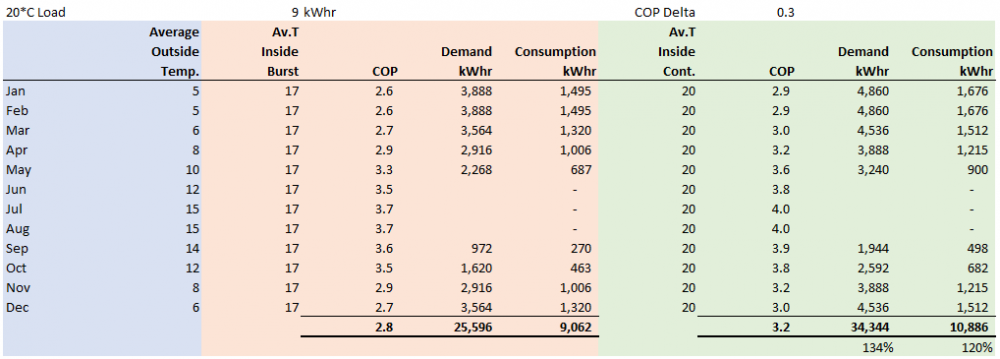
-
Thanks, takes me back to the dot matrix days, where one could look up the 'special characters' in the printer manual!
-
Yes this is my thinking... currently the system is slogging away at a COP of maybe 2.5 to heat the system... if I can save 10°C of flow so the COP goes up to like 3.5.
-
I have a Vaillant Arotherm Plus system heating through 17 radiators containing about 250 litres of water and dual-rate electric supply with a 3rd-party 'smart' control and weather compensator. Q: Might it be cost effective (or at least cost neutral) to heat the building continuously? Obviously fabric heat loss would be higher, because the average temperature would be higher. This would avoid heating the system from cold every day and enable a lower the flow temperature to be selected. Because it has a plate heat exchanger and buffer cylinder, the ASHP runs (significantly) hotter than the radiators when heating from cold. E.g. 50*C HP flow to get to 40*C radiator circuit flow - which levels out to a delta of maybe 2*C once up to temperature. Will the higher building thermal loss be offset in terms of operating cost buy the lower flow temperatures and avoiding the cold start? As it would obviously be more comfortable to always have a warm house. Any experiences with similar?
-
Rough experience from memory: 1 day - remove oil system 1 day - outside ground prep, install 1 day - new electrical circuit 2 days - buffer and heat exchanger 2 days - DHW cylinder; piping to it; replace cold tank; insulate 1 day - fill and test 2 men (at least) on each day. Plus the MCS paperwork in the background, the costs really add up. Of course you pay a premium to get MCS... these are businesses providing value after all.
-
ASHP, GHG, RHI, capital cost and cash flow (enough acronyms?)
J1mbo replied to SimonD's topic in Air Source Heat Pumps (ASHP)
Just look at RHI and use a better heat pump. The payments are based on the SCOP so if you choose a system that will produce 4 or 4.5 RHI will pay you more. An R290 based system and increasing the size of your radiators where necessary to reduce the flow temperature required are the keys here. -
Are air source heat pumps noisy
J1mbo replied to Technoheckno's topic in Air Source Heat Pumps (ASHP)
Look at R290 based heat pumped for heating water directly. They will produce 75*C from the compressor alone. As to noise, there are now planning requirements in this respect. However, the latest units are exempt as they are below the thresholds even when right on a boundary. When heating, the outdoor unit will be cooling so yes, it will be cold standing in front of it and may make paths more susceptible to icing. -
Interesting thought. I found this explanation: "The main problem with using water as a refrigerant lies in the compression stage of the refrigeration cycle. One desirable property of a refrigerant is that it should have a low boiling point. In order to lower the boiling point of water, we need to subject it to extremely low pressures. These pressures cannot be obtained with a conventional compressor and also water creates such a volume of vapor that the compressor needed would be huge. Even if we managed to design such a compressor, it would take a lot of energy to get it down to such low vacuum pressures that the refrigeration system would end up being inefficient. Water is as such an inefficient refrigerant because it requires too much power to make any sort of refrigeration happen."
-
Some R290 info is here: https://www.gas-servei.com/shop/docs/technical-data-sheet-r-290-gas-servei.pdf
-
Normal set point is 55*C. Weekly boost to 70*C for legionnaires control. All compressor driven.
-
I do, but it's R290 and this type of ASHP doesn't need immersion at least at "normal" outside temperatures.
-
Well, gas will always be gas. With ASHP, the environmental impact can be controlled after installation by virtue of the grid energy mix.
-
EPC for RHI and Electricity Tarrif
J1mbo replied to canalsiderenovation's topic in Air Source Heat Pumps (ASHP)
Cooling is allowed, but needs metering. The annual reporting requirements are here: https://www.ofgem.gov.uk/key-term-explained/annual-declarations -
I have a 250L tank and this is providing adequate to supply 5 showers in two hours with the (12kW) ASHP set to heat the cylinder for 30mins max with 20mins break for space heating. RHI does require MCS which adds cost. The system I have consists of ASHP, buffer, plater heat exchanger, and Telford HP cylinder plus associated controls. RHI is covering 85% of the cost and it took about 15 man-days to install and commission. There are hidden costs like the new circuit, the MCS paperwork itself, heat loss surveys required etc. The scheme has worked out well for me provided it lasts for the 7 years promissed.
-
sounds like the coil might not have enough surface area.
-
But there is no explosion risk because the stored water cannot boil. That is the reason for the annual services for unvented.
-
Here, most significantly an annual service requirement by the look of it. But, does that annual service requirement exist in the scenario that there is no resistive heater and only an R290 ASHP? I can’t see what risk there would be.
-
One thing that springs to mine with unvented. The risk arises from a depressurization scenario, where the cylinder temperature is over 100*C. Say a fault has resulted in a stored water temp of 120*C at some elevated static pressure. Should the pressure be released, the water will boil and hence expand something like 1600x as steam. This obviously causes an explosion risk. However, an R290 ASHP simply cannot produce water temperatures above 100*C. One because there are multiple protection mechanisms but secondly because it has a critical temperature of 97*C. So there doesn't exist the same risk provided there is no backup heating element as far as I can see.

