SimonD
-
Posts
1941 -
Joined
-
Last visited
-
Days Won
10
Everything posted by SimonD
-
That is true, while difficult and unfortunate, in some ways I've found the lockdowns have helped not to lose focus on the building work, merely because there's nothing else to do. Oh,other than try to homeschool a couple of young boys...it's easier to build!
-
That is probably what I'm most scared about. I have to give myself a slap when we're out for a walk and I start looking at derelict properties or infill land, then while I'm working away on the house I find myself daydreaming about how to raise the capital for the next project while living in this house. I've been through a phase of properly hating this house, now I'm starting to really like it again and can't understand why I'm still thinking postively about the prospect of more! At least I'm not the only one. ? Yet I've still got months of work to go here....
-
Ah, nice one, sounds good! Bucket list and restoration would be good. I'm a good few years away from retirement and not sure I'll have the cash left over for the bucket list but I do have old race bike I've stored away for years that needs a load of work. Hmm, but then I'll have to build a workshop ?. So what should that be, timer frame, brick & block, or icf or maybe something experimental? ? OMG, that's just reminded me we got planning permission to build a 1.5 width garage half dug into the hill in front of our house but had, pardon the pun, buried the idea a few years ago due to budget. Permission still stands because it was part of our whole house planning. Oh no.....
-
I took on my own build, deciding, for good or bad, to do it all myself. Unsuprisingly it's taken longer than planned and Covid certainly hasn't helped. So by the time I get to go back to making a normal living, I'll have been out of my game for at least 3 years if not more. I'm not sure I want to go back to much of what I did and I'm finding myself distracted by how I'm going keep myself occupied when I finish. I'd like to have some sort of idea. As a result of my investigations into heat pumps, I'm nowcompleting a heating engineer qualification, which will help a bit, but I'm still unsure. What did you end up doing after taking on a self-build. Could you go back to what you did before and did it take you in different direction?
-
Problems with my thin coat render system
SimonD replied to ProDave's topic in Plastering & Rendering
Here is a link to a paper that looks at ETICS failure and common reasons. Has some good photos similar to your situation. https://www.apfac.pt/congresso2012/comunicacoes/Paper 104_2012.pdf Good luck dealing with NBT or Soprema as they are now. I had a nightmare even dealing with their sales people so completely change materials and suppliers for my house. However, on a hopefully positive note, my experience with their technical people was very good. Have you contacted Baumit directly as this may be more in their domain than NBT? The EWI looks very low to the ground. Maybe it's the photos but was it installed > 30cm above ground level? -
Zinc angled standing seam.
SimonD replied to Makeitstop's topic in House Extensions & Conservatories
Interesting, do they supply a retrofit version or does this have to be integrated with the trays before installation? -
There's so much sensible input here already on this so I'll likely duplicate much of what has already been said, but here are some of the things I've learned. Know your area - by this I mean build somewhere you know already people or know people who know people. We moved regions, away from a network of trades and contacts to somewhere we didn't. None of the trades/contractors knew me and this really made things difficult and time consuming because I had to find people, or as what has happened, do it all myself. If trades know you, that you won't waste their time, you make decisions and stick to them, treat them with respect and you pay on time, they'll come back. If they're busy, don't know you, and don't know if you have the experience to manage them, you're less likely to get them. Design your build to use squares and triangles. A square shape is more space efficient than even a rectangle. Triangles, as in on the roof are well understood, simple and cheap to build. Avoid things like dormer windows etc. Not only do they add complexity, they're more difficult to detail for energy efficiency, for example. Avoid large spans as this requires extra structural design and materials. Keep materials and build method standard. For example, use standard sized windows & door so you can get them off the shelf. Design according to material sizes - 8' x 4' (2440 x 1220 or 2400 x 1200) sheet materials and as close to standard lengths for carcassing timber etc. The easiest place to spend a lot of money is the bling that lots of self-build magazines will try to sell you - high tech stuff, home automation, network cabling, even the type of light fittings. Really consider how much you really need all this stuff as much of it will be obsolete in a rather short period of time. My electrician has, for example, suggested using standard GU fittings for downlighters and using replacable LED bulbs - far cheaper than your LED units (I think there's already lot of discussion about this on this forum). When buying materials, go to the supplier with a large order quantity, this will get you a better discount and potentially reduce your delivery costs. Get multiple quotes and play suppliers off against each other if you can. A minor thing, but over the course of the project which can really help is to phone online trade suppliers. For example, I saved £200 on my framing nailer and received and automatic 20% discount on all fixings from one supplier compared to if I'd bought online from them, all with next day delivery. An alternative option for some purchases is to use your architect or someone else in the trade - this way the supplier thinks they may be in for repeat business and may be more helpful. There's also a couple of items here that I think is the most important, but often overlooked - also contrary to what many people might say! Give yourself time to think things through when you need to. The building schedule can often be very intense and trades, if they come up against an issue, will want an immediate decision on a solution or diffierent way to do something. Don't fall into this trap and instead seek to understand all the implications and take time to think through all the alternatives - but when you make your decision stick with it. Do not be afraid to change your mind and stick to your guns! This is your house and your money. I don't think there is any way you can really know what your house design is going to look and feel like on paper so I personally think you need to give yourself leeway should you feel you need it - if you include this in your plan and design it will save you money. The building trade is notorius for given advice that suits them, not you. They'll almost always tell you that anything you ask, that's different from what they have in mind is going to cost you loads of extra money. This is not born out of truth, more a trade culture in the UK. If something doesn't feel right, stop what's going on, think it through and take a different direction. I've found that having thought something through and then explaing it well to the trades can often overome this problem. Sometimes this may end in a builder or tradesman walking off site, but if that happens you may just be better off anyway. Finally, do as much as you feel you can and want to do.
-
So as you're not within the Brexit zone, this is all down to supply and demand, and that production and supply chains have been decimated as a result of Covid? What are the bests prices won't come down too much following recovery? Unless of course there's a major follow on recession?
-
Your experience mirrors mine almost exactly, although I got mine for £10.18/board in December. So about 10% in less than 2 months! It's challenging isn't it? Not only has our budget been massively affected by this, it's also the drag on making progress sometimes due to little stuff like delayed fixings holding up a job. My sequence is now a wreck as it has sometimes ended up as doing a little bit here and a little bit there, while I wait for this stuff to arrive, and while all that's going on lets try and homeschool the kids! I think you're right it has loads to do with Covid, all timber manufacturers across Europe have been operating at full capacity yet still can't satisfy demand and then you have situations like late last year when apparently European CLS supplies were all diverted to the US because they paid more for it. I pretty much cleared out the last couple of pallets at my local merchants before Christmas and did the same with 3 pallets of plywood where they warned me they had no idea when they'd be able to get additional stock in.
-
Apologies, I should have made a note to say that although providing some indicative data, treat with caution! Although it does provide some correlation to the global commodities of timber products,for example, due to their interconnectedness. There are always the ONS construction price indices, if you're really desparate for something to do ?Although again not sure if it'll be that much help either. Not unless you're in the middle of building! Good luck with it.
-
Here's both recent and long term construction cost inflation data: https://edzarenski.com/2020/01/28/construction-inflation-2020/ https://edzarenski.com/2016/10/24/construction-inflation-index-tables-e08-19/ I've found it difficult to correlate this kind of data to real world self-build costs because for both labour and materials, you're dependent on your local market. For example, we're based near Bath which is a ridiculous micro-climate of high build and material costs, partly due to the influx of Londoners with large amounts of cash. Go somewhere down the road like Trowbridge, and it's a completely different story. I've also seen some pretty scary short term price fluctuations. For example, one year, timber prices, particularly for OSB rocketed by 23% percent, but then settled down, so this year I bought a load t & g 4 osb floor boards and they were 'just' £1.18 more than over a year ago (but still over 10%), but were at one point in the year much higher than this. With windows, I've seen the greatest increase of well over 20% over 18-24 months. Difference between 2g and 3g is marginal at present. In short, whilst general material and labour cost inflation can be evened out nationally and over a long period of time, I'd say it's not a very reliable indicator to use when pricing up your own build, but I think that's exactlywhat you're saying ?
-
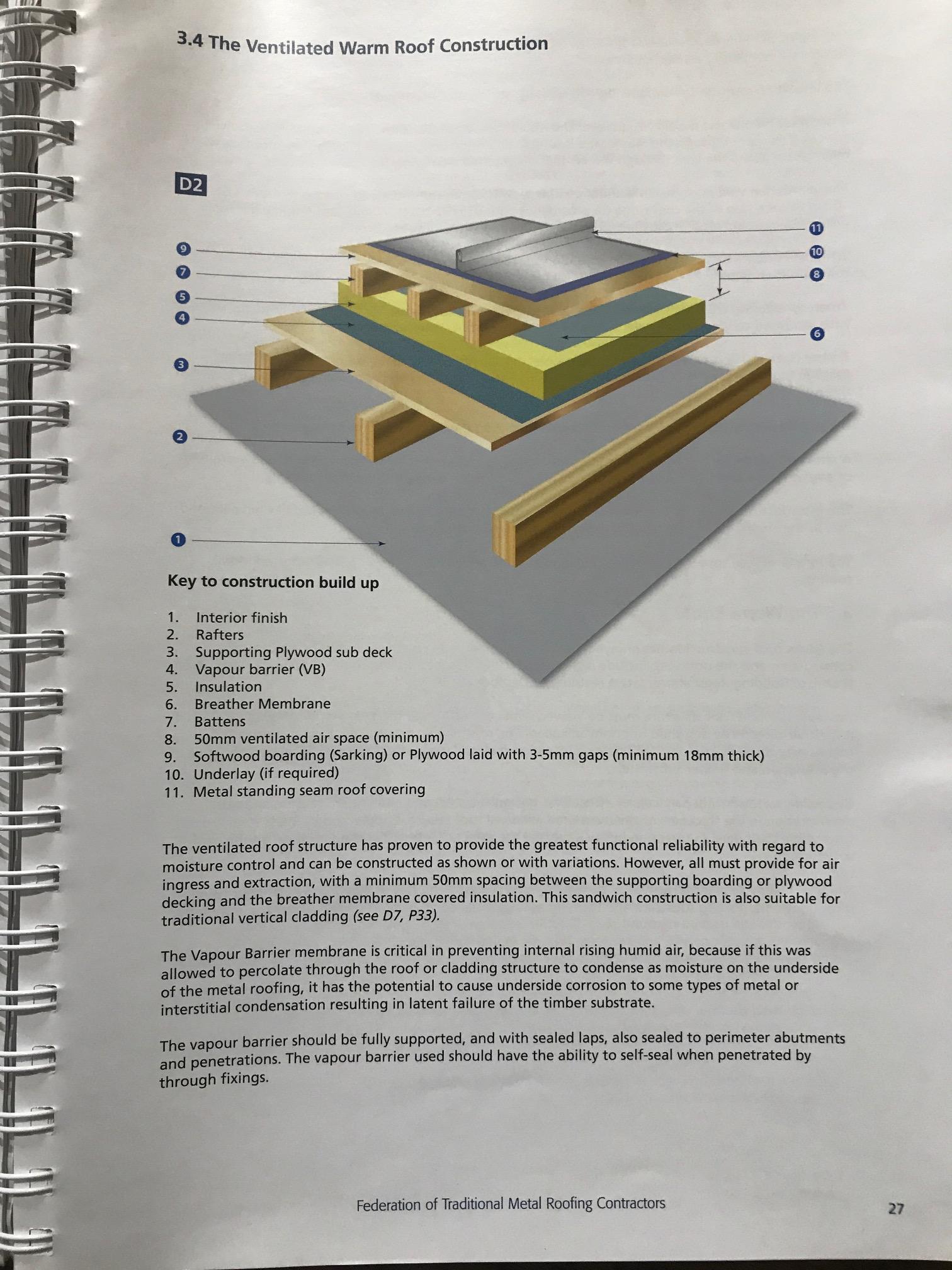
Morning Kevin, Thanks for the input. However, to risk being anal about this - but it is an important technical distinction to be made on build up - is that what I think you mean is Alutrix Vapour Barrier, not vapour control layer. Vapour control layers have some vapour permeability whereas the vapour barrier does not and this is what's needed if you're installing a metal warm roof.
-
Timber for SIPS - Regularised vs specified width
SimonD replied to Jamie McNaught's topic in Building Materials
I'd suggest you contact a decent local timber merchant as they should be able to machine timbers to any dimension you need. I've had this done by two local suppliers for various bits of work. Doesn't cost much, if anything at all. They'll simply take the next size up and machine it down for you. This is a better option than relying on regularised timbers which aren't great for framing, especially if you want good tolerances as regularised are only a nominal finished size. This is why cls is typically used for framing as finished dimensions are more consistent. -
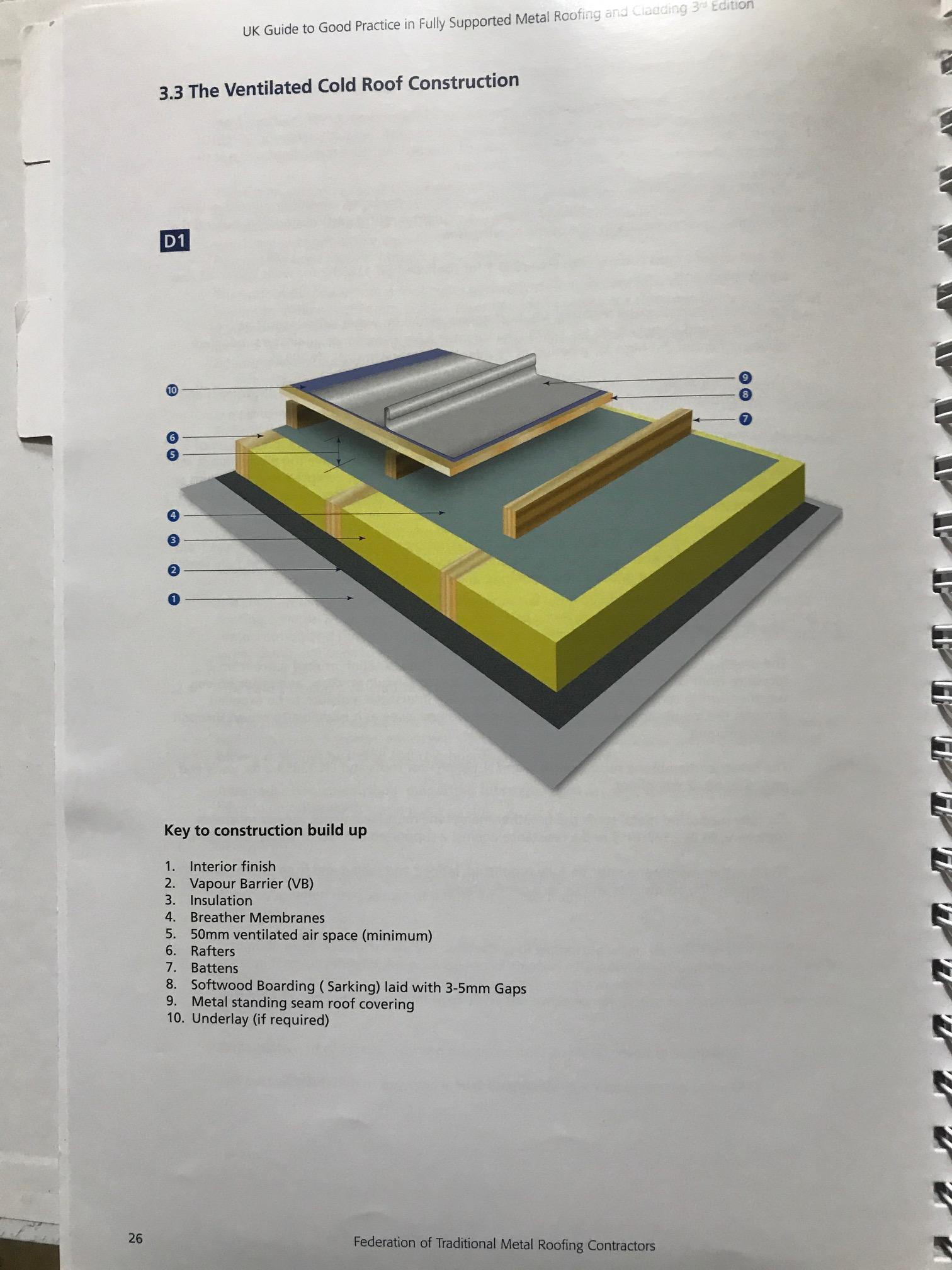
I'm sure it does prevent pooling and build up of condensation against the zinc and as it lets it run off the roof it's got to be a good thing. The membrane I recieved with my coated steel has a fleecy backing to it but more normal fibre weave on the top. Yeah, I agree it's really weird. There are certain types of warm roofs covered within the guide to good practice, but these tend to be warm roof systems, for example WarmFast, structural insulation board or composite metal faced insulated panels. In most cases however, there's a big emphasis on the number of fixings that penetrate the vapour barrier. As such in these cases they recommend the metal roofing contractor is used to fit the whole roof substrate. So the concern is definitely about moisture ingress as I quote from the manual on warm roofs: "The vapour barrier must be fully supported, self-adhesive, bitumen-backed aluminium foil sealed at the laps, to perimeter abutments and around penetrations. The vapour barrier must have the ability to self-seal when penetrated by through fixings.....Unless a Composite Panel System with cellular glass insulation is used, there is a risk of failure, most often caused by the vapour barrier not being laid and sealed correctly thus allowing eventual moisture ingress....no means of escape and therefore condenses and corrodes the underside of the metal or denigrates the timber.....This can particularly be the case with a structural warm roof installed by a generalbuilding contractor prior to the specialist metal roof installer's arrival." It also differentiates between vapour barrier and vapour control layer, how and where they should be used. Whoever wrote this doesn't have a lot of confidence in general building contractors either it seems! Under these circumstances it does seem sensible and easier to simply build in a 50mm ventilation space at least for this type of roof.
-
That's funny stuff, for a moment I thought it was just bitument felt with a fleece backing! Looks like your roof was the size of a football pitch ?
-
It looks like it in the pic, but spec says 50mm just as with the cold roof
-
I can only guess it's down to risk of condensation behind the metal, but perhaps because of the riks of corrosion, there's a bit of a hedging against crap vapour barrier installation.
-
I got a strange feeling when I saw this thread as I was sure there's something wrong about warm roof build up and zinc standing seam. So I dug out my UK Guide to Good to Practice published by the Federation of Traditional Metal Roofing Contractors. Low and behold it recommends against using an unventilated warm roof buildup - or shall we say it diplomatically suggets to approach such a design with caution, especially with materials like zinc. So definitely listen to your roofing contractor, not your designer. The recommended design for a warm roof actually includes 50mm ventilation below the plywood/osb deck supporting the standing seam. Instead of writing and quoting loads, I've attached pictures of the pages so you can see for yourself. If you need any further details, let me know. HTH.

-
It looks amazing..and massive! That's one hell of a gable window and vaulted ceiling. Good luck with weeding out the samples.
-
Picture 2 shows a flatlock metal cladding. There are quite a few suppliers around in the UK - Zinc, Copper, Coated aluminium/steel, Stainless Steel. In picture 1 it looks like a metal fascia, again using a flatlock or simple lap.
-
Best construction method to avoid mould growth
SimonD replied to goatcarrot's topic in General Construction Issues
Yeah, that's usually the assumption although with sufficient collector area (a lot), storage size and energy efficient house, many UK locations receive enough solar radiation to provide enough energy. There also isn't actually that much high quality research available specifically for the UK. My main problem was that I made the whole system myself - flat plate collector and storage tank included - and I made a lot of mistakes. Essentially they were pretty crap and I need to rebuild the whole thing. There's an interesting piece of research published on Science Direct in about 2018 looking at this which confirms there is some feasability of these systems. I don't want to hijack this thread but can dig out the link and post if you're intersted. -
Best construction method to avoid mould growth
SimonD replied to goatcarrot's topic in General Construction Issues
I'm most impressed by his ground heat bank. I played around with building a prototype out the back of my old house about 15 years ago but life, children and other things got me distracted so never developed it to work very well at all so had to bin it all. Wish I get the funds and time to try again someday. -
Best construction method to avoid mould growth
SimonD replied to goatcarrot's topic in General Construction Issues
You have an external layer, let's just call it a 'rain screen' for simplicity. This forms the outside protective layer against the weather, which could be your outer leaf of a brick & block, metal cladding, or timber cladding. Behind this, you'll typically design in a way for any water ingress to get back out of the building. Typically this is some kind of free space. However,it may also be achieved through use of building materials like a wood fibre external wall insulation with a lime render where is moisture does penetrate the outer skin, the material can buffer that moisture ingress and then naturally dry out when the weather improves. With a timber frame, which will typically sit behind such a screen, build method and detailing is important. The traditional and basic way to build up a timber frame is, from the inside: Plasterboard Vapour check - usually a membrane sometimes just a plastic sheet sealed at the seamsand sometimes a more high tech membrane that has a variable vapour check behaviour. Timber studs with insulation between the studs Frame sheathing - OSB/Plywood Breather membrane ventilation cavity - minimum 25mm outer skin. Now, there's a myriad of variations to this so this is just a basic illustration. The vapour check prevents warm moist air entering the timber frame/insulation layer. If it was allow to get in there, at some point the wall temperature would be cold enough to allow the warm moist air to condense, which would cause damp within the frame. The OSB/Plywood and breather membrane are there to allow some moisture to pass from within the frame to the outside, to prevent a harmful buildup of moisture while also providing some protection against ingrees of excess moisture from the outside. The problem as has been found in many timber frame buildings built in this traditional way is that the vapour check gets pierced during 1st and 2nd fix and not sealed up properly again. This allows the vapour to pass into the frame, causing excess moisture through condensation that can't be dealt with by typical insulation materials like glass wool. This moisture stays in the frame and causes rot over a long period of time. So your basic protection for the timber frame is proper detailing of the vapour check layer and your external membrane. With materials like wood fibre and sheepswool, for example, research has shown that because they're hygroscopic, they can soak of excees moisture in the frame (glass wool can't so the moisture condenses onto the material) and then pass it out to the atmosphere to even out humidity levels (a little like a hot item will cool down to atmospheric temperature). Because these material regulate this moisture in the frame better, it is better for the frame and actually reduces moisture levels with the frame long-term. This type of system build is approached slightly differently but again detailing is key. I've attached a document by BRE that talks about these natural insulations and how they can prevent bacteria and mould build up. The paper focusses more on vapour permeability but hygroscopicity is just as important. BRE Information Sheet Natural Fibre Insulation - IP18_11.pdf -
Best construction method to avoid mould growth
SimonD replied to goatcarrot's topic in General Construction Issues
I agree completely, but it also shows that it is not the building material in and of itself that is the problem, which was the question about cellulose. -
Best construction method to avoid mould growth
SimonD replied to goatcarrot's topic in General Construction Issues
Not necessarily, there are many examples across the country right now of newly built houses using concrete/stone/block/dryway/plasterboard-skim etc.developing bad mould problems very soon after occupation. I know someone who moved into a newbuild on a development only to find mould growing in the utility room within 3 months. The problem is more down to relative humidity and ventilation. Below a certain amount of humidity, mould will not grow on timber or cellulose or other materials. The wood fibre and cellulose (actually technically both cellulose) are treated, often with a borax solution to prevent fungal attack and for fire protection. Essentially what you need to do is ensure that your fabric is well built and detailed properly - so sufficient insulation, means of protection from ingress of damp and means of escape if damp does got into the fabric of the building. Internally you need to ensure good airtightness together with sufficient ventilation. Sufficient ventilation should ensure relative humidity remains within acceptable limtis within the house, but in addition it has been found in research that building fabrics that buffer moisture (i.e. absord excess moisture in the air and then release it at another time) can reduce relative humidity within the house by between 10-25%. Breathable fabrics include wood fibre, hemp,or sheepswool insulation but the whole wall system needs to work in concert. Hope that helps.