


SimonD
-
Posts
2215 -
Joined
-
Last visited
-
Days Won
13
Everything posted by SimonD
-
Upgrading rafter ties to proper joists
SimonD replied to SimonD's topic in Garage & Cellar Conversions
No worries! 😊 Yeah, that's one option, but will double up the amount of timber in need to use. I will keep this option in my back pocket. Only good enough to use as loft storage to get things out of the way instead of having to make a shed or get a half container. I was wondering whether I could get away with 50mm bearing and even if it's 75-80mm that should be fine, which means I could get the joists in place with a small amount of bearing on existing wall plates and then bolt additional wall plates to the wall immediately below for the rest of the required bearing. I think this might be the solution. -
Worcester Bosch Greenstar 8000 System Boiler Issues
SimonD replied to EinTopaz's topic in Boilers & Hot Water Tanks
A low loss header is not going to be the solution for getting your system to heat up faster. What is responsible for getting heat into your house from your boiler is mean water temperature, driven by the boiler. You've got more than enough output available from the boiler to do this. Now, with 8000 I have heard feedback that it takes a while until it ramps up to max output when the heating is initially turned on. First, test this by doing some gas rates. When you turn on your system from cold - go to the meter and take a reading at the same time as starting your stopwatch. At 2 minutes, take another reading. Then do this say 10 minutes later, and again after 10 minutes. By all means post up the before and after figures so we can do the calcs. If you want immediate feedback, you can do the first gas rate and then put the boiler into chimney mode and max. then do another gate rate and calculate the difference. So again, to do a gas rate: Have boiler running Take meter reading and start stopwatch at the same time At 2 minutes, take meter reading again and post up results. What we want to find out is if the boiler is programmed to run at a lower output for a period before ramping up to maximum output and how long this takes under normal running conditions. Ideally we want to do this with all the settings at default, before you've amended anything like pump setting etc. As an approach to heating there is the idea that not ramping the boiler up to max output immediately provides energy savings as well as reducing overall wear and tear on the boiler itself. ATAG, for example, has for years had an approach where it starts on minimum output and slowly ramps up output over a long period of time. Others will modulate too rather than put everything in at once. The conclusion we may end up with is that you have to put the heating on earlier to get it to temp for when you want it and change your behaviour and expectations. If it does turn out that it takes a while to reach its max output and that this is just a feature of the boiler, it's not really something you can put on the installer because it's unlikely they knew about this when specifying the boiler as it's unlikely WB made this explicit. The gas boiler industry and market have unfortunately been complicit in the de-skilling of the heating engineer industry for the last few decades, as, of course, they know best..... -
Upgrading rafter ties to proper joists
SimonD replied to SimonD's topic in Garage & Cellar Conversions
Not without damage as the felt is properly fixed. I have to say that compared the the old bungalow, this garage was well built with attention to detail. -
Upgrading rafter ties to proper joists
SimonD replied to SimonD's topic in Garage & Cellar Conversions
It's just like this but with ties every other rafter.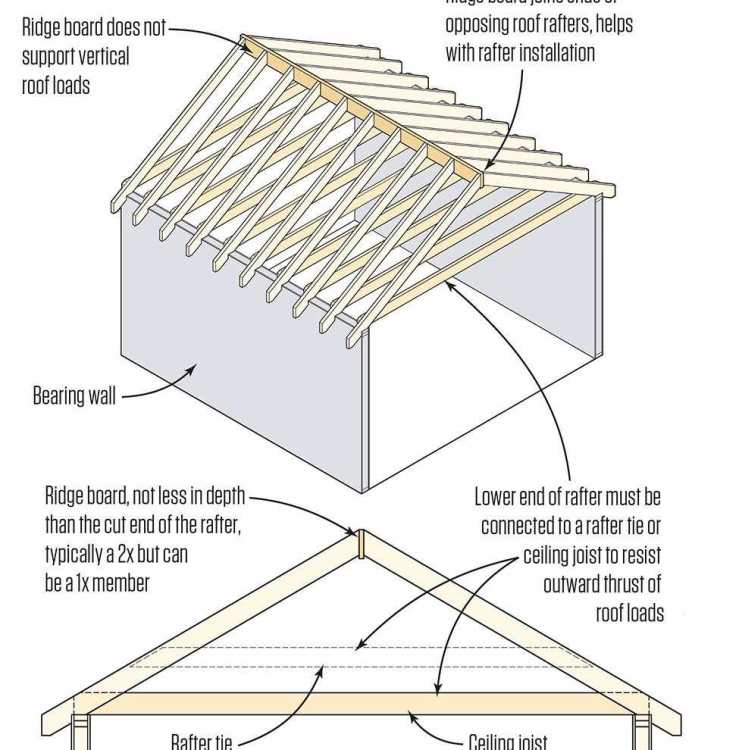
-
I need to create a loft in the existing garage before I build the new one. It's got a traditional pitched roof with rafter tiers every other rafter. The ties aren't of sufficient size to use as rafters across the current span, so I'm considering how to easily add joists across to create my new loft space. Options I'm considering are: 1. Cut ends of new joist on the diagonal and then fix to existing wall plate - but with sufficient bearing on the wall plates I don't know if I can slot them in; 2. Install wall plates to the wall just below the ties and fix new joists to these (garage has sufficient height for this); 3. Sister the ties with the new deeper joists - and add new ones to rafters without existing ties. Walls are ashlar faced breeze block. Any thoughts, ideas and experience to help me decide? Any details I need to be aware of?
-
Worcester Bosch Greenstar 8000 System Boiler Issues
SimonD replied to EinTopaz's topic in Boilers & Hot Water Tanks
I have to say, John, that I try to avoid WB boilers like the plague. I think their designs are awful, I hate working on them and I would definitely never install one (although I have installed one, once!). I think the 8000s are worse than ever, but lots of installers seem to like them for whatever reason. I've never been called to investigate this specific problem, only that radiators aren't getting hot and this is almost always to do with a system balance issue and not the boiler itself. When I do system diagnostics involving temperature measurement I always ignore the internal boiler temperature given by the sensors and instead use my own clamps to as close to the boiler as possible. This is because I very often find discrepancies between displayed flow/return temps from internal sensors and those measured immediately outside the boiler, it's not just with Worcester. The only times I take the internal sensor readings more seriously, is if I see the boiler cycling when my readings suggest it shouldn't and 5C difference is just not unusual in these circumstances. This is why my approach here would be to ignore the boiler and investigate how the wider system behaves over time. A recent example is a hall where I installed a boiler a few years back. I designed a low temp system and explained all this to the caretaker and for several years the system ran beautifully. This year I received calls to say the heating wasn't working and the hall wasn't getting warm. I went and looked at the boiler and found out that the new caretaker was expecting the system to heat the hall up from freezing cold to between 18-20C within 40minutes so they'd even cranked up the boiler output to 75C! I explained to them that they should drop the flow temp back down and be a bit more patient as their bills had dropped noticeably since I installed the system. So in short, sometimes it's about education! -
Worcester Bosch Greenstar 8000 System Boiler Issues
SimonD replied to EinTopaz's topic in Boilers & Hot Water Tanks
I have to jump in an ask why would a system with the installed pipework as described ever need an secondary pump of 8meters head, let alone a LLH. I find it almost inconceivable that the index circuit on this system needs an extra few meters of head above the 4 it's already got, unless the installer had accidentally welded shut the pipes somewhere. I've worked on Worcester 8000 system boilers that are fine under more demanding system conditions. I would suggest doing a factory reset of the boiler (maybe that was done when the engineer came?) to get everything back to default. Then run the system taking regular temperature measurements through the system. Pinpointing which rads are problematic and then taking a methodical approach to understand the whole system behaviour. But I'm also wondering what exactly is the problem you're attempting to fix? If it's this: Then we need more specific information about what exactly you define as quick and from what beginning state to what desired state. -
The basis for my calculations came from the Handbook of Domestic Ventilation by Rodger Edwards. It's a book that's getting a bit long in the tooth and could really do with another edition, but the fundamentals, including various formulas are there. Its section on PSV is very comprehensive and shows that it works, and if facts works better in air-tight houses because they have more control - e.g. studies in Denmark show a mean ACH of about 0.45 with PSV with no detrimental effect on air quality. In terms of understanding implications of hygroscopic materials, I did a lot of research looking at studies across Europe and North American to gain an understanding of how these materials reduce ventilation rates due to buffering moisture load - so, for example in cases of PSV, with a house that does not have moisture buffering peak RH can reach 75% for short periods (but not periods long enough to cause issues with condensation etc, in the building) and with moisture buffering, this can easily be reduced to peak loads of 60-65% during peak moisture load, like showers, baths and cooking etc. However, the area is still pretty poorly research tbh, so there is some guesswork required and a careful attention to detail. I have made sure I choose materials through the whole of the fabric, including paints - so everything is finished with clay paint. I also use gypsum plaster as opposed to lime because gypsum is both vapour permeable and hygroscopic whereas lime is only vapour permeable - which is why lime can survive damp stone properties and gypsum can't, but gypsum is excellent in a newly built of deep retrofit property (but it's also been used in Italy for a good couple of thousand years because of its moisture buffering properties). We also have clay bricks on the ground floor, which are brilliant for moisture buffering. Yes, it's bouyancy and also wind - if the PSV is designed and installed properly it should benefit from a negative pressure zone above the roof. It's actually been shown that if ventilation at the bottom of the stack is increased, the flow through the PSV increases, which is one reason why PSV performs better in airtight buildings that have controllable ventilators - in leaky houses you can easily get over-ventilation with PSV.
-
Why did you choose an air source heat pump?
SimonD replied to SimonD's topic in Air Source Heat Pumps (ASHP)
You've also got the option of just buying a second hand unit too, which you don't usually get with a gas boiler. Or at least I wouldn't install a second gas boiler for any of my customers. -
Why did you choose an air source heat pump?
SimonD replied to SimonD's topic in Air Source Heat Pumps (ASHP)
Not really. Theoretically it should be easier than swapping out a gas boiler. Even connecting the flushing equipment is easier as you can do it off the isolators outside. -
ASHP BUS Grant - when does it pay out?
SimonD replied to Great_scot_selfbuild's topic in Air Source Heat Pumps (ASHP)
I bet you were 😊 -
ASHP BUS Grant - when does it pay out?
SimonD replied to Great_scot_selfbuild's topic in Air Source Heat Pumps (ASHP)
MCS and the consumer protection companies don't really like this structure any more. They prefer the BUS grant to be subtracted from the quote. -
ASHP BUS Grant - when does it pay out?
SimonD replied to Great_scot_selfbuild's topic in Air Source Heat Pumps (ASHP)
The installer will make an application for the grant to confirm eligibility as soon as you sign on the dotted line for a contract. It's normal practise to ask for stage payments first and then apply for the grant after commissioning. Once the initial grant eligibility has been confirmed with OFGEM the installer has 120days to finish and apply for grant redemption. -
There always lots of content about why not to get a heat pump installed, but I would like to know why you chose to get a heat pump installed instead of a fossil fuel boiler? Doesn't matter whether it's for retrofit/renovation or new build, I'm just interested to know. And what were the pain points that were most difficult to overcome? Was it just the price or is it in line with so many posts on BH that it's difficult to find a decent system designer and installer?
-
We are 4 plus dog in a volume of above 900m3. But as I mentioned above, ventilation requirements change dramatically once a hydrophilic fabric is introduced into the equation. So, to quote from an earlier study I read when deciding on my design: https://web.ornl.gov/sci/buildings/conf-archive/2004 B9 papers/002_Simonson.pdf Now, it does acknowledge that consideration regarding air polutants is probably separate, but other studies using MVHR show similar reductions on ventilation requirements simply because moisture drive such a significant proportion of those ventilation requirements. Yes, indeed. At some point when I actually find some spare time, I might draw together my collection of research into this and building physics just so there more readily available reference.
-
Stainless Steels in warm, damp and chlorine environments.
SimonD replied to SteamyTea's topic in Boffin's Corner
SS is used for traditional metal standing seam roof clips and screws. -
There are some articles out there that talk about this. If using over-lay, then it must be one that uses an insulated backing such as pir. In effect, this creates a decoupling with the slab and as it increases thermal resistance to the slab, it pushes it upwards instead. However, you need this to be properly calculated by someone who knows what they're doing because floor down losses also depend on the shape of the floor and external sides.. It's probably going to be better than over-lay on a suspended floor, but neither are that ideal into uninsulated floor. The other thing you need to consider is that you'll be raising the finished floor height and this will have an impact across your entire house and will also impact your stairs, which may need modification to still comply with building regs.
-
Not necessarily, it depends on the ventilation strategy or mixture of strategy, of which buoyancy, is just one aspect. Mine mainly utilises pressure which is either vapour pressure difference or wind pressure. I do have a stack effect used for when it gets warm, and a limited stack from ground floor to first floor. But one of the things often overlooked is how building a house which uses materials that buffer moisture significantly reduces the ventilation requirements of the space which in turn reduces the energy requirements, whether through heating incoming air, or running mechanical ventilation. The calculated ventilation rate we have is about 0.38ACH and complies with building regulations minimum vent rates. Thermally, we now know that the building outperforms the calculated heat losses too. IAQ is fine. We've on a few occasions had raised CO2 but nothing to worry about at all. All the other measures like particulates etc. are always good, other than immediately after doing a load of dust inducing building work, but that clears pretty quickly.
-
This whole thing is a bugbear of mine ever since I did the detail design of my house, which is so fundamentally different to most building methods that I've even had extensively long debates with the powers at be on the green building forum and the understanding here on BH is also narrow when it comes to the full understanding of ventilation in relation to moisture management and building physics, and particularly the differences and relationships between vapour permeability and hygroscopicity in the building fabric. This is why people still think I'm mad for designing my house to be low energy while also naturally ventilated. But suffice it to say that when I not long ago had some people planning a self-build round to look at my house, they asked why would I seal the whole building up and then introduce air supply - the simple answer is of course so it's then properly controlled while also adequate for good indoor air quality. When explained it was good that they accepted this having seen it in practise. Well, that is the million dollar question when people try to calculate the roi of upgrades that will provide them with a lifetime of better comfort in their home (even if it costs a few quid, versus spunking goodness know how much on crap quality tack on extensions, kitchens and bathrooms every 10 or 15 years and trying to mask the problems with dehumidifiers, over-sized boilers and radiators etc.
-
Preliminary SAP and heat loss tool for SketchUp
SimonD replied to jack's topic in Building Regulations
Thank you, you're on my tester list ☺️ -
Preliminary SAP and heat loss tool for SketchUp
SimonD replied to jack's topic in Building Regulations
Just to be aware. SAP calculates heat loss slightly differently to the industry heat load calculations as defined by BS EN 1283-1:2017 and CIBSE Domestic Heating Design Guide. SAP is interested more in energy consumption and energy efficiency whereas CIBSE is about sizing the heat source and system appropriately for peak loads. SAP is absolutely fine to use to gain an understanding of the thermal performance of the building, but just be aware of the differences and you might need an alternative calculation for final system sizing and design. For BH, please keep and eye on a free design tool coming soon that can do both, which is something I've been working on since the latest implemented changes to heat load calculations last summer, but I need to test it on a couple of real world projects first 😉 I might be able to make it available sooner if I can receive bug feedback as a beta test kind of thing.....? -
Damp Bungalow
SimonD replied to Potatoman's topic in Mechanical Ventilation with Heat Recovery (MVHR)
I completely agree. Investigate first. For example - when we bought our shell for development, the bungalow built in the 1920s, which we had to live in for a few years was extremely damp - I installed a pretty heavy duty extractor in the bathroom as a first step because there wasn't one in there. We found problems in a few of the rooms that had to be addressed and when we stripped out the old kitchen, we found black mould completely covering the wall behind the cupboards. -
Sorry if my post wasn't clear enough. There's the unfortunate tendency in construction of using terms interchangeably in unhelpful ways. By sarking boards I do indeed refer to the 100 or generally 150 x 22mm boards and not the woodfibre sarking boards. If you were to use woodfibre sarking boards your roof buildup would change dramatically and you would dump the pir and instead use woodfibre bats between rafter with woodfibre sarking boards on top, then battens running inline with the rafter fixed through the sarking to the rafters then 150mm sarking boards/plywood, membrane, standing seam. This gives you a cold roof, which is still preferred in traditional standing seam roofing design due to the requirements of very careful detailing if doing a warm roof. If you wanted to go down the warm roof, then have a look at the buildup provided by pro clima, but which uses woodfibre batts between rafters, 150mm sarking, pro-clima metal roof underlay, metal roof. https://proclima.com/products/external-sealing My view is that if you're going down the route of natural materials such as woodfibre or celulose, or even sheepswool, you stick to a buildup with all those materials as a homogeneous system. Likewise, if you want to go down the route of kooltherm/pir, then use a system buildup as specified by the manufacturers. This reduces your risks of cockups, misunderstandings and mistakes during the build, especially when you might have trades that don't know the system. JMHO.
-
Heat pumps. Any negative points about 3 phase?
SimonD replied to saveasteading's topic in Underfloor Heating
Good point. Given his background, experience and attention to detail, I just assumed @saveasteading would have it all covered off. -
Heat pumps. Any negative points about 3 phase?
SimonD replied to saveasteading's topic in Underfloor Heating
The Panasonic M series Aquarea is available in a 9kW 3ph unit. It is very nice indeed and super quite, even if it is physically quite large.


