


Alan Ambrose
-
Posts
3392 -
Joined
-
Last visited
-
Days Won
15
Everything posted by Alan Ambrose
-
>>> I have a high tech equivalent, a long tube connected to a pressure meter, and giving height difference digitally. That’s interesting - tube has water in it? Digital pressure meters are expensive, no?
-
Little emdoscope cameras that attach to your phone are not the greatest but they may help you too.
-
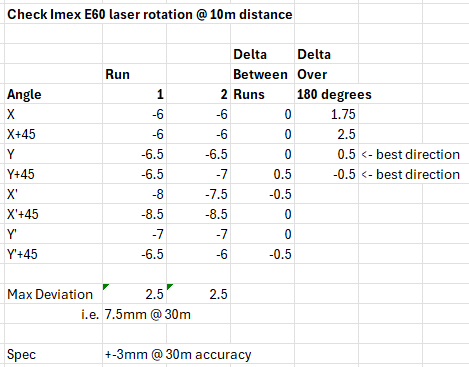
OK I repeated my rotating the laser on the tripod thing again with the laser and receiver fixed at the same points: So, the laser seems fairly consistent and close to spec. I don't think the E60 has any adjustment possible. One thing I learnt is that '3mm @ 30m' really means '+-3mm (i.e. 6mm total) at 30m'. Maybe this argues for figuring out the most consistent laser direction and then positioning the laser to keep most of the measurements in that arc.
-
Anybody have a take on the original question i.e. VAT on muckaway?
-
OK understand, let me try those ideas and report back. >>> Do you need to be accurate with your posts you normally pack them up with steel packers and then grout underneath them. Yeah. that's exactly what I'm at - but either way I need to get them all level - which means measuring that they're level.
-
Ah thanks, I should have said that this is an outside site laser with only a horizontal sweep.
-
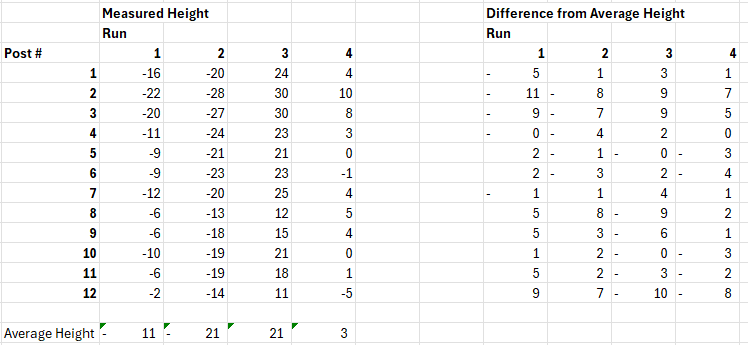
I'm trying to measure height on various bits of my slab accurately to figure out whether I need to adjust some structural post heights which assume a flat slab. I went round the 8 points needed a couple of times and measured the height with the receiver (new Spectra HL760). I tried four circuits with the rotating laser (a 6-month old Imex) in various positions on the slab. I thought I got the rod accurately vertical at each point. I went round 4 times and the results were a bit nonsense: That is, the height of a post base seems sometimes 20mm different when measured again. The slab is ~12mx6m i.e. not huge. I thought I would check the accuracy of the set-up today by leaving the receiver and laser in the same positions and just rotated the laser on the tripod carefully through 45 degree intervals. I got rained off before finishing, but I was getting readings that varied only a couple of mm. I did notice that the wind made a difference and the tripod (the Imex one) is a bit lightweight. Any ideas or tips on how to ensure laser accuracy?
-
>>> HMRC guidance I'm impressed you know this, but FFS we need to look at case law to get the answer?
-
Ah another one - when is a service a service? Suppose I have some fabrication guys make me up some brackets. In this case it means supply steel, cut shapes out, weld, polish. Contrast that with buying some 'off the shelf' parts (which could actually be advertised as standard or customisable parts but made-to-order). Is this a service (I need them to specify no VAT) or a supply of materials (I can reclaim the VAT)? Also scaffolding, I guess that is a 'service' and I can't reclaim the VAT? Jeez, what a looney set of rules.
-
This is not complicated - suggest you need to get the water provider to move their stopcock - they may very well install a meter while they're about it.
-
As long as you have a spec and some drawings - maybe get a QS to do some calculations for you. You can then check the QS calc detail against contractor's quotes a they come in as a sense check.
-
I suddenly twigged this morning that on a 'deliver material and muckaway soil' service (these both happening on the same trip) that maybe the delivery of material should be VATable (as it's building material) but the muckaway not (as it's a service)? Is this practical - they normally appear on the same invoice and they're just one trip? p.s. another VAT question - what about materials that are used during the build but not 'incorporated' e.g. shuttering ply vs. concrete.
-
Maybe try a Pegler valve. I like the newish Plasson artic taps but haven’t run them through a cold winter yet.
-
Suggest best course of action is to contact your water supplier and get the meter installed somewhere on the pipe where it’s not going to bother you. I don’t think having the stopcock or meter under your shed is going to work. They will generally read the meter without liaising with you and need access at any time. The meter will be a combined meter and stopcock assembly in a similar chamber to the one you have. I can’t imagine they can swap it without digging it up.
-
That’s interesting, I use ball valves everywhere for extra convenience. Never had a problem. Was yours a Peglar valve or someone elses?
-
Neat, their temperament probably due to steroids.
-
24v lighting circuit - good or bad idea?
Alan Ambrose replied to SBMS's topic in Networks, AV, Security & Automation
Yeah, each to their own and you have to choose carefully where you want to innovate (if anywhere) and where quick and off the shelf is the order of the day. It’s Indicative though that Loxone lights are 24V and I think that style of technology (not necessarily that company and pricing) is where we’re heading eventually. -
CAD software recommendations?
Alan Ambrose replied to Great_scot_selfbuild's topic in New House & Self Build Design
I’ve done all my stuff in Fusion including for planning application and detailed drawing for construction. It’s pretty much a Solidworks / Inventor replacement and, I think, targeted to product designers rather than architects. The drawing facilities are a bit weak in not having hatching, colour fills etc and the rendering is basic. But, if you’re so inclined it has FEA stress and thermal analysis and you can easily generate dxfs to send out 2D profiles for laser and waterjet cutting. Also CAM for 3D printing and CNC. It’s a proper CAD package though so will have a bit of learning curve to get the most out of it. -
24v lighting circuit - good or bad idea?
Alan Ambrose replied to SBMS's topic in Networks, AV, Security & Automation
Actually I think your 24V idea is a good one. It’s a bit nonsense converting 230V to low voltage all over the place. These days, the only things actually needing 230V are the higher power items, appliances etc. Regarding current and cable size at low voltage - the whole point of LEDs is that they are much lower power than the old fashioned lights they replace. Say you’ve got 100 off 5W leds in your place - that’s 500W or 20A and that’s with all your lights on (and they won’t all be on the same circuit). -
The government is desperate(it shouldn't be but it is) and I think that means they will cast avaricious eyes over any wealth with a view to taking a slice of it. Politically, their best choice is probably targeting smaller groups without much say or influence and who can't or won't take much avoiding action. The boomers house price inflation is an obvious target. It would be good to make the tax system have a bit more common sense and fairness - sudden tax cliffs and now-we've-got-you paperwork snafus (e.g. CIL) are grossly unfair and penalise the not-so-smart or simply unfortunate. = Stamp duty is just silly, we've looked at moving a couple of times, but the stamp duty payment would be eye-watering, so like a lot of people we just stay put. An annual property tax instead would be fairer and encourage people to downsize if they don't need the space. >>> The danger here for self-builders is that they, technically, have no conventional property purchase price Well they do, and I'm sure we, for instance, won't make much gain, but it does involve keeping good records.
-
I have a couple of Reolink battery / mobile network 'Go Ranger' trail cameras for the plot. Occasionally I can't connect to them, but by-and-large, they're fairly reliable. They do time lapse, but I've not used it yet. They do person & vehicle recognition but limit the recording to 30s a go - to save battery I imagine.
-
+1 for heavy duty piano hinge
-
Well I thought I posted this already, but maybe .... brain damage. I was going to say, as the visit is courtesy of @JohnnyB 's kindness, that he should choose the date that suits him best.
-
Stuart Turner Negative Head 3bar Twin
Alan Ambrose replied to John Carroll's topic in General Plumbing
Sure will do, not at that location at the moment though. From memory, it looks pretty much like the picture you posted, but with my pressure vessel mod. I’ve never really thought much about how these work - I guess when only hot or cold is used, one pump just thrashes. It looks like there are a couple more sensors additional to the pressure switch - not sure what those are for. -
Just saw this, similar to @Iceverge technique he described above. Best video I’ve seen on grading . BTW I think my digger technique is improving, mostly just with seat time, and I think it’s mostly unconscious learning when the brain figures out what combination of 3D movement i.e. boom / arm / bucket adds up to the motion you’re trying to make.

