Adsibob
-
Posts
3609 -
Joined
-
Last visited
-
Days Won
10
Everything posted by Adsibob
-

Any good suppliers of affordable large pots (for plants)?
Adsibob replied to Adsibob's topic in Landscaping, Decking & Patios
Good shout. I just placed an order from BandQ and delivery was only £6. -
I’m after some fairly large plant pots, prefer in terracotta. Minimum diameter 36cm but 45cm would also be fine. On the continent, these are cheap as chips, yet over here the garden centres charge a fortune for them. Anyone recommend any online suppliers that are affordable? With these being breakable, the delivery charges soon add up…
-
Potential garden room/gym - early stage ideas
Adsibob replied to Adsibob's topic in New House & Self Build Design
I’m happy to build in compliance with the building regs. The BCO on our build was less ridiculous/illogical/unreasonable than our local planning department. And importantly, neighbours don’t get involved in the process. -
PM me. I can recommend a good one which isn’t too crazy on price.
-
Yes, I think the issue is that the tower needs to be mounted on a sloping roof that is above the ground floor extension. I thought that would make it easier, as it's less height to erect, but apparently the slope makes it more "technical".
-
This assumes you aren't being charged an arm and a leg for having to erect scaffolding. I wanted to install some external smart brise soleils, made with microfins. Really impressive product and was happy to pay the £500 or so for the product itself and the £180 for installation. But then the installer quoted an additional £1400 for the scaffolding and I said no thank you. I think I'm regretting it now as my loft floor office gets hot
-
Sell the flat. Then this glue issue can be dealt with by the next mug.
-
We laid tile over screed for our patio that had some clever falls built into the screed so that rainwater wouldn’t pool in the patio. My builder used steel profiles about 50cm apart to help him outline the progressive changes in height and then the sand and cement screed was poured over the area by the screed company and my builder used a very long edge to shape the screed so that it was flat but with a fall. He was very skilled though… in his 60s and been doing this kind of thing for decades.
-
Sorry but this is really quite naive. Solar gain is a very serious problem and not something you can easily address after you’ve got planning without actually making an amendment application. Your western wall looks, and will behave like, a greenhouse. I would reduce the amount of sliders on the ground floor, and make the windows on the first floor much smaller. You will still be able to appreciate amazing views. Regarding the ground floor sliders, you could instead make some of them out of timber or steel, rather than glass, and go with an industrial look to match the barn’s heritage. In that way, when they are closed there is no light pollution, but when open you get the views. Alternatively, cover the glass with sliding wooden external shutters. You will appreciate this when the house overheats.
-
Personally, I would just tell the wife no. Seems silly to go to all this trouble just to fit recessed downlights. Lots of other options exist that won’t ruin your insulation.
-
Potential garden room/gym - early stage ideas
Adsibob replied to Adsibob's topic in New House & Self Build Design
Yes, I think you are right. That involves waiting another two years so that my existing works are immune from challenge. -
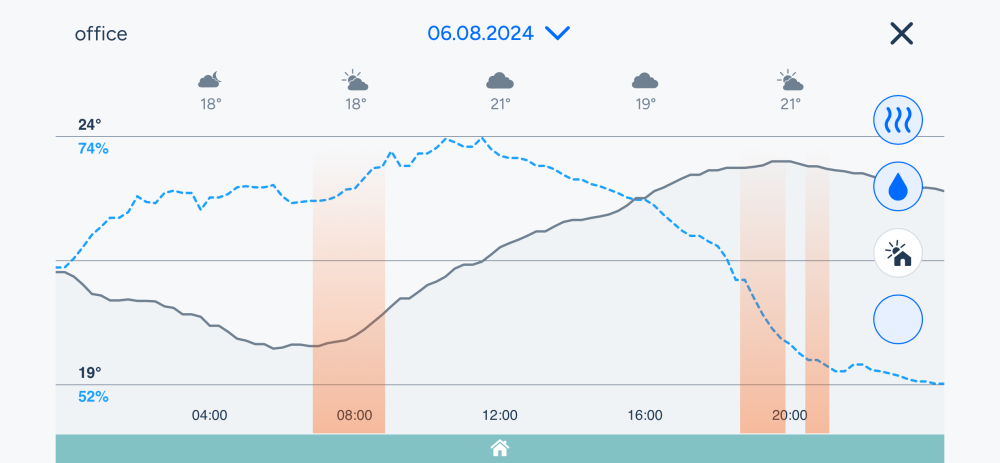
I’m not sure you can if the “data” is basically an image, like this, for each room of the house and for each day of the year:
-
Potential garden room/gym - early stage ideas
Adsibob replied to Adsibob's topic in New House & Self Build Design
Yeah, it would need to be a significant drop down. -
I do. The only problem is that I have it individually for each room of the house and you can only see the data 24hr at a time.
-
Potential garden room/gym - early stage ideas
Adsibob replied to Adsibob's topic in New House & Self Build Design
e.g. not sure if ground screws like those mentioned here would work: https://www.gardenspaces.co.uk/detail/foundations/ -
Potential garden room/gym - early stage ideas
Adsibob replied to Adsibob's topic in New House & Self Build Design
I think the starting point is really what is physically possible from an engineering point of view given the row of leyland cypress trees which, on my preferred layout, will just be 1 metre from the building. Once I understand what implications those trees have for foundations, and whether suitable foundations (e.g. piling) for a one storey building, perhaps slightly sunk into the ground, can coexist with the trees, or whether one will harm the other, they I can progress my thinking to tackle any planning issues. Perhaps someone like @Gus Potter could chime in on the foundations question. cheers! -
Potential garden room/gym - early stage ideas
Adsibob replied to Adsibob's topic in New House & Self Build Design
Please could you direct me to the relevant rule (applicable in England)? -
Potential garden room/gym - early stage ideas
Adsibob replied to Adsibob's topic in New House & Self Build Design
Unfortunately not. At least not noticeably. Unlikely to be perfectly flat, but if it has a slope is negligible. -
So I haven’t recovered from the stress of the first build, but already I’m getting the bug to build an outbuilding at the back of my garden to house a home gym, perhaps with a large overhanging roof to create a shaded patio area. Didn’t really get on with the planning system last time around, so toying with the idea of doing it under PD so that we can bypass the f🤬🤬kers . I suspect this won’t be workable. Here are the constraints: the garden is rectangular and about 8.6m wide. I understand I can build across the full width under PD as long as the maximum height of the building is 2.4m. That is my preference, since if I go higher than this, I need to be 2m from the boundary which cuts my building width from 8.6m to 4.6m. The depth of the building would need to be about 2.6m internally, so depending on wall thickness, this would equate to an external footprint of about 3.3m deep, by 8.6m wide, with a maximal height of 2.4m. Haven’t thought about roof design, but maybe tiled with a slight pitch. There won’t be any roof lights. The other limitation is that at the rear of my garden, we have a row of about 6 Leyland cypress trees. These were about 11m tall when we bought the house 6 years ago, and grew at a rate of about 75cm a year until we lopped the top of them off about 2 years ago. They are now about 8m or 9m tall and we would prefer to keep them, given they provide excellent screening and privacy from the neighbours on the other side of our rear boundary. The row of trees is about a metre from the rear boundary fence. My preference would be to find a solution that enables us to build the outbuilding as close as possible to this row of trees, without damaging them. A further limitation is that I would like the outbuilding to be insulated so it stays cool in summer and can be used in winter without spending too much heating it. It will only be used a couple of hours a day, but still want it to be comfortable. Therefore, we will lose a chunk of the height in insulation materials, particularly if we are going to achieve a half decent decrement delay. So that we can still have a decent internal head height, I’m thinking of sinking the building into the ground, so that externally it is only 2.4m above ground level but internally, you take two or three steps down to reach a slightly subterranean floor. I appreciate this will add complexity and cost, given it might need to be tanked, but I think it will make the place much more enjoyable. Any thoughts as to whether such a building and the existing leyland cypresses can co-exist or is this madness? The soil type is London clay. What construction type would you consider?
-
It's a shame I - or the professional company that designed and did my install - did not think about this in advance. My setup is incredibly cramped and I'm not sure I have enough space. I will post pictures later in case anybody can see a way of squeezing this in. I have the same MVHR machine as @Ultima357 so could follow his setup exactly I think particularly as I think our flow rates are the same, I'm also running at about 220m3 per hour.
-
yes, I'm pretty sure. Save that some air will get in when the front door (which is rather large) is opened.
-
Interesting. What does “do not use on box fans” mean at the end of that url?
-
I was surprised to smell smoke in my house today. It was only faint, but definitely smoke. Looking out the window confirmed that it was coming from the neighbour whose garden backs onto my adjacent neighbour’s garden. All my windows were closed but the MvHr was running as usual. Clearly my F7 filter isn’t doing enough. Googling around, I can’t seem to find any better than this. Could that be? Smoke is unusual, but smog isn’t given we live in London. Would be good to get as best protection as possible, given the pollution. My machine is a Brink Flair 400, fitted with an F7 filter between the air intake and the machine, and with a G4 filter to filter the extracted air before it hits the machine.
-
Low transmittance glass for skylight
Adsibob replied to Bancroft's topic in General Construction Issues
Ok, fair enough. I thought it was a bReg thing. But yeah, if it is planning, I would ignore it. -
Low transmittance glass for skylight
Adsibob replied to Bancroft's topic in General Construction Issues
I’m not sure I agree. My inspector required me to evidence all manner of things before issuing my certificate. I had to supply documentary proof that I had installed toughened glass for one window and was made to replace a couple of doors because the glass within them was not fire rated. I can’t remember the full list, but it had at least 10 items on it requiring 10 different bits of paper. E.g. they wanted to see the commissioning certificate for the MVHR unit, another one for the sprinkler system.