


Adsibob
-
Posts
3609 -
Joined
-
Last visited
-
Days Won
10
Everything posted by Adsibob
-
Thanks. Is there a benefit of using isover/rock wool over nitrile though? I ask because I have a few 1.6m straight runs of 22mm pipe which could take a rigid insulation product relatively easily.
-
So nitrile is better than poly. But what about things like Isover pipe insulation (which I believe is a type of glass fibre covered with alu foil, like this) or rock wool pipe insulation, like this). Where do they fit into the hierarchy? There are a couple of spots where I only have about 12mm of space between a pipe and a wall for pipe insulation, so would be good to understand where to use the more expensive stuff and where I can just increase the thickness (e.g. some places i have up to 40mm of space).
-
The point I was trying to make is that PIR does not have very good thermal mass compared to something like stone or wood fibre.
-
Is this recommendation for nitrile rubber also the case for internal use? I just need to insulate the copper pipe coming out of my boiler and into the HW cylinder.
-
is climaflex considered inferior?
-
Steico and Pavatex/Pavatherm are the leading wood fibre insulation products. I did a combination of wood fibre products. Here is my build up, but on reflection I should have foregone another 40mm of ceiling height to increase the wood fibre thickness.
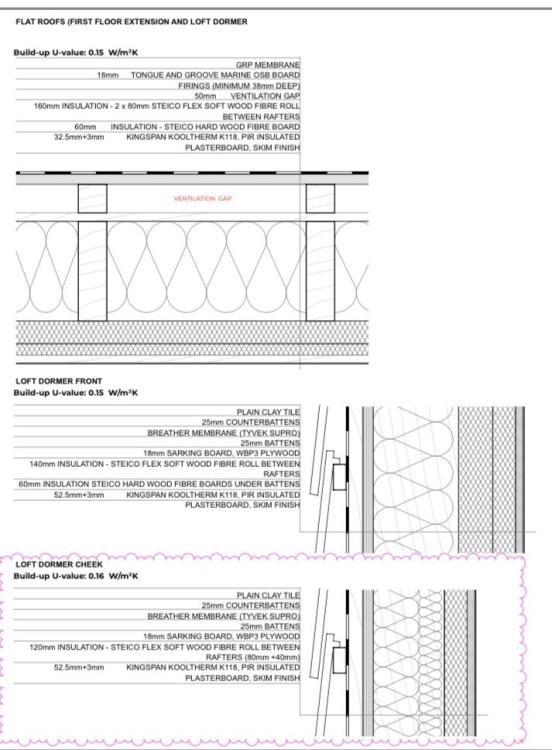
-
As I was just saying on another post this evening, PIR is useless for heat protection. U values are important to for keeping the warm in, but not for keeping the heat out. To try to illustrate this, consider that a caravan and a stone cottage have the same u values, yet the stone cottage will keep cool in summer whereas the caravan most certainly won’t. That’s because the thermal mass of stone is very high. It has a high specific heat capacity. you therefore want to insulate with wood fibre and PIR, not just PIR.
-
 What I meant by this was that with one layer, there is actually nothing to prevent the sound going through the gaps along the joints of the plasterboard. If you reduce your ceiling height by 15mm, you can install an additional layer of plasterboards and stagger them so that the joints of the first layer are covered by the second layer. It’s double the materials, and more work obviously, though not double as you are still only plastering once, you are just boarding twice. But you will get a much better result.
 -
I would not leave pipe diameter and spacing to your builder. Makes a massive difference to output and performance, as well as ability to change heating source in future.
-
PIR is awful for summer. building Regulation compliance will only keep you comfortable in winter and sweaty in summer. If you want to use that space, make it comfortable by designing for all seasons.
-
You need to create a barrier to stop or rather delay the heat from passing from the outside into the inside. This is usually achieved by insulating with materials which have a high decrement delay. Do a search for decrement delay on this site, but effectively you want to utilise quite a lot of wood fibre products. From memory, you want to aim for a phase shift of about 11 or 12 hours.
-
There's a good amount of detail here, but you could add more. For example, you specify the thickness of PIR in the buildups, but I'm not sure all PIR is equal. Aren't there different types? Similarly, in one part you state "100mm of sound insulation", but that is area where there are all sorts of densities and materials available. You should choose something specific and specify it. Your skylights don't show any insulation detail. Velux for example supply insulation collars for their skylights separately. Similarly, flashing kits don't appear to have been specified. These are all things I assumed would be included as part of my tender and then discovered they weren't. Added cost and the surprise is never welcome. A couple of other amendments you should consider: If the loft is intended to be usable space, rather than just storage, I would seriously consider investing in: wood fibre insulation. You need quite a lot of thickness to make it worthwhile, at least 160mm but preferably more, and of course you'll need to run calcs to make sure your build up complies with regs, which bizarrely only care about insulation in winter, not summer. This will increase the decrement delay making it cooler by delaying the heat transfer time to a time when it is cooler outside so that you can open the windows and purge heat quickly; and external blinds for your two skylights. For sound proofing, where you've specified 15mm of soundbloc plasterboard. It's better to double up on this and stagger the joints. Have you specified the pipe thickness and type for the UFH? I couldn't see that.
-
You shouldn’tairtight a damp house. Unless you have MVHR drying the place already
-
anyone used black polished cobbles for landscaping?
Adsibob replied to Adsibob's topic in Landscaping, Decking & Patios
You’ve had rain, or are you joking? Photo would be appreciated. Rain would be even more appreciated. -
I meant that it is good to have almost EVERYTHING drawn in considerable detail, with build ups for walls, floor structure and roof structure. Similar for how you will tackle anything that’sa bit non-standard, such as frameless doors if you have any, or level threshold with outside. To get an actual architect to draw up such detail and think about, eg u values, decrement delay is ££££ whereas an architectural technician is cheaper and probably more experienced in this type of “grunt work”. ie after the architect has finished the overall design, the architectural technician implements it as construction drawings.
-
I would definitely go for it, because with good research and planning you will end up with a much better home than anything you could buy on right move. But I think you need to also prepare yourself for the fact that not everything will be plain sailing. There are going to be small hiccups and the occasional much bigger c*€k ups and you will stress about it. A lot will be outside of your control, eg supply chain crisis. I would make sure you know exactly what floor finishes, wall finishes and electrical and plumbing layout is and then make sure your construction drawings are very detailed so that they can accommodate all that. Worth spending money on an architectural technician to dream the construction drawings once you have all the design finalised. In terms of over heating, worth reading up on decrement delay, solar gain, shading and ventilation. Do install MVHR but don’t rely on it to cool your house as it won’t.
-
I’m confused about ubiquiti
Adsibob replied to Adsibob's topic in Networks, AV, Security & Automation
Just by way of update: I bought a ubiquiti dream router and two ubiquiti in wall access points, all wifi 6 (overkill, but what the heck). I decided to go all in and get a ubiquiti managed switch after all. Only trouble is that the switches are all sold out*, so I will have to make do with the 4 ports on the dream router for now, using the two PoE ones for the WIreless APs. there is also a fifth Ethernet port called a “GbE RJ45 WAN port”. Haven’t worked out what that is yet. Anyone know what cable is required to connect my Virgin media Super-Hub to the dream router? The super hub really is a fest of marketing. I really thought it was sorry until I owned one. * There are some available, like this, but it’s much more than I need and want to spend. -
We'd like to cover our french drain with a layer of decorative gravel. Came across these black polished cobbles: https://www.midland-stone.com/uk/product/decorative-stones/polished-pebble-cobbles/black-polished-cobbles/ I got a sample and they look nice, although I had to rinse them to get some dust off them which I assume must have been caused in transit as the pebbles bashed each other. Not sure. One thing that made we wonder was the part of the description that says: "Over time, due to natural weathering, the pebbles will lose some of the high polish and become more matt in appearance." Why is that the case? The only weathering is rainwater really an dpossibly some UV damage. Does this imply that these pebbles are not polished and are in fact varnished?
-
I still can’t see why you don’t just put the utility room on one of the corners of the house and have the utility room door on the side of your house. It will save you a lot of trouble and look better. You mentioned a cinema room that you had added, but what about the other corner. Also, if you haven’t started building yet, you could still reconfigure the internal layout quite easily.
-
Easy solution: get rid of the dogs.
-
Your other half is correct. You are “mental”, to quote your (correct) architect.
-
Your architect is correct. I know a good psychoanalyst; PM me for details.
-
That’s okay, there is a train that will get you there in 20 minutes.
-
I don’t think you get that many birds in the Saudi Arabian desert
-
Looks like it will be two 170km rows of 500m high sky scrapers, 200m apart, clad in mirrors., with Gardens in between. Quite a feat of engineering. The Saudis are only putting in £500 billion. I wonder where the rest of the money will come from. Surely something of this scale will cost much more.

