


Adsibob
-
Posts
3604 -
Joined
-
Last visited
-
Days Won
10
Everything posted by Adsibob
-
 Thanks @Nickfromwales found some formulae in Approved Doc Part F which are as follows: Odd that the approved document doesn’t mention volume, but I guess the building regs are assuming a certain occupancy/per m2 or per bedroom. I have about 180m2 of floor space and volume must be about 470m3. On the Part F calcs, that works out at 194.4m3 per hour (180 x 0.3 x 60 x 60 / 1000). I have 4 bedrooms and a study, but 43 l/s works out at 155m3. So I’m feeling fairly okay with the 180m3 flow rate at the moment, not quite as high as the 194.4m3 but with the boosts throughout the day we must average out at close to 194.4m3. There is a timer in the remote controller (Brink call it the eBus or “Brink Air Control”), so I guess I could use that for a good purge after everyone is up if I think we need it, but kids are little still and many years from puberty, so no BO yet!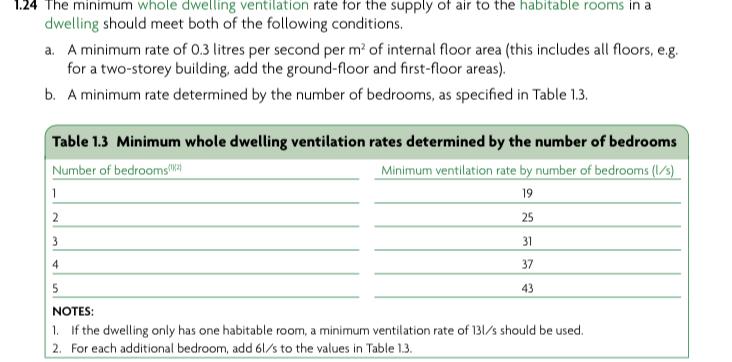
-
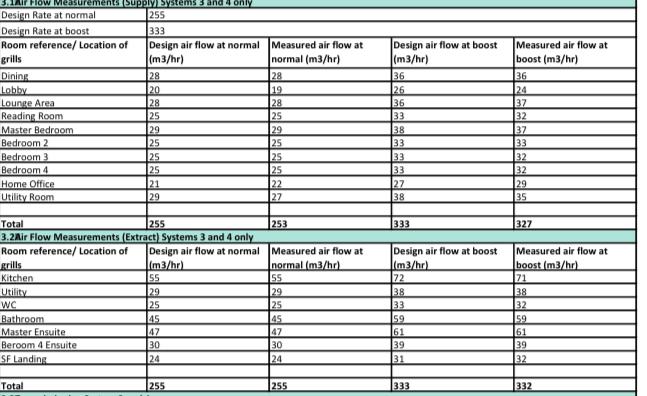
I have a Brink flair 400 My commissioning certificate says this: The options for my system (as commissioned by the supplier) are level 0. 50m3 level 1. 180m3 level 2. 255m3 level 3. 330m3 When I realised the system was a bit noisier than usual (as mentioned in my recent exchange with @jack), I started investigating what was going on and saw that it was operating at level 2, when I seem to remember that level 1 was recommended for default use. I have turned it down to level 1 and the system is definitely much quieter, hardly audible. I think level 1 is the correct setting I should run it at, but grateful if somebody could confirm this based on the commissioning certificate which definitely counts flow rate at the higher 255 m3/hour value.
-
Worth installing PV on entirely West facing roof
Adsibob replied to Huckleberrys's topic in Photovoltaics (PV)
I thought it was more nuanced at least. For example, root vegetables that are organic are healthier, but they are the only ones where the differences are noticeable, because they are in constant contact with the soil. So chemical free soil impacts them more. -
Sort of, Fabco made us a PAS24 compliant door out of steel and reeded glass which we installed as a front door, even though they said they had never done it as a front door. Beautiful door. Not cheap, but still cheaper than the likes of IQ glass.
- 1 reply
-
- 1
-

-
Worth installing PV on entirely West facing roof
Adsibob replied to Huckleberrys's topic in Photovoltaics (PV)
I thought the jury was still out on this. Controversial indeed. But a lot of meat is produced in that way and people still buy it. Ultimately, a lot of people can't afford to eat free range. The mad cow disease scandal was caused by farmers having to cut corners to be able to sell beef cheap enough to sell. A better solution in my view (also controversial) would be to ban all farming practises which are dangerous/risky. I've read a lot about diet (e.g. book by Tim Spector) and in my view he reliably shows that the healthiest diet is pescatarian, but with red meat thrown in once every 10-14 days or so. Something to do with it being very difficult/almost impossible for most people to absorb certain B vitamins from anything other than a bloody steak, but only needing that vitamin a couple of times a month. -
Worth installing PV on entirely West facing roof
Adsibob replied to Huckleberrys's topic in Photovoltaics (PV)
Have you looked into the differences in health between grass fed meat and non-grass fed? Certainly with beef, there are significant health benefits of buying grass fed; something to do with the ratio of harmful fats to healthy fats. Also affects the ratio of fats in butter and ghee. Irish butter is usually made from dairy milk that comes from grass fed cows are there is plenty of grease in Ireland. Not sure how you would go about finding the equivalent for ghee. Worth spending money on. Irish butter isn’t even that much more expensive. Grass fed beef does cost a lot more though. -
Worth installing PV on entirely West facing roof
Adsibob replied to Huckleberrys's topic in Photovoltaics (PV)
Not raw they don’t. Well maybe to a bomb calorimeter they would, but I doubt you’d be able to digest them raw. What’s the net figure after allowing for your cooking energy consumption (per portion, in that I assume you don’t cook a 1kg bath all at once). -
If you are buying new windows anyway, and extending the back, you have a good opportunity to make most of the house fairly airtight, as the main points of weakness are junctions with windows and doors. If you are replacing all windows, you can make sure those junctions are taped properly and that the windows don’t have any trickle vents. New rear extension suggests new rear door (sliders/bifold if/French doesn’t matter, so long as they are airtight). If you are asking EwI that will also improve air-tightness. So I would go for MVHR. You just need to make sure the front door is draught proof.
-
I cleaned the filters yesterday and have noticed a bit more noise since. Maybe I didn’tfit them back in properly. How often do you do maintenance that is more involved than just cleaning the filters? Mine was only commissioned 5 months ago.
-
I’m surprised by this. My Brink Flair 400 (which I think is a very similar model) is pretty loud when standing next to it. Very quiet in the rooms of the house, but definitely not silent. I wonder if there is some issue with my install that makes it Lot in the actual room it’s in. Though this shouldn’t really bother me, because we deliberately designed the MVHR room off a bathroom, rather than a bedroom. Occasionally, I think it is louder in the bedrooms than it should be, but then I think I might be overfocussing on the sound.
-
I would seriously consider selling up and buying something newer that isn’t going to affect your health. I’m not sure I buy the “it’s the local microclimate” thing, because a good house should be built to deal with it’s climate. If you had a fully airtight and water tight well insulated new build with MVHR you just wouldn’t have mould anywhere, whatever the local climate.
-
Control - multiple zones and heat/cool sources
Adsibob replied to RichardL's topic in General Alternative Energy Issues
What is your concern with cloud based systems? If the internet fails, Tado’s system still works and can still be controlled locally or via the preset timers, just not over the internet. -
In not sure that is quite right. When I increase pump speed from 1 to 2 the flow metres slow an increase in speed from about 2Litres per minute to slightly over 2.5L/min.
-
Thought I’d revive this thread as keen to understand how settings impact performance. In particular, what impact does changing the pump speed have? Mine was set up with all pumps set to position 1 (out of 3). I’ve not had to run the UFH since we moved in in May, but this morning we realised we had left the kitchen window open and so the temperature downstairs has dropped to 18C. UFH has been running for about 50 minutes and it hasn’t warmed the floor covering yet, despite this just being 3mm thick microcement. I guess the heat still needs to get through the 60mm of sand and cement screed (we have 16mm pipes at the bottom of 76mm of screed). Well increasing the speed improve the responsiveness?
-
Can you tell me about brushed/rubbed wood finishes?
Adsibob replied to Adsibob's topic in General Joinery
To clarify, this is not an aesthetic question. I have already made up samples and I really like the look of the rubbed finish. It gives a very slight sheen, which makes the wood look much more premium. And I’m not worried about particles of steel rusting the wood, because using the correct steel wool, that isn’t an issue. My question is purely about the performance of rubbed wood versus un-rubbed. Rubbing obviously does something to the hard wax oil coating. The heat must change it in some way, or it might push the wax oil deeper into the pores of the wood, or it might take some of it off. I just don’t know. -
All my bulbs are low wattage LEDs but my electrician refused to fit downlights without hoods.
-
installation of a recessed downlight requires a hole to be cut in the ceiling, which may compromise the ceiling's fire integrity and significantly decrease the time it takes for a fire to spread. In line with Part B building regulations, downlights should therefore have the ability to maintain the fire rating of the ceiling to 30, 60 or 90 minutes. If your spotlight is not fire rated (most aren’t) you fit a fire hood over it, like this: https://www.nationallighting.co.uk/heatguard-small-round-fire-hood-60min-fibreglass?vat=1&gclid=Cj0KCQjw1bqZBhDXARIsANTjCPIFPJdmBU9DuAGEAaN5PoEMHPRsnMWi7APzPrCNo9YMbPHG6Umz3m4aAtZWEALw_wcB
-
Can you tell me about brushed/rubbed wood finishes?
Adsibob replied to Adsibob's topic in General Joinery
I was hoping somebody clever like @SteamyTeaor @ProDave would comment on this. My main concern is whether rubbing with a product like 0000 steel wool would create a more or less permeable finish. I would prefer the look of the rubbed finish, but I don’t want to compromise it’s resistance to water. -
We have had some oak furniture made. We specified the stain and hard wax oil so that it would match our flooring exactly (the manufacturer of the floor pointed us to the Saicos pear stain and the Saicos hard wax oil - very similar product to OSMO). We have had the piece stained and oiled and have been asked by the maker whether we want it rubbed. The hard wax oil we went for is a clear Matt finish, no gloss whatsoever. It looks really good, though we now realise the floor has been Rubbed with a very fine steel wool to give it a tiny bit of sheen. Ignoring the aesthetic difference between rubbed and not rubbed, are there any other differences to take into account, particularly in terms of durability? Will rubbing remove some of the hard wax oil or not?
-
So on the mould, I think whether or not BCO sign off is the last of your concerns. You need to fix that! I presume you don't have MVHR, as otherwise you wouldn't have mould. I presume also that those windows don't have trickle vents, is that right? You need to drastically improve the ventilation and if possible upgrade your insulation to fix this issue. Walls are cold, condensation from inside converts into moisture as it hits the walls, this creates a slightly damp area where mould thrives. On the screws, I doubt the BCO will pick that up, but if you want a sturdy and rust free balcony in 10 years' time, why not replace the screws now? On the spotlight, as long as it was installed with a fireshield, the fact that it's sagging shouldn't matter to your BCO. he might want to see the evidence of the fire shield though.
-
What energy rating is your HW cylinder?
Adsibob replied to Adsibob's topic in Boilers & Hot Water Tanks
Do you need any help? -
we have very comfortable steps next to the driveway that lead from the pavement to the front door, so there is no chance a delivery person would choose the driveway over the steps. The driveway is fine to drive in and out of in rain. BCO wasn’t the last bit interested. We actually got our BCO certificate last week. i think the main issue is ice, but I think when it gets icy (not that common in London, maybe a week or two a year) we will just not use the driveway. But even with ice, I reckon one could manage by gritting it.
-
It is a Ford Fiesta, but it’s 10 years old, almost 11. Titanium Trim 2012 registration. I’m pretty sure it does not have any sort of assist. It’s a genuine manual car.
-
https://www.theguardian.com/environment/2022/sep/14/increase-in-led-lighting-risks-harming-human-and-animal-health thoughts???
-
Shallow being the operative word. Ours isn’t very shallow. I blame the architect who designed this. And myself for blindly following his lead.

