


Adsibob
-
Posts
3609 -
Joined
-
Last visited
-
Days Won
10
Everything posted by Adsibob
-
 How about adding EWI? You mention part of the outside is covered by an adjoining building, but what about the other part? Can you annotate the pan to show which part of the wall is attached to the neighbouring building and which part is detached?
 -
Avoid this if you still have to design your UFH
Adsibob replied to Adsibob's topic in Underfloor Heating
Ok, have checked. See picture below. From what I can tell (but grateful if someone could confirm) there are unfortunately only two loops. In picture to the left, under the orange pump are a pair of pipes, one with a blue sheath and one with a red sheath - I assume this is the hot water coming in to this manifold from my boiler and the cold water going back to get reheated by the boiler. To the right, there are two pairs of pipes, representing the two loops. One supplying my front room and one supplying the hallway and WC. Real shame the installer didn’t think this through better. Am I right in thinking that I can only adjust pump speed and temperature? or is there a third adjustment available on each loop? @ProDave you mentioned something about balancing and flow, hire does that work? I noticed that the water temperature was set to 45C which seemed high (the terrazzo in the hallway and WC gets pretty hot, not quite burning hot, but too hot really. And the wood parquet in the front room shouldn’t be exposed to that kind of temp, so I’ve turned down the water temp to 40C. Anything else I can do?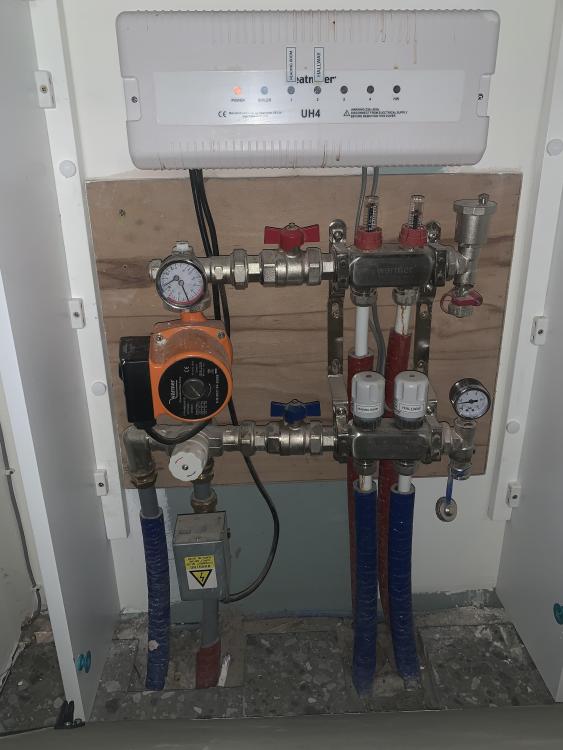
-
Avoid this if you still have to design your UFH
Adsibob replied to Adsibob's topic in Underfloor Heating
That’s a good point. I had assumed it will all be the same, but actually if the plumber has any sense he hopefully put it on its own loop. Particularly as the manifold which serves it only serves that zone and one other, both medium sized areas. I am not home now, but will check. -
I thought my UFH design was pretty good. But now that I've lived through a couple of cold weeks, I've spotted an incorrigible flaw which I thought I'd write about here so others can avoid making it. Our ground floor consists of the following zones: Fairly wide entrance hallway with a WC under the stairs Front room kitchen and utility room open plan lounge area off kitchen I thought that was plenty of zones. Turns out I was wrong. The WC is in the middle of the ground floor, with the hallway and utility room to one side of it, the front room on the other side and the lounge behind it. Accordingly, although it's just made out of stud walls, being in the centre of the floorplan, it has no external walls and so probably doesn't lose much heat. The WC gets significantly warmer than the rest of the floor. Setting the thermostat on the zone (which is located in the porch on an external (brand new cavity wall) to 20C, gets the general area to about 20.5C but the WC to 22.7C. I think it's mainly because of the lack of external walls/windows, but there's possibly other factors I'm not aware of. So I guess the lesson is if you have a space which has the unique characteristics that my WC room has, consider putting it on its own zone.
-
I had wood in mind, but it looks like I might be mistaken. We have thermally broken aluminium 2G windows and a thermally broken stell 2G door. The aluminium windows perform better than the steel door, which is to be expected as the aluminium windows had a higher energy performance rating than the steel door.
-
Of course not. There is insulation sandwiched in between. Wood is a better insulator than plastic. Plastic is ok, just not as good as other materials. Also, as uPVC is a cheap material, i wouldn’t be surprised if the windows have used inferior insulation elsewhere in the unit.
-
Because uPVC windows are not great insulators. Think of a plastic ice tray sitting on your palm of your hand. How long before your palm starts to feel the cold of the ice?
-
Rear extension under PD combine with existing side extension
Adsibob replied to JayBo1979's topic in Planning Permission
Once you have a property that is already extended, it becomes very different to do anything elegant that does not require PP. But don’t be put off by the fact you will need PP. Hire a good planning consultant and they can advise you what is realistically achievable. -
You are right. It doesn’t provide the machine based learning. The free app is generally very comprehensive. You can: - create lots of schedules and easily copy schedules across from one thermostat to another or from one day or day pattern to another - control temperature to the nearest tenth of a degree, both on the schedule and in real time - you can also see how each thermostat behaves when you are home or away - track months worth of temperature and humidity data on each thermostat - and it draws nice graphs for you which in addition to displaying humidity and temperature, also display the local weather and whether or not you had your hot water and/or heating on at the time, so you can see if you can spot any correlation between those factors.
-
Going back to @Radian's criticism of Tado (which I share): It turns out some clever bod has written a Python script to effectively give you Tado's subscription service (called "auto-assist") for free: https://sascha-brockel.de/en/tado-auto-assist-free/ I haven't got the time/brain power to try it, but maybe a project for somebody clever here?
-
i don't think i want to go near something that might be carcinogenic.
-
Indeed. It's the only thing I don't like about their system. You get a lot of functionality for free, but the machine based learning feature is one of the features you have to pay for. £25 a year.
-
So that means that if you get home to a very cold house (well not that cold, but 16.9C) and you want to boost as quickly as possible by 2C, but you aren’t bothered by overshooting, a temporary higher pump speed is a good idea. Have I understood that correctly? generally my heating is very clever, but I haven’t subscribed to Tado’s algorithmic machine learning service (as I’m too cheap and prefer the subscription free service) so plan the adjustments myself using the schedule feature. Got it wrong tonight and SWMBO is complaining the heating is too slow.
-
You need to install a fire shield around each spot light. Something like this: https://www.nationallighting.co.uk/heatguard-small-round-fire-hood-60min-fibreglass?vat=1&gclid=CjwKCAiAs8acBhA1EiwAgRFdw10MRNYsGAbvoreW2mwdX2DumPVNckVKWpTL_XAaw0SFeZTTodR54hoCwLcQAvD_BwE
-
Not sure if you’ve already progressed past this, but OSMO oil is microporous and they do make one with UV protection that should mitigate bleaching/silvering AND it’s specific for cedar: https://www.brewers.co.uk/product/HA4760J?gclid=Cj0KCQiAkMGcBhCSARIsAIW6d0AJ1o5j2UFqyhsGRB6afHpBJKrmZBpzeEI5ysGCLFZthXqgrGZo8_oaAl-cEALw_wcB Actually, scratch that. I think it is “cedar coloured”.
-
I thought creosote had been banned due to it being a carcinogen?
-
This is what I did in the end. I painted the three sides most exposed to damp/rain with a Sika anti rot wood preserver. Just had time to do one coat, but I did a thorough job I think, so together with the coating the shed manufacturer applies in the factory, I'm hoping this will be fine to get me through the winter. Although this is not as water repellent as a varnish, it says it can be used as a base under paint or varnish, so when things warm up I will do some paint or varnish on top - haven't decided on the end finish, so that was another advantage of using this. I'm also going to do the inside of the shed over the christmas holidays, for that temperature won't matter as i can quickly warm up the inside first with a space heater. Then need to think about cheap shelving and storage solutions. And solar powered lighting...
-
Not really. There is a south facing side and an east facing side which would normally be in the sunfor a bit, except that both of those sides have an overhang/oversail roof which projects 60cm to allow for dry space underneath to store wood. The east facing side might get a bit of sun late morning, but not much as it's shaded by my house mostly. The south facing side is shaded by an old shed that we need to empty and get rid of. I'm more concerned by the other two sides of the fence that don't get any raincover from the roof or any sun.
-
So the shed is up and now i need to apply some water protector to stop it rotting when it gets wet. Only trouble is that all the products I've found say it shouldn't be applied in the cold. I'm looking for a clear matt varnish, as I don't want to change the appearance of the wood too much. If i can get UV protection as well as rain protection, that would also be good. This Ronseal product, for example, states it shouldn't be applied in less than 10C weather. Similarly, Osmo says ideal application temp is over 10C. I have a window of a couple ours this afternoon when it will be 4C when I could, if I find the right product at my local screwfix, apply one coats to the most exposed sides of the shed. After that the temperature is dropping for the next 10 days, and after that I'm away for a week until Christmas. There isn't much rain forecast at least. Shall I just leave it and wait for the weather to improve? The shed came with one factory applied coat, but the installers told me it's just a basic level of protection and i really need to apply at least two coats myself.
-
What product did you buy/use in the end?
-
I think heat does the air. The more heat, the drier the air. If that logic is correct, low temperature heat emitters, such as UFH are likely to dry the air less than higher temperature emitters such as fan heaters. But I’m just guesstimating here. May well be wrong.
-
Depends… my SE was much more £££ than my architect.
-
Have a look at local planning applications which have been approved (preferably first time). They will all disclose the names of the architects/practices which did the application. Telephone the architects that you like based on those research findings. Interview them on the phone and then get the three you like the most to quote for the work.
-
Right, slowly making progress. Worked out there are three studs in my wall, which are each 100mm thick. The brackets which @Hobbiniho posted a link for can have 70mm inbedded in the wall. Shelves will be about 380 deep, so hopefully the 320mm brackets will work (250mm in the shelf plus 70mm in the plasterboard and wall). So a few questions: 1) With 236cm wide shelves and only three studs to anchor to, will I need additional support in the form of visible brackets, say one at either end of the shelves, so that instead of 3 anchor points I have 5? If so, what would be the best way to conceal these as much as possible? Would a 15cm bracket be enough, so that it sits quite far back on a 38cm deep shelf? 2) The chap that’s going to put these up for me has recommended 50mm thick MDF. I’m worried this will be quite heavy. Ikea’s floating shelves are also that thickness, but they are made up of two separate sheets of chipboard with paper based filling in between. Is there a lighter material that I can use that paints well? Maybe something like Ikea’s construction, but in bespoke sizes. Or can I get away with a thinner sheet of MDF. The rebar brackets are 12mm thick, so needs to be thick enough to take that hole and still have enough thickness to support itself. 3) some MDF suppliers advertise a product described as “ready to paint”. Is this just to save me having to prime it with my own primer, or is there something more special about this finish?
-
This is a fundamental issue. Knock the house down and start again.


