Adsibob
-
Posts
3604 -
Joined
-
Last visited
-
Days Won
10
Everything posted by Adsibob
-
I don’t understand the confusion. Builder was instructed to build an opening that is 2372mm in height, from the bottom of the opening to the top. The bottom was to coincide with a level which was 170mm above the top of the slab. Builder has constructed an opening that is 2380mm in height and only 162mm above the slab. So by packing out the bottom of the opening with some cement board - which is what I asked him to do this morning - he would fix the issue. Simples. Builder has a complex personality issue which sometimes gets in the way of things. Complex.
-
Well if we do that, we will have an 8mm deep divot rather than a flush threshold. There are three tracks for this sliding door, so it would be quite a wide divot.
-
Door company came back to me. They said they can work with it being up to 4mm out, but more than that is “not great”. They suggest adding a 6mm thick cement board. Very similar to what I suggested! Back to speak to the builder!
-
Thanks. You are right @Russell griffiths that i often worry too much. This building project has brought this character flaw into sharp focus! As a layman, it's difficult to know when 8mm matters and when it doesn't. E.g. relative to the 10mm space around the frame, 8mm is 80% out, whereas relative to the overall aperture 8mm is pretty tiny. But I guess they will work it out. The way I left it with the builder is: you will be here when they install the door and I won't, you know the level of the finished floor level and so you better make sure they can achieve this notwithstanding this 8mm discrepancy. So it's on him.
-
Sorry, i mean the height of the aperture is 8mm too much. The bottom of the opening needs to be 8mm higher than where it is. So if they just installed the door without correcting this, the door would be 8mm too low.
-
The aperture for the sliding door we have ordered is 8mm higher than the sliding door manufacturer agreed with us when we ordered the sliding door. The aperture has been specified to be 20mm wider and 20mm taller than the door unit itself, effectively allowing a 10mm border all the way around for the compriband and fitting. 8mm doesn't sound like a lot, but if our door is 8mm lower than specified we won't have a flush threshold and instead will have an 8mm deep gap in the floor. So I asked the builder to build up the 8mm with something waterproof and solid. I suggested cement board. He said I'm fussing over nothing and the door company can sort this out when they fit the doors later this week and that 8mm is "within tolerances" and that otherwise they would struggle to get the door in. This last point must surely be wrong because presumably the door company has specified the size of the aperture knowing full well that they need to get the door into it. Actual door size is 4280 wide by 2352 high. I'm not worried about deflection because engineer has specified a solid beam above the opening and there is hardly any weight on the beam anyway. Am i fussing about nothing, or is the builder right? I tried calling the door company but can't get through.
-
I don't need the doors, just the carcass and soft close hinges and legs. The DIY Kitchen carcass colour I'm going for is called Dakar (which the website linked above also does), so if you could match that, that would be great. Feel free to PM details. Thanks!
-
I would like a base unit (carcass only) that is 750mm (W) x 720mm (H) x 560mm (D). The 750 width is not a standard width in the DIY Kitchens range and they won't bespoke it for me. I found this company (who are clearly copying DIY Kitchens' name) https://www.diykitchens4u.co.uk/750mm-highline-sink-base-unit-350mm-lh--400mm-rh-407726-p.asp but their minimum order os £1000 and I only need this one unit. Can anybody recommend a company which do 750mm kitchen sink base units as standard (to fit a 700mm undermount sink) and won't kick up a fuss about only making one unit?
-

Best spec for high pressure hot water to multiple outlets?
Adsibob replied to sendu's topic in Boilers & Hot Water Tanks
I’m a bit confused now. Was going to do a secondary loop for all the hot water outlets so that we can have near instantaneous hot water supply, but that would be in series, not a radial arrangement. Is a radial really better, and if so, how does one combine it with a secondary loop. -
Do you have experience of DIY kitchens’ bespoke painted range?
Adsibob replied to Adsibob's topic in Kitchen Units & Worktops
Only downside of that approach is that painting it won’t give you the same protective finish you get with their paintwork. It is somehow plasticised and cured so that it is really tough. -
Thanks, but what's a silt catcher? I get that it catches silt, but how?
-
Green Home Grant application - have you had a response?
Adsibob replied to joth's topic in Environmental Building Politics
Or don’t enact stupid GDPR law. Probably the only good thing about Brexit is we can get rid of GDPR. -
Non integrated but hidden washing machine
Adsibob replied to willbish's topic in Kitchen Units & Worktops
Agreed. We are going to put non-integrated laundry machines under the worktop in our utility room with no doors. Just need to find some rubber matting to sit them on to absorb some of the vibration. -
We are getting DIY Kitchens units. We want to use their bespoke painted option in one of the farrow and ball colours. Speaking to them on the phone, I now realise that it is not actual F+B paint; they colour match, or at least try to. Anyone know how accurate the colour matching is? It doesn’t need to be identical, but it does need to work with the rest of our colour scheme (which has been chosen on the basis of working with the F&B sample pot). For £66 they will send me a sample door painted in the fake F+B colour I choose, but it adds almost two weeks to the process of getting our kitchen. Wife says not to bother, architect says it’s essential. Who is right?
-
I think a factor of 10. No, more like 100.
-
Just to update everyone on progress: 17 days after my last post and I'm scratching my head to try and work out what's been done in that time. The remaining slab has been poured. Drainage trenches have been dug up. Second floor of posis has gone in. They are almost ready to start tiling the roof at the back and the windows have gone in (though this last feat has nothing to do with my builder). So they are definitely making progress. Trying to take a more relaxed approach as suggested by many on here, but it's difficult. Happy Friday everyone.
-
The house did flood earlier this week, which had never happened before but has now got me thinking. It was such a fun day I posted about it here. When we bought the house the usual flood risk assessment done as part of the pre-contractual enquiries was low, so really never thought it would ever be an issue... until earlier this week when London got more rainfall in 90 minutes than it typically gets in the whole of July. Watching the news about Germany and Belgium today has got me wondering that maybe these "extreme" weather events will be more common in the future. We are probably going to put one of these in at the edge of our driveway just before the crossover. So that would be our first line of defence if it rained so much that the water mounted the pavement/crossover. Then we will also have a french drain or linear drain along the perimeter of the house. The question is just whether there is any advantage in making the driveway itself permeable? At the moment, I'm not sure there is such an advantage to justify the extra cost involved.
-
Thanks @nod, good to know. Is that a simple linear channel drain?
-
Thinking about the design of our driveway which is on a 10 degree slope from the road to our house (with the house at the bottom of the slope). I am considering whether it would be helpful, in addition to the drains we are installing at the top and bottom of the driveway, for the driveway itself to have some permeability to it as otherwise when the road floods (which has only happened once since we bought the house a few years ago, but with climate change may become more common) all the water from the road will cross the pavement and slide down the driveway and onto the drain just in front of my house, which won't be very deep and might be overwhelmed by the excess water. My thinking is, even if we go for a permeable solution, the water will just seep into the soil below the driveway and make it's way to the foundations at the front of the house anyway. Whereas if we didn't go for the permeable solution, the water would slide down the driveway and towards the front wall of the house (but not onto the front door as that is on a slightly raised platform), just before hitting the front wall it would mostly get caught by our drainage system there (either a french drain, if we can make that work - see towards the end of this thread - or a linear drain), but if it's a flood it might overwhelm that drain, splash the wall and then seep into the ground anyway. Walls are white rendered. So is the only non-environmental advantage of the permeable solution in my circumstances that my white walls are less likely to get dirty in a flood? Or am I missing something here. I know that there is an environmental benefit in not displacing naturally falling water by sending it to the sewer, but I'm not sure what good that water would be doing stuck under my driveway/pooling near the foundations if I didn't send it to the sewer.
-
This is the film I was recommending. HIGHLY recommended: https://en.wikipedia.org/wiki/Wild_Tales_(film)
-
@AliG you have my full hearted empathy and support. We bought our house in Aug 2018 and had put in a planning application by November the same year. In our original design we included space for a pram to be stored in the new porch, on the basis that we were hoping to have another child. It took so long to get planning, that by the time the house is redone, our second child will be almost 3 years old. He started walking at 13 months and I doubt he will need the buggy by then! This country’s planning system is a mess. But then it’s not surprising when salaries in the sector are so low. Pay peanuts get monkeys. Add in the public sector angle and the monkeys become lazy. Covid is a great excuse for such an apathetic area of the public sector. Not sure what the solution is. There is a great foreign film called Wild Tales. In one Of the stories, Darin plays an average joe who is fed up of getting unreasonable parking tickets and getting his car towed. Eventually it drives him so mad he bombs the relevant municipal office. He is arrested and becomes a national hero for exposing the people’s frustration with bureaucracy. Maybe you could try that approach?
-
it's okay, we have just spend a small fortune underpinning those foundations. The wall is damp and the damp surveyor (who is a RICS surveyor) recommended that part of the damp mitigation strategy was to improve the drainage of the walls. For the last 20 years or so, it's effectively had no drainage because the previous owners messed about so much). But maybe a shallow trench filled with pea shingle is sufficient for these purposes.
-
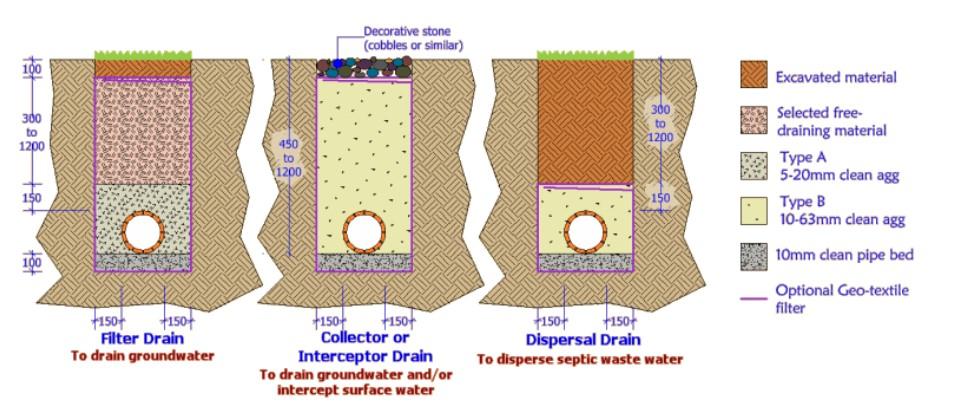
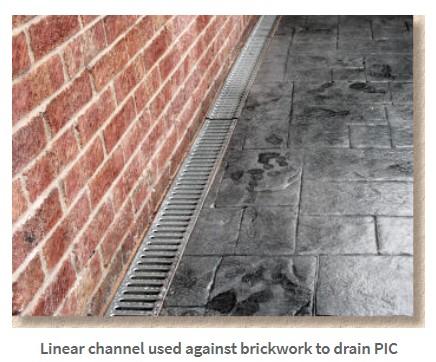
The minimum recommended depth on pavingexpert.com for a french drain is 550mm (450mm to the bed, then a 100mm bed): We are trying to fit the drain along the outer perimeter of the house, to keep the base of the walls dry. We realised today that we hit the first corbel at about 250mm below ground level. So the options are to either have a much shallower french drain (which I think will really be too shallow given it will be less than half the recommended minimum of 550mm) or to locate the pipe about 180mm or possibly 250mm further away from the house, which will allow us to go deeper (but probably still not as deep as 550mm) and for the bottom of the trench on the side of the house to be stepped to accommodate the corbels. Any ideas on which option will work best? Or should I give up on a french drain altogether and fit something more shallow, like a linear channel drain shown here?
-
To add to my confusion above, the pavingexpert link above then goes on to explain that for a water collector drain, holes should go up, whereas for a dispersal drain, they should go down. Makes sense, right? Except that is not consistent with what I found here: https://www.jdpipes.co.uk/knowledge/land-drainage/perforations-up-or-down.html
-
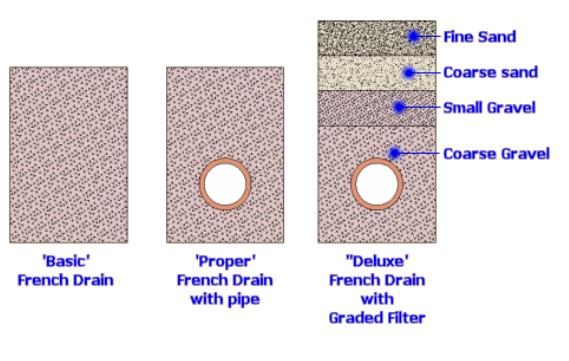
I'm a bit confused by the discussion here about not needing a pipe in a French drain. thepavingexpert.com website that gets lots of rave reviews here, just says the following: "A big part of the problem with French Drains was that the vast majority of them were poorly constructed. As already stated they often comprise nothing more than a trench backfilled with any old gravel that happened to be lying around, but a true French Drain should include an unjointed pipe and the better ones would be surrounded by a graded filter of selected gravels and sands." There is then a somewhat helpful picture: But apart from describing the third option as "deluxe" it doesn't really tell you why. Why would it be helpful to have a graded filter? As long as the perforations in the pipe are smaller than the size of the pebbles/gravel/pea shingle it presumably won't impact performance, or does the filter make sure that the closer the water gets to the pipe the cleaner it is and therefore the less likely the pipe is to block up? The other point, which I'm sure is obvious to everyone else, but not to me, is whether the pipe needs to be installed at a fall or whether it is sufficient for the bottom of the trench to have the fall? And finally, what are the pros and cons of a fully perforated pipe (top and bottom) versus one that is only perforated on one side (presumably the top side)? For context, I'm trying to finalise the spec of my french drain for the perimeter of my house, which includes two damp walls where a significant cause of damp was insufficient drainage of water away from the wall. It would also be incredibly helpful to have people's views on what diameter pipe I should specify. Architect has specified 60mm and two types of gravel coarse and then a finer decorative type on top. I've also found an 80mm pipe for similar money. Which is better?