Adsibob
-
Posts
3604 -
Joined
-
Last visited
-
Days Won
10
Everything posted by Adsibob
-

Energy supplier gone bust
Adsibob replied to CotswoldDoItUpper's topic in General Self Build & DIY Discussion
No, Octopus have been quite good compared to Avro. But then a dead corpse would provide better customer service than Avro did in the 8 months I was with them. Shocking excuse of a company, I am actually glad they have gone bust. -
Automist Fire Suppressor
Adsibob replied to Ferdinand's topic in General Self Build & DIY Discussion
I don't disagree with this. But they do cause more damage than a mist. The mist system is more efficient in terms of water use because a mist has a much greater surface area to volume ratio compared to the droplets from a sprinkler. According to imist at least, their mist system runs for 30 minutes which should be plenty of time for the fire brigade to get there and by the time the fire brigade gets there most fires are usually out anyway. -
Automist Fire Suppressor
Adsibob replied to Ferdinand's topic in General Self Build & DIY Discussion
I thought there were two downsides to sprinklers: in the event of a false alarm there is much more damage to the property; they require more water, which may mean a bigger pump or a bigger cylinder for storage. -
Automist Fire Suppressor
Adsibob replied to Ferdinand's topic in General Self Build & DIY Discussion
I see that this is published by the LABSS (Local Authority Building Standards Scotland) which claims to be "a not-for-profit membership organisation representing all local authority building standards verifiers in Scotland. Our members are dedicated to protecting the public interest delivered by public sector expertise to ensure buildings are safe, accessible, dry and warm." To me, and I my be wrong, this looks like protectionism, because they are not saying that you can't use these systems, they are saying "any proposal should be considered only as an alternative approach with full evidence submitted to prove compliance". It's a way of generating fees for their members. I knew that for an open plan system with no fire door separating the kitchen from the entrance hallway and bottom of stairwell I would need a mist system or a fire curtain. But my BCO won't accept a mist system without a fire engineering report. The fire engineering report is going to cost £1200 plus VAT. Absolute bonkers. Given that I'll be going down the mist system come what may, I thought I would report what I've learned: A 6 nozzle system that will cover the 80% or so of my ground floor which is open plan is going to cost about £4k plus VAT. Crazy for six nozzles, some pipework and a pump. But their customer service seems very good and they are going to provide me with their stats on false alarms to reassure me that their system really is decent. Works on a heat sensor that needs to sense a temperature of at least 68C to activate the mist. Mist goes for a maximum of 30 minutes. Apparently, even if there was a false alarm, the amount of moisture released by the mist would only take a day or two to dry out from most things. But one thing I didn't like was the annual service charge of £250 a year. Seems excessive. It's not like a boiler that is constantly being used and so might need the occasional tune up. The imist nozzles are 88mm in diameter, so small but not tiny. If anybody knows of a mister system with smaller nozzles I'd be interested to know. -
Laying external porcelain tiles - what primer? Screed ok?
Adsibob replied to oranjeboom's topic in General Flooring
In my case the microcement manufacturer suggested a 100mm, but my architect queried this as excessive, and the microcement people said we could go down to about 70mm think. -
Energy supplier gone bust
Adsibob replied to CotswoldDoItUpper's topic in General Self Build & DIY Discussion
I was with EDF until I thought I could save a couple hundred a year by switching to Avro. I regretted it. Avro have been a nightmare and eventually went bust last week, owing me £780. I moved to Octopus just before they went bust- purely for the reason that I thought they were about to go bust because they were helping themselves to my money, running up a huge credit balance to support their cash flow needs. -
Laying external porcelain tiles - what primer? Screed ok?
Adsibob replied to oranjeboom's topic in General Flooring
I'm laying sand and cement screed externally with the intention that it will be coated with a special microcement product. The manufacturer of the microcement initially gave us various options for how the screed should be laid, all of which included a vapour membrane underneath the screed. When we queried what the difference was between the options, they said it actually didn't matter as long as we could guarantee that the screed was solid, wouldn't move and would have a humidity content of less than 16%. Is that realistically achievable, even with a vapour membrane? Will i need to keep it dry whilst it fully cures (which could take a couple of months!) -
@Iceverge thanks for doing those sums, much appreciated. A couple of assumptions I didn't quite follow: Why would the stored temperature in a vertical tank be 70C? Isn't that going to cause scalding? I thought recommendation was 60 to 65 but even that is on the high side and could potentially scald a toddler. Why would the stored temperature in a horizontal tank be lower? I'm not sure i follow this. I appreciate you are trying to calculate the "energy equivalent", but I think you are you assuming that the energy required will be the same as the energy required to convert 10C water to 40C water. But in actual fact, won't the system mix X litres of hot water with Y litres of 10C water to make 130L and the issue here is we don't know what that ratio is? Or maybe we are talking about the same thing in different ways. There are a couple of calculators here that appear to answer my question: https://www.engineeringtoolbox.com/mixing-fluids-temperature-mass-d_1785.html If I am using the calculator correctly, the ratio of COLD 10C water to HOT 60C water required to make 40C water is 10 to 15 So for a 130L bath at 40C one would need 52L of cold water and 78L of 60C water. If we increase the incoming hot water temperature to 65C, the ratio falls to 10 to 12, meaning that one would need 59.091 litres of cold and 70.909 litres of 65C water.
-
Windows not quite as expected - distortion issue
Adsibob replied to Adsibob's topic in Windows & Glazing
By way of update, the window company agreed to replace the glazing units that were distorted. Even though I told them to make sure the glass is from a GGF supplier so that it complies with GGF guidelines, the distortion is just as bad. Really fed up of these idiots. I think I will have to end up suing them. They've made a bunch of other mistakes on some of the other windows, like not applying a sealant between the aluminium window frame and aluminium sill and we actually have a tiny amount of water ingress on the more exposed windows because of that. Seems like a pretty flagrantly stupid error to have made. Is it just a case of sealing the external join between window frame and sill, or should the whole frame be taken out so that two beads of sealant can be run in between the frame and sill? -
Best spec for high pressure hot water to multiple outlets?
Adsibob replied to sendu's topic in Boilers & Hot Water Tanks
I'm trying to visualise how this radial system would work and apply it to my house where I have hot water needs on three floors (shower room on top floor; two bathrooms on middle floor and kitchen, utility and WC on bottom floor. Is the attached diagram what you would suggest to get the manifold and secondary loop benefits you mention, i.e. manifolds are in series, but outlets serviced by each manifold is supplied radially from the manifold?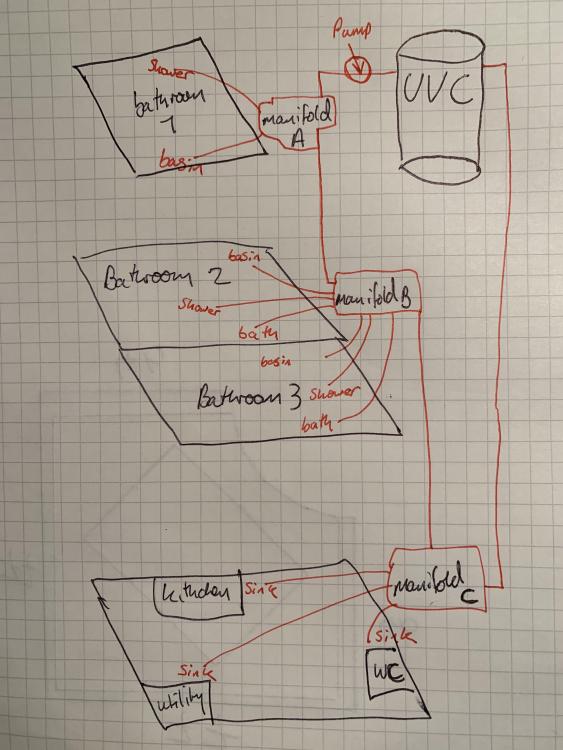
-
So shall I get a 300L cylinder or strengthen my loft floor to have a 400L one. Strengthening the floor might not actually be necessary - SE is looking into it (at his usual snail's pace).
-
I'm not sure this is right. Maybe you aren't expressing yourself clearly, but clearly the water that is in the hot water cylinder does end up coming out of the shower (at least that's what this says: https://www.plumbnation.co.uk/blog/benefits-unvented-hot-water-cylinders/). So I rather there was zero risk of legionella in it.
-
We are staying in an old rental property down the road. The showers aren't great and we miss more powerful showers. The baths at our proper house are bigger than the ones here, so it's really chalk and cheese. But either way, this still hasn't answered my question as to what formula one uses to convert hot water in the cylinder to blended bathing water. I appreciate it depends on the temperature of the cold water, but to get a rough idea, how many 125L showers and 250L baths would I get out of a 300L cylinder?
-
So this is another area of confusion for me. I was chatting to the plumber about the setup and asked him what temp to set the UWC to and he said 50C. I thought that must be wrong (and googling I now see that anything below 60C risks legionella). Maybe I misunderstood him but he seemed to be implying that if I had it at 60C, let alone 65C, it would risk scalding and googling that he seems to be right. So now I'm thoroughly confused. Again, this is just an area where everyone seems to have their own opinion/view. I also don't understand why bigger cylinder implies lower losses. Looking at Telford Tempest's figures for heat loss, is actually suggesting the opposite in respect of losses: Heat loss for a 300L tank: 2.32kwh/24hrs Heat loss for a 400L tank: 2.58kwh/24hrs And I also don't understand why you say a smaller cylinder is more prone to cause the boiler to short cycle.
-
Unfortunately, I can't actually measure it as the system isn't installed yet. We are completely re-doing our house. Part of that includes upgrading our water supply with Thames Water. They've told us peak performance with the 32mm pipe that they are upgrading us to (which will also be upgraded all along to our house) is going to be 1.3 litres per second. I find it hard to believe we will actually get anywhere near that as 78L per minute sounds a lot and as they haven't told us this in writing I'm assuming it is going to be much closer to 30L a minute. The rain shower we'll be installing is rated at 24 l/min at 3 bar. Hopefully we will have 3 bar most of the time (still debating whether to install an accumulator). So assuming the shower uses all 24L of it's capacity, that 288L of showering water in 12 minutes. But how much of that is hot? The system is a gas boiler.
-
My plumber is telling me I need to allow 100L per person per day (implying 400L tank), whereas my architect is telling me I should go for 300L because plumbers always over-specify. Our water usage pattern is as follows: The way things will be in the immediate future: we run one bath for both kids to share every evening - the bath we will have requires approx 125L of (blended water); we each shower for about 12-15 minutes in a fairly good rain shower, usually in the evening but occasionally in the morning. No idea of water usage for that. once or twice a week, I run a large bath (250L of blended water required), instead of the daily shower. In the future, things for us adults will stay the same but I imagine the kids will eventually want to bathe separately, so that will be an extra 125L per day of blended water and when they are teenagers I'm assuming showering will replace bathing. So what indirect unvented tank should I go for: 300L or 400L? Struggling to understand how much I should plan to heat on an everyday basis and how often I should use the "extra hour" feature. For example, would a 300L tank suffice as long as for my once or twice weekly giant bath I used the extra hour feature. How does washing up impact the above? We mostly use a dishwasher, but there are still large pans to do in the sink etc.
-
Thanks @Nickfromwales but unfortunately that link doesn't seem to work. My pipes will mainly be plastic with decent insulation. Are you saying that a horizontal cylinder will actually hold more hot water than a vertical one?
-
Put the hot water cylinder under the stairs and the MVHR centrally in the loft space. You can run a secondary loop for hot water to the basins that are far away from the staircase.
-
Thanks @fezster. Is a composite tank the same as an accumulator? Sorry, I’m probably being super dim.
-
So my options are basically: - pay Thames Water £4k to upgrade my connection, without any guarantee of what it will be like after the upgrade; or - buy the E. Sybox and get my plumber to install that. This won’t actually be much cheaper than the Thames Water quote, because I need to spend some money upgrading the structure of my loft floor to cope with the 650kg weight of the E. Sybox. It’s odd because over the phone Thames Water said i should have enough pressure “for your needs” and about 16L a minute, but when I asked them to put it in writing they apparently couldn’t. To me, that stinks.
-
Just to clarify, the system I was posting about is not the ESYBOX Mini 3. It's this thing, which comes with its own 500L tank: https://www.anglianpumping.com/product/mains-pressure-boosting-systems/dab-e-sybox-c-w-e-sytank?gclid=Cj0KCQjw1ouKBhC5ARIsAHXNMI93Qsi2b1wAbDB6E16CY3mmkYWoD3BRsFDhgUbhNJKbrRGgr06Om8EaAkg_EALw_wcB
-
Builder wanting to renegotiate terms halfway through...
Adsibob replied to Tom's topic in General Self Build & DIY Discussion
Whether the contract was oral or in writing is probably only relevant if you are going to sue them. You're not. I say "probably" because it does give you a bit of moral high ground, although if the builder is a shameless f*cker then that won't really count for anything. Personally, I think that the most important thing in my view is being able to trust them. You clearly can't trust these guys. What's to say they don't renegotiate again in a few months time. I appreciate labour is short right now and particularly if you are building with specialised materials, but if I was in your shoes I would prefer to go with someone else, even if it meant having a down time of two to three months whilst I found a replacement. Whilst switching builders midway through is always a bit of a nightmare, with enough attention to detail it can be done. The incoming builder has to inspect everything that the outgoing builder has done before you agree a price so that he knows exactly what is unfinished/done incorrectly and what he needs to finish/remedy it. This happened to me in Christmas 2013. The day before Christmas eve I get a text from the foreman telling me he and his labourers have not been paid by the company I was paying for three months and that if he carries on like this he will default on his mortgage. They went bust and i had to find a new builder. We lost 10 weeks (during which time I got quite depressed, watching the big gaping whole at the back of my property, loosely covered with a tarp) but we ended with a really good result because by that point I was wiser and was able to be much more detailed about the contract I agreed with the second builder. I also lucked out to an extent because the second builder was a top quality guy. It was worth waiting for him to sort out the mess the first guy had left. -
Maybe I didn't express myself very well. The point I was trying to make is that if your maximum pressure is X, storing it in an accumulator won't increase that. All it will do is make sure you don't fall below X whilst there is still water in the accumulator tank, in theory at least. But in practice, that sounds dodgy to me. Once water is released from the accumulator tank, won't Boyle's law dictate that the pressure will fall as essentially the extra space created by the release of water will result in extra volume for the remaining water. Now of course one needs to take into account that the space can be refilled by the mains water as it is being used. But without a pump, that will only be coming into the accumulator tank at mains pressure. So if mains pressure is 3.5 bar in the middle of the night, but 2 bar during the peak usage times in the day, then whilst the accumulator can accumulate pressure at 3.5 bar in the middle of the night, if usage in the house is a couple of showers at 7am (time of peak demand in my street) then whilst those showers are running and the accumulator is emptying, it will only be refilling at 2bar, not 3.5 bar. So overall, won't the pressure of the accumulator tank fall to a weighted average of the pressure in the tank before the showers and the mains pressure at the time the tank is refilled (weighted by reference to the proportion of the tank that is being refilled). I'm probably missing a lot of important details, but that's my take on it as layman who thinks he understands how Boyle's law works.
-
No PV, just a gas boiler system. Not sure how a Hot return circuit pump would fix the issue. Does it just mix the water in the tank so that it is all hot when heated?
-
Or is it just a case of adding a pump to the cylinder to mix the water and accept that there won't be any stratification.