
LSB
-
Posts
963 -
Joined
-
Last visited
-
Days Won
1
Everything posted by LSB
-
what is one of those - help
-
we are planning on 4 sets of French doors rather than bifold or sliding, as a barn conversion planning says that it needs to look like opening for internal areas. We looked at some alu and upvc ones yesterday, but the salesman could show us one, but didn't really understand how they were installed.
-
it's only at the doors that I want lower, I want 4 x level threshold French doors along a long wall
-
thanks, I've got a few of these drawings, but none of them cover what you do with the DPM which runs along the top of the foundation blocks. This is as per my 2nd terrible drawing.
-
I really don't want one of those horrid ramp things, I would rather slope the whole patio, but then I have the worry about my disabled visitors disappearing into the garden unable to return 🙂 I also hope the drain will work, but at the moment I'm struggling to get a definitive answer. I've just had the builder, who's not had to do this before, asking what he should do. At the moment I've just said to leave the gap where the doors will go.
-

Do we pay vat for the survey and setting out?
LSB replied to CalvinHobbes's topic in Surveyors & Architects
Hello The land survey, yes, only stuff that can be claimed VAT is materials and stuff done by builders, which shouldn't be charged. But, that said, do you already have planning and is the setting out being done by a contractor. If this is part of the preliminaries to get planning then you have to pay VAT on all that stuff. -
I've had a bad night stressing about DPM, level threshold and BC. In our family room to the garden I want 2 level threshold doors, that's the easy bit. When I say level, I don't want to go to a slope or ramp, I want it to be level to the whole outside patio / garden for a wheelchair user to be able to go from inside to out without rolling away and then struggling to get back in. Terrible drawing below. The bit going down is the drain, the bit going up is the door. But, the DPM must be 150 above GGL ???? So, do we just do this which doesn't have the DPM 150 up, or is that covered by the drain. I've looked at our SE drawings, books, interweb and nothing explains how it meets the latest building regs. All our drawings were pre the BC change. I have a drawing which shows it from side on, but that doesn't cover the above question. I don't have any level thresh-hold in our current house and all the doors are steps to get in, too old for ramps or anything. We spoke to a guy last week who sells level thresh-hold drains and bizarrely he said, you can't do this in the UK, so why did he have a stand at an exhibition !!! We haven't finalised on our window / door supplier yet, we know the sizes, positions etc just not the finer details. By the way, this is French doors, not sliding or bifold, just 2 pairs of opening doors.
.thumb.jpg.9501b82b9c0e40c8f216fa2a227341e8.jpg)
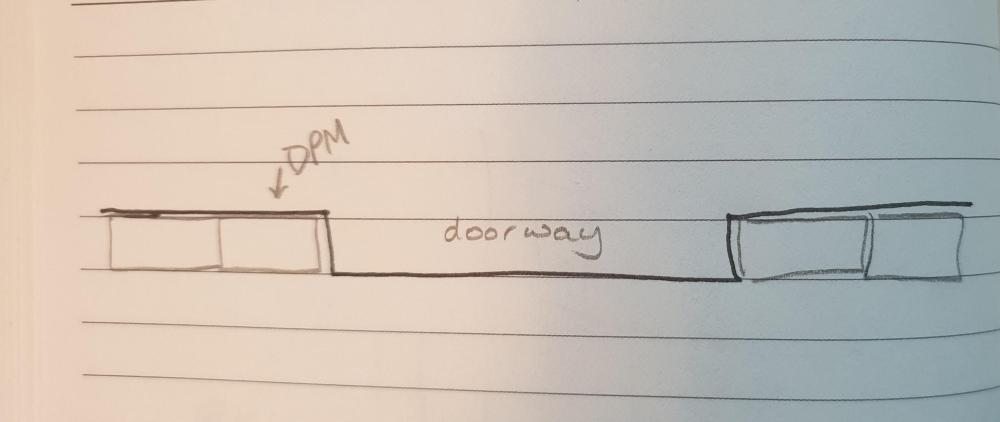
-
What's worse is I also lost the stables, they will be the snug and bedrooms. I was promised replacements, but the horses have been living with field shelters only for some years now. Not that they care really to be fair, they prefer keeping cool and shaded to being dry.
-
HID has 1 huge workshop and 3 sheds, so I said I wanted my own for my gardening things. So he bought a kit (for speed), we built it and now it stores all his expensive tools because it's more secure than the others, which he hasn't moved out of. So, I have sympathy with SWMBO as I don't have anywhere either. Eventually I have a corner of the woodshed and all the pots outside, about 60 of them.
-
That would be interesting and is our current house which will definitely needs some changes before it's sold in the future. Particularly in that area of insulation.
-
How would you insulated if building block and block ?
LSB replied to Big Jimbo's topic in General Construction Issues
this is the first time ever that I've seen drawings this way round, normally outside is left 🙂 -
as we are cladding / render then at least we don't have to worry about this. After all there are plenty of things that we do need to worry about.
-
It was dry this week, shouldn't have believed it, but HID laid first layer of blocks and now they have got wet. He has covered the top, but is worried about the mortar being affected by the damp. Is this an issue or will it just take longer to set hard as it still seems quite soft today, or is it because it's covered and it needs air. We have been told not to let the blocks get soaked hence covering them loosely with a tarp. The usual 1 step forward 2 steps back 😞 FYI blocks are 3.6n H&H and these are the ones that will be below the DPM.
-
How would you insulated if building block and block ?
LSB replied to Big Jimbo's topic in General Construction Issues
Are you saying that insulation below DPM in the block / block cavity WONT transfer moisture and cause damp. Is this the case with all types of insulation. My arch drawings show insulation (rigid) right to the founds, but I was concerned that this would allow damp and when I asked her, she said it's up to the SE, who said it's up to the arch / BC. -
How would you insulated if building block and block ?
LSB replied to Big Jimbo's topic in General Construction Issues
pity I've just had my first batch delivered 🙂 although, this is only a 1/4 of what we finally need. I looked at our local BnQ and they don't even sell this stuff so maybe Ireland is different, being in the EU (wish we still were) -
Isn't there a gov grant of 5k if you get MCS installer, so doesn't that make it the same as DIY.
-
You are softer than we were 🙂 4 daughters in 5 years, so all teenagers at the same time and 1 shower between then, another bath as well and our ensuite. They are now in 20's and moved out, but they learnt to get on with it. And the school picked them up on the doorstep every day so they did have to leave at the same time.
-
How would you insulated if building block and block ?
LSB replied to Big Jimbo's topic in General Construction Issues
that's a brilliant price, when was that we went for dritherm 32 @ 150mm thick and the lowest price we were quoted was much higher @ £30 excl VAT -
How would you insulated if building block and block ?
LSB replied to Big Jimbo's topic in General Construction Issues
I'm surprised at how thin you are allowed to put insulation at 75 or 100 , we must include 150 in our block / block cavity wall. Will be the same as you are doing, just thicker. This came from BC with the latest regs. -
Welcome to the forum it's always good to hear other people's experiences and stories. You sound remarkably similar to us, we are converting old pig buildings. It sounds like you ended up doing a knock-down and rebuild which our LPA were adamant would be refused so we are reusing what we can, walls, floor and some of the roof, with underpinning, planning restrictions insisting we do so, although our building control think it's all a bit extreme. We also have to have sprinklers, but also allow for fire appliance turning space, due to the distance from the road. BC said it should be one or the other, but we seem to have different bodies all saying different things and sometimes it's easier to just do it all. Good luck with the progress we are still at groundworks level, with my hubby doing it all himself having taken early retirement to do this. When you started in 2019 was your planning for converting the existing buildings and is that what you started on.
-
I have the drawing on paper, will dig out the phone to take picture and post.
-
arch just says 'base' level and doesn't show them on the drawing focusing on the insulation. thanks for the prompt reply
-
I need help 🙂 We are building block / block with render / cladding but are struggling with weep vents and cavity insulation positioning. Our SE drawings just say 150 full cavities, simple enough, but then I've looked at loads of books, websites, diagrams, spoken to arch & BC and they all vary on where the weep vents go and where the insulation starts and if we even need weep vents. Our founds are 1000 deep with 850 poured concrete. Then below the DPM there will be 1 block on its side, so 110 high (incl mortar) and 1 block std layout, 225 high (incl mortar) totalling 335 incl mortar. So, this equates to 150 below FGL with 185 above FGL to allow for the min of 150. This equates to mortar (10), side block (100), mortar (10) plus 30 of the lowest cavity blocks below FGL leaving the 185 above ground up to the DPM. This is all pretty straightforward except; Does the insulation go right to the bottom of the cavity with 30 'underground' and 185 below DPM or does it start at the DPM (or somewhere else completely). If this is the case then do we need to put a thin mix of concrete in this cavity. I asked the architect who said it up to us or BC. Surely this will have the potential to get damp and rise up, BC not replied yet. Obviously the DPM doesn't go across the cavity so there would be nothing to stop moisture going up and up. The weep hole, the arch said at 'base' level, so I asked where that is and they said FGL, but surely if there is a puddle or heavy rain / wind combination it would enter the cavity in through the vent rather than exit. The render / cladding won't be going to ground level so weep vents will be fine at FGL, but if they are higher then won't that allow damp to sit below the vent and if insul is at the bottom just make that damp. Insulation is mineral wool, which raises the question if this starts at DPM and, supposedly, doesn't need fixing then why won't it just fall down to the bottom of the cavity. I am getting so much conflicting information that I am hoping that this place will have a more definitive answer for me. TIA Jill
-
we got the architect to do the drawings, he failed at 2 apps so we parted ways as he was refusing some things the planners wanted saying they weren't necessary (ground survey). I just got an SE, got them done along with tree, bat, small furry animal surveys, resubmitted and passed. I did make sure I had permission to use the drawings. Since then I've gone back to the arch to get the BC plans. But now we are doing everything ourselves.
-
What is your soil type, don't forget roots are generally as big as the trees and if you have clay then you will have problems with roots. We had some trees on our boundary, these were killed by the power company by over enthusiastic pruning to get them away from the power lines. About 4 years later we cut them down as they looked awful. A few years later we submitted planning, they used Google Earth (not just the most recent) and asked where the trees were as they affect the soil, even long after the trees were gone. There were probably about 8" in diameter.
.jpg.ed4d94f5235efa73c35ee706b87c329f.jpg)