JohnMo
-
Posts
13292 -
Joined
-
Last visited
-
Days Won
200
Everything posted by JohnMo
-
I would hate that, that's what a utility room is for. But like sticking your shower in the utility - you just wouldn't. But everyone to their own.
-
Either connection can be self trenched - which exactly what we did, saved a small fortune. But do you really need gas? I was convinced I did when I built, but ASHP was/is so much cheaper to run. £3500 will buy you a heat pump and have change.
-
Airtight - think about how you will implement with your build method. Airtightness tape, we don't have any in our build. We do have airtight mastic/adhesive, airtight paint. Thermal bridges are cheap to eliminate, but takes thought. Heating system, keep it simple. It's keeper to install generally cheaper to run. Ventilation MVHR is normal, but not the only way (unless in Scotland). Conditional MEV or dMEV are other options. Cascade MVHR allows reduced ducting etc. Add PV, as much as you can, add battery, add an ASHP to eliminate gas standing charges. Running costs are as important as anything. Our April energy bill (April has been mostly heating season in Scotland) is about £30.
-
You are maybe correct. Airtightness makes for good comfort as you have no drafts. Good form factor allows less insulation for the same heat loss, compared to poor form factor. We have a particularly poor form factor, so although great insulation, our heat loss doesn't comply with passivhaus requirements. But we have great views from all main rooms and all bedrooms and the vaulted ceilings make for light airy feel to the building. Having our build comply with passivhaus standards would be almost impossible. Life is a comprise, could have build a nice form factor building, but not sure the living experience would be as nice. Currently sat in from a 6m tall bay window, looking out to a Scottish loch, not sure that is compatible with passivhaus heat losses or heat gains either
-
Not exactly sure, asked AI and looked at my performance and said it was running at minimum stable refrigeration limits. Possibly as a result of thick screed, widely spaced pipes UFH. Plus the floor acting as huge buffer quite happy to take all the heat it can get. I had an over sized heat pump which didn't modulate well, once setup it didn't short cycle, it did cycle but in a controlled manner. But I found any cycling hits efficiency, so typically when running ASHP would get a CoP of say 5, but standby losses dropped that down to 4 over the 24 hrs. My boiler I found a sweet spot the boiler liked and floor didn't over heat the house via overshoot and used a 0.1 Deg hysterisis thermostat and fixed flow temp of around 36 degs. Would get 4 to 12hrs run time depending on outside temperature then off for 12 to 18 hrs. Gas isn't really 6p, it's 6p plus a proportion of standing charge. Your standing charge is around £100 per year, so if you use £100 of gas (£200 per year £100+100), your unit price of gas is really 12p. If you use £200 of gas your unit price for gas reduces and so on. ASHP is one standing charge for electric (which have to pay if you have any electric in the house, gas boiler is two standing charges. I was using less than a £100 on gas but getting nearly £200 bill running hybrid mode (12p per kWh). I pay 10p for off peak electricity, so just use an immersion. It's easy and it's cheaper than gas in real terms. Plus I generate more PV than I can export 9 months of the year, so do most my heating around 1pm when electric is cheap and/or I have excess PV that would be clipped instead of exported. Our house is similar but single storey fully vaulted ceiling everywhere so our heat losses will be worse than yours (plus we have private water and sewage treatment all taking electric) we have a 13kW and it does fine even when we get -9, maybe take in a little electric at 25p. I would look at typical winter days, which are around 7 degs, even running last night (5 degs) the heat pump was getting a CoP of 6.3. 3 hrs of that in a cheap periods so nothing coming out of the battery. Your installer went for an easy install and zero discussion with DNO. Our battery has a 6kW inverter we may draw a little expensive electric in at Christmas but nothing most the year. If it does it's for seconds not hours. Hobs aren't a constant power draw they switch on off constantly.
-
No idea how far you are off retirement, we decided to do single storey, with an eye of getting older and limited mobility, making the house fully future proof. All bedrooms have access to decking as does the dining room and all are level thresholds at the doors. Single storey makes passivhaus more difficult due to form factor. We went architect, but on the basis I reviewed and approved all drawings. Treated on a proper engineering basis. He came up with a design I never would have, but to the spec I wanted. I decided build method, insulation, airtightness, designed heating and how to achieve everything. He did the leg work of building regs etc. Worked for us. Be prepared to roll up your sleeves and get stuck in, it isn't a part time task. If you are working full time and doing a build management, be prepared for delays and maybe not getting what you want. But good luck and enjoy the journey. I did.
-
That's a bit more specific. You simply said Mac mini. But like asking for a BMW when you are only looking for an M5 BMW. But hay ho. Was only trying to be helpful, but get a world of scorn for my efforts... Won't bother in future. Don't bother replying because I won't see it
-
Mac mini, M4 is what I quoted and yes it's for sale, delivery on Wednesday.
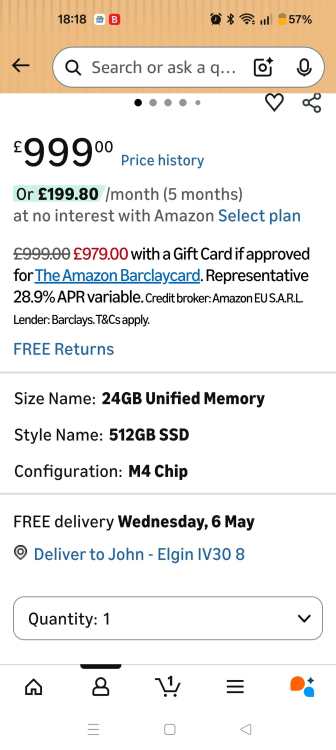
-

Fan Coil Units for use with a (cooling) ASHP
JohnMo replied to ProDave's topic in Air Source Heat Pumps (ASHP)
Rubbish weather is back -
That's what we did before battery and smart meter (last August)
-
Bought mine the other week from Amazon, just looked and still available.
-
Fan Coil Units for use with a (cooling) ASHP
JohnMo replied to ProDave's topic in Air Source Heat Pumps (ASHP)
Had my cooling on this year already, one fan coil and UFH, flow rate 14.5 to 15 degs, zero condensation from fan coil -
True, but my decision to install was flawed I should have installed a heat pump. Currently 10p. Very true, I don't have one, just export what I don't use My 4kW will do 0.9kW, but must admin never seen it go below 2kW. But you pay nearly as much in annual standing charges as you do for gas. So effective cost per kWh is nearly double. That's when I realised the gas pipe meter had to go. So the real cost of gas is actually close to or more expensive than the electricity, to power a heat pump on an annual basis (Cosy 10p) plus you should be getting a CoP of 4.0 to 4.5.maybe better. Even at normal cost rate of 25p you really only need a CoP of around 2.5p to break even. My system is super simple now. Immersion to do DHW, a direct cylinder can be as cheap as chips compared to a heat pump one. Heat pump direct to UFH, no mixer or pump, no zone valves. I have room temperature monitoring via a good UFH controller, but a single on/off signal to heat pump set to where I want house temp. A single switch to move from heat to cool. Cylinder £500 Heat pump £2100 (including vat) UFH controller and room monitors came to a around £200 from eBay. But a Viessmann is a good boiler can make a very simple setup, just get a 4 pipe boiler job done. Either weather compensation or set flow to 30 to 35 and let the controller look after house temperature. But install a heat pump cylinder to get condensation mode through our the DHW heating cycle.
-
Sorry not answering your question - but more or an observation. Why are you installing gas on a new build? Install a heat pump and save your self a fortune in running costs. Add a battery/PV and save more. Our new build was completed in 2021, with gas boiler. After a year or so fully optimising how it it ran, I added an ASHP specifically for cooling the floor. Operated a hybrid system. Realised, with standby charge for gas and the great cop from a heat pump, the boiler had to go. Since added more PV and battery and pay almost nothing for energy even in NE Scotland. Gas is last century.
-
Veissmann ASHP buffer required for cooling use??
JohnMo replied to MrWhat's topic in Air Source Heat Pumps (ASHP)
Isn't the in-built buffer just for defrosting, as in it's heated via ASHP and or immersion tona high temperature the energy is then used to defrost rather than stealing heat from the house. So not that relevant to a nerd real or otherwise for a cooling specific buffer. Been running my cooling an a 70L system volume zero issues (no buffers). Second type/manufacturer ASHP used, both have worked with zero issue. -
Neighbours want to scaffold in my courtyard
JohnMo replied to DannyT's topic in General Self Build & DIY Discussion
Wonder if its the same rules a trees and bushes, you cut the branches off, as long as you give the owner as its there property. -
Neighbours want to scaffold in my courtyard
JohnMo replied to DannyT's topic in General Self Build & DIY Discussion
Where are you England or Scotland, as you location says both - rules will vary? -
Can't see that - have they forgotten that was well?
-
Combi grille I linked to, are fully compliant with BRegs.
-
Just use a combined inlet outlet, they work well (I have two) https://www.paulheatrecovery.co.uk/product/160mm-directional-external-combi-grille-for-mvhr-black/
-
Advice on economy 7/9/10 tariffs for meter upgrade due to RTS switch off
JohnMo replied to jfb's topic in Electrics - Other
From what understood RTS is used to switch on the cheap rate consumer unit (charge up storage heaters etc), so what they say may be correct - if you don't have storage heaters switch to standard rate now, while everything gets switched over. I would then get your consumer units brought together to act as one - should be an easy job for an electrician. -
Veissmann ASHP buffer required for cooling use??
JohnMo replied to MrWhat's topic in Air Source Heat Pumps (ASHP)
This is location specific and depends on the dew point locally, and choice of heat pump. My older R32 (6kW) has a much smaller condenser (finned radiator in ASHP) than my new 4kW R290 unit. As a result in exactly the same position needs to defrost way less than previously, moving from once per hour to once every few hours in similar conditions. We have a large body of water next to the house so local humidity levels are higher. -
Advice on economy 7/9/10 tariffs for meter upgrade due to RTS switch off
JohnMo replied to jfb's topic in Electrics - Other
Move to octopus they have better smart tariffs, are a better company to deal with, use the forums referral scheme and get £50 credit. Your tariffs will also have a peak rates, so you need to understand how you use energy and work out the best one for you -
Veissmann ASHP buffer required for cooling use??
JohnMo replied to MrWhat's topic in Air Source Heat Pumps (ASHP)
Our house sounds a similar build, we have lots lots glazing 192m² and we have 4kW heat pump. Your calculations sound in the right ballpark. Do not over size, you will take an efficiency hit. important to look at min modulation at around 7 to 10 degs, you basically want to output half your design heat load. So about 2kW in your case. -
Veissmann ASHP buffer required for cooling use??
JohnMo replied to MrWhat's topic in Air Source Heat Pumps (ASHP)
Zero idea why you would need or want a buffer. Other comments as per @Dave Jones.