
JohnMo
-
Posts
12469 -
Joined
-
Last visited
-
Days Won
179
Everything posted by JohnMo
-
It's taken me a year to get there!
-
You can and mine does it all the time. I run pretty much pure weather compensation so the heat pump is energised and ready to go and circulation pump on all the time, except 1. During cooling the house drops below 20.4. 2. During heating the house goes over 23.1 A thermostat stops the cooling or heat demand. During cooling and heating I have the temperature settings set, so they automatically modulate the heat pump output to match demand. So in cooling when the house is sitting at about 21 the heat pump compressor will run for about 10 mins every the hour or two. When the sun's out and we get plenty of temperatures rise, the heat pump compressor can run 40 mins an hour every hour. All done by the heat pump sensing the return temp - the restart hysterisis of 4.9 for the compressor and flow temp target set to 14.5, so when the floor goes above 19.4 the ASHP compressor starts. Heating is done in a similar way. The continuous circulation helps even room temp and gives the fan coil a flow of cool water for continuous slow cooling effect.
-
Not really. The cold main is connected to the inlet group of the UVC, which is connected to the bottom port of the cylinder. The expansion vessel is connected either to the inlet group or cylinder contents via a port. So a closed main valve. A collapsed or punctured membrane on the expansion will alter system volume/pressure very easily. So worth checking. Also check the tundish at the UVC for drips. Good sign something is not right in that area could be a passing valve?
-
They are normally for metal, the wood ones are very coarse thread
-
Check the unvented cylinder. There is an expansion vessel for that. If it has lost pressure that may cause the issue.
-
In the heat pump, just a single circulation pump. Everything run as a single zone or DHW heating.
-

Solar PV, combi boiler and wood stove with a back boiler?
JohnMo replied to Hannah77's topic in Photovoltaics (PV)
Then do this. The rest is just a waste of money. So basically convert combi to system boiler, so in summer during a warm dull day (not much PV) you have to fill a big thermal store with hot water to enable you to have a short shower? Why? -
That looks a complex system. What system is loosing pressure The main water The heating system or the unvented cylinder?
-
Solar PV, combi boiler and wood stove with a back boiler?
JohnMo replied to Hannah77's topic in Photovoltaics (PV)
I would be very careful about going complex. All sounds great until it doesn't work or never works as you think it should. Issues are some manufacturers of combi boilers allow pre heated water most don't because they are not really sure about it. So their easy answer is no. PV and battery, let the PV charge the battery. Use the electric as you need Really would not bother with the complications of a back boiler. Why, you now have a combi boiler doing DHW and doing CH, you have a cylinder you have to charge up to get CH started, this could be heated via combi (via a coil as combi's need a sealed system) or heated by back boiler. Your cylinder will be a thermal store and really need to be pretty big if coming off a back boiler. Bucket loads of heat loss as it will be vented and get to high temps. Companies will do an integrated system and charge a pretty penny for their troubles. My view your heat loss / waste will be pretty big. I would Small wood stove if you must. Spend the money or most likely just time to get weather compensation working on the combi. Take as much gains in efficiency from condensing as you can. If you combi will take preheat, a small 50L cylinder is all you need. see attachedCombi-SuperFlow-White-Paper-v1-2-4.pdfCanetis-SuperFlow-Product-Sheet-WE-050318.pdf Leave a few thousand pounds in the bank. Save money every day of the heating season.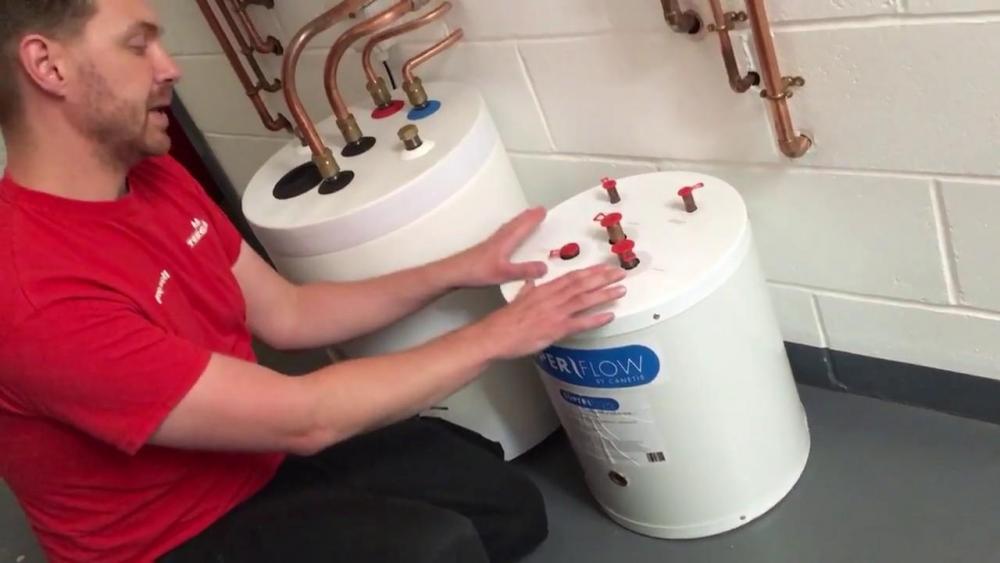
-
Work fine for us, but we do cycle on the heat pump (it's too big) so average is possibly closer to 16-18, depending on solar gain.
-
Fan coil is similar to the heater in your car, a heater matrix and fan to blow air through the matrix. The water can be a fixed or variable temperature and fan speed moves to get the heat out of the heater. In cooling mode you supply with cooled water and it blows out cold air not hot.
-
But that is only really true for the first heat cycle, after that it's only heating the bottom third in reality. My 210L has never taken more than 45 mins to heat with a 6kW. Look at the many threads on different forums where cycling is an issue. You can manage cycling but it doesn't generally happen out the box. Certainly not as left by many installers. Samsung requires use of the controller thermostat and water law together, to add more hysterisis to the heating system, mine required the hysterisis setting moving a long way from manufacturer setting, some heat pumps use good controls that make sure cycling is acceptable as a default setting - many don't.
-
Sorry to be blunt, that kitchen looks boring. Get yourself to a decent kitchen designer. It's in the living space, you need to think of it as furniture. Things I don't like, kitchen units finishing part way across a window, looks naff. The area where the hob is really needs to be tall units, and incorporate your oven, microwave etc in there. Your fridge in a different colour looks odd. Assume it's a stand alone, not integrated?
-
How to calculate heat load…
JohnMo replied to G and J's topic in Energy Efficient & Sustainable Design Concepts
Think that's where it all started from, but believe it's been distilled down to energy meter - but not really true for any more for heat pumps - as even a leaky shed could be Passivhaus with a well designed ASHP system. So think it's really delivered heat now. -
Should be ok in a partition wall, that isn't structural. Not many screws are classed as structural, so you should discuss with your structural engineer what to use. The size will also be very different from a nail due to the physical properties of the metal used in screws and nails.
-
Because it can't do it very well and it isn't cheap. I worked out our near 200m² house on normal MVHR flow rates, MVHR colling would deliver around 1kW if heating. The ASHP flow temp was 7 degs. Our floor can deliver 4x that at 14 Deg flow temp.
-
Armaflex or Kingspan for ASHP pipework?
JohnMo replied to Lisa15's topic in Central Heating (Radiators)
Next thing is rodents. If say under a block and beam floor, I would armour the insulation, insert into 110mm duct and seal each end with fine stainless mesh or wire wool, expanded foamed into place. If it's going to get wet as above also. If it's underground consider doing the same. To stop the insulation being crushed. If it's in a basement say, just insulation will be fine. Then use 25mm wall thickness of what every closed cell insulation is at the best price. I used quite a bit of armacell. Prices vary hugely going into a merchant can be way cheaper than buying in there online shop. Sometimes the other way round. -
Weather compensation curve
-
Armaflex or Kingspan for ASHP pipework?
JohnMo replied to Lisa15's topic in Central Heating (Radiators)
Can you clarify what you mean by under the floor? Is in a cold space outside the insulated envelope or within the insulated envelope? Makes a big difference. -
Possibly the most patronising post I have ever read. Get over yourself and own self importance.
-
UFH system and fan coils in bedrooms, run everything direct from the heat pump at a single flow temp - around 14 to 15 degs via a simple WC curve.
-
So heat loss first. More likely the smallest heat pump you can get (around 4kW). Panasonic seem good (I don't have one, but everything I have read seems that way) You size the cylinder is based on the number of bedrooms and likely people living there. Our 3 bed has a 210L. Get a cylinder with at least 3m² coil, for heating efficiency. Cooling - matter of finding which do it. Panasonic do it out the box. Keep it simple, less outlay, easy to run, best efficiency.
-
How to calculate heat load…
JohnMo replied to G and J's topic in Energy Efficient & Sustainable Design Concepts
So East Anglia doesn't get frosts or snow anymore - me thinks a bit of rubbish in and rubbish output. Computer says... Norwich had down to -5 in Dec and January last winter and sub zero every other winter month. Now add some common sense, average temperature is pretty meaningless for heating design, we also had an average of 4 degs for Dec, but a week where the temps dropped to -9 and barely got above -3, we had the same in Nov and January and March. You design for the likely lowest temp, not the temp that gives you the answer you want to hear. -
Try failing a percolation test - we are on sand so water drained away to quickly. Ours is about the size of tennis court. F'ing huge.
-
We flushed for a few months a few hrs a day, every day on a high flow pump.