JohnMo
-
Posts
13296 -
Joined
-
Last visited
-
Days Won
200
Everything posted by JohnMo
-
I used really good industrial scissors. Made easy work of it. Or you could use a craft knife with plenty of blades.
-

ASHP - Weather Compensation AND Zoning?
JohnMo replied to SBMS's topic in Air Source Heat Pumps (ASHP)
Where is the water going, how does it maintain min flow requirements - without a buffer? My max loop flow is around 2 L/min - lounge has two loops so around 4 L/min, my heat pump needs about 16 L/min so it doesn't trip on low flow. -
ASHP - how noisy are they in reality
JohnMo replied to Walshie's topic in Air Source Heat Pumps (ASHP)
Yep, we still get best part of zero at night. Heating could go off, every few days, but it's free from excess PV, so why bother switching it off. Mine generally is heating, then cooling until September. Not much middle ground. -
ASHP - Weather Compensation AND Zoning?
JohnMo replied to SBMS's topic in Air Source Heat Pumps (ASHP)
So decent amount of screed, so it's really a huge buffer for heat. We have a 100mm, and zones just killed efficiency. So some facts. Water flow temperature doesn't equal floor temp, temperature as the heat is dispersed gets lower as energy is removed and absorbed into screed. Floor surface temperature is pretty close to room temperature. So, If you have overheating in a room from solar gain, the UFH stops giving out heat. A 5 to 10 degree day your floor surface is about 1 Deg hotter than target room temperature. So if target is 21, floor is say 22 - room increases to 22 the floor heat output goes zero - a zone thermostat does nothing for you. You may as well just buffer heat for later. Only with a buffer and you don't want one for good efficiency. Yesterday we put 40kWh of heat into floor, at the hottest time of the day - because it was free from excess PV. It was 2 degs overnight, no heat needed at night. House was fine, cool down is slightly slower, but fine. You may as well just have a single thermostat is a good location (so wireless), that switches off the heat pump - but your controller may already have this! -
ASHP - Weather Compensation AND Zoning?
JohnMo replied to SBMS's topic in Air Source Heat Pumps (ASHP)
If a zone is controlled it will close the loop flow, so no flow. If all zone are not calling for heat everything off. Are you new build, well insulated and what depth of screed? -
Suspect your 22mm will cause pump to run out of head for satisfactory flow to cylinder. Which would then need an additional pump for cylinder heating.
-
Well done - we don't (can't) have a smart meter, so that wouldn't work for us. Even if we could export we would only get 4p per kWh.without a smart meter.
-
Average is about 89%, but with recent changes to diverter (i.e. got rid of it), utilisation is running about 94-95%
-
Or better still with the PV generated and stored in a battery
-
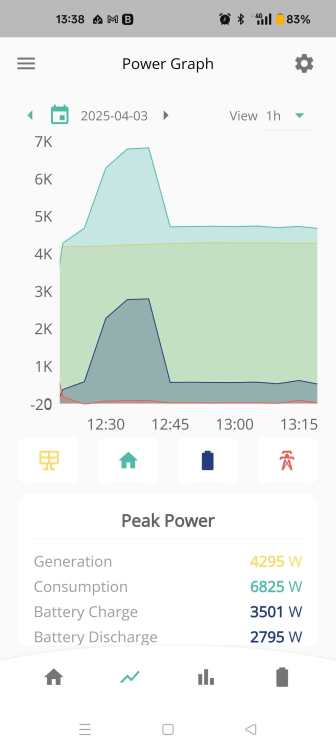
But the battery allows a few things that you are missing - difficult to work out the cost benefit really. One thing is ironing out bumps in usage. Using lots of electric over and above generation without import. So generating about 4kW while actually using nearly 7kW. No import. (Heat pump, immersion and dishwasher washer all on) Allows way higher PV utilisation, my last week figure was in the mid 90%. Without battery that could have been mid to low 70%. Allows better utilisation of immersion, run at full 3kW output. Can run heat pump over prolonged time period without having to import or it stop/starting due to clouds passing by during the day on PV, and not having to import to keep it running. Most of my heat pump running since mid March has been free and getting a CoP of around 5 when heating. Plus cylinder has been circa 70 most days except the odd wet day. Everything is always better buying later. My first Pioneer flat screen TV was £10k back on the late 90s, but that's life. I enjoyed it (still have it and it still works - could possibly heat the house with it).
-
I lined the edge of the screed (concrete) with 70mm of PIR and not the normal (crappy) expansion foam - got the normal sucking through teeth, your going to have issues. So did the expansion calculation compared cooling (min temp) and heating at -9 outside (max temperature) and got to less than 1mm expansion over 25m (house length). Think the issue is old house with UFH, they pump water at 50 degs on thin screed, so you get huge temperature swings. Then you can have issues. New house max flow is 35 or below, so very little temperature change in reality.
-
We really haven't noticed a difference in dry time, we changed the washer at the same time, and perhaps the spin performance is better, so stuff goes in to dryer, dryer at the start.
-
So some real numbers (PV and battery) We generated 5500kWh in 2024, 500kWh went back to grid the rest used in the home. So 5000 x £0.25 (cost per kWh) is £1250. Battery took 5000kWh from grid at £0.13, so cost £650. Without battery that energy would have cost £1250, so a saving of £650. Total saving of £1900. Our self installed solar was about £3k and battery installed £8200 = £11200. £11200 / £1900, so just under 6 years payback. Battery and PV costs have dropped since I bought.
-
We used Cameron Ross in Aberdeen, ICF build insulated raft. No issues. Note not a Passive raft, good luck finding anyone willing to come to Aberdeenshire to do that, unless things have changed a lot in the last few years.
-
I was shocked every time the normal tumble dryer went on (used so much electric), then installed a heat pump dryer, uses almost no electricity in comparison.
-
Yep the only way, anything else is a plain expensive.
-
Pretty similar to ours at -3, and our house has a really poor form factor. We get down to -9 and have a 6kW unit and it pretty big for the house. But depending on screed depth (ours is a 100mm) oversized can be useful, but with shallow screed depth may be a pain. Ours is useful for buffering heat that is very slowly released later.
-
It's fairly conservative, as long as your house doesn't naturally leak a lot. Passivhaus standards are in the high 80s 90s%
-
Is that a rate of generating of kW or amount per day kWh? We have a battery AC coupled and PV, we charge battery overnight on cheap rate, and then charge battery, run immersion and heat pump during the day at the moment mostly on PV. Last month's average per kWh price came out at about 9p. We utilised 92% of all PV generated. 72% of all electric came from PV or battery. Almost every thing else was cheap rate. You just have to do the maths to see if it works for you
-
Microcement for kitchen worktops - any advice?
JohnMo replied to Vesa's topic in General Self Build & DIY Discussion
I would Live with what you have for now Save your money Buy a proper top You will possibly spend just as much faffing about anyway. -
Why not UFH pipe? Way more surface area for heat transfer. Micro bore will be rubbish, just too small. Not sure it will be effective, the ground array will just be too small unless you are going vertical a long way down.
-
I did nothing, had one crack in floor, but wasn't at a door way.
-
Can you not just fit a slim line cylinder, they are about 450mm diameter? All you should need in addition is a 3 port diverter and expansion vessels X2.
-
They are Edit Diamond LED Plaster Up & Down Wall Fitting In White. But are they available any more, couldn't find them!
-
Our last house was built in 1830, and had a wine cellar on the lower ground floor. No windows, just a heavy door, but floor 8" thick stone, shelves 4" thick stone, and shelf framing 4" thick stone. Shelves and framing were about 3 foot deep. All walls were stone also. Room never changed temperature all year round. Totally uninsulated, no heating or cooling - just a stone cave inside the house.