tanneja
-
Posts
294 -
Joined
-
Last visited
Everything posted by tanneja
-
@joth thanks for the above. Just to be clear, are you saying the sink is in the sapienstone island, or on separate stainless steel counter top area? The counter top yard we visited said sapienstone was most at risk of chipping from taking pots and plates in and out of the sink. We have fallen head over heels for a 12mm one. When you say it fits onto birch ply, how to do intend to finish the sides?
-

Saint Gobain solar control glass - SKN176 / 165
tanneja replied to Conor's topic in Windows & Glazing
Some photos of 176 in 2G units: https://www.exetertradealuminium.co.uk/stone-grey-lift-and-slide-sliding-doors-in-traditional-property/ Does anyone know of any online visual light transmittance simulators / apps that can help me get a feel for the light impact of these windows in 3G, i.e. how to visualise 62% relative to 71% light transmittance? -
Saint Gobain solar control glass - SKN176 / 165
tanneja replied to Conor's topic in Windows & Glazing
Likewise, I am planning on the upstairs of our east and south elevations. I saw some photos of a person who has double glazed bifolds with SKN176II and the view was very good from inside, when compared to the door being open, i think its low risk to place in bedrooms at the least. Wont be able to report back until 3 months from now when installed. -
Internorm: Order with solar glass, or apply external film later?
tanneja replied to tanneja's topic in Windows & Glazing
@Dan F thank you for the link, as best as I can see, the comparative numbers are: Standard Internorm Triple Glazing: 71% Light Transmittance, 0.5 g-value SKN 176 II Coating Triple Glazed: 62% Light Transmittance, 0.34 g-value Has anyone got a feel for how impactful this would be when looking out of the window throughout the year light levels? -
Any feasible method to reduce RSJ cold bridge
tanneja replied to tanneja's topic in RSJs, Lintels & Steelwork
This is gold! I didn't concieve that we could build oit the wall, i had in my head that ceiling height would have to be lowered, i offer my sincere thanks for this jolt to the brain! -
Any feasible method to reduce RSJ cold bridge
tanneja replied to tanneja's topic in RSJs, Lintels & Steelwork
@Temp I think the limiting factor is next door's flat roof. If we went warm room it would be far higher than the existing pad stone that was there before, and difficult to say was part of planning. I would be in favour of it if we thought it was reasonable. -
Any feasible method to reduce RSJ cold bridge
tanneja replied to tanneja's topic in RSJs, Lintels & Steelwork
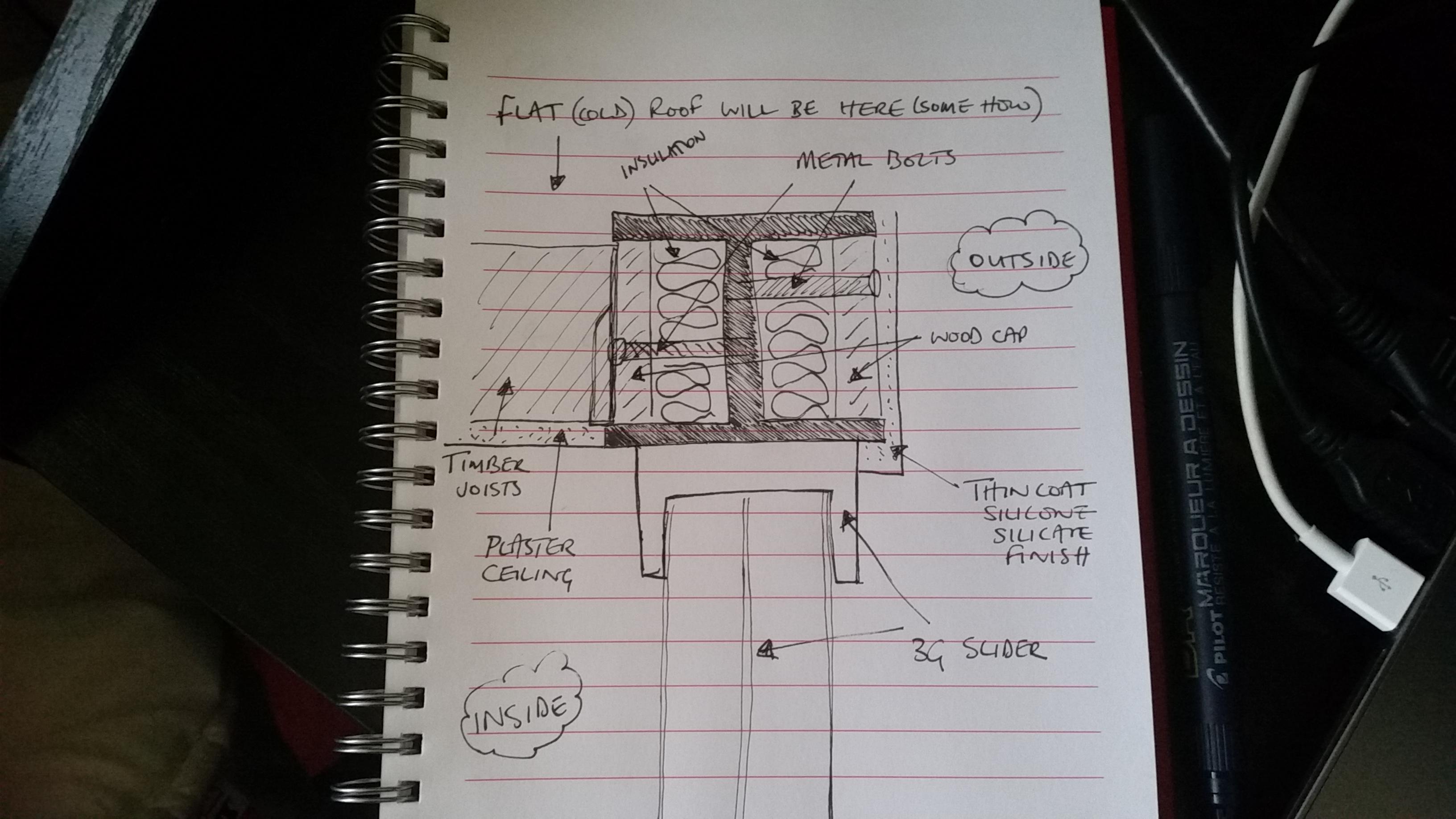
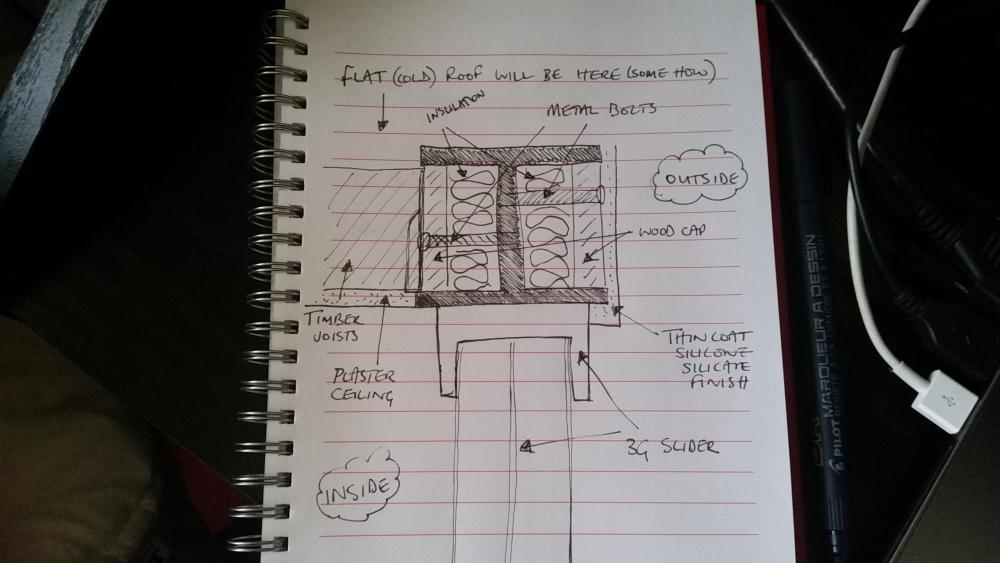
Sorry all, this is likely what we have, I have measured since I got home and is approx 100mm steel, with something like a 300mm plate welded on the underside, with block work flush around that plate. On the inside then, is the guidance to, as per the diagram, to have the finished ceiling height lower than the level the steel emerges, presumably due to the encasement in fire rated plasterboard as mentioned? What degree of insulation should be present with that encasement? -
Any feasible method to reduce RSJ cold bridge
tanneja replied to tanneja's topic in RSJs, Lintels & Steelwork
Hi @the_r_sole To be clear this is an extension, so 300mm cavity block work (100 block, 100 gap with insulation, 100 block). Floor is 150mm concrete slab, 50mm sand blinding, 120mm insulation, 50mm liquid screed. -
Hi all, We are fairly progressed with our build and have noticed the top steel for the 5m wide patio sliders doesnt have much in the way of insulation. Sliders will be very good 3G, but somehow the detail of around windows and these sliders hasn't had lots of focus with all else that goes on. We are now at the stage that the steels are in, they have been timber capped and the ceiling joists attached, but the sliders won't get measured for 2 weeks, with render planned after that. What if any salvage work should be done to reduce the cold bridge? I dont know whether the finished ceiling will come lower so that the steel is not visible, that probably needs to happen for regs, or maybe the sliders will be fitted more recessed so that the slider frame is flush with the internal corner of the steel. In either instance, would one look to a product such as aerogel? We are keen to not sacrifice any of the opening size if at all possible. Unsure what kind of strength any product would need to have given the enomous sliders. Caveat that I am not technical or on site atm, so this is my basic understanding of what we have.
-
I offer my sincere thanks for the update @bluebirdnick, I have read that others install the plenums before plastering which has its own challenges (needing to cut the plenum to length against the ceiling with a multi tool), so very interesting to hear it is still tricky doing your way. I will have to discuss with my builder so he knows his options. In hind sight, would you have approached it the same way you did again? You might not have re plastered ceilings which dictated you did it in this order, for me every ceiling is coming down. Fantastic to know you are enjoying the process, that feels essential to get a good result. Likewise our initial finish date was this week, we are at least 6 months delayed, enthusiasm can be challenging at times, but when the timelines are wildly missed, there is a spooky liberating feeling. To see photos would be great if you ever get a chance, and thank you for the feedback on the necessary loft height required. And wow, the airflow BV400 represents fantastic value relative to the vent-axia-kinetic-plus-b that I was considering, wow half the price would be a sensational saving. Despite the optional side vent options, the units seem identical. Had you encountered any reason why more people go for the Vent Axia vs your chosen unit? Is it just less pretty / less of a household name?
-
Internorm: Order with solar glass, or apply external film later?
tanneja replied to tanneja's topic in Windows & Glazing
I'll use the link to check thanks, however I have also seen situational photos and feel comfortable there isnt large percievable reduction in sunlight -
Thank you AliG, to confirm, is your loft warm or cold? Beyond convenience, i am wondering if placing in our cold loft puts me at risk of, during a heat wave, it pumping out super heated loft temp air due to being in my cold loft (with grey roof tiles). Perhaps during those heat wave conditions i would switch off the MVHR during the day and instead have an ashp in cooling mode via a multisplit managing the climate, then running MVHR overnight to address the air quality, although doubt the loft will cool that quickly after sundown. I still dont want faff, but since it loses a precious but of bathroom, wanting to determine if there are additional advantages to locating the unit inside.
-
ASHP for cooling: provisioning for internal and external units
tanneja replied to tanneja's topic in Other Heating Systems
Ok, that would still be a third of that (we are a 3 sided house due to being semi detached). So that is still 22kW...what does this number mean relative to the other two figures calculated? It can't be the instantaneous power needed to combat solar gain can it? For clarity we only plan to have 0.28W/m2.k walls as the best we can do with the EWI thickness / soffit overhang we have to play with, is that somehow taken account into the 500W/m2 figure?. -
ASHP for cooling: provisioning for internal and external units
tanneja replied to tanneja's topic in Other Heating Systems
Thank you again @SteamyTea Understood on the MVHR. I thought I had read that those who intend to use AC would likely turn off MVHR during the day and then night purge to recycle the air. I didn't know if this was ok for health / the house, and a viable strategy since MVHR, as far as I knew, should always be on to retain their balance. On the ACH, it sounds like 1.5 is what most refurbs are lucky to achieve (I don't plan to be lucky, but am going with that standard case), we are not planning to open our sans trickle vent windows. That seems to need 18kW to cool the all air in the dwelling. However, if as you say you can do that in a strategic way, where you begin to cool the air as it heats, then perhaps maintaining the differential with outside would be less power heavy. Would half of that maximum load be reasonable as an approximation (i.e. 9kW)? Please, if you were considering it, don't go to the trouble of anything more detailed on my behalf, somewhat logical guesses is more than I could ask of anyone. RE SG, walls minus windows is 130m2, how should i interpret 65kW (130m2 x 500W/m2)? The first part where I looked at the house surfaces, their relative conductivity, maintaining 8 deg between their surfaces, seemed to yield 0.9kW The second part, ACH, seemed to yield 9kW The last part SG, I'm really not sure, its obviously not 65kW (well, I actually have no idea, I take many things are face value). I'm struggling to have a feel for if these numbers are reasonable. -
@joth thank you, I did wonder that, borrowing the MVHR air flow to assist with the circulation. Downstairs that is very doable, but upstairs MVHR supply is inside the bedrooms, so that would mean quite a few more AC outlets, basically a second multisplit. I am getting some assistance with understanding what quantity of cooling would be needed given realistic expectation of air tightness. Having said that, I do feel like I have read a strategy of some ASHP users is to turn off the MVHR when the AC is on, obviously impacting air quality, but preventing the cooled AC air exiting via the summer bypass. This probably isn't a viable action if you intend to use the AC frequently. My hope is it is a last resort for (historically speaking) out of character hot british weather.
-
ASHP for cooling: provisioning for internal and external units
tanneja replied to tanneja's topic in Other Heating Systems
@joth thank you for righting my false understanding, as stated previously, I am very green with the science of houses. I'll carry through 1.5 ACH in that case, does that then equate to 17kW (0.00278 kWh x 1.5ACH x 8deg x 500m3)? -
ASHP for cooling: provisioning for internal and external units
tanneja replied to tanneja's topic in Other Heating Systems
Thank you @SteamyTea We would have an MVHR system, it seems most users are happy with something like 0.5 ACH? My expectation is we will end up with a fairly air tight house given everything is being changed (walls, floors, ceilings, windows). As such with 500m3 house volume, does that translate to 5.6Kw cooling requirement? Then, indeed SG = solar gain, just to say we plan 3G Internorm, with low SG glass on the upstairs east and south elevations (no west elevation window or exposed walls). I have the m2 glazing averaged G value of the glazing (0.46). . If I were to apply your 500W/M2, would that be of the floor area or wall areas? If I have approx 900W from the floor + wall + ceilings as per my previous post, how do i translate that all into sizing the ASHP to get impactful cooling? For your guide, I was looking at the attached 4way multi split that claims to deliver around 8kW of cooling: https://www.appliancesdirect.co.uk/p/argo-4ms9k9k9k9k/argo-argo4ms9k9k9k9k-air-conditioner I offer my apologies for my inexperience here, and of course offer my sincere thanks for your guidance. -
Thank you for this warning @ryder72. Can you suggest any more durable worktop materials that can get us close to the finish of these mix of Sapientstone finishes? Ideally we had planed for sections of both of these worktops. We are particularly struggling with something that comes close to Black Diamond in terms of the white and gold veins: https://www.sapienstone.com/collections/black-diamond https://www.sapienstone.com/collections/calacatta-macchia-vecchia
-
ASHP for cooling: provisioning for internal and external units
tanneja replied to tanneja's topic in Other Heating Systems
Sorry to ask, but could you lead my thoughts on the bits I am unsure of? I presume temperature difference of 8 deg is the most one would want to realistically achieve (i.e. 33C outside, wanting 25C inside)? Is there a sensible airloss and SG based on the information Does the resulting W value then tell me the cooling requirement I need from the ASHP? w/m2.K m2 dK W Renovation EWI walls 0.28 115 8 258 renovation ceiling 0.15 36 8 43 Extension New Walls 0.16 50 8 64 New ceiling 0.11 80 8 70 windows 0.68 41 8 223 floor 0.22 130 8 229 Total 887 air loss SG (area averaged G value 0.46) Adjusted total -
ASHP for cooling: provisioning for internal and external units
tanneja replied to tanneja's topic in Other Heating Systems
Thanks @SteamyTea, I will attempt those calcs today. I had hoped based on some anecdotal accounts from users here that any amount of cooling, especially in high places, had a profound impact on the house temperature, more so than expected. Sounds like a calculations approach is needed. Also, as of earlier this morning I restarted this post in the ASHP forum, I didn't know there was one for ASHP when I posted this originally. Happy for either to be removed if causing unnecessary clutter. -
Internorm: Order with solar glass, or apply external film later?
tanneja replied to tanneja's topic in Windows & Glazing
In case it is useful to anyone in future, know that today I will go ahead and order Internorm with the SKN176II grade glass upstairs on east and south elevantions, and keep to regular triple glazing downstairs. While the screens look nice, they are relatively expensive, the SKN176II on the upstairs is relatively cheaper with no maintenance / operation required, the risk being a dull day seeming a little more gloomy when you wake up first thing in the morning, and loss of some amount of useful solar gain on a sunny winter day. The numbers from @Dan F showing that SKN176II only has 1% less light transmittance than normal 3g has me less worried about the potential gloominess, not that I have a feel for 1% light transmittance feels like in real life: Typical Triple Glazing: 71% Light Transmittance, 0.5 g-value SKN 176 II Coating Triple Glazed: 70% Light Transmittance, 0.37 g-value -
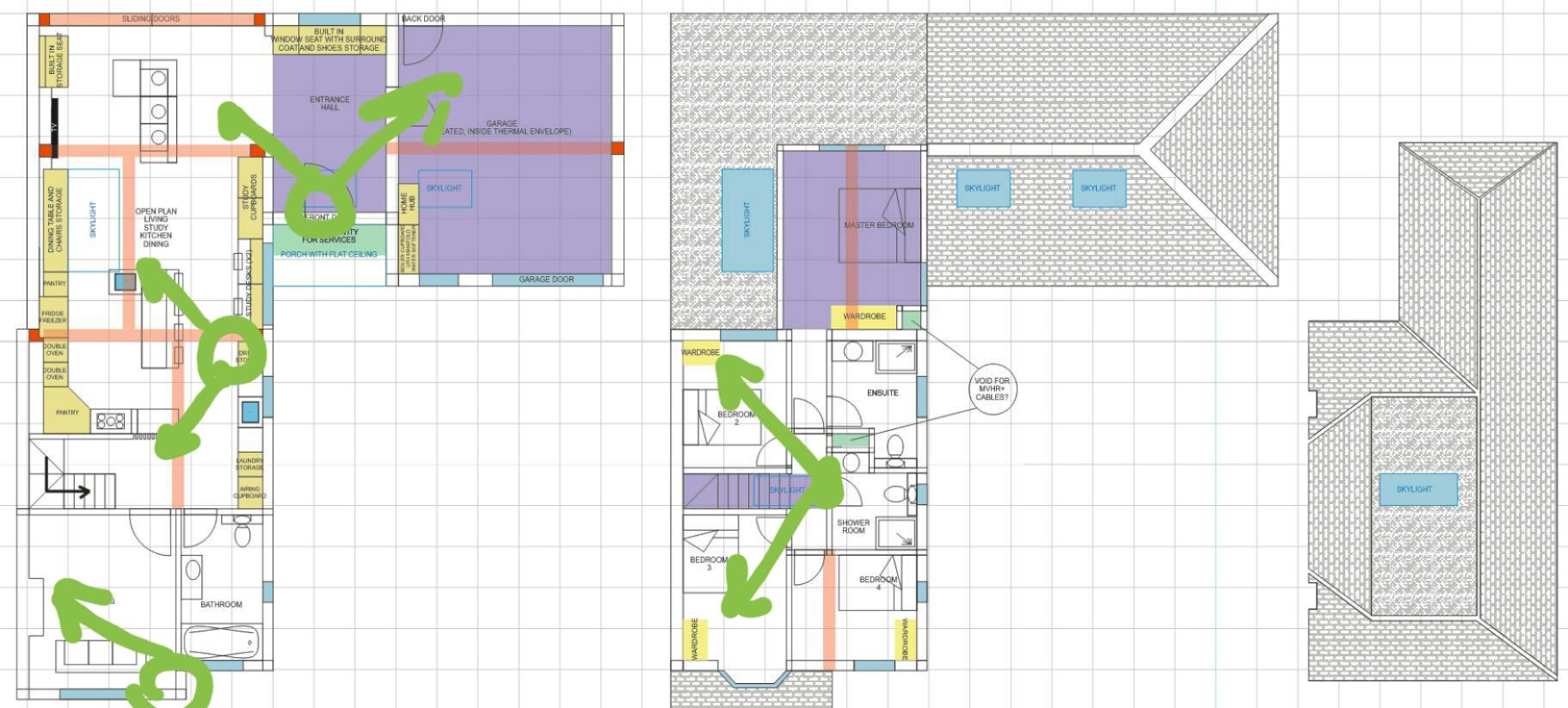
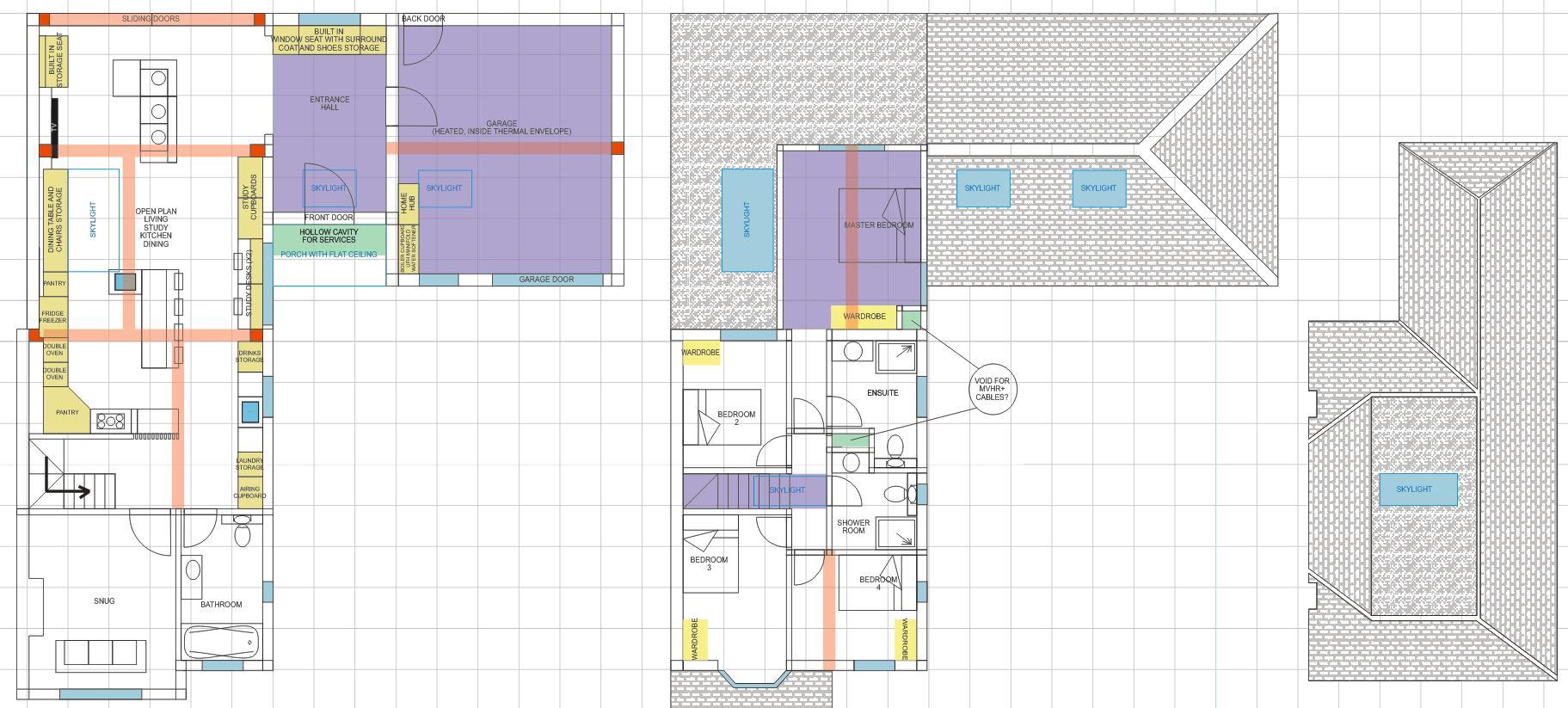
I am likely to get a 3way (https://www.appliancesdirect.co.uk/p/iqool-c3ms9k9k9k/tcl-iqoolc3ms9k9k9k-air-conditioner) or 4way (https://www.appliancesdirect.co.uk/p/argo-4ms9k9k9k9k/argo-argo4ms9k9k9k9k-air-conditioner) split ASHP from appliancesdirect. I wonder if they are happy mix and match between ceiling cassettes and wall units, will ask them today. Their installation service seems very good value for money. Question is where to optimally place the internal units so to have their effect experienced throughout the house. Attached is my thought on how I might best get some cooling to most rooms, including the garage. Would be appreciative for any opinions as to advantageous layouts. Have attached a blank version of the layout without my doodles incase useful.
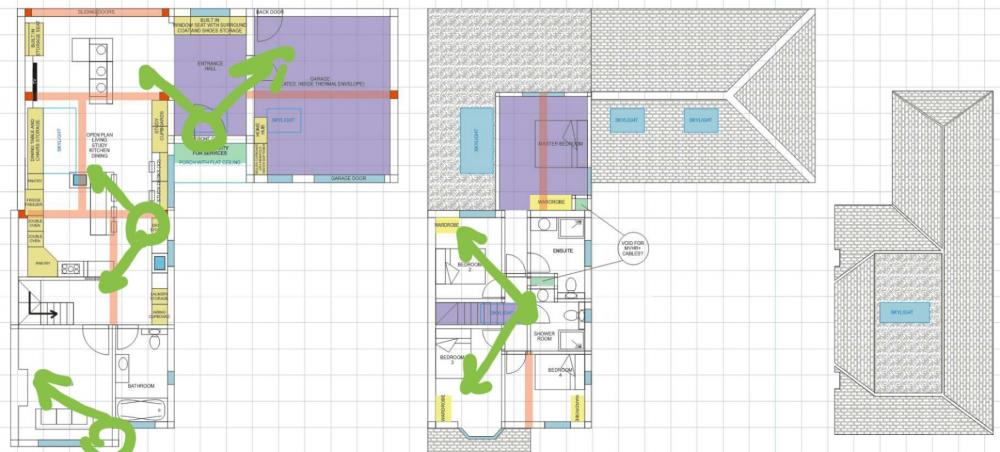
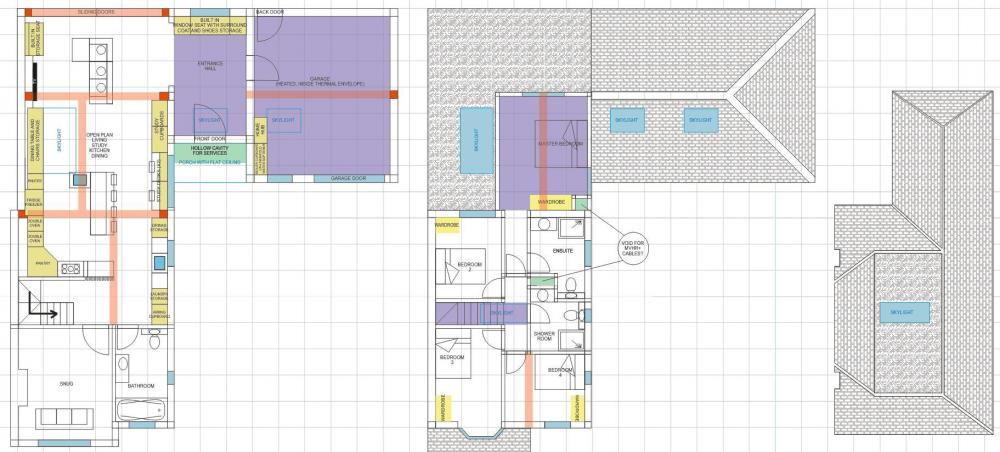
-
I have been discussing the placement of the MVHR unit with my builder. We have a potential space on the first floor inside the thermal envelope of the house. It would be easier to access the filters this way, but there may be more noise (it would be between two bathrooms, so not right next to a bedroom, but less sound insulation than we planned). Builder thinks pipework would be more of an ask like this. It would also sacrifice some of the size of one of the bathrooms. Is bringing the unit into the thermal envelope a good idea to try reduce the risk of the unit getting roasting hot in summer, and so even with summer bypass perhaps delivering very warm air via the ducting? P.S. we have grey roof tiles.
-
@Dan F if you don't mind, in the end did you manage to select a panel that represented best value to you?
-
Ah the quantity is included in the cost per item, no idea how i missed that, thanks