djcdan
-
Posts
139 -
Joined
-
Last visited
Everything posted by djcdan
-
Integrating an MVHR to our build
djcdan replied to djcdan's topic in Mechanical Ventilation with Heat Recovery (MVHR)
Are you able to achieve higher rad temps compared to water coming from an ASHP? It certainly does seem to be the easier option here. Any advantages of running water to these rads? -
Integrating an MVHR to our build
djcdan replied to djcdan's topic in Mechanical Ventilation with Heat Recovery (MVHR)
Yes, I'd seen others mentioning it to be fine with an MVHR extract point. With this constantly extracting - even when washing is not in that room - it should remove any moisture particles to keep it damp-free. The room isn't that large. It is 2.06 * 0.88m on the top floor of a 1.5 story. So 0.92m of the 2.06m length of the room is full height. It is probably just about large enough for clothes drying and nothing much else. Not sure. It was going to be water, but seeing as though we're not installing rads to bedrooms, it seems logical to consider both. Advantages of water - cheaper to run? Advantages of electric - negates having to plumb any heating upstairs so cheaper to install. -
Integrating an MVHR to our build
djcdan replied to djcdan's topic in Mechanical Ventilation with Heat Recovery (MVHR)
Yes, we'll probably be looking at the recirculating cooker hood approach to remove grease particles. Good to know. I'll bare this in mind when looking for a hood. Aint going to happen That's what I've told her. Not been easy to convince but I think she has just about accepted that rads aren't needed in the bedrooms!! Upstairs, we have a cupboard designated as a 'drying' room for drying clothes in the winter months. The door will likely be closed whilst washing is drying but there will be an extract point for the MVHR in that room. With the door being closed - therefore not allowing at much heat to enter that room from downstairs - is it recommended to place a rad in there too as well as the two ensuites? -
For installers in Scotland, it is worth noting that for ASHP installations, applicants can claim 75% up to £7500 'cashback' - virtually a grant - on their £10000 Home Energy Scotland loan when using an MCS registered installer leaving the remaining £2500 as an interest free loan. Prior to the launch of this cashback scheme a few weeks ago, I tended to agree with you, but this cashback scheme has changed this somewhat. But of course, the installer will need full accreditation and their details are checked during the application process.
-
Integrating an MVHR to our build
djcdan replied to djcdan's topic in Mechanical Ventilation with Heat Recovery (MVHR)
Thanks for the advice @Bitpipe I'm sold on the idea of no rads. Our u-values seem strong enough to support this. However, my partner is a bit of a 'traditionalist'! We've never lived in a well insulated or airtight home so is a little concerned she'll be freezing in bed at 12C on winter nights ?. This is the direction we'll probably take. I had planned a gap of 1.5m between recirculating hood and extract vent. This should be ok, shouldn't it? -
Integrating an MVHR to our build
djcdan replied to djcdan's topic in Mechanical Ventilation with Heat Recovery (MVHR)
@DavidO Thanks for this info. It seems your situation is similar. Ours is 193sqm with generally open plan living downstairs, stairs roughly in the centre of the property and central to all rooms upstairs. Others have suggested that MVHR plays a minor role in distributing heat, however if a constant supply of air is supplied to upstairs rooms - enough to complete an air change in that space every 3 hours at normal flow - at circa 18-19C, this must contribute to the overall climate control in these rooms... This, combined with the layout of the property, which promotes heats funnelling up from a continually heated downstairs and improved u-values to the glazing by improving from double to triple glazed, I think we'll scrap the rads upstairs, but keep rads in the bathrooms as you mentioned. Our SAP is being recalculated next week, and I'll request the calcs be produced based on no rads upstairs and see if they balk at the idea. -
We requested our meter installation in June. We are five missed appointments in, countless phone calls and lies, have a decision from the Ombudsman that we must be treated as an emergency and still have no meter... Buckle in for the ride. Avoid Scottish Power like the plague!
-
@revelation where have you found the Q350 for less than £1500?
-
Integrating an MVHR to our build
djcdan replied to djcdan's topic in Mechanical Ventilation with Heat Recovery (MVHR)
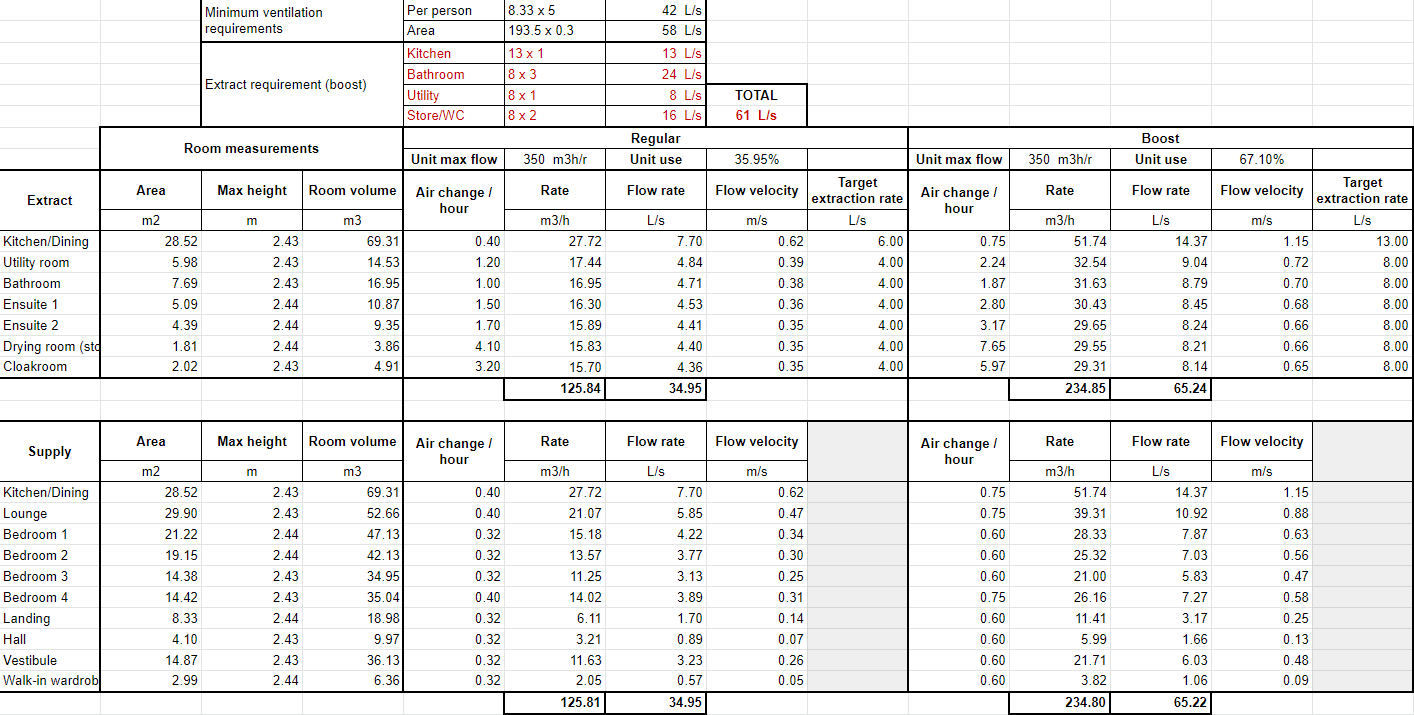
Xmas has been well spent working on MVHR research and calcs. Does someone mind having a quick check over my calcs? A few points of note: - I've narrowed it down to four possible units, each with a max rate of between 300-350 m3hr. Based on the calcs, this would be a 36%/67% usage of unit capabilities (regular/boost) for 350 m3hr units, or 42%/78% for 300m3hr units. Is 78% in boost mode still acceptable if we were to choose a 300m3hr unit? - I'm aware that rooms under 4sqm don't need to be included in the extractions. However, there are two rooms in the property that are smaller, but will be damp rooms. The drying room is small, but will be used over the winter months to dry clothes. The cloakroom will be on the groundfloor, so will have UFH and will be used to store boots/coats etc, so there will be water vapour in the room. I presume it is ok to include extraction points in these rooms? I have these spaces with a minimum extraction rate of 8L/s. Is this correct, or is it better to categorise these as WC's, which only require 6L/s as per building regs? - Is it best to leave the hall/landing/vestibule areas - which are centrally located to rooms with extract/supply points - as transfer space? Or can supply valves be added to these spaces? Through my research, I've noticed that these areas don't usually contain supply outlets. - The longest ducting run is just under 15m, so each run is based on single ducting as, based on calcs, it seems our velocity is well below the 2.5m/s advised here on BH as a maximum so each run is single duct. This, in addition to the unit usages in point one should result in low noise output from the unit?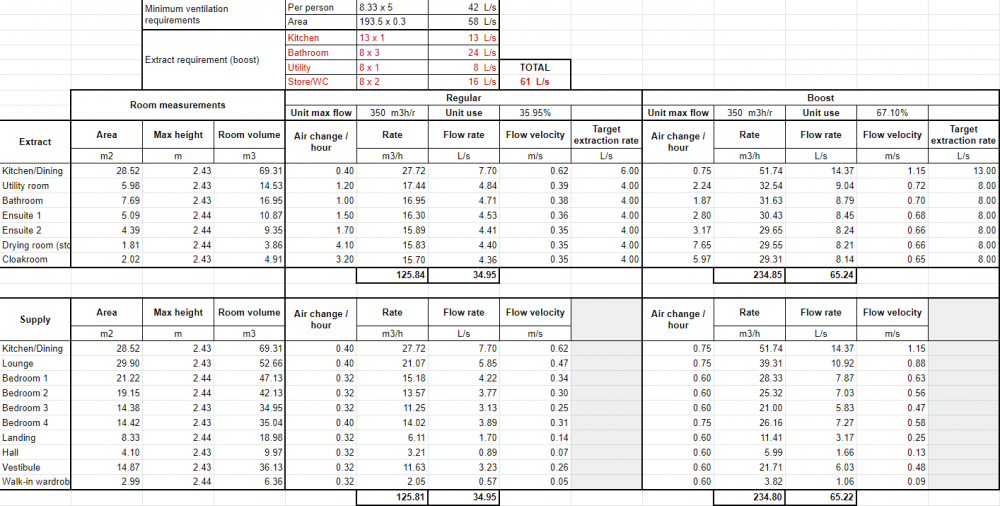
-
Integrating an MVHR to our build
djcdan replied to djcdan's topic in Mechanical Ventilation with Heat Recovery (MVHR)
I've sent across a quote request to compare the costs of triple compared to double. We have a decent amount of south facing glazing, so reduction of overheating would be a nice addition on top of optimising u-values. I have read a lot of content on MVHR systems over the past few days on BH and now leaning towards installing a standalone system like the majority here tend to do rather than a system integrated with an ASHP. In practice, it doesn't seem to be any benefit other than having one control panel. I am in the process of processing calculations and designing ducting routes, which I'll plan to have checked by BPC prior to purchase - which I have seen others mention on other threads. It has been mentioned numerous times on BH that a flow velocity greater than 2.5m/s will result in potential for increase noise from the system. I'm not sure whether I'm being dim and it is really simple, however I cannot find the equation to calculate this. In my head I can understand that the velocity will be the speed which is required to pass through the ducting in order to deliver the necessary flow rate to each room, but Maths is failing me! I'd use this to ascertain whether I'd need to double duct on certain runs. Installation near-enough to the mid point of the attic space would be desired to keep this central to all runs. But this would take the unit further away from either gable than the optimal distance for the main inlet/outlet. I'm therefore looking to take the inlet and outlet through the roof. We're having a Cambrian 'slate' roof and they offer a Hi-Flow ThruVent tile that offers a ventilation rate of 15,000mm2. Would this be suitable for a 193sqm property? Alternatively, we'd need to install closer to one gable, have a 'traditional' inlet/outlet on the gable, but the runs are longer. Cheers, Dan -
Integrating an MVHR to our build
djcdan replied to djcdan's topic in Mechanical Ventilation with Heat Recovery (MVHR)
We've currently speced Rationel double glazing units for the windows, which have a rating of 1.2. The velux's in the bedrooms (it's a 1.5 storey) have a rating of 1.3 and there are two in each room. I've not had PHPP modelling. Is this something that could be calculated myself, or best left with the architect? -
Integrating an MVHR to our build
djcdan replied to djcdan's topic in Mechanical Ventilation with Heat Recovery (MVHR)
Thanks @Mr Punter @Conor Ok, so a combination of both replies is that: - rads upstairs won't be needed. We're having a closed panel Scotframe construction. The U-value for external wall insulation is between 0.13-0.15, with glazing @ 1.2. I presume this would be enough to qualify for insulation levels? - The MVHR doesn't move the heat. Does the heat exchange simply take the chill from incoming fresh air before it's sent through to individual rooms rather than apply temperature? - Whilst there may be a minor impact on SAP calcs and heat demand, this wouldn't be enough to lower the sizing of the ASHP. - Oversize the system to reduce noise output. - Bathroom extraction isn't required, but kitchen is advisable. With regards to units, are there any that you would recommend, or any that you've had experience of which should be avoided? -
We're considering specifying an MVHR system for our build and have some general enquiries which I hope others who have installed one will be able to help with and answer. - We'll be having UFH on the ground floor and previously had specified radiators to the upstairs. By installing MVHR, could the upstairs be heated by i) rising heat from downstairs and ii) the MVHR to replace the needs to install rads? - By installing MVHR, this replaces the need for other forms of ventilation to kitchen and bathroom areas, which would typically be extractor fans? I assume this is correct since any additional ventilation system would reduce the airtight seal on the property and decline the efficiency of MVHR. - We're having an ASHP installed and had been expecting to have something in the region of an 8KW unit installed for our 200sqm property. As the heating would be supplemented by MVHR, would this reduce demand on the ASHP enough to allow us to install a smaller (5-6KW) ASHP unit? If we decide to go ahead with MVHR, our SAP calculations would need to be recalculated - as current calculations are based on without MVHR - but it would be ideal to have a rough expectation on this prior to making the decision to install to calculate potential cost savings on the ASHP? - I have seen mentions to slight noise during a 'boost' period, and to ensure the correct unit/ducting is sourced for long term maintenance reasons? Other than these, does anyone have any negative experiences/feedback for MVHR. Which unit to install? Our budget is most likely mid-range. Based on own experiences, can other users recommend which brands/models to consider and which to avoid? One local contractor installs NIBE units only and has based his quote on the NIBE F2040 ASHP. NIBE also offers MVHR which, according to their site, would integrate to the ASHP to create a single heating solution that works on one system with a single smart control panel to improve efficiency of the heating system. To me, this seems like a logical thing to do if the option is available in comparison to having the ASHP and MVHR on separate heating systems. Does anyone have the NIBE ASHP/MVHR installed and able to give feedback on this?
-
We have specified on our plans a pocket slider door with a 1524mm opening and therefore looking for much larger than the 'normal' door for this space. The timber door would be a single piece and slides in one direction. It seems my options are: i) Approach a bespoke door supplier ii) Find a supplier that produces doors of these sizes off the shelf iii) Commission through a local carpenter/joiner iv) Secure x2 762 doors together. I would like to avoid iv - this doesn't come across as the best solution. I will be pursuing option iii. However, I was wondering if any other builder here has previously sourced doors of this size through options i or ii? I have contacted a few larger suppliers who have confirmed they don't supply doors of this size. Has anyone here been in a similar position, and if so, are there any suppliers that can be recommended? TIA
-
We bought our 17 yo van for £3200 delivered from a caravan park, which we're currently living in. It's double glazed and centrally heated, and frankly, find it more comfortable/warmer compared to the cottage we spent the last few years renting. I would definitely recommend going big - I work from home and have a separate office, which helps with sanity. From taking deliveries to working a few hours around work or in the evenings, living on site is invaluable. Of course, you could spend £15k, but imo if you purchase correctly, there is no need. I'm pretty confident that we'll sell for what we paid, but will have saved us £££££ in rent!
-
As the title says, when should we screed? We are hoping to have our timber frame arrive on site early spring. To optimise efficiency of time, I was expecting to go in the following order slab > insulation > UFH > screed > frame erection - basically getting the floor complete whilst we wait for the frame to arrive. However, a screeder who has just provided a quote has stated that screeding cannot happen before wind and watertight stage; so slab > frame erection > insulation > UFH > screed. My father built a house 4-5 years ago and screeded prior to frame going up, hence thinking this was do-able. Can anyone enlighten how this should be handled from experience?
-
I get this all the times with contractors too. They make it seem like I'm trying to rob them blind. The best one I've found is the summary on the topic by Homebuilding and Renovating. Of course, there is the guide on HMRC's website about the scheme which is a little more formal, but more difficult to follow.
-
It is. Cheers. I just discussed zero rating the invoice for a supply and install through the DIY Housebuilder's scheme with the Building Merchant and they didn't have a scooby what I was on about! I'll discuss with the manufacturer who appoints the installer about the best option to move forward on this.
-
How to display internal drying areas on house plans
djcdan replied to djcdan's topic in Surveyors & Architects
Thanks @the_r_sole -
We have submitted our architects annotated drawings to our Building Warrant. Building Control have come back requesting that the internal drying area be shown on the house plans in addition to the annotations describing the location of internal drying. However, our architect is currently on holiday and unable to make the change. Instead of waiting for his return and delaying the application, can someone else advise how internal drying space should be shown on house plans (or how it was shown on your drawings previously) and I'll add this to the drawings before submitting the revision to BC. The architect can then adapt his master copy on his return should he wish. If it makes any difference to how it is shown, the architects annotation described internal drying on a pulley system.
-
Ok. So even if the installer is not employed or instructed to complete our job by the building merchant, the invoice from the building merchant should be zero rated? I put in the order this morning, but will contact them now to clarify this with them to make sure everything is clear.
-
We're purchasing a supply and install package for a treatment plant. The installation team is associated with the manufacturer, but the manufacturer doesn't sell directly to us. We are purchasing the supply and installation as a complete package through our local building merchant. On a usual supply and fit job, I'd expect to have the VAT zero rated, but since it's being purchased through a merchant, am I correct in saying the VAT is applied to the invoice to be claimed back at build end?
-
? This image will give me nightmares tonight.
-
@PeterW @Nickfromwales Thanks guys. The bearers of the bad news I was hoping not to hear, but still expecting to hear.
-
Our subsoil is clay. Around 50% of the previously excavated hole was topsoil with clay beneath. There won't be much opportunity for wiggling in to the correct position. To get any of the clay moved beneath the dry mix to solve the issue it would need the entire mass lifted out. The mass will weigh 7T, so our groundworkers digger wouldn't cope with that.