


djcdan
-
Posts
139 -
Joined
-
Last visited
Everything posted by djcdan
-
The outlet filter system is a cylindrical insert that fits inside the inspection chamber you can just about see in that photo. The outlet slots in to the insert. Imo, there should be no issue reintegrating the new outlet position to this insert if this adaptation is made to the tank.
-
Tricel Vento 3080 L. I'll attach a photo of the outlet - if that makes any difference.
-
Hi all. We sunk our septic tank last week, and based on manufacturers installation guide we surrounded in dry mix. We took level measurements prior to backfilling, but at some stage (possibly with weight of water and potentially a pocket beneath the septic) there has been movement during installation and the inlet end now sits 1.5cm lower than the outlet end... ? We need to find a way to rectify the situation before we begin using. A complete removal is a possibility, but one that I'd like to avoid to avoid the time and cost involved as well as the potential for puncturing the tank. If we could find a solution without uninstalling, that would be ideal. The best solution I can come up with is lowering the outlet point. The outlet point is a separately manufactured part secured to the HPDE tank with a form of sealant. My idea would involve removing the outlet (possibly with the correct sized hole saw), creating a lower hole (again with the hole saw) and then securing and sealing the joint with a suitable form of sealant. I would lower the outlet by around 5cm. Has anyone had similar issues before? Does my idea have legs or am I best exploring other options.
-
We're in MAKI. A fire hydrant is just further than 100m from site. Private drainage. Water connection already in place. Access is taken from the road going through the village. We're using a Scotframe construction. Yes, the officers seem pretty on the ball tbh. Emailed at 3pm today, had a reply by 4pm from the team leader.
-
@the_r_sole We're Argyll and Bute. Agreed end of Oct in extremely optimistic. If I am being honest, end of November would be our target if we can submit the BW application asap and have it processed without hiccups. Dec-Feb are worst conditions where we are. November isn't too bad (I know I have jinxed that now and Nov will be the wettest on record :)).
-
Cheers @jamieled. That makes sense. Yes, the workload from our SE is a concern. However we're in a relatively remote area with no local engineers. Our current engineer has already conducted a site visit has assessed ground conditions and has the necessary information just to complete to work - time permitting. I'm weary about starting this process from scratch with another. I really do not understand why they do not unfurlough at least some staff to ease workload. They clearly still have work coming in but don't have the staff to support the demand.
-
Hi all. We have a bit of a conundrum and hope someone with prior knowledge can advise. We want to be in a position of having our build wind and water tight by the end of October this year for weather related reasons. By my calculations, this means we need to submit our application for Building Warrant in the next 7-10 days. Covid has obviously been presenting delays to having our BW drawings prepared however we are now in receipt of all architect drawings - after three months of waiting! However, the next hurdle to surpass is having drawings completed by our engineers. However, they have furloughed all staff (three directors left working from home) and cannot commence with our drawings as they apparently have 65 live projects right now and it will be a while before they can work on our drawings... Why they would keep all staff furloughed with this much work is beyond me, but that is another topic. However, in their latest communication they confirmed that the BW can be submitted without their drawings and have provided us with their certifer details (apparently which we can use to reference in the BW application?). They have said they would then be able to follow up with their drawings and submission of SER certificate after the application has been submitted. They are providing foundation drawings and SER certification to the application. I was obviously expecting to submit the BW once all drawings were present and was not even aware a submission could be make with only some of the required drawings present. Does anyone know how this would be handled or how far along the process we could go before we would need the foundation drawings and SER certs?
-
All materials have been ordered. I went with the 6mm 2 core SWA for caravan supply, however forgot to order the earth wire to go from caravan CU to earth rod! With a 6mm supply cable, logic would say the earth should also be 6mm. Before I order, can someone confirm that to save the potential hassle down the line. Thanks
-
It does have CH. However, I'll fit a 6mm SWA to be sure, if nothing else. What size earth rod do you have fitted?
-
Having researched SWA cable sizes, my findings, based on our three phase supply, say I should go for: 16mm² three core for house supply - length 12m, 80A (I presume the max Ampage would be 80A since the fuse in the switch fuse is 80A) 1.5mm² three core for treatment plant pump - length 30m, 3.3A 1.5mm² two core for caravan - length 15m, 13A Does this sound correct? Are there any negatives to laying a cable that is too large other than increased cost? Also, Screwfix offer a 3/8" and 5/8" earth rod. The 3/8" is what I need?
-
Thanks @ProDave
-
Perfect. I think that's exactly how I had it: What do you reckon about the quote below? Is three core SWA needed for the caravan if we're TT earthing: Other than this, does all look ok with my plans? It's my first time doing electrics of this nature, and would prefer it not to go bang! But at the same time, determined to do it to learn some great skills. From the garage CU, I'm planning on running another SWA cable for the treatment plant pump since the cable is going outside, but the garage circuits just PVC insulated cable.
-
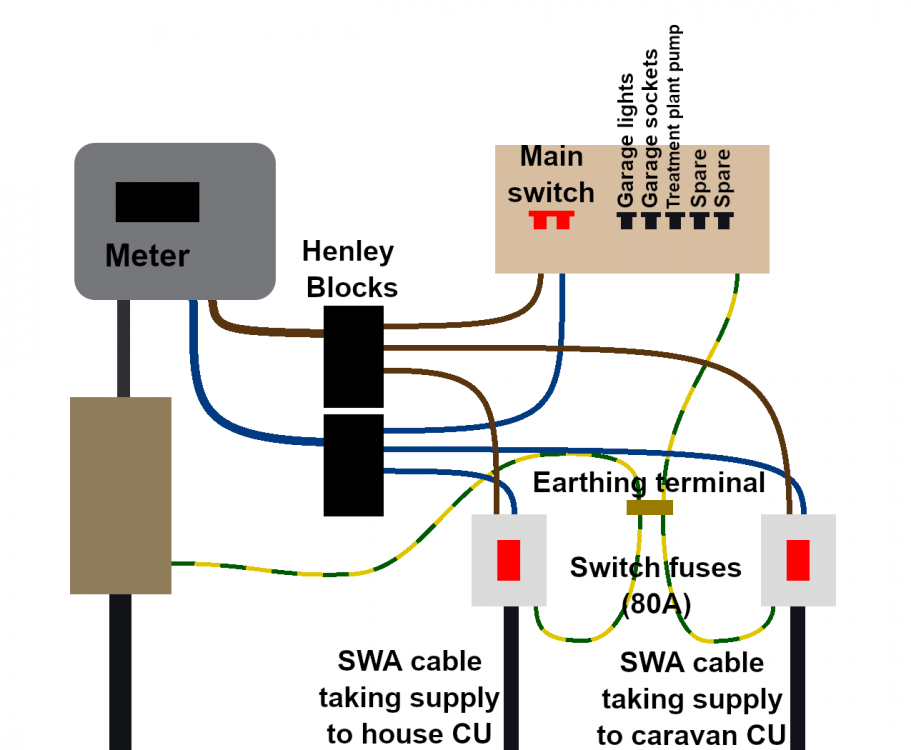
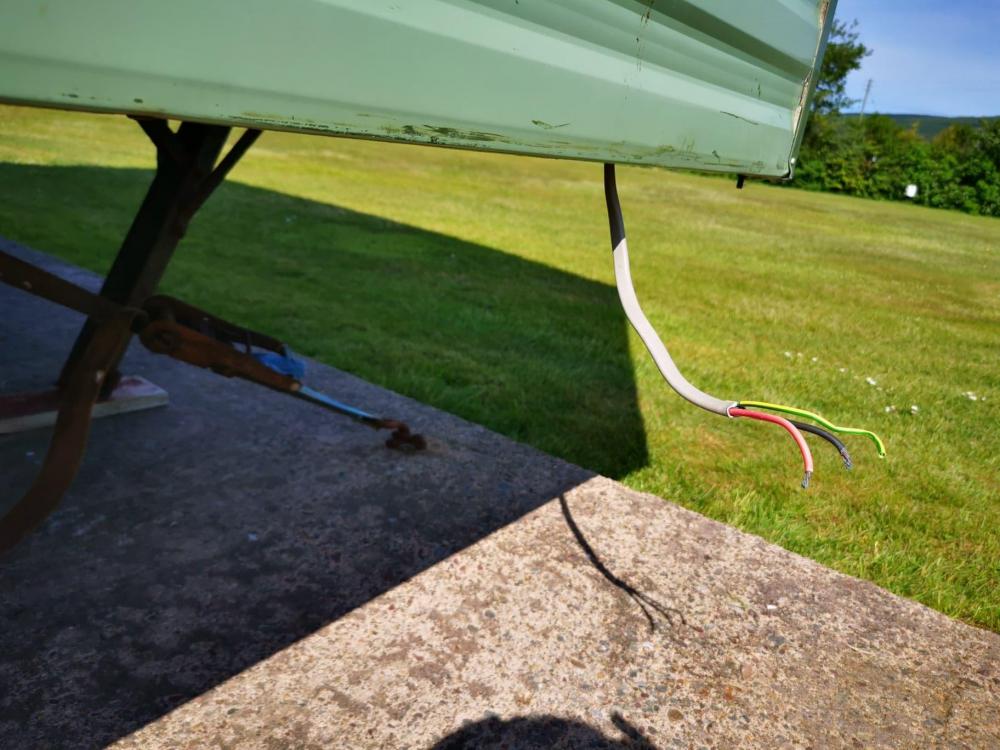
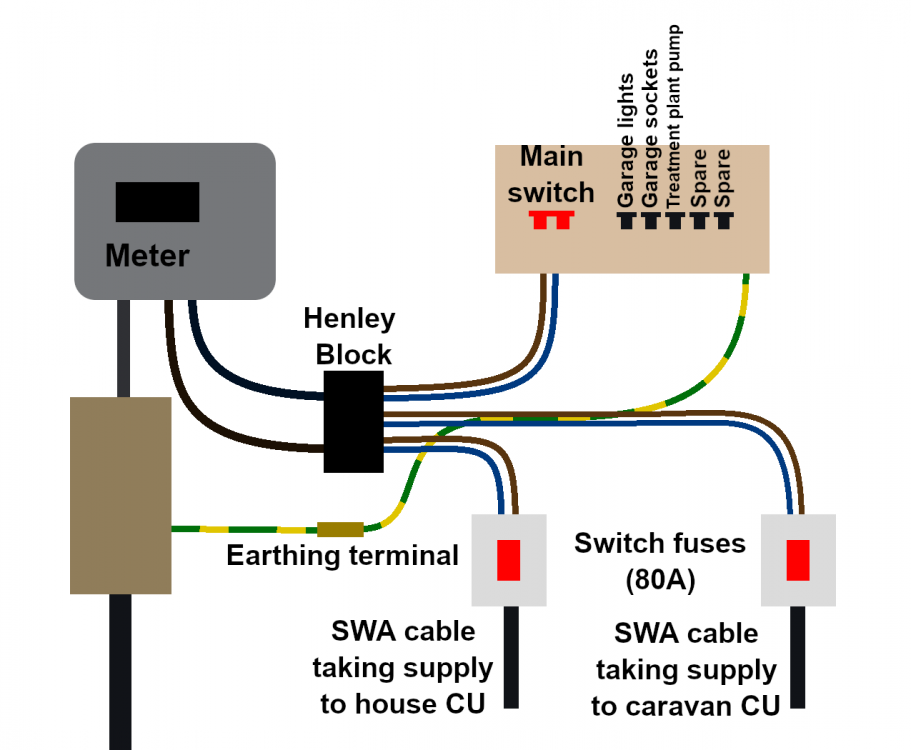
@PeterW @ProDave Thanks. Attached an updated drawing. I've updated the setup so one Henley Block to cover live and another to handle neutral. I now have earthing connected to the terminal from the switch fuse/origin of the SWA cable on the diagram. Is this correct? I have attached a picture showing the current state of the electricity connection point on the caravan we've purchased. To confirm what I will do; I'll remove this cabling up to the CU position and run the SWA cable in it's place. Upon entry of the SWA at the caravan CU, I would install with an insulated gland. I'd earth the insulated gland to the CPC in the caravan and then from the CPC (which would already be prewired to earth everything else in the caravan), I would install a TT earth, with the rod exiting the caravan and fitted securely in to the ground beneath the caravan. The SWA would still be earthed at origin as shown in the diagram. Because the caravan has a TT earth, would I need a three core SWA for that sub main or should I use two core? Since the earthing wire in this sub main - if we used a three core - wouldn't be needed as we are using TT. Let me know if I've misunderstood anything.
-
Hi all. Connection went ahead successfully. They fitted us with a three phase rather than the single they originally priced and paid for, which was good of them. SSEN have therefore taken supply to the box and waiting for lockdown restrictions to ease for SSE to fit the meter. Exact same thing happened with us. We had prepared to the their official customer installation guide, the local engineer said it wasn't needed and we actually didn't use the ducting. We'll likely use it elsewhere though, so not too bothered. Before meter installation, I'm looking to have all other infrastructure installed to the meter cabinet myself so when they arrive, SSE connect their installed meter directly to our Henley Blocks and we're good to go. I'm looking for the very helpful advise here to put me on my way (first time doing this stuff!). I've attached to this post a drawing of the setup I am currently expecting to install. The meter backboard (not a cabinet) has been installed in a fixed and permanent position inside the garage and from there, I'm expecting to run a small permanent CU and two sub mains. The garage CU will operate garage lights, garage sockets (inc x1 external socket) and the waste treatment plant pump (situated about 30m away) and leave two for future garden related electric requirements. One sub main will run to the main CU in the house, and the second CU will run to the caravan, which has it's own CU. Both sub mains will be protected by a 80A switch fuse. Question: - Is it advisable to run a second sub main to the caravan, or could this supply be run from a suitably sized RCD (can you run CU to CU)? - If two sub mains, can x1 Henley Block handle this or will two Henley's be required? How would two Henley's be configured? One with the garage CU and the other supplying the two sub mains? - Would running the supply for the pump chamber for the treatment plant be ok to come from the CU or better as it's own sub main? - The caravan would have it's own TT earthing. The garage CU would be earthed. However, other than this, does any other consideration need to be given to earthing? In terms of the materials I need to purchase for this, am I correct in saying: x1 Henley Block 25mm² connector (possible x2 based on the advice) x1 Main switch consumer unit x5 RCD's as shown in the diagram Roll of 25mm² SWA three core cable 1m 25mm² 1-core live meter tail 1m 25mm² 1-core neutral meter tail 1m 16mm² earthing cable x2 Switch fuse (with 80A fuse) x1 Four way earth block The guidance and ideas received from here are always welcomed. Thanks!
-
@ProDave Interesting. Thanks for that information. That is definitely worth exploring with SW. We are in a similar position - very quiet road with no traffic management needed.
-
@Simplysimon My quote from Scottish Water for the connection is roughly the same. The works in your quote box relate to the opening of the road, resurfacing and the laying of the tar access. It'd be great if someone who has had similar road works and tarred access laid could confirm if this is the sort of quote I should be expecting?
-
@Simplysimon @ProDave Ok. I'll bring this up in the pre-start meeting to find out exactly what they need and may have to change my schedule of works. However, what is the difference between 1) completing all pipework and backfilling the trenches ahead of their connection and 2) completing all pipework after SW have been and gone? In both scenarios, SW wouldn't see the pipework. Why would they have interest in viewing pipework in scenario one, but not scenario two? I presume they wouldn't return to check pipework our side of the boundary if we installed pipework later? What's your opinion of the quote to tar and excavate the road?
-
I'm planning on completing my end of the pipework to the boundary box before Scottish Water connect to their end of the boundary box. The reasons for this is: 1) It will allow us to complete all groundworks to the access - inc laying sub base - at our own pace whilst reducing previously expected labour fees whilst we wait for lockdown to be lifted (SW won't connect at the moment). 2) By completing all groundworks, it allows us to bring the groundworker (for the tarring) to site for one visit rather than two. Bound to save on cost. 3) Everything we can complete now during lockdown would effectively stop because the water trenches haven't been backfilled. They cut across all land that we plan to work on. The current layout of my pipeworks isn't as shown in the OP. It has evolved beyond that point and now feel confident with stop tap/inspection chamber/tee placement to get water to the places needed whilst optimising water flow to the main property. However, I also have a pre-start meeting via phone with Scottish Water on Thursday where I can basically ratify my plans with them. However, my enquiry now is relating to the cost of laying the tar, excavating and resurfacing the road. In your opinion, is this quote reasonable or on the high side?
-
We received a quote for a road opening this evening and to tar the access opening to the road. The quote came through as: £2390 - Plant and labour to lay tar access (22sqm) @ 80mm base layer and surface layer of AC10 at 40mm with seal to existing road. Also tar reinstatement to public road (5sqm). £1540 - Liasse with Scottish Water to organise track inspection and connection. Plant and labour to excavate 4m across the public road. Backfill trench and connection hole ready for tarring. £300 - Road opening permit Above not including VAT. It is worth noting that the quote does not include preparation to the sub base. I will be laying the sub base (hardcore) to a depth of 150mm along with a friend who is a garden landscaper. I will also be organising the works so that tarring to the road and access will happen at the same time in one visit rather than over two visits. Is this the sort of pricing that would be expected? It feels a little steep for the amount of time and materials needed for the job.
-
Thanks for all the advice! Appreciated. The connection is booked for 20th May, and now far more prepared.
-
Thanks for that @ProDave. I can see this is going to be a great learning curve, looking forward to getting stuck in with it all. So to review it to make sure I have understood each point: - SSEN will take the connection from terminal to permanent position inside the garage and the supplier install the meter in this position. The meter connects to i) a permanent CU in the garage (next point) and the switch fuse. - Connecting to the meter, we would install a permanent CU, which would feed 1) the garage circuits, 2) the caravan (which needs to be TT earthed instead of PME) until it leaves site and 3) any other site sockets positioned close by if desired. - Also connected to the meter separately would be the switch fuse (fitted with an 80A fuse). - The switch fuse would feed the house with a SWA cable running from the switch fuse to the finished property once built. Once the SWA cable arrives in the property, I presume this would then go through a second CU positioned in the house to manage the individual circuits inside? By installing inside the garage in a permanent position, would we still require the meter cabinet or can we install directly to a backboard/sheet of plywood considering it is positioned inside and undercover? Going back to my OP, would either of the linked ducting be sufficient? I have noticed the second link states Class 3. It this better or worse than the required Class 2?
-
A sub main would include having the meter at one end and consumer unit at the other? In the SSEN guide, it says 'The length of cable between your supplier’s meter and the consumer unit must not exceed 3m'. In another thread, I saw you answer this by saying installing our own switch fuse would allow us to increase this 3m distance (garage to final CU position is around 9m). https://forum.buildhub.org.uk/topic/3030-new-electric-supply/?do=findComment&comment=47128 So you'd propose installing the meter, temp CU and switch fuse to a backboard in the garage, run the supply to the caravan, and then also run a supply to the CU installed in the house when available? Then when moved out of the caravan, removing the temp supply and temp CU.
-
@Mr Punter Thanks. That has been added. I came across an inspection chamber offered by jdpipes.co.uk advertised as a boundary box for those in Scottish Water areas - https://store.jdpipes.co.uk/scottish-water-boundary-box-meter-chamber/ Has anyone used this or am I best just using a standard stop tap chamber with stop tap and non-return valve installed within? I also noticed in the connection guide provided by SW that during their inspection, they would need to see the double check value (non-return valve) and drain valve installed. What is the drain valve?
-
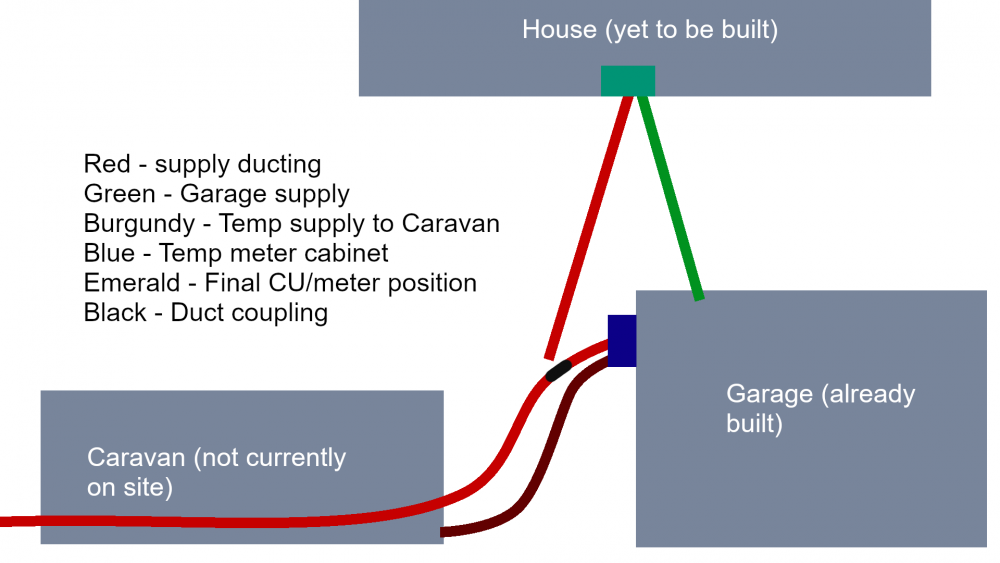
We are having a new connection installed in the next few weeks by SSEN - our local provider in Scotland. I want to run a few options by the Buildhub community so I can work out what is best in our situation. We will be living on site during the build in a static caravan so would like to install the connection for temporary and permanent use. I've attached a diagram showing my thoughts right now: - I'll excavate and lay ducting in all areas (red, green and burgundy colours). - Initially, there would be a temp meter cabinet next to the garage. - The supply will run through the ducting via a ducting coupler towards the temp meter cabinet. - When we are ready to move the meter to the final position, I will reroute the cabling through the previously laid ducting going towards the house, attach the ducting coupler to the duct running towards the house and remove the temporary ducting previously used. - I will build boxing around the coupler to allow ease of access later for this to be changed. - We will pull through enough cabling to get us to the final meter position, so would likely mean extra cabling would sit beneath the temp meter cabinet. - Until we move to the final position, the unused ducting lines will be capped off. - Once the meter/CU has been moved, the cabling to the supply the garage will be laid through the prepared ducting. We had considered both options - install the meter/CU in a temporary or permanent position outside - and we're leaning towards repositioning after the house has been built for aesthetics. Are there any other benefits to having this installed in a permanent position immediately other than the cost of repositioning (how much would we expect this to cost)? On a separate note, SSEN have requested ducting meet ENAT 12-24 standards of at least Class 2. Many suppliers advertise their product as electric cable ducting, but do not advertise which class the product is. For example, would this or this suffice? I see some suppliers advertising Class 3 ducting. I presume Class 1 is the highest, and 3 the lowest and therefore not suitable? Is this the best way to handle the ducting in this situation? Does anyone have any other solutions other than using a coupler to reattach the ducting to a different line? Thanks in advance!
-
@PeterW Thanks. I'll do that. Other than that, everything looks ok, and the materials list shown will complete the job?


