


djcdan
-
Posts
139 -
Joined
-
Last visited
Everything posted by djcdan
-
We plan to have electric UFH mats in the ensuites upstairs and trying to work out the materials needed. The floor makeup is 22mm chipboard on joists at 600mm centres. Within three spaces - between 1.5sqm and 3sqm - we want to install UFH mats. Two of these spaces will have a tiled flooring and one carpeted. It seems standard that a chipboard floor naturally has a little 'give'. What floor make up is required in the tiled spaces to ensure longevity of the tile floor and best performance of the UFH mats?
-
Zero rating vat
djcdan replied to nod's topic in Self Build VAT, Community Infrastructure Levy (CIL), S106 & Tax
I've had trades who have supplied and fitted zero rate their invoice on applicable materials. If Pasquils are fitting, then the VAT should be zero rated once you've provide you PP reference. If not, then VAT would be payable and claimed back as you did before. -
Thanks. Would you recommend with or without a HP12 base layer? Cement board - https://www.builderdepot.co.uk/10mm-cemboard-general-purpose-cement-board-2400mm-x-1200mm-8ft-x-4ft Self-tapping screws - https://www.screwfix.com/p/easydrive-carbon-steel-self-drilling-screws-5-5-x-75mm-100-pack/44476?tc=OB8&ds_kid=92700048793290424&ds_rl=1249413&gclid=Cj0KCQjwpreJBhDvARIsAF1_BU2hBLHaj4LBpyEkMq2xBG2YremcBsAvBR_v7zbdi7GHLEKYwCfg83gaApqMEALw_wcB&gclsrc=aw.ds (or something along these lines) PH Glue?
-
We have a renderer on board. We've had discussions with him who has said he has K-Rend on his house and that if we're ok with the occasional clean (algae can grow on the silicone render in our location), which we are, then we'd go with that. They have also given the option of labour only and supply & fit, hence looking in to this in greater detail. None-the-less, the control freak in me wants to understand the system down to the fine detail to ensure I also consider this best ?. We're in quite a rural location, tucked out of the way with little outside influence from other locations. Sometimes the trades here recommend things just because that is how things have always happened, with the more 'current' products not yet filtering their way through. I've read render warranties aren't worth the paper they're written on? The manufacturer would always find a fault with installation - however small - and installer site blame on the product?
-
We're currently finalising details for our render system and planning to get this on order in the next week or so. We are set on having a K-Rend system laid directly on block skin, but have a few questions: i) Which system, between the FT or K1, is better? I can see that K1 can be sprayed, but other than this, there doesn't seem to be much between them? ii) We have steel lintels. I have read that render board can be secured to the face of the steel lintels and the render applied to the render board. Is this the best way to do it, and if so, what is recommended to secure the render board to the steel - fixings or an adhesive? iii) Other than the bags of render, it is only beading required by the renderer to complete the job? iv) Is it recommended to use K-Rend HP12 as a base coat beneath the FT or K1? I see some mentions that the top coat can be applied without the base but a thicker layer. What would be the reason not to use a base coat? v) How thick should the layers be? vi) Can anyone recommend any suppliers (other than the usual building merchants)? Thanks in advance!
-
Cheers @nod. I have purchased a few rolls of the Airguard Control VB based on your recommentation, so thanks for that. Quick question, can you clarify the abbreviation of PB? On the ceiling and walls beneath the coombs, the plasterboard will be applied directly to the timber of the trusses/roof frame. I presume they'd be no issue with laying the Airguard right beneath plasterboard with no air gap?
-
Once at ground level of the first floor, does it just terminate at the joists, or continue somewhere? Polythene is what is supplied via the kit manufacturer, Scotframe. Is it worth purchasing my own? Any idea on the correct way to lap around the Velux's?
-
Hi all! I'll be installing the roof insulation this week. Everything feels clear RE: insulation/battening, but wanted to check from those who know that 1) I understand the primary role of the vapour barrier and 2) the correct way to install. For clarifications of build details: - Our roof makeup is shown in the below architect drawing. 170mm insulation between the trusses. Then vapour barrier stapled to the trusses. On top of this, boards of 25mm insulation secured in place with 35mm service battens nailed at 600mm centres in to the trusses through the 25mm insulation. - It is worth noting that we will have MVHR and understand one of the results of a correctly installed vapour barrier is increased airtightness. With regards to the vapour barrier, am I understanding correct that the primary objective of the vapour barrier isn't as a final barrier of keeping water out (in the event of a loose tile etc combined with breakage in roof membrane), but to keep condensation (formed from the potential meeting of warm internal air and cool external air and uninsulated spaces) from infiltrating the trusses and insulation? I am expecting to secure the VB to the trusses with staples, but my questions are really focused on: - Does the vapour barrier completely encircle the upstairs ceiling as shown on the red line I have drawn on the plan below? - Does the VB run down the walls beneath the coombs? This would seem to make sense as the eaves are uninsulated, so provides the barrier between heated and unheated space. If so, where and how does this terminate? - In the roof space, we have six velux's. What is the correct way to lap and joint the VB in to the velux spaces? - Am I correct in saying the polythene VB I am installing is jointed to the preexisting silver faced VB on the internal gable installed by the kit manufacturer using foil tape? I feel this is quite crucial in order to achieve our air tightness goal, so any assistance would be appreciated. TIA
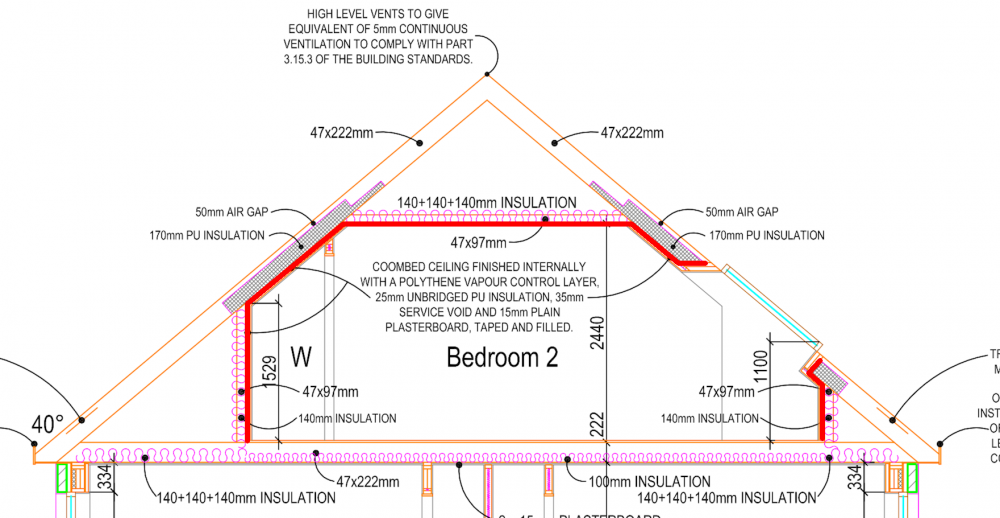
-
Our attic space is currently planned to be uninsulated. However, we will be installing our MVHR unit in to attic and the plan was to wrap the necessary ducting/pipework in insulation. The other option would be to insulate the entire attic space instead. If we were to do that, as well as no longer needing to wrap pipes in insulation, I would have thought it would have wider benefits to the properties overall heat loss. For clarity, the attic floor (upstairs ceiling) will already be insulated and am referring to the apex of the roof between the trusses. What would others recommend and if you'd insulate the apex what type of insulation would be suitable? The simple option would seem to be insulation board. Would CWB do the job? This seems to be more competitively priced compared to general PIR boards.
-
Yes, I see what you mean. Thanks for taking the time to draw that out. ? To confirm, the face of the lintel would be 140mm high thus allowing for larger cut ends to sit on the block as shown in the amended drawing? ... and lay the block first of all before cutting and fitting the lintel? The feature stone is 26mm stone cladding pieces that will be applied direct to the blockwork/concrete lintel using mortar adhesive (is what the supplier calls it).
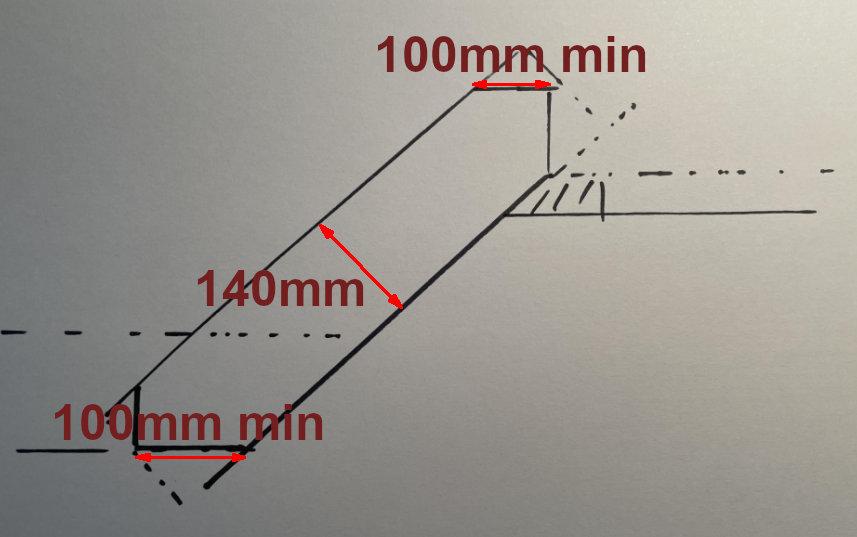
-
The window is already in @Olf ?. It looks great, but the brickie is quickly approaching and I have no lintel for him to fit!! I also cannot see why a concrete lintel wouldn't suffice. Has anyone here fitted a concrete lintel on an angle?
-
Can anyone offer any advise on this? Still in the same boat and struggling to have this special lintel manufactured by Keystone or Catnic. This is the window in question. The weight above the lintel is relatively small, but my main question is whether a concrete lintel can be laid on such an angle. Has anyone successfully done this?
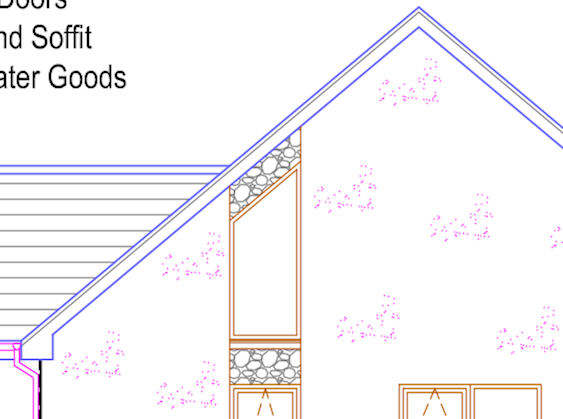
-
We've been supplied a GGU Velux with EDW flashing kit from our kit supplier. I'm fitting the first window today. I'm confident the window and flashing kit provided have been installed as intended, but it seems that this system should also have been installed alongside the BDX foam collar and accompanying gulley that fits above the Velux. Our roof is counter battened. With the EDW flashing kit alone, it feels as though water could enter under the EDW flashing (which sits completely above the battens/counterbattens) should rain or condensation should find its way beneath the roof covering. Has anyone installed the EDW kit alone without the BDX kit?
-
Condell was a great shout. Quick and simple to order even during steel shortages and half the price what our local building merchant had quoted initially. I now have 12 of the 13 lintels I need. The last is for a window 900mm wide but has a 40 deg slope at the top of the window rather than being flat. Having spoken to a few suppliers, as well as Catnic and Keystone themselves, I would need a 'special' half-apex lintel produced specifically for the job. Problem is, they don't seem to have manufacturing capabilities at the moment for specials. This window is right near the top of one of the gables, so has relatively little weight on top. Would a concrete lintel be sufficient rather than waiting for the steel to become available? I presume there would be no issue installing a concrete lintel on a 40 deg slope?
-
General order list for blockwork
djcdan replied to djcdan's topic in Bricklaying, Blockwork & Mortar
Thanks @Brickie @Declan @saveasteading Ok, so will purchase enough of this to line openings two courses above doors and two course above and below windows. So a product like this can be used to fill the expansion joint and fill the gap between top block course and eaves/soffit? I have common course brick for below DPC/bell cast. Can the brickie not cut the block to size for beneath and above openings? It has taken me six weeks to get block materials to site and the job is due to start next week, so not sure of the viability of bringing anything else in. Yes, came with the frame and already installed ? Fair enough. Perhaps the frame erector saw it on a previous job where it was overspecified. It's quite costly so would be happy to install a more cost effective material that is more intended for our job. -
General order list for blockwork
djcdan replied to djcdan's topic in Bricklaying, Blockwork & Mortar
Has anyone ever used Compriband expanding foam tape to create a seal between top coarse of block and soffit? The contractor who is currently erecting our frame suggested it, but there aren't any suggestions online for this use case. If not Compriband, what is used? Or is it just left as an open gap? -
The roof system we're using recommends Wakaflex lead free flashing for detailing around GRP valleys. However Wakaflex seems incredibly dear in comparison to other lead free adhesive backed flashing on the market. Has anyone used these cost effective alternatives and had a positive experience. Ultimately I want the roof to perform as expected and want to ensure that these cheaper solutions, such as this (https://www.lbsbmonline.co.uk/lead-free-flashing-5m-roll-smooth) won't fail over time. Any thoughts?
-
I bought myself a Wagner based on some of the feedback seen on BH. I'm coming around to giving this first use for painting to external timber so is an acrylic based paint. Will I require a special cleaning agent to clean an acrylic based paint from the system and to clean the nozzle/filter, or will the normal flush through with water do?
-
Does anyone have experience of using concrete lintels rather than steel for above doors/windows?
-
Our BM wouldn't match insulation and drainage quotes found online. I bought 150mm insulation a few months at £43/sheet. The lowest the BM would entertain at that time was £55. Likewise, I bought my drainage well ahead of schedule last year. 3m length of 110mm S/S was £6.99 + VAT when I bought (that particular supplier has now increased 50%). BM was above £10 + VAT per length. Luckily, our contract with our kit supplier was fixed in Jan this year, so the bulk of our timber and insulation cost has been fixed prior to increases in 2021.
-
I order bulky items (block/cement) from our merchants and aggregates from the local quarry, but literally everything else comes from online retailers. As well being MUCH cheaper, the selection on offer with online retailers is far larger in comparison to BM's allowing me to find the precise product I want/need. I daren't think how much a budget could slip if I only used a local BM for all materials.
-
Thanks all @Moonshine @James Newport @PeterW I'll make contact with Condell.
-
Does anyone know of any steel lintel supplier taking orders right now with a lead time without 8 weeks? I have been in conversation with Keystone for several weeks and the order was all but confirmed, but this morning they confirmed that their allocation had been taken up by a large house building firm and wouldn't supply our build... ? Not impressed that we went through all the pre-sales chat to confirm our order to be told this after order confirmation. Has anyone successfully placed orders for steel lintels recently? If so, with who? TIA
-
General order list for blockwork
djcdan replied to djcdan's topic in Bricklaying, Blockwork & Mortar
Thanks - added. I did mean to write that ? Is anything required where block meets roof verge or soffit? -
Our outer skin blockwork is scheduled for July/August, and ordering materials ahead of schedule considering shortages. Below is a list of materials I'm expecting to purchase. Have I missed anything? Our construction is pretty typical - timber frame with 100mm block outer skin. In the main, block will be rendered, but other areas stone cladded. Materials list Block B.Sand/cement/plasticiser 100mm DPC Concrete sills Steel lintels Cavity wall ties for timber frame Expansion ties Have I missed anything - maybe sundries/consumables? There will also be strong-ties to fix the frame down, but these come with the kit.

