


Brickie
-
Posts
634 -
Joined
-
Last visited
Everything posted by Brickie
-
Why below Dpc? Who has suggested this?
-
Would it be feasible to power float a finished concrete floor with dye to the desired colour,then grind the false joints out & point in with natural coloured muck? Or is your build way past that stage?
-
Okay,a cavity tray will go from your inner leaf down to the outer leaf,with weep vents @900mm or 450mm centres as per spec. For rendered work they should be sat proud of the blockwork to the depth of the render (say 20mm,if 2 coat sand & cement) so they sit flush with the finish render. They are a common detail on cavity work,principally over lintels but also at g/f level if spec'd & also at any parapets or where adjacent structures abut (I.e. Garage roof.) Your TF supplier should supply you with a technical sheet showing how to install.
-
A trial pit is your first move,I'd say. I know it might seem like s lot of hard work for nothing but if it saves you having to do it in sections it'll be time & money well spent.
-
Really old timber lath would've bent around most curves,horizontally. The method I learned in college was using EML & two coats of bonding before skim.
-
That would mean you've got an extra 75mm to make up on your b&b floor to ffl. 2 courses of these in 140mm will get you there http://forterra.co.uk/thermalite-and-aggregrate-blocks/thermalite-aircrete-block-detail/thermalite-aircrete-coursing-brick
-
I wouldn't depend on BCO to have the technical knowledge of timber frames to answer that question properly. Fair chance he doesn't come across them too often. It may be common practice now but every one I ever worked on,the cavity stayed as a void.
-
Are you sure there's insulation in the cavity? Check with the Tf people about that. Also,as yours coming off b&b floor-what width of wall is supporting the ends of the beams? If it's 100mm & you're then laying 140mm on top to receive the frame,is it not the case that 40mm (or almost a third) of your structure will essentially be sat on fresh air?
-
Thanks all-had a reply from Whitegoods.co.uk telling me that it is indeed all integrated & the replacement would be £150 odd. Ordered a new one a paying the extra for 5 year warranty. New van will have to wait a bit longer :(( (when I say 'new',it'll more likely be a teenager,with all the aggro that goes with.)
-
Is that white cylinder the spider? Was thrown by it not looking like the parts I've come across in searching for bearings.
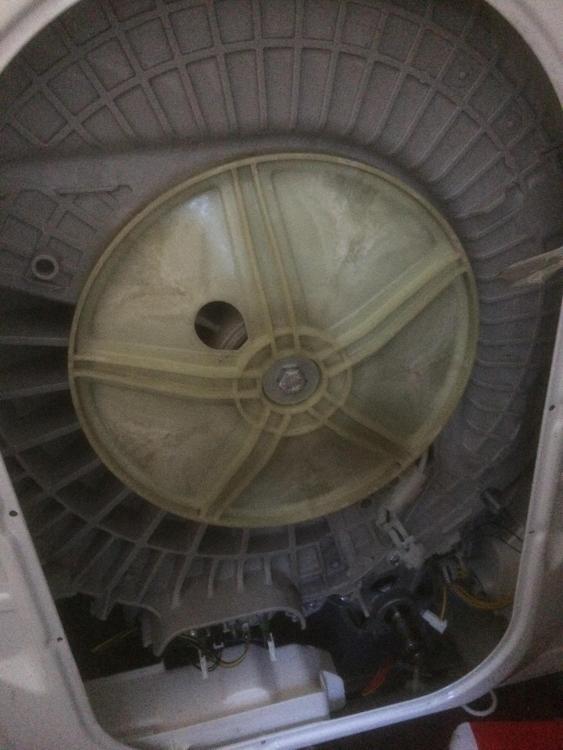
-
1/ it's a long time since I worked on timber frame but every single one I have had the cavity empty. Weep holes were built in at the bottom (on the cavity tray) & near the eaves to create a ventilated cavity. The 'norm' may well have changed since then so worth looking into. 3/ you need Dpc all the way round for it to be effective. As I mentioned above,it used to be the norm to fix a cavity tray at ffl,if not then 100mm damp all the way round,with additional stepped down (& lapped) to 150mm above dropped ground level. When the time comes we can go over exactly how to install a tray,also care need to be given to propping lintols & cutting blocks to go across them. By God,thermalises love to bow out over openings,esp on tf. We had to put bed joint reinforcement (brick tor or train track) for two courses below & above all openings,to minimise movement & prevent cracking. Again,worth researching if this practice has been superseded.
-
Opened the back up and-there's no spider!! is that normal? No sign of it broken off or anything!
-
Only just woke up at 8.50-living the dream! Had a look myself & also can't see it,nor anywhere else. Puzzling-could it be the design is such that the bearings alone can't be replaced? I'll have a look at the online manual when the two Fun Size People in my life will allow it.
-
???
-
Is that the product number? if so,it's 91460560500. Cheers
-
I hear you mate but it's a £600 machine (washer/drier) so I can't let it go without a fight :))
-
L75480WD. Its an AEG. Jeremy-would a site like that also likely supply a seal for it or is that unlikely?
-
Hi all, need to replace ours & our Aeg model is proving unbelievably hard to locate the part for-does anyone have a secret golden website they know of to order from? Cheers, Stinky Brickie (till it's fixed)
-
I'd even hold fire on that-your internal block work will need to spot on (or near as dammit) to receive the sole plate for the frame. You'll need a laser level for this & I'd get a competent brickie in for this as it's critical. The height of the sole plate will be relative to your ffl (you should have a drawing sowing this detail) & external Dpc should be same as ffl. Any rises or drops in external g/l can be dealt with by additional lapped Dpc,&,in the case of your front elevation with the concrete roof detail,a dpm wrap around detail might be the way to go. All in all,you need to be armed with a lot more info,levels wise. Iirc,you're building abuts an existing structure? In which case,can you post your ground floor make up drawings? From that,between us all we should be able to give you a height for ffl,which you can mark 1m above on your existing structure. All subsequent work can then be referred against this datum,to keep you on track. Btw,the concrete structure for the basement walls-was it poured in one hit with waterproof concrete?
-
You will also need the frame up first in order to install a cavity tray at g/f level. There are lots of people on here to help (& that's what we're here to do,not to patronise) so please take the advice given to get some professional help in. At the very least,write off the next week as far as progress goes & post as many pictures,architects drawings etc as you can. I can't imagine the stress of a self build-tackling diy outside my own sphere of knowledge is bad enough so I'd hate to see things south for you.
-
Whoaaaaa there!! your timber frame needs to go up first,roof on,windows & doors fitted,then your outer skin is built with ties fixed to the studs & lintols over openings also restrained back against the frame. It's about 10 years since I worked on a timber frame,but at that time we were leaving compression gaps above & below all openings in the masonry. Think all the ones built in the 70's have issues with door frames squashing up as the building settles over the years.
-
How are you going to tie the two skins together? The roof structure would normally sit on the inner skin.
-
I take it the inner skin steelwork's going up before you start building above Dpc?
-
When you say more concrete & insulation is needed are you talking externally or internally? Sorry,I'm still thrown by what the issue is here-the 150mm height for dpc above g/l is a minimum-if it we're say 175mm to suit coursing then so be it. As I see it,you need to work down from ffl-take that as your Dpc height put any split courses/bricks in to suit that so your coursing is running level all the way around. I.e if you have 300mm down from ffl to what you've already built then you need one course of bricks down & you're back to block coursing.
-
You'll need a time machine to get someone for that rate,& I bet they're dear :)) So,Pocster,clarify the issue here for me-is it that your dpc level isn't working to block courses? Personally,I'd work on the assumption that your Dpc will be at finished floor level-if the ground level outside drops down by all means step it down to suit but I'd have one running all the way round at that height. Likewise,if the ground level rises (e.g. If you're having a level threshold at your door,where you step out level from out to in) then insert another dpc 150mm above that height,but all dpcs should lap into one another,creating a continuous barrier. Btw,what's your inner skin construction to be?

