


MortarThePoint
-
Posts
2294 -
Joined
-
Last visited
Everything posted by MortarThePoint
-
@Gus Potter So kind of you to share some of your knowledge on this. It's interesting to see how it is all worked out the right way. Also, great rafter sizing tip! Are you happy with the ledger size (120 x 45)? So you'd definitely recommend hangers rather than a birds-mouth at the top? I was a bit low with my design load then (1.5kN/m vs 1.64kN/m). I compared the Design Load with the table's Approved Resistance (shear) as I wasn't so sure and felt better to us a lower capacity. Better to know what you're doing and use the correct figure though 🙂 You've picked the drill diameter 12mm fixing which is M14 I think (14mm thread). I'd think I prefer a greater number of small fixings so I think I would need either of: M10 at 0.8 / 1.64 = 487mm, could go with 300mm to match rafter pitch or 330mm to match brick bond M12 at 1.14 / 1.64 = 695mm, could go with 600mm but perhaps that's too aggressive Is that valid? So do you think the ceiling ties should be at the same c/c as the rafters or could they be every other rafter or even just at every post? Just at every post feels a bit weedy, but every other rafter (1200mm c/c) could make the ceiling area feel a bit more open. I'd go with 95 x 45 C24 for these. Matching and lining up the ledger fixings sounds good. If using fewer ceiling ties, particularly if only at posts, I was wondering about using short sections of ledger, perhaps 900mm long with 4 fixings. Would you screw (2no. 6.0mm x 100mm) through the beam / ledger to the ceiling tie or use mini truss hangers? I guess a nice feature of a hanger is it has a published load. Agreed, 2no. 200x 45 C16 or C24 should look nice and sturdy and exceed those two in strength. The architect has used 150 x 150 posts which obviously are stronger than 100 x 100. Sitting a 90mm wide beam on top of a 10mm column could look awkward though.

-
How heavy is that and over what length of timber? It looks like wallplate that's not bedded on mortar. Could you do that but with DPC or liquid DPC between the timber and mortar. If the latter, you could mix some sand into the bitumen/blackjack for 'grip' though not sure really needed as you have screws near
-
Rough weight on the beam above posts: area of tile per metre of beam: 2.5m - 0.5*(1.375/COS(46)) = 1.5m weight of tiles per metre of beam: 1.5m2/m * 77kg/m2 = 116kg/m Double to cover timber, snow load, someone standing on it and safety factor: 116kg/m * 2 -> 2.3kN/m The two middle posts each carry about 3.1m so vertical load on post is 3.1m * 2.3kN/m = 7.1kN Post Base: has plenty of capacity 85.7kN (extract at bottom of this post). Post: I don't know about the post (timber column) itself as I haven't found any load tables. The closest I have come is: "According the diagram above - the safe loads for 4x4 Douglas Fir-Larch Columns with lengths 7.5 feet (2.5 m) are approximately 8 kips (35.6 kN, 3624 kgf)." https://www.engineeringtoolbox.com/wood-columns-safe-loads-d_1834.html (typo not comforting there as should be 2.25m not 2.5m.) 6x6 looks to be over 25 kips at the height proposed, so that's over 100kN so more than the base. However, the webpage doesn't specify constraint so that could greatly reduce the capacity though not by more than the factor of 14 margin I've got (or 5 for a 100mm x 100mm post if I wanted to downgrade). Beam: uniformly loaded at 2.3kN/m. Proposed 2-ply 50x200. I calculate using https://skyciv.com/free-beam-calculator/ about 4mm of deflection based on that and with freely rotating ends. (UDL of 1.2kN on a 50x200: Y=10800MPa, Iyy=33.3E6 mm4). That's span divided by 772 so OK. Constrained ends (by symmetry about the post) would reduce this deflection further.


-
Attached is a useful document that includes allowed loads for these types of fixings that are made by a range of suppliers (including Rawlplug LX). In brickwork it looks like M10 allows around 0.6kN for both shear and tensile loading. @Gus Potter would I be right in thinking the loading at the location circled in the previous post would only be tensile? I don't think there would be much and wouldn't it tend to be compression anyway? At the upper ledger, as a ball park calculation: Tile load: (1.375m / COS(46)) * 77kg/m2 = 152kg/m [1.375m lateral distance between beam and wall) That's carried by the ledger at the wall and by the beam at the posts, probably slightly more by the beam due to eave overhang (not factored in), assume 50% Double to cover timber, snow load, someone standing on it and safety factor 152kg * 50% * 2 -> 1.5kN per meter of ledger. Masonry anchor screw every 330mm: 1.5kN * 0.330m = 0.5kN of shear. That's a bit close, so maybe consider going up to M12 screws. Ankerbolt_Masonry.pdf

-
I'm trying to finalise my thoughts around this loggia we are having on the back of the house. The main two open questions are the attachment to masonry at eave level and the post bases to use. Masonry attachment: It's straightforward at ridge level, using a 50 x 125 ledger which will be bolted with anchor screws every 330mm (Flemish bond repeat). At that point in the structure there is mainly a shear load. Less clear is what to do for the timbers at eave level. I am planning to have rafters on 600m c/c coming down onto the timber beam, but fewer lateral joists. I definitely have to have them at the post locations. What about in between the posts that is a 3m gap? I had thought to use face hangers, but a ledger would be easier though the fixings would be subject to mainly tensile loading. A ledger going full length gets close to the tops of windows and doors (circled red). I could have sectional ledger if few 'joists'. Post Bases: I'm thinking to go with Simpson Strong Tie PPT post bases which would raise the timber 100mm up and avoid rot. That would require the concrete to come to the surface (or near). There is going to be a slab patio around this area.


-
Installing Gyplyner Ceiling
MortarThePoint replied to MortarThePoint's topic in General Construction Issues
Hi Annker, I got pulled away onto other more urgent bits. I have got a small room reads (GL8 round the edge and brackets in place). The brackets can be at 1200mm centres so that is one fixing per 0.48m2 or 0.72m2 depending on whether you are at 400mm or 600mm c/c respectively. I forget what centres the top hat hangers go in at but isn't it similar? I'll share some pictures and thoughts when I get back on it which will be in a couple of weeks hopefully. -
Bay windows for complete beginners
MortarThePoint replied to MortarThePoint's topic in Windows & Glazing
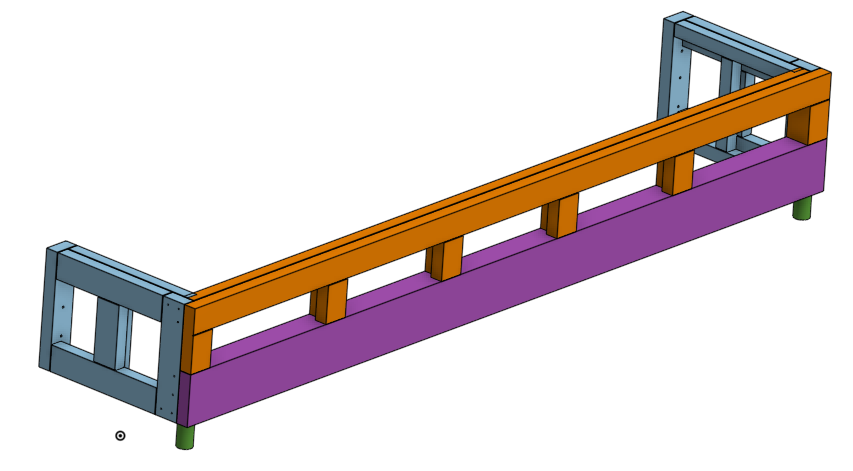
I think it would be better if the top frame (orange) had the 4x2 on flat as that should stiffen the assembly against lateral forces. The ;studs' on 600mm centres should easily be able to take the weight of the rafters bearing on the top 4x2. I could position them to coincide with the rafters as well.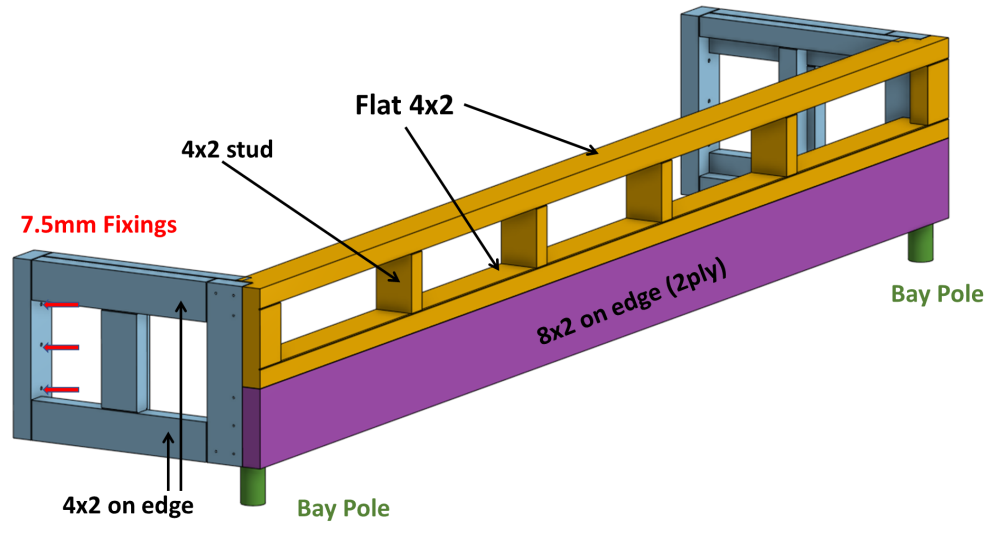
-
Bay windows for complete beginners
MortarThePoint replied to MortarThePoint's topic in Windows & Glazing
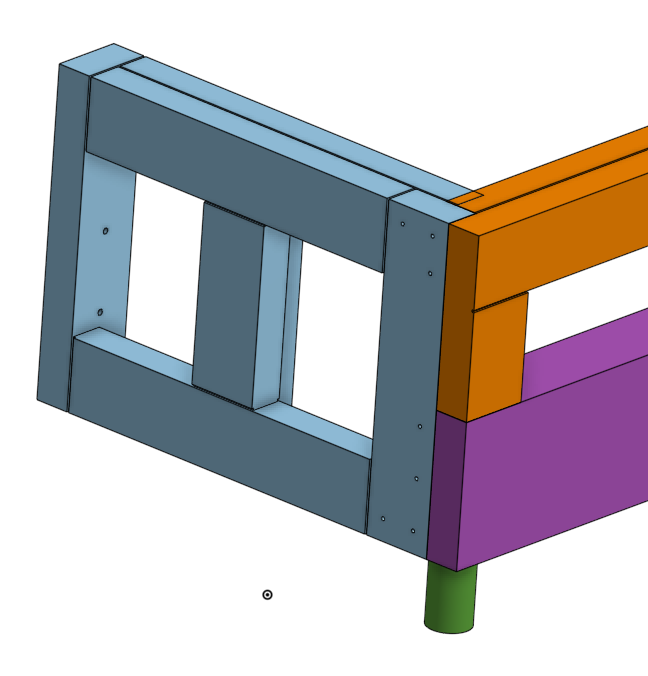
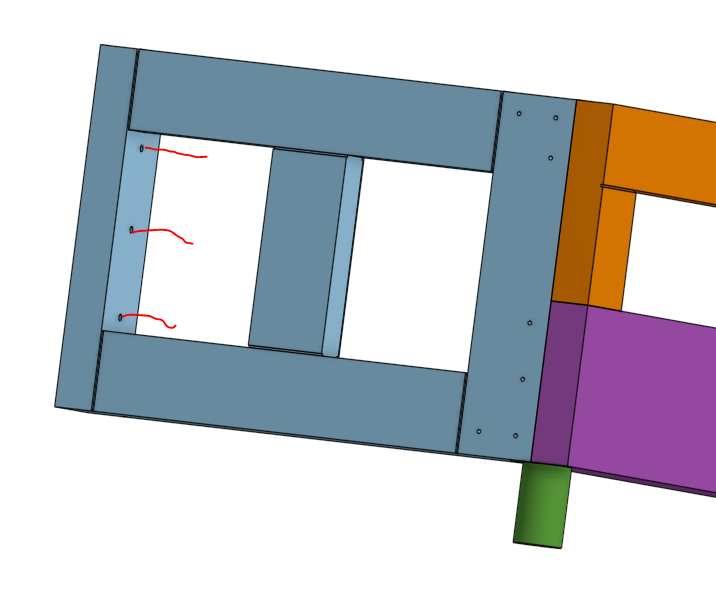
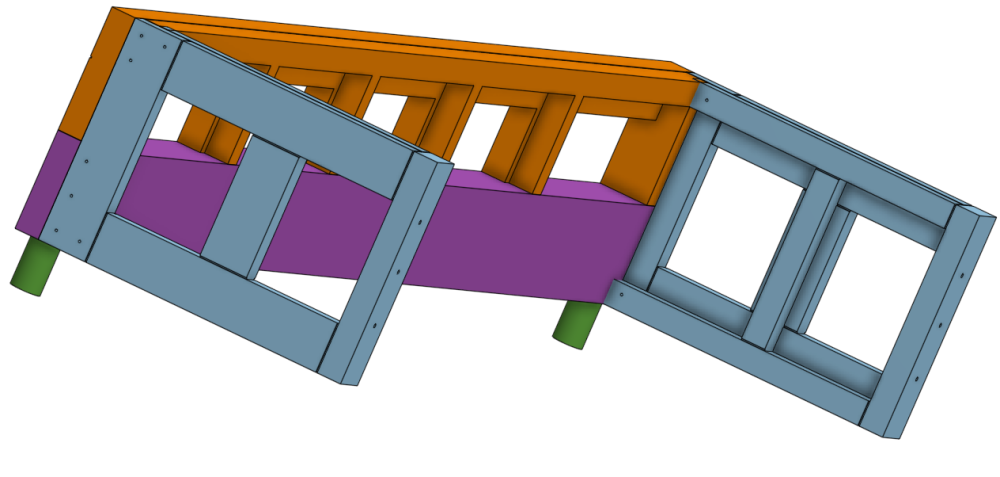
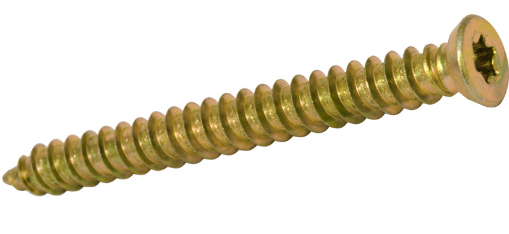
Thanks, I'll try to take some more photos. Makes sense, pole is good but need to be sure everything else is sound too. The total weight of the bay roof will be about 600kg (6.5m2 of tiles = 500kg). The timber against the face of the house will be taking some of the load but I expect the bay poles probably take more than half, so perhaps getting on for 200kg each. There will be a substantial beam (8x2 2ply shown purple below, 3m long) across between the bay poles which most of the rafters will bear on. At the sides it's less clear, but I am thinking I'll make a simple 4x2 frame (blue with some 2x2 as well) and use frame fixings to attach one side of it to the house brickwork (red lines). The bottom and top chords of these side parts is a 4x2 on edge backed by a 2x2. I thought I'd use the 2x2 rather than 4x2 on the inner side to allow more insulation. The front beam is 3m long so has quite a bending moment, but those side frames are only about 600mm, so not much moment I figure. Additional 4x2 and 2x2 frame work in orange above the purple front beam to make up the height and allow insulation infill. Bay pole positions shown in green. I had originally planned (even bought some) to use a masonry hanger for the side frames, but they typically cut into the brickwork and don't provide any lateral constraint. I can see one made by Parkes that is face fix, but can't see where to get it from and it feels like the 4x2 bolted (7.5mm frame fixings or M8 bolts) to the masonry will be just as secure. The rafter closest to the house wall will be bolted to the house wall so the vertical load carried by these side frames will be quite low. I am more concerned about the lateral constraint.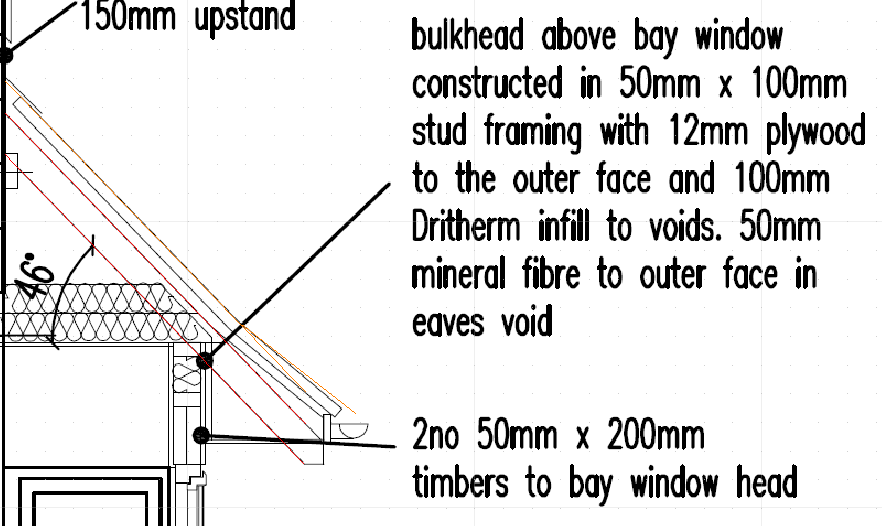
-
Bay windows for complete beginners
MortarThePoint replied to MortarThePoint's topic in Windows & Glazing
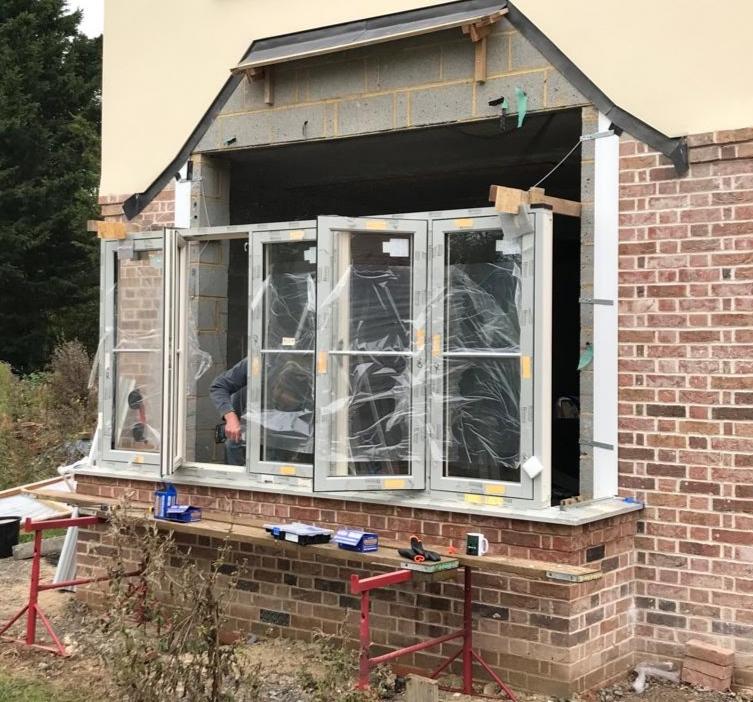
Lifting and moving the large central window was something I had dreaded. 3105mm x 1460mm so heavy and unwieldy. I roped in 3 friends the wife helped too. We had to flip the window as well. Carrying the window out of the house was the hardest bit and we used straps under the window and carried it out to trestles (strong). We couldn't use anything going under the frame for the final placement, so I put a short length of batten through the loop the window manufacturer had put on each end of the window. I don't trust such a loop to lift a large window like this so also screwed the small bit of batten to the frame (2no 5.0 x 50mm). I then screwed a piece of 4x2 across the front and back of the window with a block at each end for the screws to go into. This gave us convenient handles at a good height to do the precision lift. The wife guided the window into position using rubber window suckers (no force just precision). We got it spot on and the final lift was a breeze. I had rigged some timber braces to swing down onto the top of the window to stop it falling and the whole operation took less than an hour.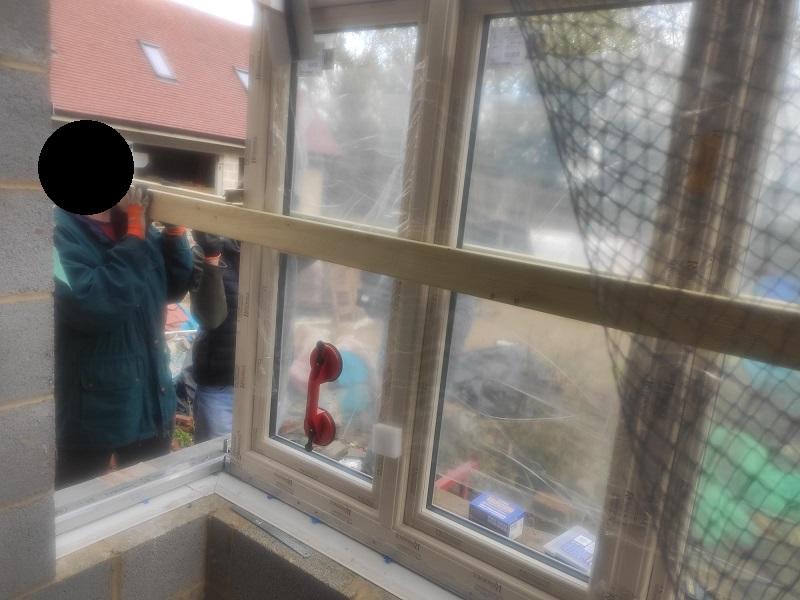
-
Bay windows for complete beginners
MortarThePoint replied to MortarThePoint's topic in Windows & Glazing
Windows came with Bay Poles and Bay Pole Jacks by Window Widgets. Their catalogue says they are rated to 2t (I think)so plenty of capacity there. An important thing to remember is to check them at the end of the installation as the bay pole may have crept off a tight seating and so the bay pole load would be left being carried by the windows not the jacks which would not be good. We had pretty smooth and level brickwork already, but I lightly touched it with a grinding cup to get it very flat and tweak level too. Need to allow some wiggle with the bay pole jack position as their position ends up defined by the window(s) (the large central window in my case). For me the cill was predrilled (Window Widgets suggest 20mm which I guess was what I had). It would be good to have a washer (guess M12 or M14) to put over the bay pole thread and to rest on the cill as that would help with the subsequent sealing. I had a large gap as no washer so glooped it up a lot.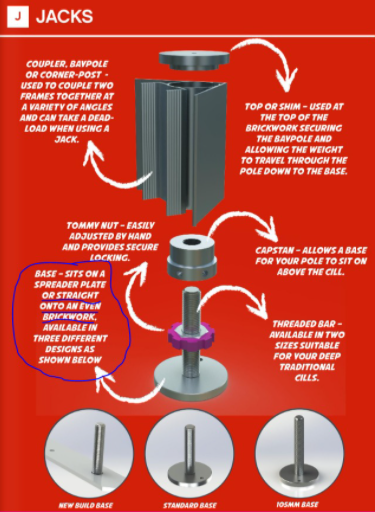
-
How to control an Ecodan with UFH manifolds?
MortarThePoint replied to ADringer's topic in Air Source Heat Pumps (ASHP)
Neat, so no heating until it's below 11C outside. I like the strategy but note the following drawbacks: - can't preferencially heat rooms being used (e.g. study during week day working hours and living room in evenings and weekends, or bathrooms at certain times of day) - without energy storage, can't take advantage of Economy 7 cheaper electricity - Increased wear on pipes / flow restrictors due to constant flow (?) No idea if that's a reasonable concern - home politics as the wife doesn't have a little box on the wall to tell what to do so she has to tell me instead Even so, it seems an excellent approach. -
How to control an Ecodan with UFH manifolds?
MortarThePoint replied to ADringer's topic in Air Source Heat Pumps (ASHP)
Awesome thanks. I guess there is a maximum outside temperature above which the ASHP turns off as it would be being asked for too little power. -
How to control an Ecodan with UFH manifolds?
MortarThePoint replied to ADringer's topic in Air Source Heat Pumps (ASHP)
@JohnMo to confirm the strategy: - control heat flow by varying flow temperature (called Weather Compensation), colder outside means more heat lose so higher flow temp. - use manual manifold flow valves to set relative flows into each room - ASHP runs constantly (when outside temperature is below some threshold?) - no room thermostats needed - no manifold actuators or controllers needed -
I haven't installed yet. Bought a reel of 22mm before learning/deciding 15mm will be OK. Might be able to use to service the garage with cold water.
-
I'm feeding most of my basins with 10mm direct from the plant room. 5l/min feels fine (a pint in 7 seconds) and mixed with cold the flow would be greater , e.g. 10l/min if 50/50. The numbers suggest 15mm @ 10m gives bags of flow for a shower. For a bath, dead volume isn't really relevant as you run all the water before using it. For 10m, 15mm has a dead volume of 1.1 litres (7sec at 10l/m shower) whereas 22mm has a dead volume of 2.5 litres (15sec at 10l/m shower). Bath filling time is then the only other time based factor. As @Nickfromwales says most taps have a limited flow rate. I don't know what taps you are thinking of using, but I find it difficult to get data. "A flow rate between 10 and 15 litres per minute is considered acceptable but can be improved. A flow rate that is above 15 litres per minute will be regarded as good." [Plumbworld] 15mm pipe drops around 1bar with a flow rate of 15 litres/min over 10m with a couple of bends so that should be fine. I like to run the numbers to understand it, but put much more sway in what people like @Nickfromwales have learnt to work.
-
I've forgotten all the corners in the UFH pipe which will up the pressure in the loop itself, but pressure dropped there should still be low. Is that at the moment or when running full wack? 0.14bar and 12W suggests a flow rate of about 40 l/min. I'm guessing you temperature drop is under 5C. I've seen UFH checklist type websites that suggest pressure should be 1 - 2 bar but maybe they're wrong.
-
Makes sense. I am planning to use the Wunda auto-balancing actuators. They look to maintain a 7C temperature difference when actuated so should make my life easy. The loop itself doesn't seem to drop much pressure if you have a low system flow temperature, like 35C or 40C. The heat comes out relatively slowly so the flow rate has to be quite low (e.g. 1.1l/m for a 8m2 area supplying 400W of heat). It feels like the flow gauge (or auto-balance actuator) is dropping most of the pressure in a low temperature system. I think you'd normally need to cope with the varying number of loops switched in and their relative resistances as you said. If using the auto-balancing actuators, it should be possible to have a low Flow pressure, well under a bar. The actuator could adjust to compensate for another loop switching in and out. Even if the manifold is a 50m round trip away, 28mm pipe should work with only 0.5bar (11.2kW makes for 32l/min flow which has a pressure drop of 244mbar over 50m of 28mm pipe). I am thinking in part about the pump power consumption which if an 11.2kW ASHP system and running at a flow pressure of 1.6bar would be around 100W. That could be as much as 5% of the electrical energy (as the 11.2kW is the heat not the electricity which could be 2.2kW if COP is 5).
-
Am I right in thinking the flow gauges act as a restriction to set a flow rate based on the inlet (aka Flow) pressure? Does that mean the majority of the pressure drop is across that restriction. If there is 0.4kW of heat coming from a 100m loop of UFH pipe, then with a dT of 5C the flow would be 1.1 l/min and pressure drop will be around 21mbar, so tiny.
-
I'm interested to know what typical flow and return pressures are in an UFH setup? Not temperatures, but pressures. Here are some useful bits of info: Required peak flow rate, Qmax_litres_per_minute = (60 * ASHP_Power_kW) / (4.2 * Termperature_Drop_C) e.g. (60 * 11.2kW) / (4.2 * 5C) = 32 l/min UFH power Watts/m2 = (3.34*(FT - RT) - 14.78) * 0.82^((pipe_centres_mm - 100) / 100) e.g. Flow temperature of FT=40C, Room temperature of RT=18C -> (3.34*(40-18) - 14.78) * (0.82^0) = 58.7 W/m2 [derived from 1] Pump hydraulic power in Watts = (Q_litres_per_minute / 0.6) * (Flow_Pressure_bar - Return_Pressure_bar) e.g. (32 l/min / 0.6) / (2bar - 1bar) = 53W (random pressures)
-
ASHP vs Oil in 2022
MortarThePoint replied to MortarThePoint's topic in Air Source Heat Pumps (ASHP)
With an Heat Transfer Coefficient of HTC=372W/K, ignoring any gains, means 10% duty cycle per degree of difference between indoor and outdoor with 11.2kW Ecodan 11.2kW on min setting (4kW). E.g. duty=60% when 12C outside (2.4kW average), 100% when 8C outside (4kW). Gains work out as something like 4C equivalent, shifting those temperatures down to 8C and 4C respectively. That could allow lower flow temp and better COP. Perhaps FT=30C giving a COP of 5 when 7C outside. lots of scope for optimising. -
ASHP vs Oil in 2022
MortarThePoint replied to MortarThePoint's topic in Air Source Heat Pumps (ASHP)
Are Ecodans binary in power delivery? Full on or full off or can you get an 11.2kW to deliver 6kW of power? I presume the COP would be worse, but is there data on that? -
ASHP vs Oil in 2022
MortarThePoint replied to MortarThePoint's topic in Air Source Heat Pumps (ASHP)
I've installed UFH upstairs and downstairs so should be able to dissipate 11.2kW with a flow temp of 35C or a bit above. Is short cycling when it turns on for a short duration? I imagine that is influenced by the allowed temperature swings on the thermostats. Is that correct? If so the cycle on time would be the same if I allow proportionately larger temperature drops. All my options are the same size I think. Vary between brands though. -
ASHP vs Oil in 2022
MortarThePoint replied to MortarThePoint's topic in Air Source Heat Pumps (ASHP)
The hour figures are simply outputs that show how long the ASHP needs to be on for at 100% to provide the required energy. It could be run at a lower setting for longer if that is desirable. I have done a basic thermal time constant model that suggests the house will cool down (i.e. loose heat unheated) at a rate of 0.1C/h when it is 4.2C outside (so dT = 14.4C). The cooling rate is 0.07/h or the time constant is 144h (6days) (half life 4.2days). With 11.2kW I'd almost be able to only run the ASHP during E7 electricity and only suffer 1.4C temperature changes. I know the COP would be worse as colder at night, but the electricity is cheaper. I don't fancy making a 60kWh battery at the moment to allow the electrical demand to be spread across the day. I know this already from the SAP: Total Fabric Heat Loss 234 W/K (A) Ventilation heat loss (max): 138 W/K (B) Heat transfer coefficient (max): 372 W/K (A+B) If AT=4.2C and indoor is 18.16C then average power requirement is 372W/K * (18.16C - 4.2C) = 5.19kW if there were no solar/metabolic/appliance/etc gains. In December the solar gains seem to average 0.47kW and the internal gains are about 1kW. 5.19kW - 1.43kW = 3.76kW SAP has a monthly space heating demand for December of 2774kWh: 2774kWh / (24h/day * 31days) = 3.73kW Water heating is shown in the SAP as 220kWh/mo so that averages to: 220kWh / (24h/day * 31days) = 0.3kW. In theory I could have a smaller ASHP, but I would want extra grunt for when it is unusually cold. 8KW would suffice (down to AT = -11C). Other than capital cost, what is the main downside of having too big a unit? Do you mean Jeremy's Spreadsheet? -
ASHP vs Oil in 2022
MortarThePoint replied to MortarThePoint's topic in Air Source Heat Pumps (ASHP)
Dimensional comparison: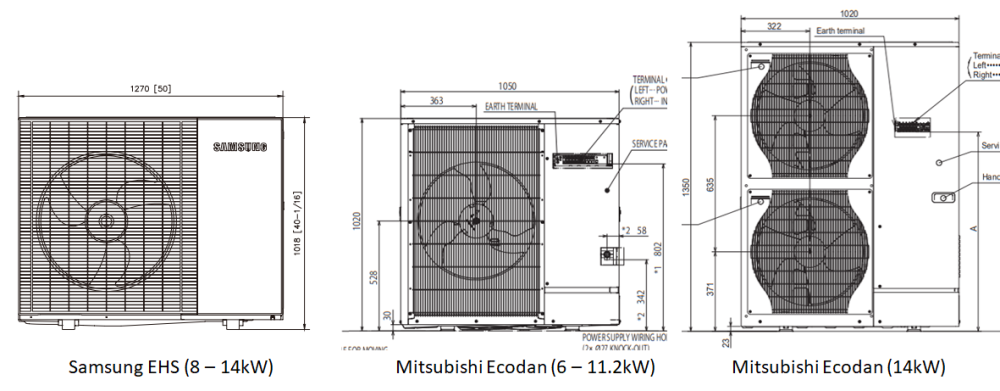
-
ASHP vs Oil in 2022
MortarThePoint replied to MortarThePoint's topic in Air Source Heat Pumps (ASHP)
I think I'm more drawn towards the Ecodan due to its proven track record. If I needed 14kW it would be a different matter. My SAP shows a peak monthly heat demand of around 2700kWh in December with an average outside temp of 4.2C. that works out as about 90kWh/day so about 8 hours of 11.2kW (3.75kW average). That's with an indoor to outdoor dT=18.6-4.2=14.4C. If outside goes to -5C then dT=23.6C and that would make for 90*(23.6/14.4)=150kWh/day so about 13hours of 11.2kW (6.1kW average). There would be an additional hot water demand but pretty low (max. 300kg * 50C * 1Wh/kgC = 15kWh so about 1 - 2 hours worst case). Bear in mind that would have to be a day with average temp of -5C which where I live is unlikely.





