MortarThePoint
-
Posts
2294 -
Joined
-
Last visited
Everything posted by MortarThePoint
-
Do I need VCL, Vapour Barrier or nothing
MortarThePoint replied to MortarThePoint's topic in Damp & DPCs
There is a continuous length of vent along each edge of the flat roof instead. -
Do I need VCL, Vapour Barrier or nothing
MortarThePoint replied to MortarThePoint's topic in Damp & DPCs
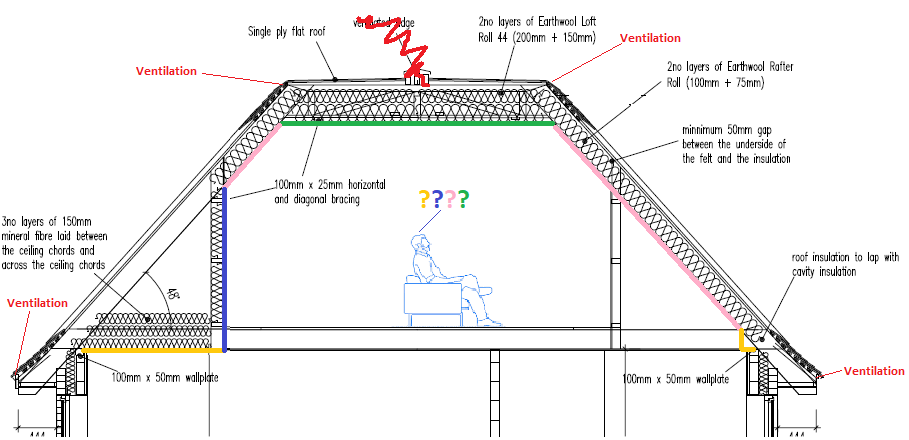
My plan has been to do pretty much as you suggest except 75mm under rafters. Interesting. Polythene sweating must mean it's cold no? Does that mean there is some for of draft cooling it? I've already bought my plasterboard (SoundBloc F) and it's not foil backed. Would you omit polythene all round then (orange blue pink green)? -
I know this is really important for timber frame construction and something that looks to be evolving. I've read an article that draws a distinction between VCL and vapour barrier and suggests that understanding has moved on and that the layer shouldn't be completely impervious, like sheet plastic is, and calling into question foil backed plasterboard. These are what my Architect has called for at ceilings: I had assumed it was everywhere, but I'm now unclear if the polythene vapour barrier in the first paragraph is only for wet areas. That's me sat up there looking confused, though sadly I don't have a comfy chair yet or a floor to put it on. Skimmed plasterboard is good enough for airtightness as I understand it. I know skimmed plasterboard won't be completely moisture proof, but there won't be significant quantities of moisture passing through will there and there won't be a temperature difference across the plasterboard? Consequently, why would a vapour barrier be needed at ceiling level in a normal room? Without a vapour barrier, I suppose the humidity under the plasterboard is going to be higher than above it, presuming the air above has a consistent moisture content per m3 but obviously varying temperature as you move through the insulation. That would create a moisture gradient in the plasterboard which would serve to draw moisture through it, but it wouldn't increase the moisture level, it would lower it. Is there a concern of the moisture transport degrading the plasterboard by migrating water soluble 'goodness'. I have heard of that happening with masonry wall mortar when people have ventilated subfloor voids in the US.


-
Here's an option that uses the existing noggins at the base of the dwarf walls. Before putting the ceiling up I can apply the lower VCL. Before putting the floor down above the joist, I can apply the upper VCL, lapping the joint. This creates a much larger volume outside the airtightness though. Not a problem if the joist is filled with insulation there.

-
I wonder about using expanding foam tape under the noggin, so between the noggin and the plasterboard. That wouldn't sort circuit the resilient channel so much [Note the minimum R=1.2m2K/W can be achieved by 53mm of 0.044W/mK Loft roll, so 150mm is plenty to meet that).
-
I agree no point in having isolation valves as long as it's not a regulations requirement like it appears to be in the US.
-
I'd love to use compression fittings for all sorts, particularly isolation valves as the Hep2o ones look rubbish and are expensive (£7 Vs 70p), but not at the cost of introducing a possible issue. I guess there is little point in being able to isolate a basin or shower inside a room if I can isolate the whole room at the main manifold.
-
I wondered about using UFH pipe for mains water but: am not sure its WRAS (think some of Wunda's old stuff may have been) 16mm so wouldn't fit the fittings probably a nuisance to 'cable' Is heating the pipe and forming it sanctioned by the manufacturer?
-
I'm content to avoid anything that someone with more experience than me is concerned by.
-
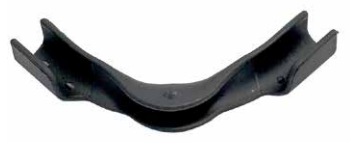
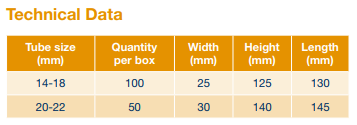
Has anyone tried using UFH pipe formers with Hep2O? Annoyingly I can't find anywhere that says what the bend radius of these formers is, but they are massively cheaper that the cold bend formers that nobody stocks for Hep2O. I've copied the closest thing I can get to useable data below. I guess the 14-18mm one probably has a bend radius of around 125 - 25/2 = 112mm. Not in spec for the 15mm pipe's minimum bend radius of 120mm. The 20-22mm one is probably around 140 - 30/2 = 125mm but would probably be a bit loose/risky.
-
If I make the holes in the OSB/plasterboard 19mm and have the clip holding the Hep2O pipe about 150mm up from the holes it should leave a couple of mm wriggle room in each direction which will be nice.
-
I think this all works out as first fix being as the image below. It's pretty tight to drill the screw holes for the wall mount fixing kit.
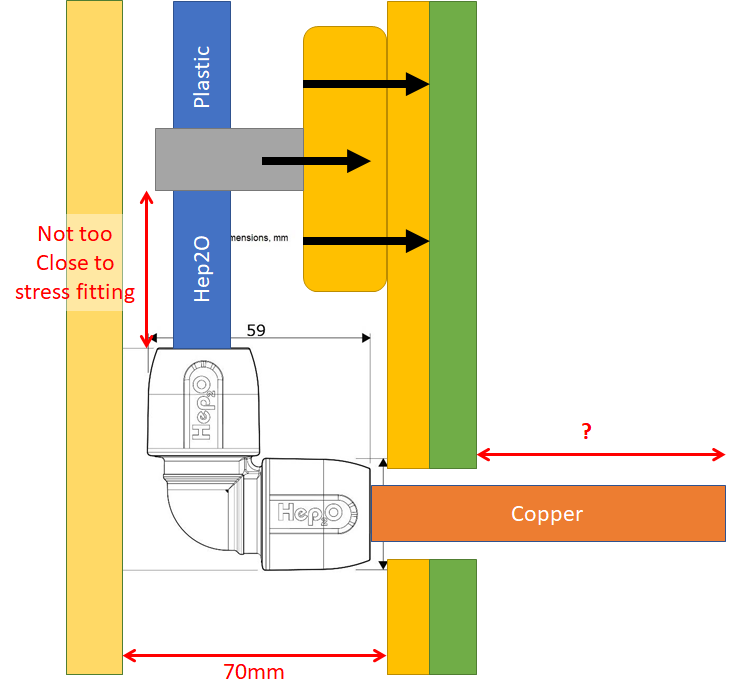
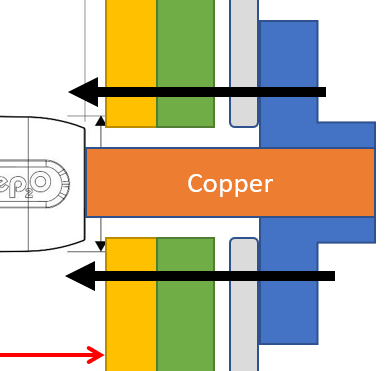
-
Thanks. Classic example of the difference between (book) knowledge and experience. I would have walked straight into that one.
-
Is that one of those things where the brochure says you can but experience says you can't?
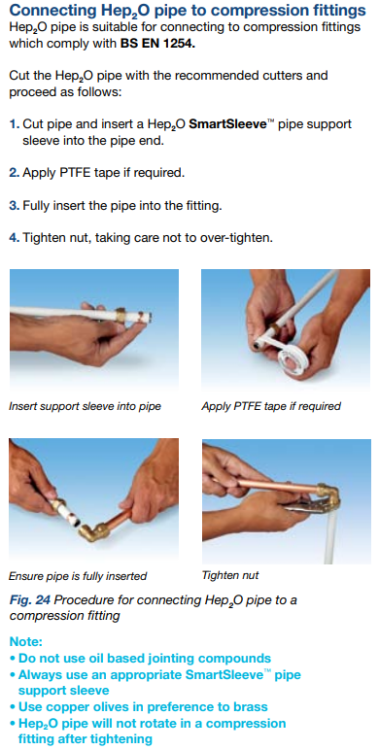
-
I still don't know why the transition to copper. It seems to be common practice (see below) but I'm in the dark ( @Nickfromwales )?
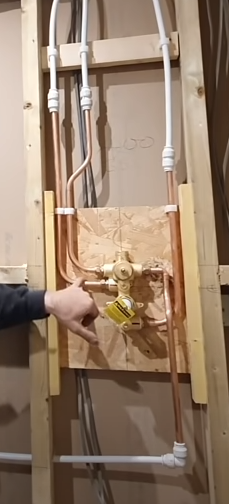
-
Looks sturdy, but won't that need to be installed prior to the plasterboard that it goes through? Or do you attach it to a pattress and then mount the pattress on the studs.
-
Why the transition to copper? Thanks for the link, exactly what I'm after.
-
Another hopefully simple question for you. Do you just use pipe and a couple of elbows (all Hep2O) to prepare for a 150mm pipe spacing shower bar mounted on a plasterboard wall (with OSB layer behind the plasterboard)? I've got my OSB and plasterboard wall up and want to poke the pipes through and seal up the wall. I as planning to just use a couple of Hep2O elbows and pipe to do this. Is that how you do it? I'd then use the Easy-Fix style of connector with its included olive to attach to the Hep2O pipe.
-
A fair call. I find I only have two tools to compensate for my inexperience, asking and researching/analysing. Asking is much preferred but I feel a bit guilty asking so many questions sometimes.
-
The detail below is a solution except I am using resilient bar to separate the ceiling plasterboard from the joists so I need to bridge that gap. The noggin would normally do this but that world short circuit my resilient bar. I'm not really sure why in that detail it's a double noggin.

-
Is it a viable solution to create two separate airtight 'cells'? One above the joists and one below? The air in the height of the joist would not be sealed. That shouldn't be a problem from a thermal perspective as there is insulation at the ends and the two 'cells' would be airtight so not transferring moist air to this space. This is the easiest approach, but is it valid?

-
Laser Level/Builders Level...
MortarThePoint replied to Mulberry View's topic in General Self Build & DIY Discussion
Interesting. I've always been impressed by the Napoleonic era triangulations. Curvature of the earth would render a laser level 3mm out at 200m I think. Unless the world is flat of course 🙂 -
Laser Level/Builders Level...
MortarThePoint replied to Mulberry View's topic in General Self Build & DIY Discussion
Interesting, that webpage is a bit light on how it works but is the 'wire' connecting the two units actually a tube full of a liquid and it measures the pressure difference between the two sealed ends? Very handy it doesn't need line of sight. -
Laser Level/Builders Level...
MortarThePoint replied to Mulberry View's topic in General Self Build & DIY Discussion
is rather poor. I'm not timber frame person, but +/-2.2mm over 30m doesn't sound poor to me. That means one end of a 15m house might be 2mm lower than the other. What needs to be better than that? -
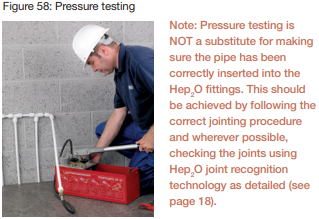
I hope so, thanks 🙂 I'm going to need to invest in a pressure testing pump as I need to high pressure test at something like 10bar.