


MortarThePoint
-
Posts
2294 -
Joined
-
Last visited
Everything posted by MortarThePoint
-
Installing Gyplyner Ceiling
MortarThePoint replied to MortarThePoint's topic in General Construction Issues
Tempted to use 15mm plasterboard and 600mm centres to reduce the workload, but that puts up the load per bracket by 80%, though I think the brackets are OK with a double layer of 15mm anyway. Starting in a smaller area so will get an ideal of work rate. -
Installing Gyplyner Ceiling
MortarThePoint replied to MortarThePoint's topic in General Construction Issues
Plasterer is nervous about channel being flat enough, so plan mount GL1 on brackets (GL2) slightly high, and then use a laser to adjust each one down to level using packer between bracket and concrete (all approx 230 of them). that should get all to within 1 or 2mm of level. Using TechFast masonry screws with Hex & Torx head (link) well priced at CPC. Note: fully threaded unlike photo. Also have some 32mm ones, which will limit to GL8 if used at all. -
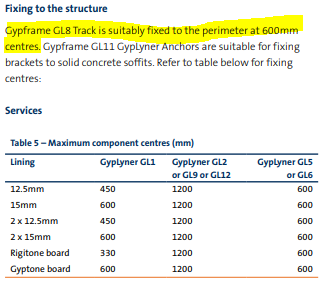
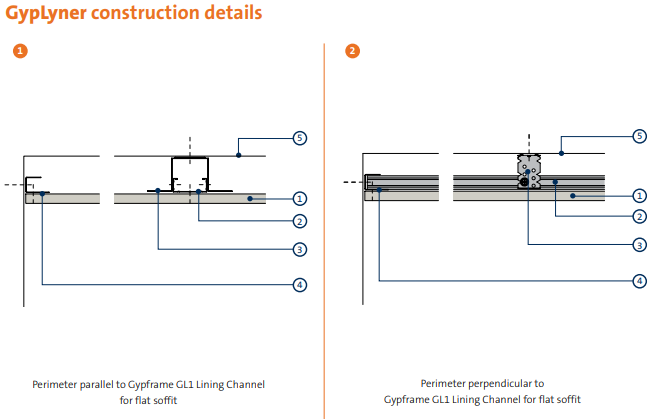
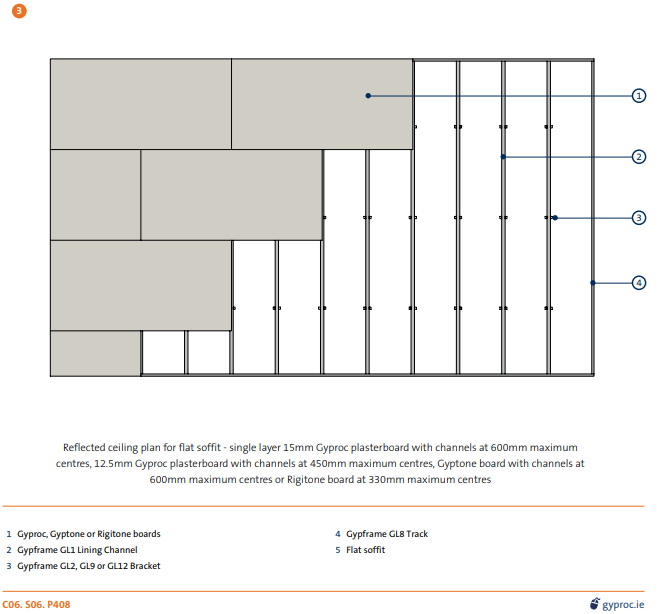
GL1 channels at 400mm c/c for 12.5mm plasterboard and 600mm c/c for 15mm plasterboard. Brackets (e.g. GL2) only need to be every 1200mm. Not clear how far first bracket can be from perimeter track (GL8), but diagram below suggests pretty far, so may be OK at 1200mm. Will probably limit myself to 600mm to first bracket. British Gypsum components: Channel GL1 & GL1 datasheet Perimeter Track GL8 & GL8 datasheet GL3 connectors for extending GL1 Brackets: GL2 (<=75mm), GL9 (<=125mm) and GL12 (<=175mm) for under solid (hollow core concrete in my case) soffit A Hough alternative brackets: AH185 (=GL2) AH186 (=GL9) AH175 (=GL12)

-
Some additional information about GL1 and GL8
-
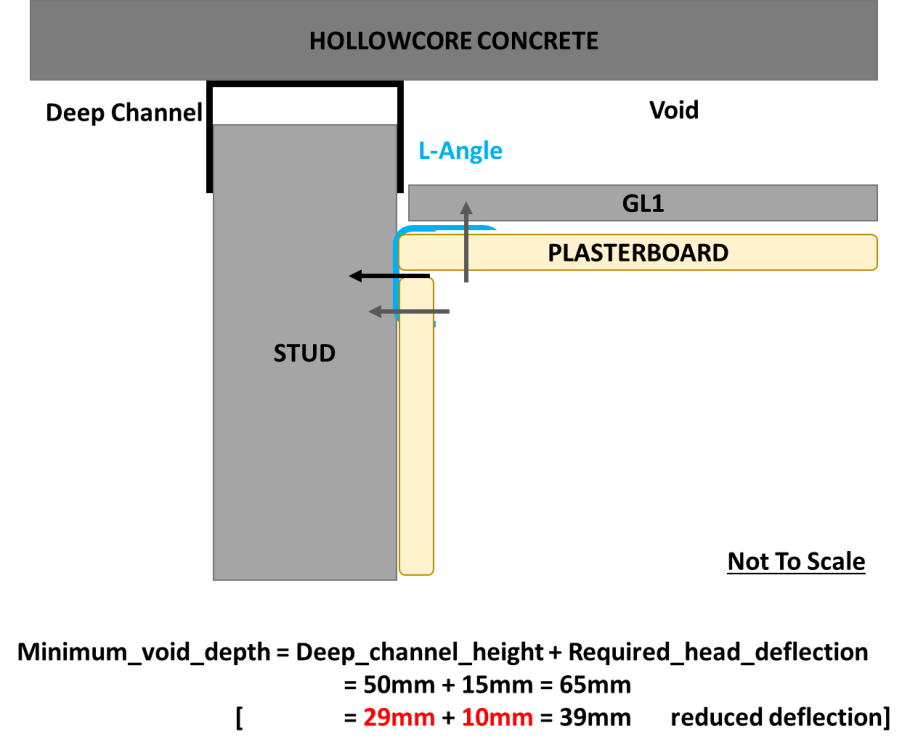
As it turns out, I have few places that this applies to, and in the longest section of it (6m vs 3.6m) I have worked out it doesn't matter due to a happenstance. Where it still matters, I am wondering about using L-angle on the studs instead of GL8. This should be robust enough. L-angle doesn't cons train the GL1 from moving upwards unit they are screwed together which would normally be done by the drywall screw attaching the plasterboard. I can overcome this by screwing the GL1 to the L-angle before fitting plasterboard.
-
Achieving a small void with a deflection head and metal frame seems challenging. Even reducing the deflection head to 10mm and using standard depth channel makes for a 60mm minimum. Any thoughts? My blockwork has been done in such a way that going beyond a 50-55mm void causes pain.
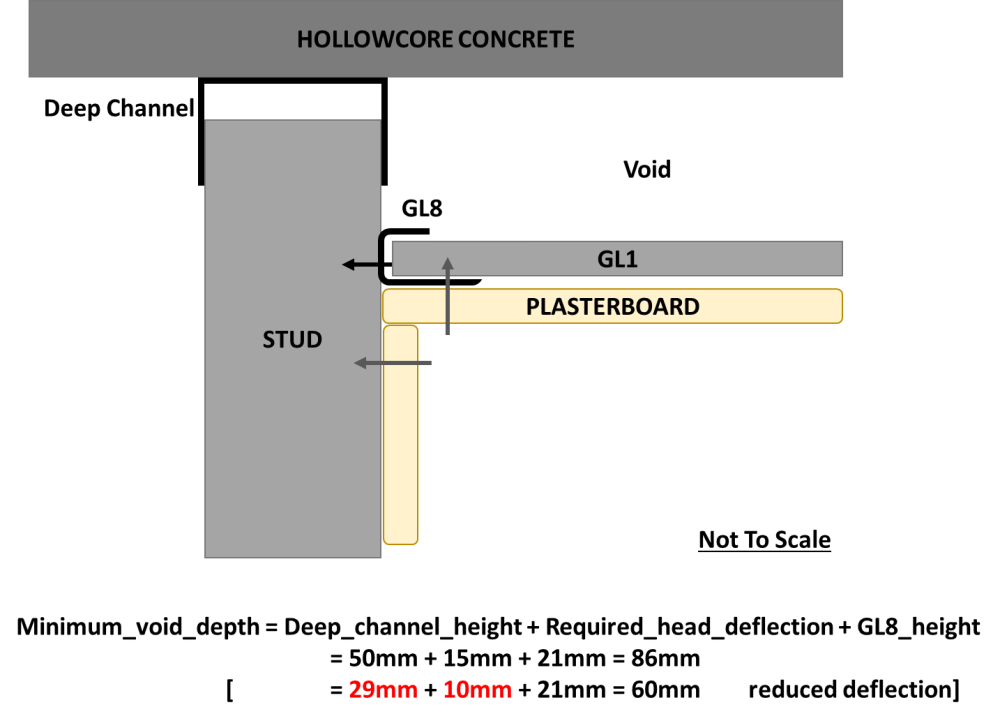
-
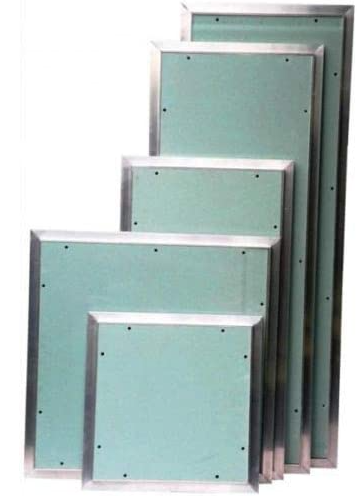
There are some plasterboard access panels that leave a very clean finish once skimmed and painted. The ones I have found use 12.5mm plasterboard and I have 15mm. Has anyone found ones for 15mm plasterboard?
-
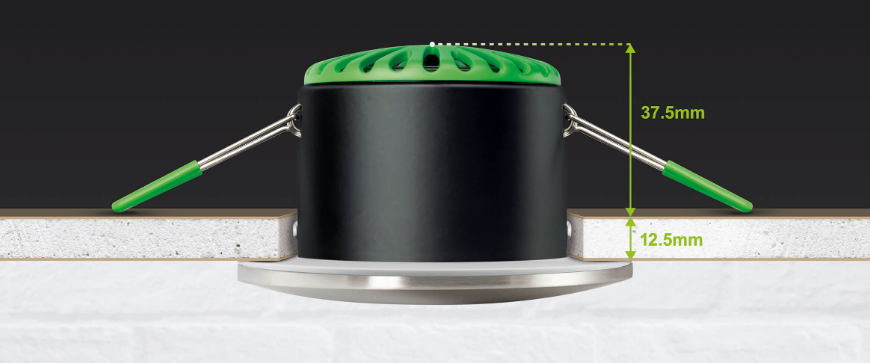
They do look great. How much void do you need above the plasterboard for these?
-
Suitable Weather for Plastering
MortarThePoint replied to MortarThePoint's topic in Plastering & Rendering
Roughly how much water goes into the plaster per m2 of blockwork wall? -
Suitable Weather for Plastering
MortarThePoint replied to MortarThePoint's topic in Plastering & Rendering
Thanks nod, is there no bother when it's humid getting all the water out or any ill effects on the rest of the building (timber joists, studs, doors etc)? -
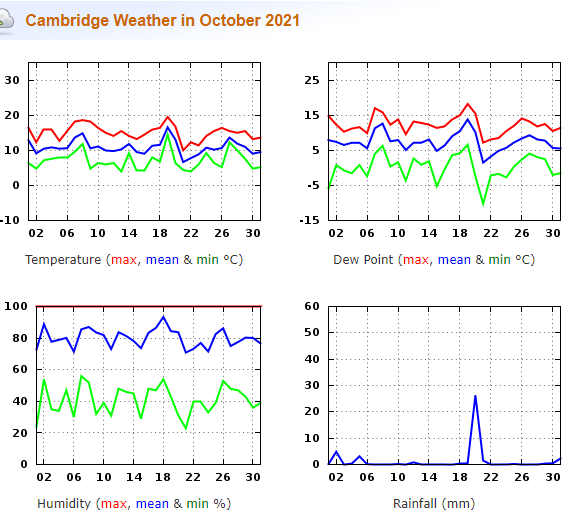
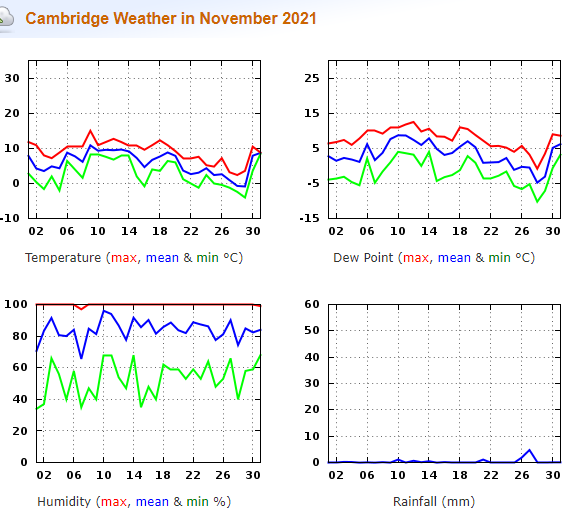
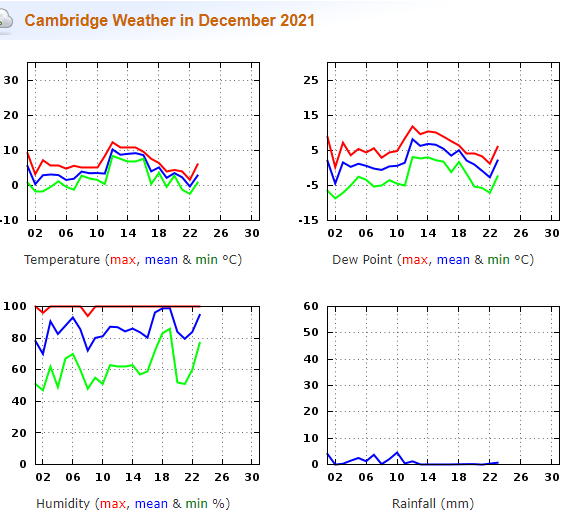
I'm going with wet plaster to (Stranlite/Fibolite) blockwork and skim on plasterboard partitions. I was wondering when it would be OK to have this done. I'm still going through first fix, slowed by every full plasterboard needing the wife's help as well of shear weight of activities. My layman's understanding: I had hoped to have it plastered in September when the weather should be mild enough to not dry the walls too quickly but dry enough to be able to use fans to blow air though and avoid the fabric of the building getting too wet. That's slipped away and the plasterer says he's available end of Oct / early Nov. Below is some weather data from last year. I guess the most important things are temperature and humidity/dewpoint. https://www.cl.cam.ac.uk/research/dtg/weather/index-period-graph.html
-
Bay windows for complete beginners
MortarThePoint replied to MortarThePoint's topic in Windows & Glazing
Gearing up to do this. You're right, it is bay pole jacks and they are rated for plenty of weight. What's the normal installation sequence? The central window (3m wide) is very heavy and it would be very difficult for that to not me the first item put in place and braced bay poles are installed with the side windows. But that presupposes the sequence. I then imagine the head timbers being built on top of the bay poles and then the rafters cut in. -
Thanks, that looks like an option. It has a driver too, but I can probably bulge the vapour barrier slightly where that goes.
-
Is that creating a 50mm void under the vapour barrier and above the plasterboard then? I'm using Resilient Bars. So I have stuck the polythene to the underside of the truss bottom chord and then screwed the Resilient bar underneath. The resilient bar is 16mm high so there is a 16mm void.
-
I'm keen on having downlights in the bathrooms like the JCC V50 shown below. I am installing a polythene vapour barrier in the ceiling as there is insulation and loft above and a bathroom is obviously one of the most humid spaces. How to I deal with the downlight as that will make a pretty big hole in my vapour barrier?
-
Chimney DPCs and damp handling
MortarThePoint replied to MortarThePoint's topic in Stoves, Fires & Fireplaces
I guess, depends how well the mortar sticks to the tray. The weakness is in tension or shear I suppose. It's how it's typically done though. -
Would you recommend foil backed plaster board
MortarThePoint replied to Arnold9801's topic in General Construction Issues
I don't know what prices you are seeing, but foil backed plasterboard seems to cost about 60% more than standard so adds something like £1.75/m2. The common alternative is to put up polythene sheeting vapour barrier (green 500ga, not cheap dust sheet) which is around £0.40/m2.It's extra work to do the vapour barrier poly sheeting, but at leas you can see what you've got before adding the plasterboard as you can never inspect the back of the plasterboard once it's up. I don't know how often the foil is damaged when you receive the sheet as I have had plasterboard with torn paper. That's interesting. Can you recommend any brands? I suppose one tricky bit is how you get continuity with any poly vapour barrier you might be using. I guess one option is to overlap by a good 300mm or something. -
Do I need VCL, Vapour Barrier or nothing
MortarThePoint replied to MortarThePoint's topic in Damp & DPCs
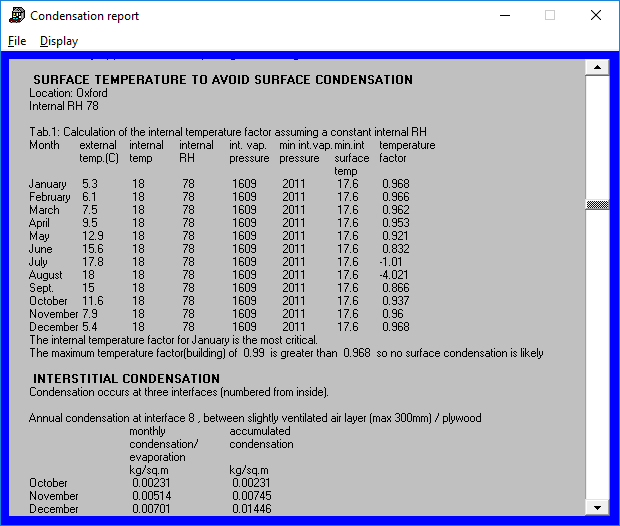
How to identify the difference between well ventilated and slightly ventilated becomes pretty critical: BS 5250:2011+A1:2016 page 38 Air vent is 10mm equivalent height so 10,000mm2/m. The width of the flat roof is 3m and there is one vent at each side so that works out as 2*10,000mm2/m / 3m = 6,700mm2/m2. If I consider just the eave vents, the distance round from eave to eave is about 4.5m + 3m + 4.5m = 12m so that works out as 2*10,000mm2 / 12m = 1,670mm2/m2 still OK (just). I think the roofers actually used 25mm vents so better by a factor of 2.5. Should be OK to consider as "well ventilated" then.
-
Do I need VCL, Vapour Barrier or nothing
MortarThePoint replied to MortarThePoint's topic in Damp & DPCs
Need to be careful with DrewPoint 3.0 as it can lose some of the data fields and make erroneous calcs. -
Do I need VCL, Vapour Barrier or nothing
MortarThePoint replied to MortarThePoint's topic in Damp & DPCs
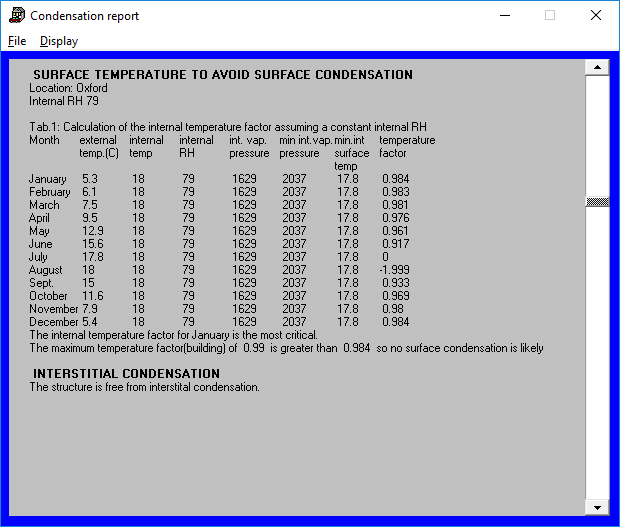
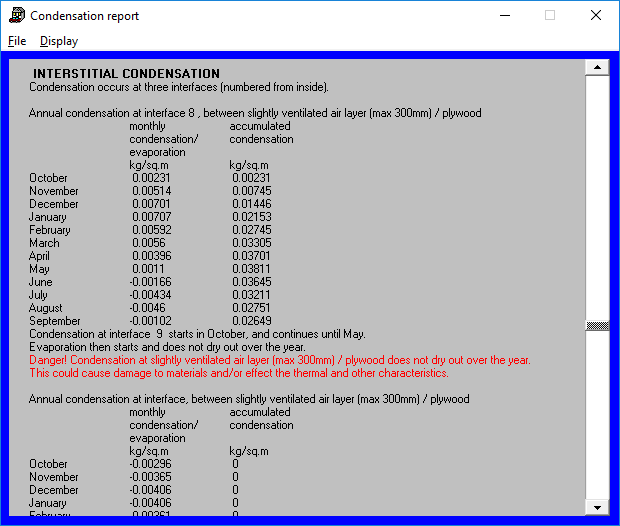
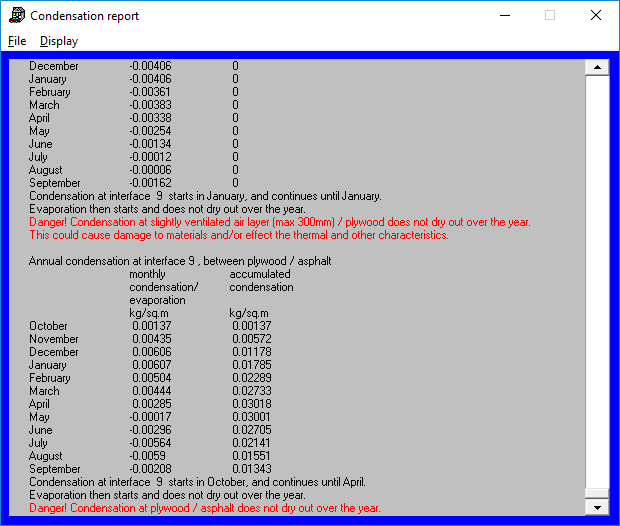
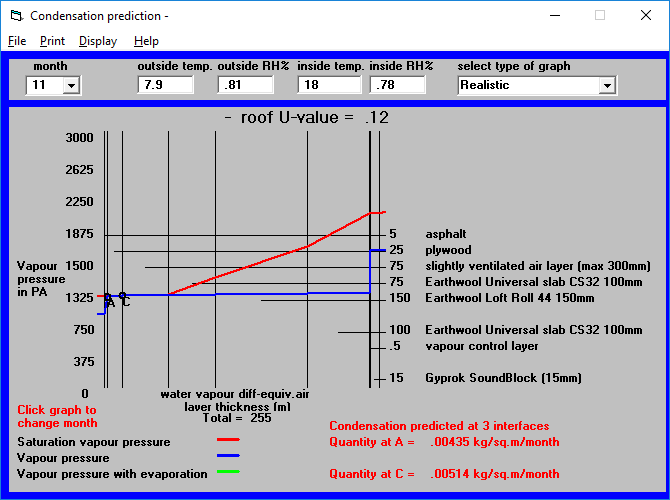
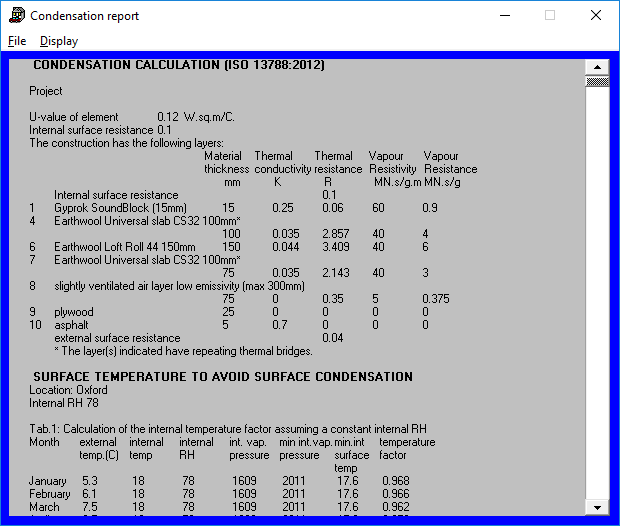
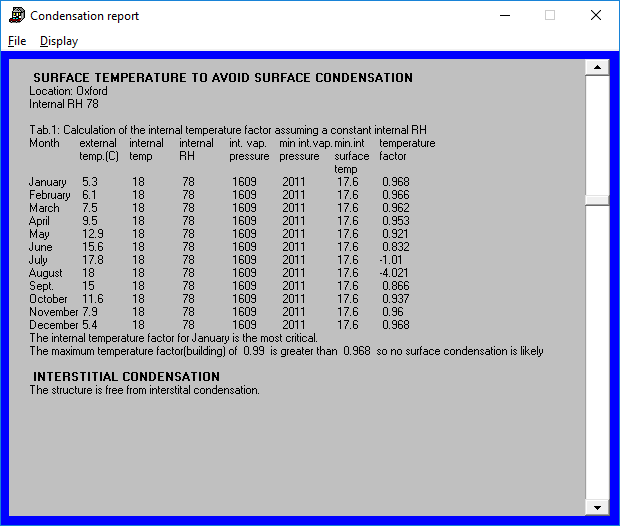
Hi, I presume that was DewPoint 3.0. I've just downloaded a copy and tried it out. For one of my makeups (effectively pitched roof with insulation at ceiling and for vapour resistance of the VCL of 250(standard) or2500), it seems to say "No surface condensation is likely" and "No interstitial condensation is predicted" as long as I keep the internal temperature 18C or above and the RH 79% or lower: Insulation between rafters needs >=18C and <=78% RH: The flat roof @18C and 78% RH is a problem if the air space between the insulation and plywood is only slightly ventilated, fine is "well ventilated". RH has to go down to 45% to not have interstitial condensation risk. I have used "asphalt" as the outer layer as seemed semi suitable as a replacement for the Sika Trocal I've actually got: As @nod and others suggest, removing the VCL solves the interstitial condensation problem with the slightly ventilated case.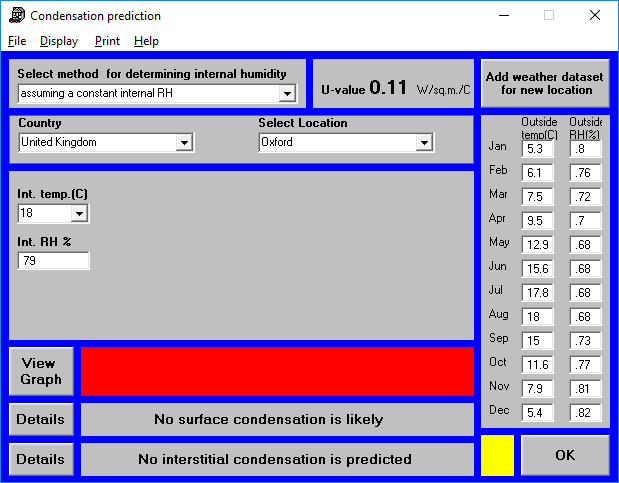
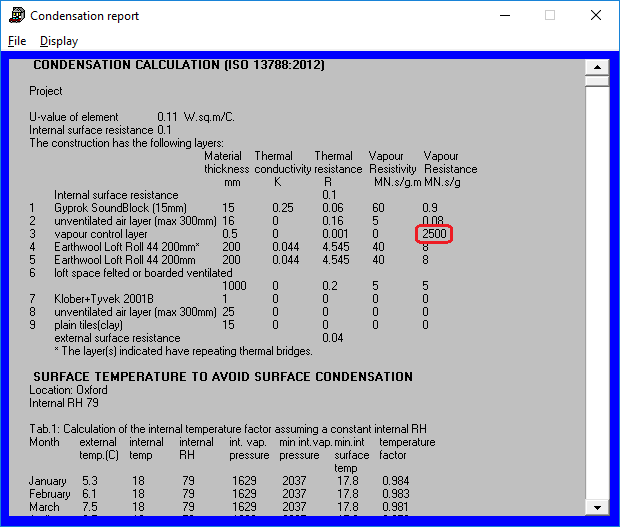
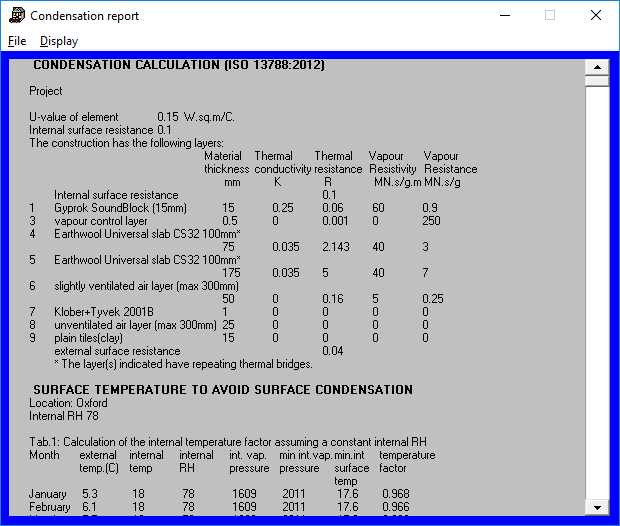
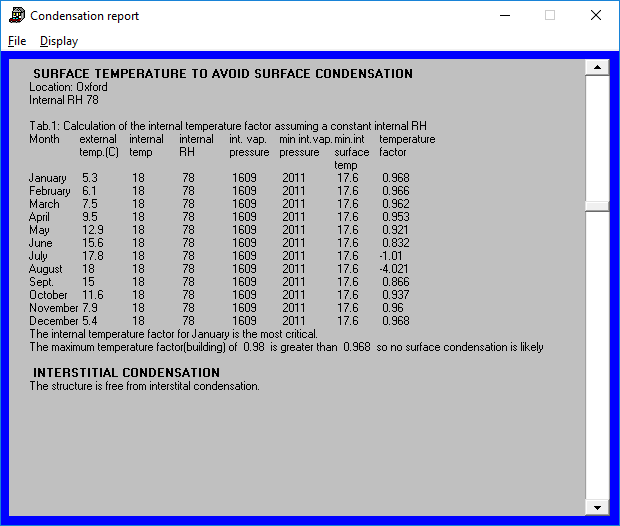
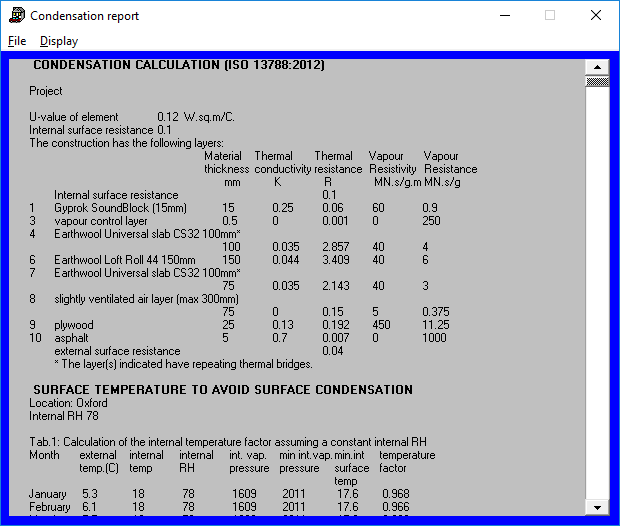
-
Do I need VCL, Vapour Barrier or nothing
MortarThePoint replied to MortarThePoint's topic in Damp & DPCs
Based on research below, I suspect: Condensation below polythene would be due to moist air pockets in a dropping interior temperature (interior RH more than 80% and temperature drop of more than 4C) or very poor insulation/ cold bridges Condensation above polythene would be due to fabric of the building drying out or leaks (airtightness or water) Obviously a holiday home type scenario could well have the very high humidity and cold interior temperatures that would be a real concern. Does that match your experience @nod ------ I'm not a weather expert by any stretch, but as I understand it the dew point is the temperature of a surface at which condensation will form at the current air temperature and humidity (and pressure). Cambridge University publishes weather data (with some easily detected errors) back to 1995 [1]. I analysed it and 99% of the time the dew point is below 17.3C. Only 0.18% of the time was it above 20C when the exterior temperature was below 25C and that appears to be in the early evening following a high 20s or above day when the roof temperature would be high. A reasonable approximate for dew point is Td = T - ((100 - RH) / 5) [2]. That means at 80% humidity, the polythene needs to be 4C lower in temperature than the air. -
Do I need VCL, Vapour Barrier or nothing
MortarThePoint replied to MortarThePoint's topic in Damp & DPCs
When you see the sweat is it on the interior (plasterboard) side or the insulation side? If it's on the interior side, doesn't that suggest the insulation isn't working well as the polythene should be at the same temperature as the interior of the house. That said, I can imagine situations where the humidity in the house interior is so high that the when the internal temperature of the house drops condensation forms in a trapped space between the polythene and plasterboard. Do you think that's what is happening? In the summer, the temperature outside can be higher than inside the house (e.g. today). That could mean condensation forms on the outside of the polythene. The roof space may be hotter still, but there won't magically be more water in that air, unless it has been drawn out of the fabric of the building. That could then condense on the polythene that is at the cooler interior temperature. -
Do I need VCL, Vapour Barrier or nothing
MortarThePoint replied to MortarThePoint's topic in Damp & DPCs
There is a bit of an air gap that is hard to see in that section drawing The planned make up is: 15mm WallBoard type plasterboard Sheet plastic VCL (<0.3mm thick) ??? 100mm OmniFit Slab 35 (R=2.85) against VCL/plasterboard and between 47mm wide timbers at 600c/c 150mm Loft Roll 44 (R=5.00) perpendicular to timbers so complete layer 75mm OmniFit Slab 35 (R=2.10) between 47mm timbers at 600c/c 101mm air gap 25mm Plywood (fitted) Sika Trocal roof membrane (fitted) I'm content with the U-value (0.115W/m2K), but need to be sure about moisture. There are firings on top of the flat top chord to create slope. I had asked chippie to cut notches in them, to allow perpendicular ventilation as well as in parallel to the truss, but he didn't and I was in survival mode at the time. I have wondered about adding a length of perforated pipe all the way along perpendicular to the trusses to blow dry air down if need be. Easy to add the pipe now and a Godsend if needed. -
Do I need VCL, Vapour Barrier or nothing
MortarThePoint replied to MortarThePoint's topic in Damp & DPCs
Good thinking, I think my SAP assessor may have done that already so worth asking him. Reasonably air tight. This plan is roughly as follows: Make as air tight as practical PIV system for fresh air in dMEV for stale air out The PIV and dMEV will never be perfectly matched so I need to decide which to do deliberatly: Add passive vent(s) (i.e. no fan) that equalises the pressure Ensure excess dMEV and use fabric to provide additional inflow (could this draw in VOCs/particulates from the building fabric voids) Ensure excess PIV and use fabric to provide additional outflow (could this result in moist air getting where it shouldn't) -
Do I need VCL, Vapour Barrier or nothing
MortarThePoint replied to MortarThePoint's topic in Damp & DPCs
With the exception of back boxes and light fittings, plasterboard and skim should be a continuous air tightness barrier shouldn't it?



