


MortarThePoint
-
Posts
2294 -
Joined
-
Last visited
Everything posted by MortarThePoint
-
That must make me an elite motorist then 🙂 Might you void the warranty of the battery by doing this though?
-
Installing wifi adapter on Ecodan
MortarThePoint replied to Garald's topic in Air Source Heat Pumps (ASHP)
What does the WiFi adapter allow you to do? Can you do everything you can otherwise do at the controller? -
Wifi current clamp meter
MortarThePoint replied to Cyberfruits's topic in Air Source Heat Pumps (ASHP)
Does it really need to be WiFi or do you just want to be able to check. If the later, my ASHP installation came with one of these: https://www.amazon.co.uk/gp/product/B08X6J865C/ Alternatively, I would love someone braver than me to try out one of these: https://www.aliexpress.com/item/1005004158545611.html https://www.aliexpress.us/item/1005005184859497.html Important to not that the first one says in its text that: "Both models have NO overcurrent protection, can not set current ,voltage in APP." The second offers current limiting, but that looks to be via software so not to be relied upon I'd say. Anyway, you need RCBO rather than just MCB function nowadays. Easy to put downstream of an RCBO. Both claim to be CE marked. Form you own risk assessment 🙂 Available as Zigbee too.


-
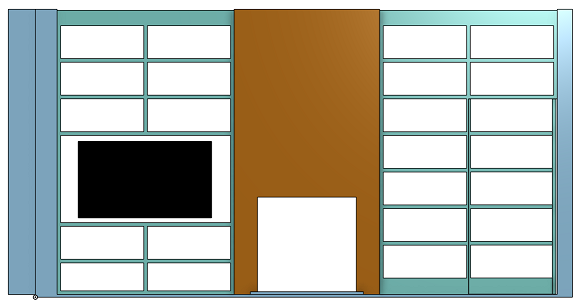
I'm planning some shelves for our family room on the 'wall' shared with the dining room. It's currently just open so the shelves would form the wall. They go either side of the chimney that has a large (approx. 900mm x 900mm) opening through to the dining room where the double sided stove fits. This opening represents a significant acoustic weakness. I could have a removable panel on one side or other of the stove opening for when there might be a rowdy dinner whilst kids watch a film for example, but it will always be a weak spot. That leaves me wondering if there is any point in having a significant partition at the back of the shelves. I could go for just 15mm plasterboard and 3mm hardboard as the the shelves are likely self supporting, though I think I would rather replace the 3mm hardboard with 12mm plywood or equivalent. That saves quite a lot of depth vs using 48mm or 70mm studwork (MF or timber). Partition options (thickness) that come to mind are: Option A (18mm): hardboard and plasterboard [102mm] Option B (27mm): 12mm plywood and plasterboard [93mm] Option C (52mm): 12mm plywood, 25mm battens with 25mm APR insulation, and plasterboard [68mm] Option D (75mm): 12mm plywood, 48mm MF studs with 25mm APR insulation, and plasterboard [45mm] Option E (97mm): 12mm plywood, 70mm MF studs with 50mm APR insulation, and plasterboard [23mm] Option E is equivalent to most of my other partitions which are 70mm MF with 15mm plasterboard either side. A thicker partition pushes the front of the shelves closer to the front to the chimney and I think they would look best recessed a bit (amount shown in [blue] based on 250mm shelf depth). The black rectangle is a 55" TV which would weigh about 30kg and I think I would have studs within the shelf depth to cope with that load if hanging out on an articulating TV mount. I am planning to use 33mm PSE softwood timber to make the shelves, either 250mm or 225mm deep. I don't imagine us hanging anything significant on the dining room side of the wall.
-
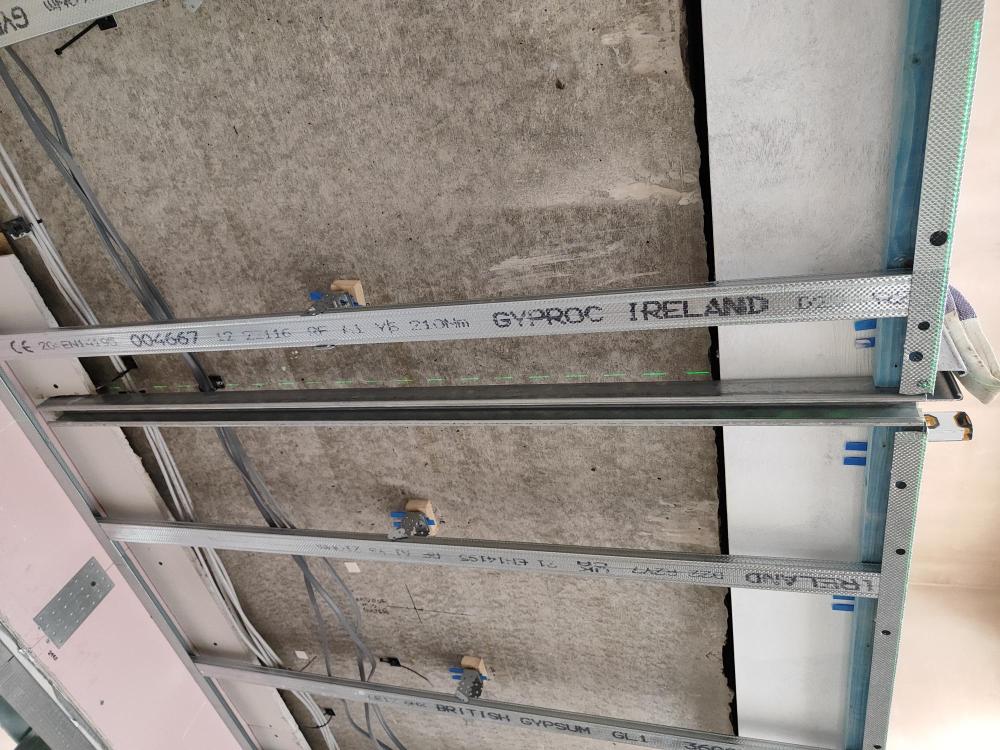
Here's the Unistrut under the HCF to counter the beam roll/twist. I wanted to anchor it close to the secured side of the HCF to avoid HCF deflection rolling the beam As both bits of Unistrut are about the same length it should serve to halve the beam roll
-
It'll reduce the Unistrut bending massively, but won't reduce the beam twist
-
Pretty sketchy test setup pushing the post out over the void but I got some numbers. Only for the 1x case though (is no safety factor). As I have two posts I can use the other to observe beam twist. Laser level and pen marks plus a crane scale and brute force. It's 1.8m between posts, so 1.8m*0.36kN/m=0.65kN. Peaked at 67kg force with a total deflection of 27mm, 7mm of which is from the twist of the underlying beam. So the Unistrut setup is deflecting 20mm which is within the 25mm limit, but I should stop the beam from twisting. To stop the beam from twisting I an thinking of adding a hidden piece of channel acting as a counter leaver. Addition of timber will stiffen posts too.
-
To complete the information, the jambs are 92mm c-stud with CLS routed to slide inside and then a second c-stud with its web screwed to the timber. As shown in the previous post, the main jamb stud is then cloaked in deep track. It all feels very solid.
-
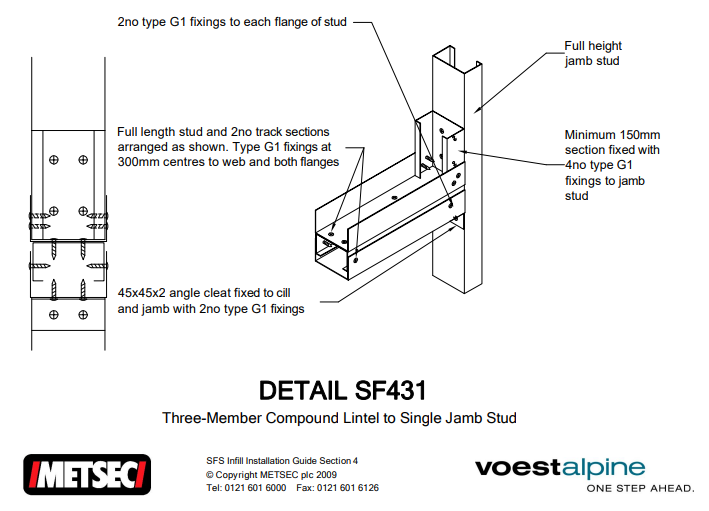
It's in a 92mm metal frame partition (2 doorways under a beam). I've used the double track and c-stud detail attached for the lintel which is good. I added a 3x1 timber in the lower track so that should allow the door lining to be screwed to the lintel. I've adopted the attachment approach of the Siniat image (folding down the vertical stud). I haven't done so yet, but may add small c-stud sections to the upper track as Metsec suggest.
.png.5335e8169bdc2ac8ee36642a545d82ec.png)
-
I've fitted plenty of door linings for single doors now but am looking at my first lining for a double door. It's for a double 686mm door with 15mm couple so the span needs to be about 1393mm. Do I need to screw the head to something mid span?
-
You can just do one (tg or thermal lintels) you don't have to do both though both is better. I went with thermal lintels but no tg due to the cost benefit
-
For shorter spans, there isn't much cost uplift and the removal of the cold bridge that the lintel represents is a similar upgrade to going from double o triple glazing. Those are some quote large spans so I'd imagine the lintels are sturdy. I used Keystone HT/XHD+ 100 WIL 2850mm lintels for 2485mm openings in 140mm blockwork and they cost around £200 each in 2020. Condell used to be a sensible place to see how much lintels cost, but be careful as some of their prices (Catnic Thermally Broken) look a joke now. When building an entirely new house it sometimes makes sense to remove a 'weak spot' that doesn't make sense removing in a renovation. I doubt you'd notice the difference in terms of condensation etc but it would make a difference to your heating bill.
-
2-ply trusses are a difficulty as they have a thin gap between the plys. I dribbled so PVA glue into such gaps as well as smearing sealant along the grove at the top and bottom of the truss bottom chord. It won't be perfect, but should help. Perhaps the ideal would be to apply sealant all the way along top and bottom, but I didn't.
-
Some pictures below. I don't seem to have one that shows how the horizontal OSB laps onto the wall plate by about 50mm and is screwed down onto the VLC that is double sided tape taped to the top of the wall plate. That leaves a stable joint that can then have sealant applied. It's a slow process, but one a became reasonably proficient at and should be good and airtight. Having sealed the OSB box itself, if there is a leak through the VCL joints then there is a second line of defence. The VCL will be continued along the rafters later. There is enough VCL for it to extend about 1ft beyond the top of the vertical OSB I think.


-
Beam helper on stair stringer
MortarThePoint replied to MortarThePoint's topic in General Construction Issues
Yes, the half landing frame is very solid and has lateral timbers bracing against the wall opposite I was mainly thinking about the splitting risk you identified, but that wouldn't be due to loads -
Beam helper on stair stringer
MortarThePoint replied to MortarThePoint's topic in General Construction Issues
This is why I was thinking it would be a good idea to glue (CT1) the nail plate to the stringer rather than using any nails. The glue would push through the holes in the nail plate making for a very string bond That's a nice arrangement as it avoids any screws into end grain. Given I already have the screws into the end grain, I am less inclined to drill / screw any more holes into the stringer. The rotation caused by any loading on the stair (or the stairs own wait) is to push the stringer into the angle that sits inside the bottom flange of the UB so it feels I figured end grain attachment would be OK. Our American cousins do this a lot and one of their common approaches is to place a piece of Plywood onto the face of the the trimmer joist and then screw through that into the end grain of the stringer. I have four 45mm wide stringers so hopefully there is a fair degree of redundancy at play. -
Skinny Metal Frame Pillar
MortarThePoint replied to MortarThePoint's topic in General Construction Issues
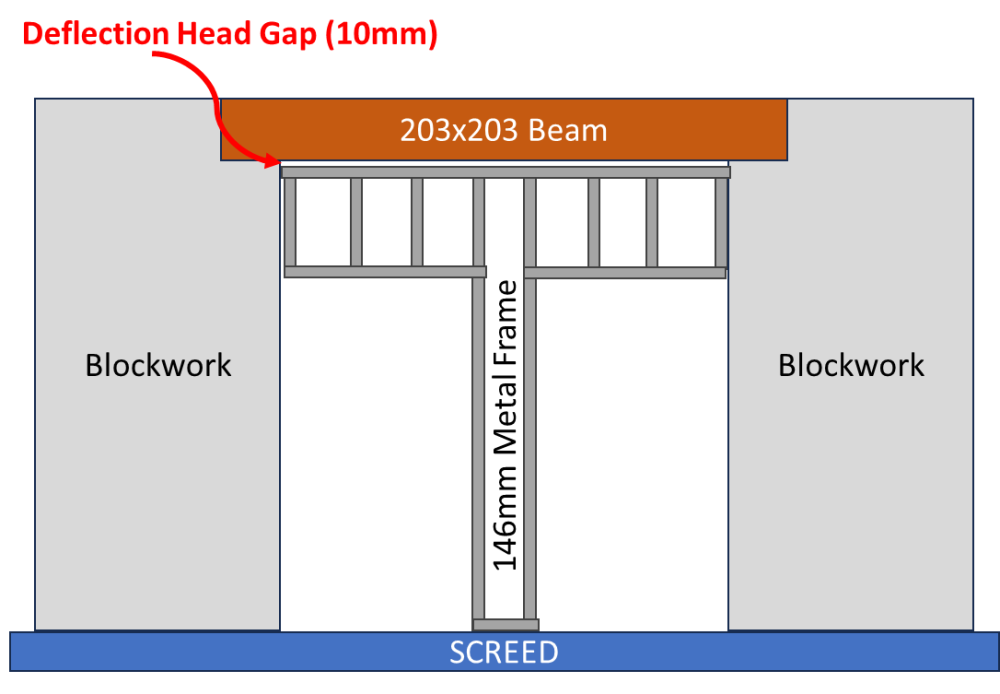
@Gus Potter What do you make of the logic here? Do you think it would be beneficial to have the pillar less rigid, so not use the I-Studs? (Note: image says 146mm M.F. but its going to be 90mm) -
Beam helper on stair stringer
MortarThePoint replied to MortarThePoint's topic in General Construction Issues
Sorry, I should have quoted more of your original post. The nail plate would be to mitigate the chance of the stringer splitting at the screws at the top. I think that the screws at the top don't really perform much of a load bearing job as the stair would still stand without them since the steel angle is rigidly bolted to the steel beam so couldn't rotate out of the way you allow the stringer to fall. Here is a mock up that shows where I was thinking I could glue the nail plate. The three screws per stringer are shown as arrows. The nail plate would just be in an attempt to stop the timber from splitting. Outermost stringer removed for visibility.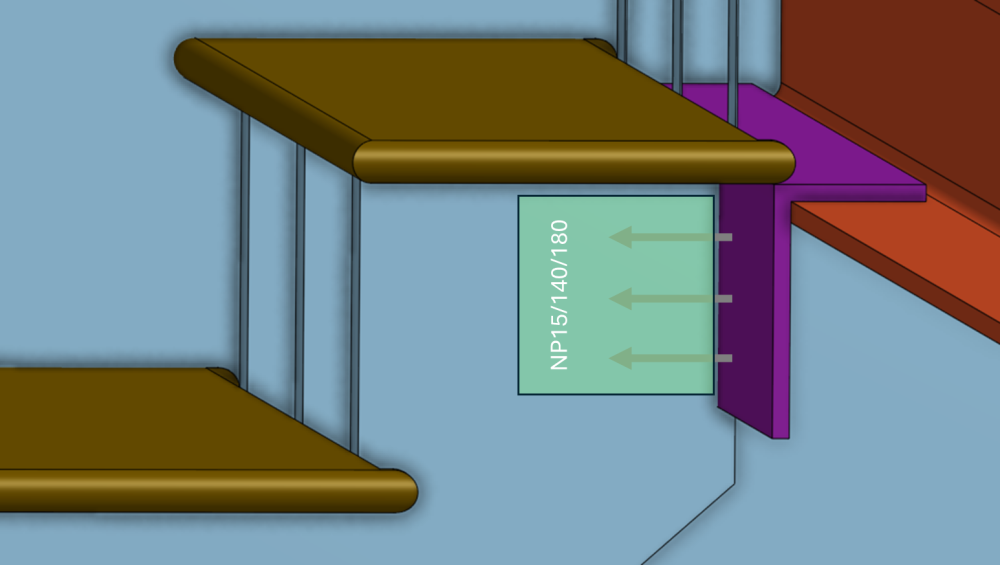
-
The image below shows an area of metal frame under a steel beam that includes two wide doorways. The blockwork opening is 3.6m wide. The door openings are something like 1.5m each meaning the Pillar is just 600mm or so wide. I'm planning to use 90mm metal frame and can probably only glue (CT1) the track at the bottom to the concrete floor due to pipes and membrane. I had thought to make the Pillar as strong as possible so ordered some I-studs as well as plenty of C-studs. Thinking about it again, I'm now thinking that making the pillar really rigid may be a bad idea as that would increase the force transferred to the small area of track at the bottom when the pillar gets knocked or a door slams. What do you think?
-
Beam helper on stair stringer
MortarThePoint replied to MortarThePoint's topic in General Construction Issues
I'm avoiding plywood and assume OSB wouldn't be a good alternative. Could I glue a flat nail plate in the area of the screws instead? I'm thinking of the Simpson style that is just like a drilled sheet of 1.5mm steel. Perhaps NP15/140/180. I'd use CT1 which would squeeze through the nail plate holes and leave it well stuck. I'd want to apply anything only to the inboard surface of the outside string as my dimensions there are critical -
I used OSB and battens to make horizontal and vertical surfaces: 1. Stick (50mm double sided tape) VCL to top surface of timber wall plate draping down wall 2. Add battens to follow with OSB 3. Horizontal OSB from top of wall plate 4. Vertical OSB up from free end of horizontal OSB up between joists Battens along OSB joint. 5. Apply double sided tape to OSB edges 6. Pull VCL onto surface of horizontal OSB 7. Cut VCL to allow sections to pass up vertical OSB 8. Wrap where VCL touches joist with polythene tape 9. Apply sealant It required carefully measuring the joist gaps and thicknesses and pre cutting the VCL before attaching to wall plate. I'll try to dig out some photos I applied sealant the the OSB box before attaching the VCL to it but that's me
-
Regulations for landing balustrade (banister)
MortarThePoint replied to MortarThePoint's topic in General Construction Issues
Can't get it in one length and prefer the look of it stopping at each post -
Regulations for landing balustrade (banister)
MortarThePoint replied to MortarThePoint's topic in General Construction Issues
What's the normal method of attachment between the intermediate post and the two sections of handrail? I'm familiar with the approach at a post that only takes a single handrail section where you can drill through the post and screw into the handrail end, but that wouldn't work with two inline sections of handrail. -
The plan is to use two 90x25 and two 40x25 timbers glued to make a 90x90 hollow square section. It's going to be painted and the narrower width timbers will be inline with the handrail and spindles so somewhat hidden. I'm thinking the 90x25 facing the landing will get screwed to the Unistrut at 200mm intervals to couple the timber to the metal. Alternatively, perhaps the 40x25 pieces as they don't stop at the top of the beam.
-
This metal post will be down the middle of a timber post that will add the vast majority of the strength of a solid timber post too.


.png.5335e8169bdc2ac8ee36642a545d82ec.png)



