Dan F
-
Posts
1431 -
Joined
-
Last visited
-
Days Won
2
Everything posted by Dan F
-
Look at the "Moralt Ferro" range they are low u-value, airtight and fire doors. Lots to choose from with u-values all the way down to 0.54. We went for the non-passive one with u-value of around 1 though as looking at big picture it wasn't worth paying a lot for a super-low u-value.
-
Right. I was more thinking about the sum (given daisy-chaining approach) which may add up.. depending on how many relays on one RCBO and what relays feed. But looks like @Thorfun has things under control,
-
Have you totted up max current per RCBO? What thickness tri-rated are you using?
-
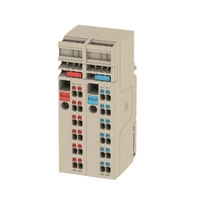
Need to dig that up, I may have already posted it on buildhub somewhere actually. There are the type of blocks though. This image shows 6 different blocks put together, but you build them up and bridge them as required. The 1-entry block supports thicker cable for feed from RCBO (but you don't have to use it) whereas the 6-way blocks are for thinner cable. For feeding relays you wouldn't have neutral distirbution. I think it's more "correct" to not daisy-chain relays, but having 20-lives come out of one of these gets a bit busy! https://catalog.weidmueller.com/procat/Group.jsp;jsessionid=E9EF0DE779FEDC73307DAC5460900F18?page=Group&groupId=("group9800831255882")
-
This shows this approach: https://youtu.be/fRq_IjiyB68?si=ZIm1Ah5WGJCOLwky&t=612
-
This is what 90% of people do from what I've seen. You can use your terminal blocks, just need to re-wire a bit. As long as you you have the 2-way bootlace ferrules and the cable from RCBO is sized for the total load of all relays it serves, then you won't have an issue. (the cable sizing for other approaches only has to account for load of individual relays, so this is important) I used a slightly different approach, where I use dedicated (power distribution) terminal blocks on bottom rail next to RCBO's to distribute live to each relay independently. This involves more materials and more wiring, but I thought it was more "correct" at the time. yes! and you should only have 1 blue cable per RCBO. For switched lives from relays I used brown for lighting and brown/black for blinds (where there are two lives).
-
Ah, so this is maybe what @Thorfun was trying to do, but without the necesary 3rd level? I can see this being quite natural when the RCBO's are external, but when RCBO's are in the cabinet it's less natural and you need an additional level. Also, not really practical with blinds/motors. @Thorfun Maybe we confused you, given we've each slightly different approach re: RCBO location and power distribution 😞
-
I see, so you were planning to do power distribution via the "installation" terminal blocks rather than i) via daisy chaining ii) seperate power distribution terminal blocks. Seems a neat idea, just I'm stuggling to see how it works 🙂 - Power would go straight out to lighting circuit unswitched (given these are connected to top level), right? - But then, how does the switching happen? On the neutral? It doesn't seem thats whats happening here though. - It seems like your lighting circuits would be always on (given RCBO's connected to installation terminal blocks) and then the relays (any one of them) would short all circuits when they actuate. Or maybe I misunderstood compeltly? Can you draw a simple ASCI diagram like mine, but what you had in mind?
-
I havn't shown cardinality, that's all. In my Loxone cabinet I have a single incoming MCB as a point of isolation and then 8 RCBO's. (it could have been a simple isolator I guess, but electrician used an double-pole MCB)
-
Or have you wired each side of each relays to a live/nuetral on one of termal terminal block?? If you have, that's not typically how it's done in my experience and would require power being supplied to the light circuit external to the Loxone cabinet somewhere. This is the approach you'd normally use. (the box is your loxone cabinet) _________________________________________________ CU -> | MCB -> RCBO -> RELAY -> Terminal Block (L) | -> Lighting Circuit (live) CU <- | MCB -> RCBO <- Terminal Block (N) | <- Lighting Circuit (nuetral). (nuetrals for same RCBO commoned on terminal blocks with single cable back to RCBO) __________________________________________________
-
Looking really tidy! Just one comment though, I'm not sure you should be using "blue" for relays to terminal blocks as this is not nuetral. Intially, I wondered why you hadn't commoned any of the nuetrals on the terminal blocks (the ones on same RCBO's anyway), but then I released that these are actually all switched lives. Where is live for relays coming in? Are you daisy-chaining between relays?
-
any exoerience on shower /japaneses toilets
Dan F replied to scottishjohn's topic in General Plumbing
Not cheap, but you can save some money if you don't get one with blow dry or a heated seat! I'd say Geberit are probably the best of the german style ones, and toto is the leading japense brand. We got a mid-range Geberit Sela (without blow dry) and it works well. Lot of other brands sell them, but I'm not sure it's something I'd buy one from the likes of duravit or Villeroy & Boch personally (they just seem more ceramics company). -
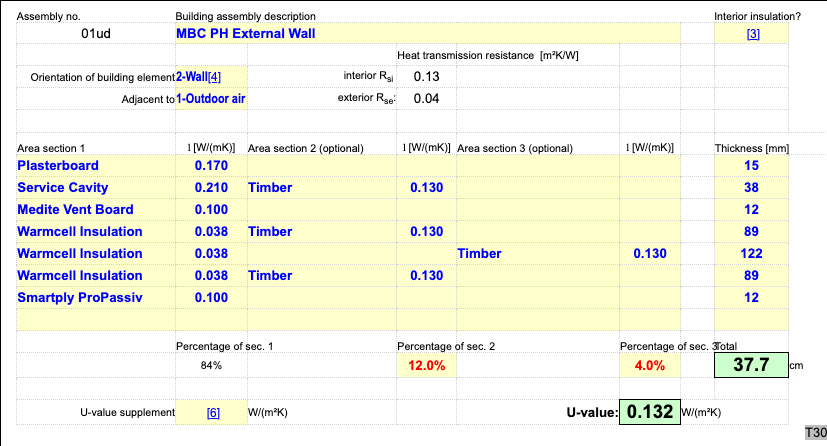
@Russdl Did you complete PHPP in the end? Also, what was your final verdict/number on the MBC twin-wall u-value? I have this, but I think the timber-fractions are too high! The teoretical values at 6.3% and 0.7% (noggins), but @A_L is right that the actual timber-fraction (in walls that have doors/windows more than roofs) is higher. Some of this extra timber does get accounted for in window thermal bridge calculations, but not all of it.
-
Are you doing your own PHPP, or have someone doing it for you?
-
What size Hot Water Cylinder for family of 5?
Dan F replied to Meabh's topic in Boilers & Hot Water Tanks
We have 300l for family of 4 and wouldn't go smaller. Our effective capacity is increased due to use of WWHRS, also if we want to get more showers out of the tank (e.g. due to visitors) we increase tank temperature. How many showers you get is a function of tank size + tank temp + wwhrs, and of course shower length. -
@J1mbo I resolved this in the end, it was a firmware bug. The old firmware doesn't respect the "-100degmin" setting, it also double-counts the change in integral resulting in increased cycling! New firmware works as expected.
-
Low loss headers and plate heat exchangers for air source heat pumps
Dan F replied to dnb's topic in Boffin's Corner
Not read the whole thread yet, but PHE (plate heat exchanger) is only required if you use glycol in the system and you don't want glycol in UFH/radiatos. My understanding is you have thee options: 1) No Glycol, use anti-freeze valves instead. 2) Glycol externally, PHE, no glycol internally in radiators/UFH. (potentially an additional pump that might not be needed otherwise too) 3) Whole system has glycol. No PHE required. We were recommended 1). Simpler, no (albeit small) efficiency losses and pure water is better for heat transfer. PHE (instead of a coil) for heating UVC is different discussion to the use of PHE to seperate external glycol circuit from internal. -
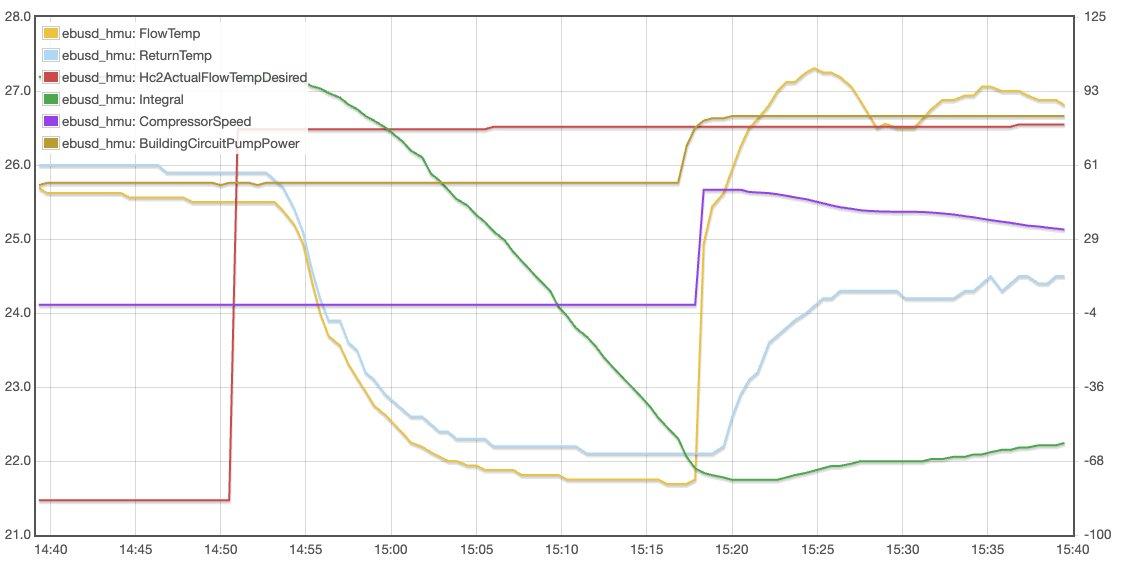
This shows this working, along with the compresor modulation: Target flow temperature increases (red) Nothing happens immedialty, as there is high integral from pevious low target temp. integral (deg.min) gradually reduces from 99 to -60 based onthe delta between actual and target flow temperatures. Once integral hits -60 heating pre-run starts and pump power increases (brown) Shortly afterwards compressor starts (purple) Compressor modulates trying to match desired flow temp (yellow) Integral increases if actual flow temp is above desired flow temp, and decreases if actual flow temp is below target. If the heat demand < min output, then (even at min compressor) the actual flow temperature will generally be above the target. If this occurs, then integral gradually increases based on excess deg.minutes. Once integral reaches 0, compressor is turned off. If the heat demand > min output then integral chaneg slightly, but won't increase to 0 over time and the unit continues to run.
-
It's via installer settings of the controller or hydraulic unit (not the sensocomfort). I don't know much about control theory or PID's, but Vailant use this for couple of things I believe: - To decide when to turn on the compressor based on deficit degrees/min (vs. desired flow temp) - To decide when to turn off the compressor based on excess of degrees/min (vs desired dlow temp) This approach is preferable to a simple hystersis, especially when combined with compressor modulation (25-100% on the vaillant heat pumps). You are right, typically there is no need to adjust this and the default -60 degree-minutes is fine. But, if your ASHP is slightly over-sized and/or it is spring and you have low heat-demand, the theory says that decreasing this theshold this will result in longer cycles which should be slightly more efficient. This is because more deficit (if that is the correct term) is allowed to accumulate before the compressor kicks-in. This in turn means that the cycle should be longer as it's starting from e.g. -100 rather than -60.
-
I've tested this, but doesn't work on my arotherm+. It seems to just ignore the configuration and fire up the compressor at -60 ° minutes anyway. Have you happened to have tested this?
-
Equipment required to monitor Vaillant heat pumps
Dan F replied to JamesPa's topic in Air Source Heat Pumps (ASHP)
Did you get this, or something similair, up and running in the end? -
Bio-ethanol Ventless Fireplace In a Passivhaus ?
Dan F replied to Nic's topic in Stoves, Fires & Fireplaces
Have a look on youtube, that way you can see the effect they produce too. This is the "cassete" version that we used: https://www.youtube.com/watch?v=MEmPgSSB4s4 -
Bio-ethanol Ventless Fireplace In a Passivhaus ?
Dan F replied to Nic's topic in Stoves, Fires & Fireplaces
Look at the Dimplex Optimyst/Opti-V poducts. While not a real fire, we personally liked the effect this create more than some of the bioehtanal options, but without the heat or ethanol smell! We used the cassete version and built it into a slate bench and even plumbed it in. -
If you think about it hybrid inverters don't have any PV at night, so why wouldn't they work with without PV? Best to check with manufacturers though. I'd want to use a hybrid inverter if possible personally in order to have future possibility of adding some PV.
-
The question is if it can be used without the solar panel input or not, all inverter/chargers use DC to charge/discharge battery. I'd need to look at the datasheet/maunal to understand this, but there are other brands.. not just Solis.