


joth
-
Posts
2861 -
Joined
-
Last visited
-
Days Won
5
Everything posted by joth
-
 Yes, thanks I meant to reply on this one: definitely planning to perform this experiment but waiting on installing curtains for the other rooms ?
 -
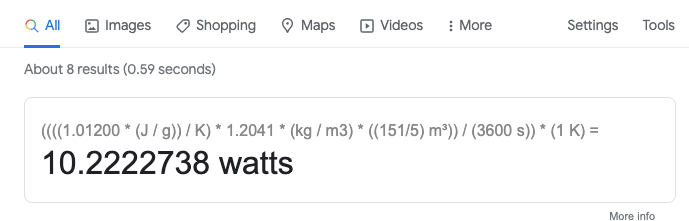
Thanks! The beauty of using the Google search box calculator is it automatically performs simple unit conversions like this (and verifies the resultant units are what you expect) Paste either these in a search box and you should see it work: 1.012 (J /g)/K * 1.2041 (kg/m3) * 151/5 m³/(3600s) * 1K 1012 (J /kg)/K * 1.2041 (kg/m3) * 151/5 m³/(3600s) * 1K
-
Exactly! I don't see how our situation is that different, I know others happily keep bedrooms a degree or two cooler than the rest of the house so trying to figure out if there's anything specific we're missing that is resulting in ours being warmer rather than cooler than the rest of the house. FWIW the bedroom door does have a smaller than average undercut, just as you are planning, I thought this would be fine as the bedroom + ensuite would makes its own balanced pair but it is not enough to keep the room at a comfortable temperature, but it doesn't seem so. I don't think widening the door gap would help though, as leaving the door open a crack does not seem to help much - there's just not much airflow through that door because the bedroom+ensuite are already acting as a pair. I know this is not seeking a reply, but for avoidance of doubt the issue with Thermal mass is it requires a temperature gradient to put any energy into (or out of) it. So if the whole house is already at or slightly above target temperature, the room has to overheat by a couple more degrees before it'll get much effect in moving energy into the mass (or through the fabric of the building). This is probably why, we see the room temp shoot up but then "level off" at about 23ºC each night. Also, there's always going to be a limit to how much can be stored, and depends on being able to dump all that stored energy during the (hot?) day while the room is unoccupied. If I'm unwell with a fever and have to stay in bed for several days I don't want to be overheating because the nearby thermal mass has "filled up"! I'd rather the system can deal with moving out the heat perpetually, to stay in equilibrium. My maths so far [which I still hope is wrong!] show that MVHR is only able to move energy at a fraction of the rate a human generates it, so is doomed to overheat without a designed in secondary pathway to carry energy away.
-
Thanks! yes I removed the "multiply by time" from my own calcs (hence why the Google box resolved to W not J) but forgot to remove that term from the formula - fixed.
-
Recently moved into our renovated house, temperature is great everywhere, around 20ºC, except the master bedroom that sits at about 21-22ºC all day and shoots up to 23+ every night. I want to get ahead of this before the summer overheating risk really starts! Full build context below. Our goal would actually to be to keep it cooler than the rest of the house, e.g. 19ºC The bedroom + ensuite have a supply + extract duct so I was hoping these would make a balanced pair and not need much additional ventilation. Even if it's purge ventilated all day, as soon as we try and sleep. it rapidly overheats. Thanks to @SteamyTea I have the formula for the rate an MVHR can move energy: P = SHC x Mass Flow Rate x ∆T. SHC of air at 20ºC = 1.012 J/(g.K) Mass of air = 1.2041 (kg/m3) Flow rate of the entire house air supply = 151 m³/hour - Lets assume 1/5th of this can be sent to Master bedroom. (A bit optimistic as we have 7 supply vents, but, whatever). Plugging all this into a good old Google search box: So for every 1ºC of air temperature difference, the MVHR can remove 10 watts of heat generation per room. That seems far too low! Where have my calcs gone wrong? 2 adults sleeping will put out about 80W each (and a bit more after a couple glasses of wine). So the MVHR supply, at 30m³/h, needs to be 16ºC colder than target temperature to keep the temperature constant. That seems completely insane! Where have my calcs gone wrong?? Our poor Q350 still thinks we're in "winter heating season" so is recovering all the heat it can, pumping 20.5ºC air into the room. No wonder it overheats. Unless I can set a different supply temperature of flow rate for the bedroom vs every other room, it seems sure to overheat. OR I need to put the whole MVHR into bypass mode, and have every other room freeze overnight. OR I need to install a secondary ventilation system to circulate the air from this room to the rest of the house more actively. (Leaving the bedroom door open is not a preferred option, as we want to keep pets out, and also it opens to a hallway atrium with a too much glass that will let light into the room at 4am.) Does this reflect what other MVHR owners find? How do you manage this? Thanks for reading this far ? @Dan F may also be interested in this, as I know you are also planning an isolated supply/extract for bedroom+ensuite. Full build Context: 151m2 house, 2 occupants. Passive house enerphit standard (25kWh/m2/yr). Zehnder Q350 MVHR House is being maintained 20-21ºC via solar gains and (as needed) ASHP to ground floor UFH. Upstairs has no heating system. Master bedroom is on first floor, with rockwall beneath the floor boards. It has North-East aspect, so some morning light but little in the way of solar gains or other heat sources. not huge, about 30m³ volume but some of that taken with cupboards. The attached Ensuite has UFH mat, which just operates 1 hour each morning. Warm loft above it.
-
I'm amazed a tax advisor company can write that much article and not mention the CGT aspect! The normal advice is to put an exercise bike in the office and say it's a dual purpose office/gym. https://www.taxinsider.co.uk/working-from-home-don-t-lose-private-residence-relief-ta
-
Bear in mind this will likely make the office portion liable for capital gains tax when the house is eventually sold. In fact even if you don't take the tax break, having an area dedicated to working can open up CGT liability, but taking a tax break to build it basically predeclares this to HMRC https://www.ftadviser.com/investments/2020/08/12/advisers-warned-of-tax-implications-of-working-from-home/
-
kWh indeed, have a ?
-
Total consumption was 603kW, of which 288 was self consumption of PV. PV total generation was 900kWh, of which 612 was exported. (So exported about double what we imported) April was only our second full month living in the house so not yet put a lot of effort put into implementing energy time-shifting (I only just built the immersion controller yesterday! Previously I was using a dumb timer switch) but I'm not sure we'll make a major dent on this as a good chunk of the remaining consumption is cooking and background load.
-
Whereas I exported 611kWh in April alone. YMMV, it's really up to the buyer to do their own maths and make their own decision
-
I think you're right that Eddi supports net metering across sum of the 3 phases, but Immersun can only monitor a single phase import/export as it only supports one CT clamp Page 30 https://myenergi.com/wp-content/uploads/2019/04/eddi_manual_v2.3_english.pdf Page 21 https://www.immersun.co.uk/wp-content/uploads/2019/11/immersun-installation-and-user-manual.pdf
-
No - I see now I worded it ambiguously, but I was replying to this: I meant if the goal is the most efficient system possible, getting both the micro-optimizers (this topic) AND an Eddi/iBoost will be best. It really depends on your definition of efficiency though: electrical energy captured per year per £ of capital investment, full lifetime financial ROI, or CO2 saved, will lead to different optimization choices.
-
Not likely, I think it will overrun the max voltage on the optimizer. Obviously "both" would be most efficient, but in a run off between these the HW tank redirect is almost certainly going to give the best £ ROI. The larger and better insulated tank, and the more HW you you expect to use from it, the better the payback. Sounds much better than other micro-optimizers. Our contractor had horror stories of installing a system where each micro-optimizer had a separate AC cable that had to be brought inside the building before connecting together. Resulted in dozens of penetrations of the airtightness envelope and a lot of taping and remedial work to pass the air test.
-
Electric supply single vs three phase
joth replied to WWilts's topic in General Self Build & DIY Discussion
Added a third pro of future proofing, as it's worth calling out a house will hopefully last several generations, it's hard to know what will be needed in future, but if it's only £20 to prepare for it, why the heck not it's worth calling out: you can get a 3 phase supply and only connect up one phase of it to a single-phase meter, and just leave the other 2 there spare in case of future needs. -
Couple thoughts - if you get the SolarEdge add on, make sure you get quotes with the newest HD-Wave SolarEdge inverter as these are designed to work with the optimizers (only) and have cost savings based on that. (No MPPT tracking in the inverter, relies on the optimizers for that) - the other 2 benefits of SolarEdge optimizers are (i) provide lifetime per-panel performance monitoring and graphing, (ii) auto safety cut out if the string is disconnected from the inverter. I like these extra benefits, but really they are mostly interested for tinkerers and enthusiasts. If you just want to fit and forget PV then they really don't add a lot. (But IMHO grid scale Solar PV is getting so good I think domestic installs are increasingly the domain of enthusiasts only; the ROI is borderline and might actually make less sense over time)
-
Seems unlikely to be a problem It's like a vortex with the water coming out at speed is directed in a stream running around and down, and the top lip folds inward / over slightly so if anything did splash up it would get knocked over and directed over anyway A picture may help
-
Yeah I doubt it's a binary decision. Simply put, the lower the cistern, the more frequent some brushing will be required to remove clingers
-
Is a floor mounted door stop compatible with UFH
joth replied to Adsibob's topic in Bathrooms, Ensuites & Wetrooms
Maybe a hinge-pin doorstop would work? Depends on the door and its hinges, of course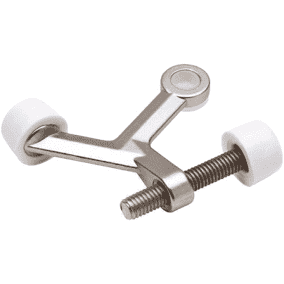
-
I really have no idea! we were advised by the shop salesmans to use "Geberit Omega 12 H112 WC Wall Duofix Frame" when using a "GSI Pura 50 Wall WC Pan Swirlflush" and can confirm that combo works great, but I cannot say how well that information generalises to other brands and heights. Sorry!
-
Just following up here as I'm really finding Texecom a pig to deal with. The PSU in my Elite 88 panel failed after 2 months. I had the installer replace it and never went through the hassle of claiming it under warranty. Now the Texecom Connect gateway has also failed. Texecom have (eventually) provided a return number, but require the return to go via the supplier. I bought it online; the Supplier is flat refusing to reply to phone or emails, and the credit card company won't take up the case as it's 11 months old (well within 2 year warranty, but > 6 month they will back). I would just suck it up and buy another, but it's borderline useful product (equal parts annoyance and reassurance to have it), and given the appalling failure rate I've had so far with their hardware I'm really loath to reward them with more sales. Just got through to tech support once again (our 4th conversation on the topic) and they're shipping me a replacement today, so I will remove this whinge awaiting a fairer judgement when this outstanding issue is actually resolved!
-
Mitsubishi Ecodan "Smart Grid" - what does it do?
joth replied to joth's topic in Air Source Heat Pumps (ASHP)
LOL. It's all a bit heath robinson, but this actually works. I used a relay to switch a 5K6Ω resistor* in parallel with the UVC tank thermistor, and magically the controller believes the internal temp has jumped up by 10ºC meaning it will need to get that much colder before the heatpump will fire to charge it up when in this "set back" mode. That'll do. (* - experimental data: at 49ºC the factory thermistor reads 2kΩ and popping 500Ω in series drops the readout to 43ºC; putting about 6K in parallel reduces the effective resistance to about 1500Ω which increases the the readout to 59ºC. It's almost certainly non-linear so the effect of the resistor in parallel will be more pronounced at lower temps, somewhat unfortunately. I guess if I really wanted I could pull the thermistor out of the tank and put in different temp cups of water and find out.) -
Mitsubishi Ecodan "Smart Grid" - what does it do?
joth replied to joth's topic in Air Source Heat Pumps (ASHP)
Got a bit of tech support conversion going with Mitsubishi, still a bit vague but it sounds like Smart Grid features are all intended for use with a (large) buffer/mixing tank with embedded thermistor, so when the power is cheap it can charge up the mixing tank, and when expensive it runs the circulation pumps to run the heating circuits off the buffer tank only. While I have a buffer tank, it's pretty damn small, and has no thermistor. The relevant thermistor input is left floating open and maybe confusing the controller into thinking "damn that mixing tank is way too hot, while the electricity is expensive I should do something with all that heat". This is kinda bobbins as I am intentionally not calling for heat on either zone while prices are high, and even if I did it should be very frugal in doing so during high energy prices as those pumps aren't free to operate. And moreover, it's running the primary pump too, which is shipping all the (imaginary) stored heat energy out to the outdoor unit and being lost to the atmosphere -- surely it should just run the two internal circulation pumps. The mixing tank thermistor is PAC-TH012HT(L)-E I'll see if I can get my hands on one, or at least the detailed spec sheet for it (e.g. what resistance is it when 0 and 60ºC) so I can simulate scenarios and figure out what state it needs to be in to stop the pumps (if it ever does). Taking a step back, as my goal is just to stop DHW heating when the electricity is expensive, I could mess around with the UVC thermistor e.g. to increase it's resistance (i.e. lie and pretend it's hotter than it is) to effect a "set back" mode during those times. -
Kinetico or Harvey water softener... but from where?
joth replied to Adsibob's topic in General Plumbing
I think Harvey's are direct sales only, and like to do a in home trail and stuff but I did get a self install price for them eventually In the end we went with kinetico just because I could pick it up same day from a shop In our town: https://www.totalsoftwater.com/products/kinetico-premier-compact/ Our plumber installed it, the supplier said he'd pop over to check the work and "activate" the warranty, I still need to chase that up. One thing to be wary of is the kinetico has two outlets (for regen cycle and overflow). The former is highly salty so can't be used for e.g. filling a water butt, the later is gravity fed so needs to go into a drain lower than the softener itself. The instructions say the overflow show go out through a wall but that's a disaster for airtightness so our plumber ended up building a plinth to put the whole unit 50cm higher so it can gravity feed down into a wall height drain. Doing it again I'd have insisted on the floor level drain in the plant room! -
Mitsubishi Ecodan "Smart Grid" - what does it do?
joth replied to joth's topic in Air Source Heat Pumps (ASHP)
I tried using IN4 demand control instead to signal OFF. This looks promising as it can be configured either to mean "boiler mode" or "off" however it has exactly the same issue, whenever it is asserted, all the circulation pumps run. So, I have complete control over heating, and can boost DHW, but just lacking a way for telling DHW not to charge during peak price electricity. -
Some pretty good overview of the range here https://evanmccann.net/blog/unifi-routers-overview They have an increasingly complex overlapping product line.

