TerryE
-
Posts
3826 -
Joined
-
Last visited
-
Days Won
30
Everything posted by TerryE
-
@bobh, the Achilles heel of this approach is that at is core it is using resistive electric heating at say 9p / kWh (off peak) or 15p+ / kWh peak / single tariff to pump those kWh into the environment just like those 1970s storage heaters. Resistive = a CoP of 1.0 unlike an ASHP which might be 3-4x as efficient or gas which runs at maybe a third to a quarter of the unit price per kWh. The reason it makes sense in my case is that my house is maybe 10× more efficient in terms of heat conservation than a typical build. Yes, is is very cheap to install, but the run costs can be prohibitive is you don't have an energy-efficient build. Do the sums before you commit to this path.
-
Russ, I discussed the math in the above post. The Willis dumps its 2.88 kW into the water and how much this heats the water depends on the flow rate through the 15mm feed. If this is 1 m/s then 2.88 kW will heat the water by 4°C so if the return from the slab is at 26°C, say, then the output from the Willis at this flow rate would be 30°C and (assuming both are working and a flow rate of 1m/s) then water would be returning to the slab at 30°C. The slab is dumping heat into your living space at roughly 7W/m²/°C, so if you have an air temp of 22°C and a slab temp of 26°C and a slab area of 100m² then your slab will radiate 7 × 4 × 100 = 2.8 kW into your living space. With a single Willis, this will be in rough equilibrium. With 2, the extra heat would slowly heat up the slab raising the delta T from 4 degrees until at 30 °C (assuming that you didn't stop the heating) you would be dumping just under 6 Kw into your space and the slab would again be in equilibrium -- event though the living space might be getting very warm at this stage. This assumes of course that there isn't any major construction flaw in your slab design so you are not getting material heat losses through thermal bridging. For a given outside temp, your house will lose heat at a rate largely proportional to the difference between the internal and external temps. Double that difference and you double the heat top up needed. So using 100 m² slab assumption, if you are loosing 2.8 kW then your slab needs to be 4°C warmer than room temperature. Double that internal to external difference and your slab needs to be 8°C warmer than room temperature. If you are putting less into the slab it will steadily cool down; more and it will steadily heat up. With my computerised control I calculate an estimate of how many kWh I need to put into the slab and dump up to 7 hrs of that in over night at E7 rates. If this was manual then a simple paper table of external temp / heating time next to my timer would do just as well. But the net result of this block of heat is that I have too much heat going into the slab for steady-state and so it slowly warms up, in effect acting as a thermal store. At 7am, the floor is nice and warm and the room temp is slowly rising. This room temp typically peaks around 11 am and then it starts to cool. By maybe 4 pm, the it falls below my control setpoint, and my system starts to top up the slab. Again there is nothing in principle stopping you implementing such a control logic with a couple of timer switches and a UFH thermostat in series with one of them so that in off-peak you do a block of heat based on a timer setting, and in peak you use the UFH thermostat. Note that these thermostats implement a dead band so a 22°C setting might turn on at 21°C and off at 23°C. This dead-band must match the overall responsiveness of the slab. One caveat to note. Most timer switches have a power rating and in general UFH thermostats are designed to switch a boiler contact circuit and NOT a 12 or 24A power circuit. If you are going to use timers and UFH thermostats to drive a couple of 3kW heaters then it might be wise to drive them through a properly rates 240V/240V contactor. @ProDave, @Nickfromwales comments?
-
It is just under a year since this last post. The main change that I have made to my system is to add an additional RPi 4 running a standard Home Assistant install with the InfluxDB, Grafana, NodeRED, Mosquitto broker, and Zigbee2mqtt add-ons. This is a pretty standard Home Automation use-case. The RPi which runs the CH + DHW control has been stripped right back to a base Rasbian + MySQL + NodeRED. This is integrated into the HA system using the main MQTT broker and a bunch of topics, so the user interface is done entirely through the HA. Quite honestly my current RPi3 + 2 × ESPs is overkill as the entire CH + DHW system would fit happily on a single PiZero, though I would still need some custom glue to drive the SSRs. If I were proposing this setup to anyone else, I would also suggest dropping the SSRs and switch to a standard passive distribution box (the sort that my electrician would understand and comfortable wire), but with separate SonOff power relays reflashed with the Tasmota firmware, which would enable the HA system to control these directly. The SonOff power relays use a HF152F-T relay which is rated to 16A and can switch the 2.88 kW Willis resistive load for long durations. IMO, this circuit is a more robust design than the corresponding SumAmp control circuit, for example. The great advantage of this sort of approach is its cheapness and robustness. The major downside is that the homeowner needs some level of IT literacy and minimal computing skills to configure and to use it.
-
I am one of the early adopters and advocates of this system. I only have one Willis heating a 3 storey passive house. On the 13th at the height of the cold snap where the system predicted a 930 min heating requirement; this was implemented as 420 mins during the E7 window, with the rest split over hourly top-ups once the hall temp had fallen below the boost set-point (22.3°C ). Three days later, this requirement was down to 460 mins and yesterday it was at 199 mins. Did the system cope? -- well at one point the hall temperature did drop just below 22.2°C --- Brrrrrhhhh. This isn't going to be the case for every house. IMO, you really need one with as-built passive class performance, but if you have achieved this then it is fit for purpose.
-
?? ? You obviously don't know Jan. We share one car between us, and I am not allowed to collect waifs and strays of any sort. ?
-
By way of context our LPA is South Northants; they are notorious for their pickiness compared to the adjacent MK and Northants LPAs. The village is classed as what they call "modestly sustainable", which is a mid-grade classification that is a nod to the fact that whilst there are some estate developments done in the 70s and later, the core of the village dates back to the 1700s and includes quite a few nice cottages, etc. such the two listed properties adjacent to this plot. To be fair to the LPA, this policy has seen the general look and characteristic of the village improve considerably over the last 35 years, as (with one notable exception) the more eyesore pre-80s developments have been replaced by more sympathetic ones. I suspect that the existing garage stonework isn't constructed to the quality that they would like given its adjacency to the listed cottage, hence the demolition condition. To give an idea of the low bar they (at least used to) set for NMA, I applied for one to change my front door material, and this got a peremptory rejection as not a non-material change, (the planner didn't even bother to contact me). I immediately contacted him to ask why this was viewed as an MMA, given that the door isn't even visible from the public highway; his response was: we treat all changes to the principle elevation as material, and the fact that it isn't visible from the road isn't relevant as callers to the house will see that it is different from the approved plan. I can see a path to approval of the sort of changes @shuff27 wants, but in my mind the challenge would be to keep then to MMA rather than a full material application. If you don't plan to use the garage then one obvious area of cost saving would be to remove it entirely. We like many on the road (including the listed cottage opposite) don't have a garage. The house will need adequate off-road parking -- say for three cars -- but I can't see the need to mandate a garage, as a defensible planning decision, IMO Modern cars will happily survive unsheltered parking for their design life.
-
That's me BTW. ?
-
Maybe I am just too sanguine after having lived through my own self-build, and it's not something that I would ever want to repeat despite it really being a 100% -- well certainly 99+% -- success. When we started on this journey we naively thought that it might take a year from pre-planning to completion. In the end it took us 3½ years, and that is a lot faster than many self-builders here have achieved. Coming from a high-maintenance and pretty cold 1700s farmhouse, one of our goals was to have a truly low energy house that we going to be as near zero-maintenance as possible. IMO, achieving decent low-energy performance with a tradition UK block / brick build is really hard. @tonyshouse is one of the few members here that I know have achieved this and IIRC his wall profile is 10 block + 30 insulation + 10 brick, and he was intimately involved in the build process. IMO in practice you won't achieve any decent level of energy efficiency except by design both in concept and in detail. The culture in the UK building industry is still anchored into processes that are decades out-of-date. OK, there is a trade-off here in that you can use traditional approaches and accept the significantly higher running costs. But to your specific points @dpmiller, we surveyed maybe 6 or 7 TF suppliers and shortlisted 3. We were quite open with them about who we were shortlisting and why. IMO, the planners interfere with your design to a degree that you'd be unwise to invest too much into TF design until after consent has been achieved, so we weren't able to down select until after we had obtained consent and have an overall approved concept to share with the two companies we eventually asked to quote. Any form of price quote is meaningless without a clear definition of scope and responsibility. A friend self-building in a nearby village discounted our supplier as too expensive and went for a cheaper quote, but in the end paid a more (and a lot more than he budgeted) because our scope was essentially a complete service: slab, frame, erection, insulation and air-tightness to contracted performance level, and he had to source many of the aspects as unbudgeted extras. Our TF / warm-slab supplier's structural engineer and architect technician were crucial to our finalising our detailed design. With a high energy performance house, the devil is in the detail.
-
@Faz, why this point? It's been raised before and most of us realise it, so it isn't relevant to the preceding discussion.
-
We got the idea from our last house, which was a 1700s stone farmhouse which had similar reveals.
-
I am another unashamed MBC evangelist. 6 days from hole in the ground to finished warm slab; 3 weeks for the slab to cure enough to erect the frame. 10 days from level slab to house with all the doors and windows fitted, and that we could lock. OK, it was another year to get the slate roof on, the external stone skin erected, and the 1st + 2nd fit completed, so we could move in, but the house internally was weather-tight to do all this. We did all the overall project management and detailed design so no architect or PM fees and after being in the house for 3½ years, I am still amazed how few niggles that we have. Having only two major subs: MBC for the slab, TF, insulation and air-tightness; a local builder for the ground-works, stone skin plaster boarding out, and roof was a critical success factor IMO. We did a lot of the internal 1st and 2nd fit ourselves. If you are going for a low U-value, high decrement delay spec wall profile then you will find it hard to do this with a wall profile shallower than 30 cm. One thing that we did was to put 30° reveals on all our windows. Everyone comments on how striking it is and how well it works. Details in my blog.
-
The Great Thermal Mass Myth................
TerryE replied to Jeremy Harris's topic in Boffin's Corner
@Tom's Barn when you refer to someone by name use the "@" format to let them know and so we know who you are talking about. I did a calc of my thermal mass of the house somewhere and IIRC the biggy by a long way was our "warm slab" which is inside the thermal envelope, then the internal plaster board. Our external stone skin overlaying the 300mm cellulosic filler plays a big impact on the decrement delay and pretty much eliminating diurnal temperature variation of out external wall temperatures inside the house. I am not sure that 25mm rockwool is going to make a lot of difference compared to the type of Isotex block as these can vary in U value from around 0.6 down to 0.1 depending on type. IMO, the main issue with any block construction is that sealing the blockwork relies on scrupulous quality control during build, to a level that few construction teams seem to achieve. The as-built thermal performance is rarely anywhere near the as-designed. -
@Iceverge, I think that you would need some form of heat supplementation in the winter months even in S Eire. If you lose X kWh in a day and input the X kWh somehow into the house then the overall temperature will remain in balance. The internal R values are so much lower than the external that if it is typically of the order of 20 kWh or so then the inter-room variations should be acceptable. The trade off is whether you use straight resistive heating a CoP of 1 at an investment of 10s-100s € or some form of heat-pumped heating at a CoP of say 4 and an investment of 1000s € plus on-going maintenance costs / hassle. As I have said here and on other posts, I find it difficult to make the case for latter in our house. A simple bi-block A2A unit at 9000 BTU / 3kW costs around 500€ and is pretty simple to install and gives you that CoP of 4. The only problem is that they are bloody noisy so I wouldn't want one running in a room that I was occupying. UFH is only one valid approach and was feasible in our case because it was a low cost option to include it in our slab pour. The main advantage for us of doing this over direct air heating is the large thermal inertia of going via the slab means that if we heat during 0-7am, say, then the air temperature doesn't actually peak until around 11 am and the ripple over the day is only around 1°C. As to the control of this, I use an RPi which controls some SSRs. In essence the approach is simple and you really only need 2 inputs: the predicted average external temperature , E, over the next 24hrs and the average internal temperature over the last, T. I compute the total heating demand of the form aE + b + k(T - Ttarget) once a day, and that determines how long I am going to need the supplementation. I do the bulk overnight in the E7 and top up a slice hourly thereafter, but only if the current temperature is below Ttarget. I use NodeRED for this, but any scriptable implementation will do. I did a bit of perfboard building to mount connectors for my SSR output and input thermometers, but you don't need to do this, as you can get WiFi or USB attached power switches and thermometers off-the-shelf these days.
-
Yup, it's that R² vs R³ thing, and the time integrates up. It works well for stores the size of a car park or warehouse but not on a domestic scale. I've seen some builds which put a concrete keel with say 30cm structural EPS around it down the centre of the slab / foundation with a few pipe loops in it to act as an independent thermal store / buffer for the daily cycle but seasonal is a completely different scale.
-
Read my blog, and the other posters who have adopted this approach. We added the UFH to our slab pour with was only a £2K increment. The other costs were small and pretty much the same as @Iceverge says. It depends where you are in your build. I am quite surprised that you didn't go for UFH as this is the norm for passive house supplementation. You don't need to dig up anything. If you have a passive-class house then the slab should be heavily insulated / isolated from the external environment or your phpp rating will absolutely suck. The slab is effective part of the heated thermal mass of the house anyway so acts as a storage heater, directly heated or not. Adding UFH after the slab has been poured only raises the FFL by ~5 cm, and this includes the levelling pour. The approach still works. This is nothing to do with the heating approach; the as-built vs as-designed performance is all down to attention to detail during the build. If your house leaks, or has bad cold bridges or missing insulation then your actual performance can be terrible. We've come across many horror stories from posters on this site when this attention hasn't been paid. My advice is to not leave this to your builder but you personally (or a project manager that is truly trustworthy) needs to keep attention to all the details. In our case everything (with one exception) performed as designed. That one exception was that we have an external stone skin which required a separate outer ring beam to carry it that the foundations SE used rebar coupling between the two ring beams which was a huge thermal bridge. We largely mitigated this as discussed in my blog, but I reckon my actual heating costs are maybe 10-20% higher than planned as a result. But in the scheme of things ... Whether this works for you depends on the predicted / actual thermal performance of your build. We have a reasonably efficient 3 storey build and our average daily heating demand Dec-Fed is maybe 35-40 kWh and over the total heating days we do maybe 90% of our heating using E7 @ 9½ p per kWh or under £4 per day. No conventional CH system installation costs. No radiators anywhere. No boiler maintenance. We've plumbed in the external pipes to allow installation of an ASHP. (We would have to install one if we ever decided to sell this house as no prospective buyer would believe that something the size of a thermos flask could keep the house so warm.) Using one might save ~£300-500 p.a. depending on how much of the ASHP running time is in the E7 window. But then we'd have the installation and maintenance costs, and so I would struggle to get a sensible payback time unless I did this work myself.
-
@dnoble, Some comments: The Willis units aren't repairable if the heating element goes, so the only practical maintenance option is to replace. Given that they are so cheap, my recommendation is to buy yourself a spare Willis now with the same form-factor as the current one and that way you won't have all the hassle of doing this on failure and have the system off for days. I am a little surprised that you are doing the Willis loop in 15mm pipe. I suspect that the water could be circulating at over 1 m/s and so this will be quite noisy. You can estimate the flow rate from the temperature delta across the Willis, simple physics, but the output of the Willis is roughly 2.88 kW so the formula for 15mm pipe works out at roughly v = 4/Δt where v is in m/s and Δt is in °C. If it is, then one little project for the summer would be to put the two Willis, as per (1), in parallel with ins and outs combined with a 15/22/15 T and the combined in and out to the manifold plumbed in 22mm. This would drop the overall flow rate through this piping by roughly 2× with the water running 50:50 through the 2 heaters in parallel, one heating and one unpowered. You only need to wire up one of the heater to the timer, so for example the powered Willis might raise the temp by 6°C say, so the delta across the manifolds would be half this at 3°C. Now if a Willis fails then the swap is a 5mins wiring job at the wall and no need to drain anything against the clock. The fill should not really be directly attached to the potable water system. This is bad practice (and against regs) as you can risk back-flow; better to add a double check valve on potable side of the 1st valve, IMO. The Building inspector might pick this up on inspection, so just detach the fill flexi-hose before the inspection so the two systems are physically separate. Where is your pressure meter on the UFH circuit? The potable system will typically be at ~3 bar, but there is no point in having the UFH circuits at anything like that. 1 bar is more than adequate. Double check your cheap rate window. (It should be on your bill.) It can vary not only by supplier and DNO, but also by type of meter (smart or not). Make sure that the leads from the flexible tail into the timer have crimped ends. You will be pulling 3kW through these for extended periods and these get quite warm (mine are at about 35°C when operating). Uncrimped, the multicore flex leads will rapidly tarnish which increases the resistance, increasing the temperature and leading to a runaway failure. I had all three of my Willis and 2 × SumAmp fail this way and ended up having to strip back 4cm of cable to get untarnished copper and add crimped terminations. An easy job, but I learnt this at the cost of CH / DHW downtime, plus needing to replace 3 × SSRs at ~£40 e.a. Why have the timer so inaccessible? You will need to tweak this every 2°C or so in average outside temp, so why crawl under the bench to do so? (Especially as in my case where this ends up as storage for salt for the water softener, bog rolls, etc.) Better to remote this to somewhere easily accessible. Another alternative, if you feel uncomfortable putting in an Raspberry Pi or the like, is to fit a smartphone settable WiFi operated timer switch (possibly with a manual parallel and series switches next to the remote switch to bypass / override). There are a lot to choose from. Just read the reviews and make sure that the one you choose has been used for 12A long duration switching. That way you are your partner can tweak the time on the spur of the moment using your smart phone from your living room. Remember that you really need a water softener on your house supply. Also consider the previously mentioned option of supplementing with a 2kW oil-filled radiator on a timer. Useful in the Dec-Feb period if you want to just use E7 rate, and also when you want to step the temp up a bit quicker. Hope this was useful. ? PS. remember to bleed the system at the upper manifold after a couple of months operation, just in case any air has come out of solution.
-
MVHR is Largely Bogus
TerryE replied to DavidHughes's topic in Mechanical Ventilation with Heat Recovery (MVHR)
@SteamyTea, Nick my NodeRED system does a RESTFul API call every day just before Midnight and writes the value to a MySQL table. The system then fetches the latest reading. Yes, I do get the occasional timeout, but this defaults to the previous day's reading. No big deal. It did fail a week ago because they have a just over 3 year validity for the API key. I forgot and it lapsed. Oops. -
MVHR is Largely Bogus
TerryE replied to DavidHughes's topic in Mechanical Ventilation with Heat Recovery (MVHR)
I use the Metoffice for that ? -
MVHR is Largely Bogus
TerryE replied to DavidHughes's topic in Mechanical Ventilation with Heat Recovery (MVHR)
? to Declan's comment. We have a reasonably spec'ed passive-class house with a Vent Axia MVHR system that's been running for over 3½ years. Pre moving in, I looked at all sorts of options control bypass, etc. by my RPi-based home automation system, but the reality is that we just leave it running and forget about it -- apart from swapping out the filters ever 4-6 months. I do press the boost button occasionally if we've been doing frying etc. that overloads the recycling cooker hood, but that's about it. We also open windows in the summer on occasion, but just leave it running. It works. It costs almost nothing to run. The house always smells fresh. It reduces air-circulation-related heating costs by ~90% -- and that drops my heating demand in winter by maybe 30-40%. What more is there to say. -
@Simon Brooke, Do you have E7? We don't have any CH on the top two floors, and like you during the coldest months the 1st floor is maybe 1½ - 2 °C cooler ran the ground floor. However I use a small oil-filled electric radiator in the doorway of my study which opens onto the hall landing. This is on a timer and dumps maybe 10 kWh space heat onto the first floor (and second floor by convection), and this gets rid of this layering. It's 10kWh into the general mix for house heating for under £1 per night. Still, it keeps the first floor nice and means that I can wander around bollock naked during the night and still be very comfortable -- though my wife (and son who live on the top floor) might not be, but that is only visual ?.
-
Soil stack to 110 drain -- the wrong way and right way
TerryE replied to TerryE's topic in Waste & Sewerage
Not ideal, but works fine in practice. In our case I was very careful to cut the rising stub square and clean. We had an inspection eye as the male/female connector plugging into the female/female coupler. TBH, I just added a bit of solvent at the joins and put my hand in to smooth this off. It's a vertical drop so I can't see any chance of leaking, and the female at the top of the inspection eye acts as the expansion joint. Not perfect, but an entirely acceptable botch, IMO. -
@Dan F, sorry for my late reply. The trade-offs for efficient DHW are nuanced. We have a KISS approach of having a couple of SunAmp PVs (the older and IMO better engineered model) heated by E7. Quite honestly we just don't use enough DHW for any running cost savings to merit the extra complexity. If I had a young family and lots of hot baths per day, then we might have a different sweet spot. Getting an ASHP to heat up to 35°C can run at a CoP of approaching 4. Getting up to the high 40s can drop the CoP well below 3. You could consider a hybrid where you use a buffer tank heated to, say, 35°C and use this via a PHE to preheat the water passing through a SunAmp PV so that the E7 energy boost the DHW from 35°C to 48 or whatever you have as your DMW mix-down temp. The one big advantage of our system is that we don't have a services room. All of our services fit into a cupboard off the ground-floor toilet measuring roughly 0.7m × 1.4m and this houses our SunAmps, UFH manifolds, water softener, Potable manifolds, riser etc. -- and is used as general storage as well. There is very little that can go wrong.
-
Sorry, I missed addressing this point. IMO, the major functional advantage of an ASHP would be to provide slab chill-down in the peak summer months, as we don't currently have this. Another option -- if we had planned it during the build would have been to add something like a single 12,000 BTU wall-mounted (room) bi-block aircon. These are relatively cheap at ~£450 and can pump ~3½ kW heat in or out of the house at a CoP of 3-3½ and hence an electricity use of ~ 1kW. As Nick (@SteamyTea) mentioned, the whole house is pretty thermally stable: there is a lot of thermal capacity internal to the insulation layer and not much internal insulation so the interior of the house stays in broad balance. The insulation keeps the warmth in in winter and the heat out in the summer. Putting such an aircon in our living room or kitchen / diner and running it for say 7 hrs during the E7 window could dump up to 20kWh heat in the summer or add the same in the winter for just over 50p per day. Yes, they are a bit noisy, but we don't need to run it when the room is in use. This would give us most of the advantages of an external monoblock ASHP, with perhaps half the operating cost savings at a fifth of the investment cost. However in the meantime, we tend to operate in one of two modes: for 7 months a year, the house is air-tight using the MVHR to recover heat and the Willis topping up if necessary and the house temperature is stable at that 22-23 °C. For 5 months a year we've got heat excess so the Willis never comes on, and we use MVHR bypass or simply opening the odd window to dump heat. Our house has a SSE principle face. We have a 3-storey hall way with a velux in the loft landing so we can open this and exploit the heat chimney; we open a back window (or two) in the morning when the back is cool and a front window in the evening when the front is in the shade. The house will typically peak at perhaps 25°C during August peaks, but I don't mind that. The hassle is having to open and close windows. Yes, the temperatures vary a bit more during the summer months, but this also gives a summer feel to the house. Thinking a bit more about this, I think I might discuss adding a room aircon with Jan.
-
Actually our approaches were different. Jeremy used a buffer tank and attempted to micro-control the UFH circulation temperature. My program just does some calcs every midnight to work out, say: tomorrow I'll need 20 kWh of heat going into the slab. As much heat as possible is dumped in during the E7 window and the rest in short bursts each hour once the hall temp falls below 22 °C. If in reality I needed 25 kWh then no big deal: the house temperature fails by maybe 0.1 °C, and because I have a delta temperature feed forward compensation, the system will adjust for this and put in a bit more the next day to compensate. Using a fixed time each night will probably work so long as the flow temp into slab is max limited (and yes this is to avoid over stressing the system). However you will need to do a similar compensation manually: what is the temperature forecast over then next few days; is the house slowly heating up or or cooling down and adjust the timer setting accordingly. A small hassle every couple of days, that I don't have because my calculation is automated.
-
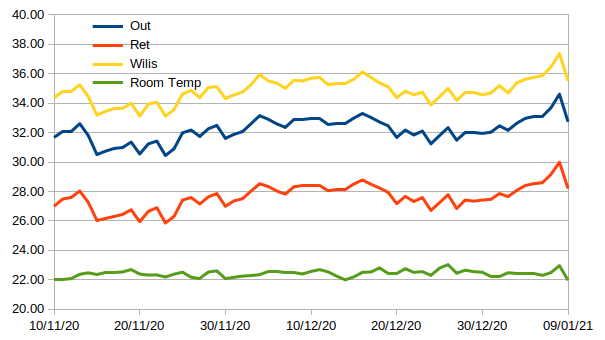
I personally think that just using a timer could be a bit problematic. Read my blog posts on how I set my system up. I use a Raspberry Pi based system with 4 solid state relays (SSRs) switching the 2 × SunAmps, the circulating pump and the Willis. I take a lot of temperatures and a met-office feed to drive the calculation of how many minutes of heat I need each day. This might seem complicated, but not for me: I have been programming for over 50 years and helped develop some real control systems in my time. This approach for me is straightforwad and cheap. I don't say that a simple timer based system couldn't be made to work satisfactorily, but more that I simply haven't done this so I don't know. However if you are going this route then IMO you will need to limit the out temperature of the water going into the slab to no more than, say, 35 or 40 °C by trimming the thermal cut-out on the Willis heaters or having a separate on on the manifold out. Just for interest here are the peak out, return and Willis temperatures as well as the average ground floor hall temp for the last couple of months. The average outside temp can shift from 10°C to 2°C in a day or two and this has a big impact on the daily heat losses and therefore how much you need to add back in to keep the house temperature stable.