


John Carroll
-
Posts
580 -
Joined
-
Last visited
-
Days Won
3
Everything posted by John Carroll
-
If you ran from midnight to 10 AM, 10hrs, with a energy consumption of 3.81kWh then the average heat demand/boiler output was only 0.381kW, if the average power consumption was 3.81kW then the 10hr energy consumption was 38.1kWh.
-
Worcester Bosch Greenstar 8000 System Boiler Issues
John Carroll replied to EinTopaz's topic in Boilers & Hot Water Tanks
Just to see if this 2.5C over target applies to all target values, reduce the target temp to 57.5C, see what happens. -
Because most circ pumps are now A rated and "smart" then the pump speeds can be changed in lots of Boilers, the attached may be of some interest on the effect of changing these speeds, its based on my own (6M) circ pump but can be modified to match any pump once the full speed curve values are known. Pump Affinity Curves.xlsx
-
Worcester Bosch Greenstar 8000 System Boiler Issues
John Carroll replied to EinTopaz's topic in Boilers & Hot Water Tanks
In non technical terms I would say its behaviour is bordering on bizarre. It takes 85 minutes to fall from 64.8c to its targettemp of 60C, despite a very steady ~ 17kW demand. As per Tests, all temps are Flow, (target temp is 60C) zero hour 60.1C (after 25 minute warmup from 15C) +5mins 63.2C +10mins 64.8C +20mins 64.8C +30mins 61.9C +95mins 60.0C -
Worcester Bosch Greenstar 8000 System Boiler Issues
John Carroll replied to EinTopaz's topic in Boilers & Hot Water Tanks
Had a look at your data and did some calcs so things adding up much better there, you can see the measured flowtemps does lag the calculated ones but not hugely so you shouldn't be burning huge quantities of extra gas even if the flowtemp does exceed the target temp by 2.5c or so under steady state conditions, the boiler output will be outputting ~ 1.0kW extra so say 15kWh over a 15 hour heating day or pro rata, at 6p/kWh?? = 90p/day, not huge?. On for 5minutes Flow 30.6 return 15.6 dT 15.00C Burner 62% 22.32kW Pump 93% 20.00LPM dT 16.00C Flowtemp 31.6C On 15 minutes Flow 50.9 return 29.0 dT 21.90C Burner 100% 36.00kW Pump 100% 21.50LPM dT 24.00C Flowtemp 53.00C On 25 minutes (target temp reached) Flow 60.1 return 39.0 dT 21.10C Burner 100% 36.00kW Pump 100% 21.50LPM dT 24.00C Flowtemp 63.00C On 30 minutes Flow 63.2 return 42.8 dT 20.4C Burner 95% 34.2.00kW Pump 100% 21.50LPM dT 22.80C Flowtemp 65.6C On 35 minutes Flow 64.8 return 46.4 dT 18.4C Burner 85% 23.40kW Pump 100% 21.50LPM dT 20.4C Flowtemp 66.8C On 45 minutes Flow 64.8 return 50.2 dT 14.6C Burner 65% 23.40kW Pump 100% 21.50LPM dT 15.60C Flowtemp 65.8C On 55 minutes Flow 61.9 return 50.7 dT 11.2C Burner 49% 17.64kW Pump 100% 21.50LPM dT 11.76C Flowtemp 62.46C big time gap now as I stopped measuring till it settled to actual target temp of 60'c On 1h35mins Flow 59.9 return 47.8 dT 12.1C Burner 49% 17.64kW Pump 100% 21.50LPM dT 11.76C Flowtemp 59.56C -
Worcester Bosch Greenstar 8000 System Boiler Issues
John Carroll replied to EinTopaz's topic in Boilers & Hot Water Tanks
Yes, this flat out firing is very hard to explain thermodynamically. For example, with a flowrate of your now 87%, 18.71LPM, then the rads will output 16.33kW(45% boiler output) under steady state conditions with flow/return/dT temperatures of 60C/47.57C/12.43C, assuming 20C room temperature, if the boiler firing is then increased to 36kW then the dT at that flowrate of 18.71LPM has to be, 36*860/60/18.71, 27.58C, so the flowtemp should/must then increase almost instantly to, 47.57+27.58, 75.15C, there will obviously be a delay in the sensors reading this correctly as they are surface mounted but surely 4 or 5 minutes should be well more than adequate time for this? also the boiler fires at 100% output for well beyond this period so a mystery as to why you are not seeing anything remotely approaching 75C., the sky's the limit then up to at least 100C, see below. The rad output theoretically/thermodynamically can output 36 kW but would require flow/return temps of ~ 100C/73C, (even assuming a 25C room temp), but I just can't see this happening. Don't know anything really re insulation, I just use the cheap as chips lengths. -
Worcester Bosch Greenstar 8000 System Boiler Issues
John Carroll replied to EinTopaz's topic in Boilers & Hot Water Tanks
If you are happy enough with that overshoot then why not leave well enough alone, you probably may not have even noticed it if you hadn't had the other big problem. But no way IMO should the there be a offset of 2.5C between the target and flow temperature once steady state conditions are achieved, these controllers are/should be PID, where the "I", (integral) will achieve zero deviation between the target and flow temperatures especially under these benign conditions, you might see + or - 0.1/0.2C deviation now and then, the colder day/pipes etc has nothing to do with the control, the controller is just looking at the process variable which is the flow temperature in this case. -
Worcester Bosch Greenstar 8000 System Boiler Issues
John Carroll replied to EinTopaz's topic in Boilers & Hot Water Tanks
Happy New Year to all. The max rad output seems to be ~ 18kW with the present target/flow temp of 60C and because the boiler isn't range rated then at times it is inputting 15kW more than required which will lead to overshoot but IMO should still modulate down before targettemp+6C and burner trip? is reached, maybe range rate the boiler to say 20kW, 56% and see what effect this has on heat up from cold and overshoot temp. Eventually, if required, to speed up the heating period from cold, you can keep increasing the range rating until it doesn't overshoot by say targettemp+4C and leave it like that. I would also leave the pump speed high at 90/100%. -
Worcester Bosch Greenstar 8000 System Boiler Issues
John Carroll replied to EinTopaz's topic in Boilers & Hot Water Tanks
I have a feeling that it all revolves around the flowtemperature measurement or what the boiler's PCB perceives the actual flowtemp is, even though the boiler does eventually return to "normal" and your measured readings correspond to the displayed reading. If, for whatever reason, the flowtemp is sometimes perceived to be as much as 5C below the targettemp then the burner output will be outputting as much as +7.53kW (21%) more than that required to satisfy the actual targettemp, even a error of 2/3C is a substantial increase in firing of ~ 3.8kW (10.6%). -
Worcester Bosch Greenstar 8000 System Boiler Issues
John Carroll replied to EinTopaz's topic in Boilers & Hot Water Tanks
I have a fair idea I think of how those curves "work" A (&B) are just the installed pump curves, A being the one at 100% speed. All the dotted lines are the pump head remaining (residual) after the head loss through the boiler, mainly the HEX, so we'll call it that, HEX loss = boiler loss and RAD (+pipes etc) loss = residual head required or remaining. A 36kW boiler at 20C flow/returm dT requires a flowrate of 25.8LPM,1548LPH, so a flowrate of 25LPM, 1500LPH will give a dT of 20C with the boiler at 34.9kW output so we'll use that 1500LPH number. You can see that the pump head at 1500LPH is 650mb and the residual head (on 6,) is 400mb so HEX loss=650-400,250mb and the Rad loss is 400mb. If you use your "average" of 20.0LPM,1200LPH then, by calculation, the HEX loss is now, 250*sq(1200/1500), 160mb and the RAD loss is 400*sq(1200/1500), 256mb, so total (pump) head required is 160+256, 416mb (4.16M) the pump will deliver 1500LPH at 6.50M so at the required head of 4.16M should reduce its speed to ~ 100*sqroot(4.16/6.5), 80%, I havn't the exact pump curve but the above is the gist of how I think this works, of course if your RADs/pipework has sludge then the pump may still continue to run at 100% -
Worcester Bosch Greenstar 8000 System Boiler Issues
John Carroll replied to EinTopaz's topic in Boilers & Hot Water Tanks
Can, if you have "pump setting proportional to thermal output" take a few sets of readings in this mode, to see what effect it has, if any, on the targettemp/flowtemp dT. -
Worcester Bosch Greenstar 8000 System Boiler Issues
John Carroll replied to EinTopaz's topic in Boilers & Hot Water Tanks
Irrespective of any of those pump settings then, as stated previously, (especially) under steady state conditions the target&flow temperatures should be almost identical, as long as the minimum boiler output is less than the heat (rad) output. The flow/return dT increases (correctly) with decreasing pump head, does this have any effect on the targettemp/flowtemp dT?. You said, I think, in one post that the boiler HEX only was replaced but a (the) card wasn't because it was for a older type boiler but in a later post you said, again I think, that a card was replaced??. Did WB advise you to try these different pump settings after the senior engineers visit??. I certainly wouldn't be happy with the above "performance" so back to WB I would go. -
Worcester Bosch Greenstar 8000 System Boiler Issues
John Carroll replied to EinTopaz's topic in Boilers & Hot Water Tanks
@EinTopaz, any update on that pesky boiler of yours? -
The 6.4kW vs 3.7kW looks like a "true" 3 phase (vs single phase) supply to me because 6.4/3.7 = 1.7297., almost sqroot of 3? Ignoring the PF, Power, kW (3phase) = VI*1.732, so 6.4kW requires a phase to neutral current of, 6.4*1000/230/1.732, 16.07A. Power, kW (single phase) is VI, so 3.7kW requires 3.7*1000/230, 16.09A, almost the same as the 3 phase (obviously?).
-
May be something as simple as this??.
-
Worcester Bosch Greenstar 8000 System Boiler Issues
John Carroll replied to EinTopaz's topic in Boilers & Hot Water Tanks
I would suggest, under steady state running, get the flow/return dT to less than 20C, say 18C, assuming the target & flow temps are equal, take readings, then slowly decrease the pump speed, (you can use your max clamping method to achieve this), the dT will keep rising, see if the flowtemp starts to exceed the target temp as the dT increases, keep reducing the pump speed until the flowtemp exceeds the target temp by 5.5C (trip point?), note all readings. Before doing, (if) I would increase the anti cycle time to 5/6 minutes again. -
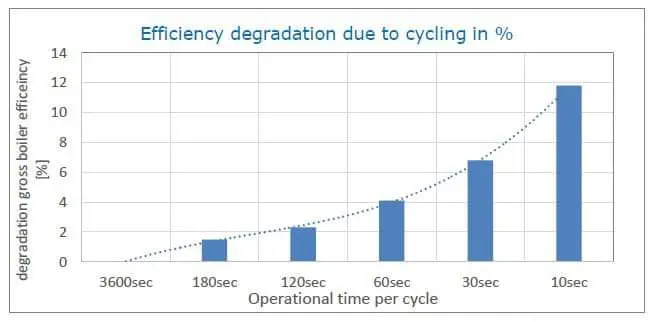
From some horse's mouth re cycling and boiler efficiency degradation.
-
Worcester Bosch Greenstar 8000 System Boiler Issues
John Carroll replied to EinTopaz's topic in Boilers & Hot Water Tanks
It doesn't matter what kind of fancy controls or otherwise it may have, maintaining a alleged targettemp+5.5C for 20 minutes smacks surely of some boiler control problem, especially since the boiler minimum output is way below the steady state rad demand. -
Worcester Bosch Greenstar 8000 System Boiler Issues
John Carroll replied to EinTopaz's topic in Boilers & Hot Water Tanks
Can you post a E link to a exact copy of your paper MIs?. -
Worcester Bosch Greenstar 8000 System Boiler Issues
John Carroll replied to EinTopaz's topic in Boilers & Hot Water Tanks
No way should the boiler behave like this, under steady running conditions, like above, the only reason that the flowtemperature exceeds the targettemp up to the burner trip point and recycle is when/if the minimum boiler output is > than the rad(s) demand, can you repost that thumbimage above or just take a screenshot as I can't open it. OK see it now, above, I don't think that has anything to do with the burner tripping when the flowtemp exceeds the targettemp, its to do with the anticycle time, on at least some of these WBs you have two parameters for setting the anticycle time..... a time (minutes) and a (negative temperature hysteresis) where the "longest" one wins, it goes something like this, if the time is set to say 5 minutes and the hysteresis set to (-) 6C, if, after burner cut off, the 5 minutes time has elapsed but the flowtemp hasn't reac hed targettemp -6C then the burner will not refire until the flowtemp does reach targettemp -6C, if the flowtemp had reached targettemp - 6C, then the burner will not refire until the 5 minute time has elapsed, or something like that. Most burners will trip at targettemp+5C. -
Worcester Bosch Greenstar 8000 System Boiler Issues
John Carroll replied to EinTopaz's topic in Boilers & Hot Water Tanks
Happy Christmas to all. I have a 20kW oil fired boiler that fires either flat out or not at all, with ~ 15kw of rads & ~ 85L system contents, and a circ pump flowrate of a measured (smart pump) of 14.5LPM. the flow/return dT is just under 20C, (19.8C) If I fire that up from a cold water system contents of 15C, it takes 25/35 minutes to reach its target temp of 65C and burner cut out, this means the return temp is 45C when this happens so a return temp rise of 45-15, 30C, in 30 minutes or 1 degC/minute return temperature rise, so depending on the rad output to boiler output ratio, 75% in my case, probably fairly typical of most oil fired systems, gas boilers, especially the WB ith its slow ramp up might have a typical return temp rise of a bit less than this. -
Worcester Bosch Greenstar 8000 System Boiler Issues
John Carroll replied to EinTopaz's topic in Boilers & Hot Water Tanks
Overall, not too bad really, 25 minutes from a cold 15.6C to 60C Target/flowtemp in 25 minutes isn't outrageously slow IMO.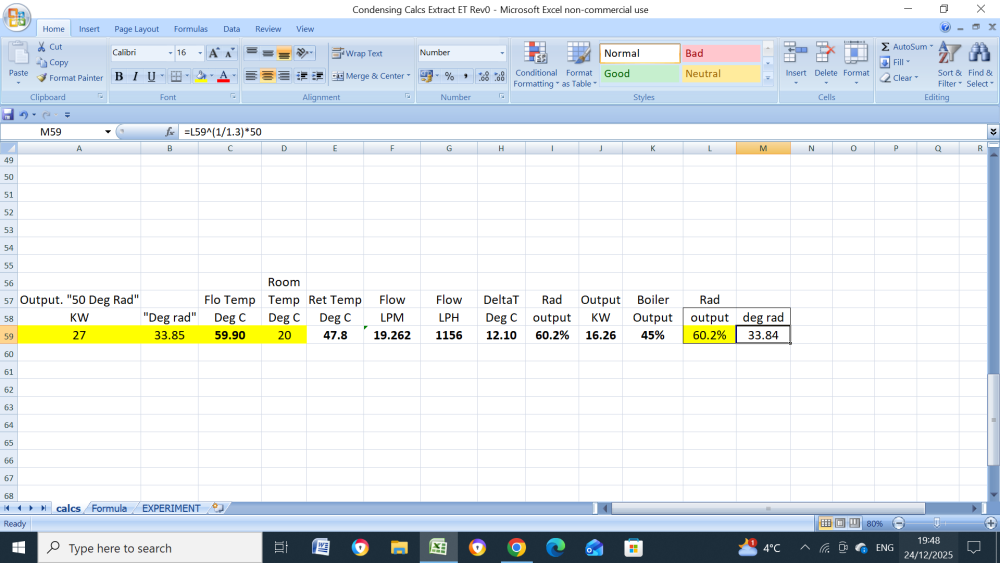
-
Worcester Bosch Greenstar 8000 System Boiler Issues
John Carroll replied to EinTopaz's topic in Boilers & Hot Water Tanks
It's more than likely that it won't or shouldn't be at 100% firing at target temp so best window is well before it reaches target temp as it should then be firing at 100%. -
Worcester Bosch Greenstar 8000 System Boiler Issues
John Carroll replied to EinTopaz's topic in Boilers & Hot Water Tanks
As above, more or less, get the boiler to fire at 100% for say 4/5 minutes, during that time take two gas meter readings exactly 3 minutes apart, should then get a fairly accurate feel for the actual boier output in kW. If the output is 36kW, then the flow/return dT should be 23.9C until the target flowtemp of 65.5C is reached, assuming a flowrate of 21.6LPM. Target temperature of 65.5C should be reached when the return temperature rises to, 65.5-23.9. 41.6C Maybe clamp the pump minimum output to 95% until all tests completed. Post back. -
Worcester Bosch Greenstar 8000 System Boiler Issues
John Carroll replied to EinTopaz's topic in Boilers & Hot Water Tanks
That's the primary flow John, not the secondary, DHW flow, strangely enough, there didn't appear to have been any restriction to this in the old PHEX.


