Beelbeebub
-
Posts
1225 -
Joined
-
Last visited
-
Days Won
6
Everything posted by Beelbeebub
-
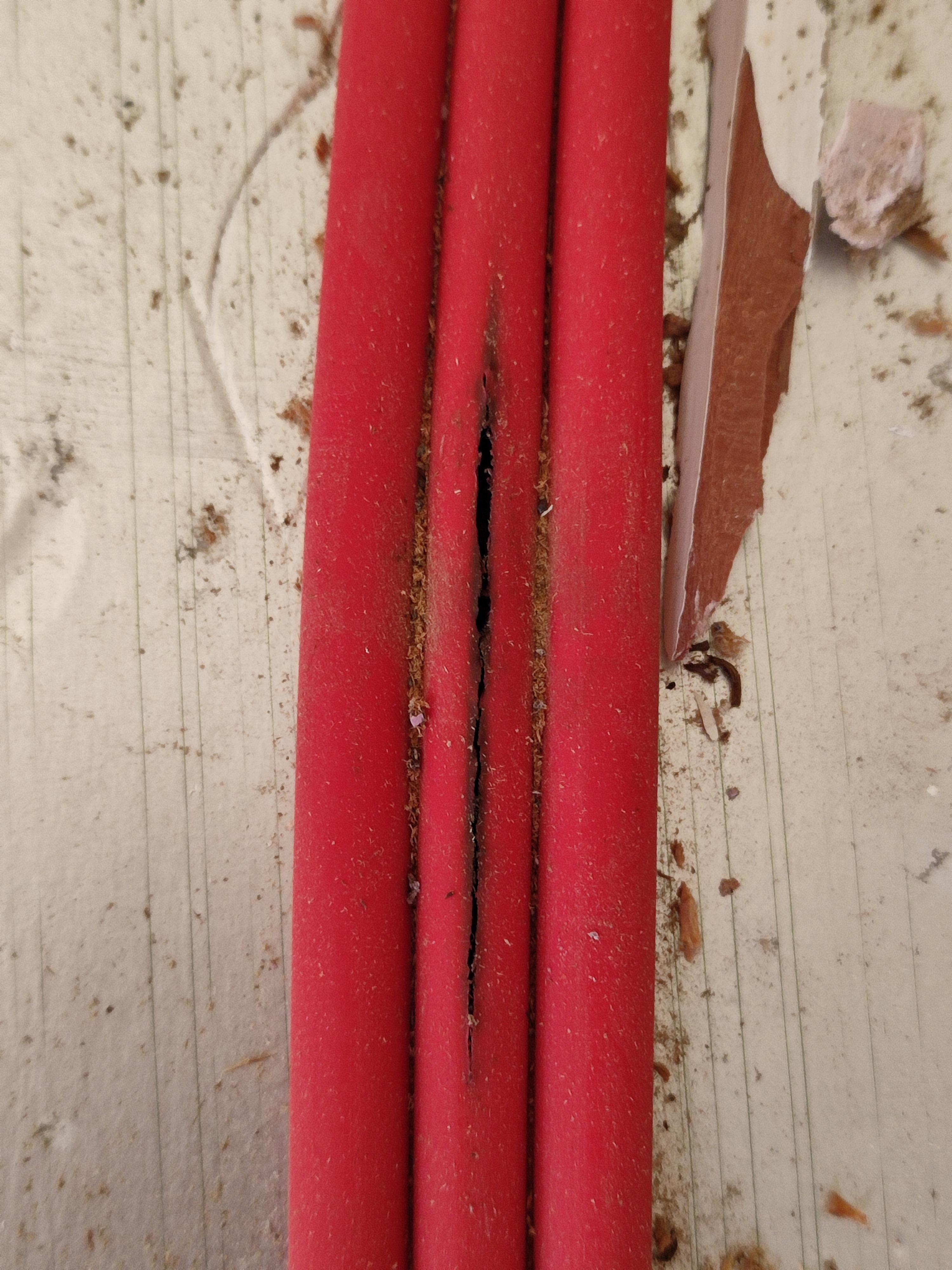
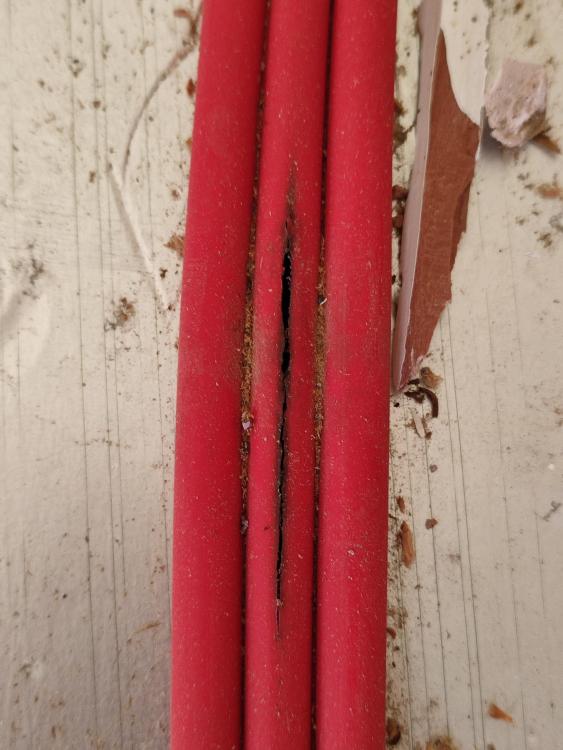
First off, I am a big fan of UFH but this is a cautionary tale of what can go wrong. My parents built their own home about 25years ago. For various reasons itvs bloody massive, over 3 floors with UFH on every floor, under reclaimed floorboards. They went for the red rubber santoprene system, which was a mistake. Flash forward to now and the system is plagued by leaks. I am converting the downstairs office to a bedroom for my dad who sadly has dementia and have been ripping up the UFH. Here are some pics. One of the 4 splits we found in one room. It appears the pipes have been abrading against the floorboards (company recommended the pipes were pressed in contact with the floorboards for better heat transfer). When my dad fiddled with the hearing system last winter he pressurised it to 1.5bar (we have been running sub 1 bar for many years) and caused these thin patches to rupture.
-
A couple of A2A heat pump questions
Beelbeebub replied to Andyh's topic in Air Source Heat Pumps (ASHP)
That would be great, especially for DHW and cooling during the summer. The main thing for the UK is we need an easy to retrofit system. At the moment we don't have enough installers who are competent in either a2a or a2w systems (either fgas certified or having the detailed knowledge to make a2w systems operate efficiently) to fit enough systems. A2W has some advantages of we can leverage the large base of heatijg engineers used to gas boilers and wet systems. But does have to be a compete switchover A2W would require fgas certification or similar. But would potentially allow for parallel installs. Which might ease the user anxiety. Alaonpfovides cooling which may be important. And the overall equipment footprint is lower. -
A couple of A2A heat pump questions
Beelbeebub replied to Andyh's topic in Air Source Heat Pumps (ASHP)
Point taken about the expansion valves which you would need for cooling But these would be primarily for heating. So the single expansion valve in in the outdoor unit would suffice. Outdoor compressor creates hot, high pressure gas. This flows around to each head unit. Each head unit would iod have 4 ports, flow in, flow out, return in, return out. The "out" ports would be blanked off at the last unit. And a servo on off valve in either allowing the flow gas into the unit or blocking it. The hot high pressure gas then either condenses to a room temp high pressure liquid and joins the return line. or is blocked and doesn't flow through that coil at all. The room temp high pressure liquid collects together in the common return pipe and flows to the outside unit. There is passes through the single expansion valve. -
A couple of A2A heat pump questions
Beelbeebub replied to Andyh's topic in Air Source Heat Pumps (ASHP)
Wouldn't need the full "heat and cool simultaneously" vrf package. Conceptually I can't see any reason why the head untis can't be connected to a common flow return pair and just have a servo valve to shut them off on the flow side if not needed. The compressor unit doesn't care if there is one condenser coil or several, it just sees pressure temp at outlet and pressure temp and inlet. Deforst would be trickier without a thermal mass to draw hear from. That could be solved by using a DHW tank. -
A couple of A2A heat pump questions
Beelbeebub replied to Andyh's topic in Air Source Heat Pumps (ASHP)
The decoupling thing is the one bit that attracts me to a2w. Radiators, pipes etc are commodity items. More or less interchangeable from a wide variety of manufacturers and suppliers. You dint need to fit vaillant radiators because you have a vaillant boiler. Or Baxi radiators if you have a baxi boiler. Even if you have some weird old boiler that nobody makes any more, you can fit a rad to it. If a2a units were the same that woukd be a big plus. Also, a2a units seem to usually use a separate flow return pair to each emitter. Making it so you can run a flow and return pair around and locally branch off for each emmiter, like we do with rads, would be a big improvement. If they could do that then moving the country to HPs would be a case if fitting a2a systems "in parallel" with the exisiting gas system. That would be there for DHW and for peace of mind about "what if my heatpump can't keep me warm in winter". After a few seasons where people realise they never use the gas boiler they'll be ready to switch fully -
That is the issue. Today the humidity was about 65% so the coolest I could get the chilled outgoing air woukd be about 20C, the dew point. That might cool the incoming air to low 20's but the humidity would be high. IIRC last year's heatwave was fairly dry. I seem to recall my weather station saying it was 35C(ish) and 25%RH(ish) which gives a dew point and max cooling nearer 13C. Then you could cool the incoming air to 20C or so and not be too humid. It's an idea with some utility for hot dry periods, which are fairly rare in the UK. Which is why I went the cheap route.
-
Last summer I bodged together a cooling system for my heat recovery. It's lain dormant pretty much all this year, but the recent heatwave provoked me to dust it off. It seems to work OK. I have a small ventaxia unit with no summer bypass, and I'm not sure a summer bypass would work as the inlet is annoyingly in a heat island so the local inlet temp can be quite high. Luckily it acts in reverse when it is hot and transfers the heat from the warm outside air to the cooler inside air that is leaving. Effectively it "keeps the cold in" Unfortunately we still see a temperature rise as some solar gain and, even with our high insulation, some heat leaks in. So i've rigged up a fairly large (up to several liters an hour) amazon ultrasonic humidifier (fogger) that plugs into the extract manifold. The water mist is injected at the point where all the extract ducts (it's a radial duct system) come together before entering the unit. The mist evaporates pretty quickly, cooling the exhaust air and boosting it's humidity. Your common all garden "swamp cooler". Normally swamp colliers are a crap idea outside of a desert environment as you are boosting the humidity. But in this case, the heat exchanger cools the incoming air down to the new exhaust air temp which is lower than the actual exhaust air temp without adding extra water. The incoming air is slightly more hunid than it would have been as it has been cooled, but the total water content is the same. The incoming air is around 4C colder than the outgoing air, i estimate around 600w of cooling power. Itvs not quite enough to drive the temperature down, but it does hold it or cap the rise. We started today at 23Cinside and 20C outside. Peaked at about 25Cinside and 29C outside. If I was confident the condensate drain could handle it (the design is crap, very easy to make it leak) I'd up the fog flow rate to get some direct heat transfer to the cold water and down the drain and get a bit more cooling.
-
Banning f-gas and the move to r290
Beelbeebub replied to HughF's topic in Air Source Heat Pumps (ASHP)
My old mondeo with near 250k on the clock lost a noticeable amount of power when the ac kicked in. We had to turn the ac off to tackle the hill by the "air balloon" pub on the a417/419. -
Banning f-gas and the move to r290
Beelbeebub replied to HughF's topic in Air Source Heat Pumps (ASHP)
I guess one point might be that to date the vast majority of HPs made have been for cooling and the Asian (and Southern US) market has been the main market So the majority of expertise in those areas is in cooling for a climate that rarely sees frost. The European market is different, heating is a much bigger component, defrosting is a big issue. Architectural considerations are bigger, water based systems are prevalent in many markets. In the same way European car makers male more vehicles suited to European cities and US makers tend to have a lot of vehicle's focused on US needs, maybe more euro manufacturers will produce better suited products. The need for a gas boiler replacement type format is very much a euro thing. Asia and the US tend not to use the box on the wall boilers that are so common in Europe. R290 had been hamstrung in Europe by regulations. China and India have been using split r290 a2a units for a decade or more. -
Vaillant ashp (my battle with).
Beelbeebub replied to zoothorn's topic in Air Source Heat Pumps (ASHP)
Grant are, confusingly, a manufacturer of boilers and associated stuff. -
Vaillant ashp (my battle with).
Beelbeebub replied to zoothorn's topic in Air Source Heat Pumps (ASHP)
That looks like a very good solution to ZTs problem. It must be rectangular in section internally to get 100l. So they must have some fairly hefty walls, but that also. Means stuff can sit on top. (I've fitted 2 of their thermal stores and they seem well made) It looks like it would fit in their cupboard and still provide ample space above for storage. If ZT's installers are happy then it's problem solved. -
Vaillant ashp (my battle with).
Beelbeebub replied to zoothorn's topic in Air Source Heat Pumps (ASHP)
The constraint is physics and economics. The buffer is necessarily at the same pressure as the rest of the heating system. This is 1bar minimum. The most efficient shape to withstand internal pressure is a cylinder (ignoring a sphere). If you made a rectangular pressure vessel the walls would need to be a lot thicker and thus heavier and more expensive. -
Vaillant ashp (my battle with).
Beelbeebub replied to zoothorn's topic in Air Source Heat Pumps (ASHP)
Buffers need to be pressurised so cylindrical is the norm, though some do have rectangular external casings. -
Vaillant ashp (my battle with).
Beelbeebub replied to zoothorn's topic in Air Source Heat Pumps (ASHP)
Don't bother trying to understand Heatpumps if you are struggling with those explanations. It's a black box of stuff that you put electricity in and hot water comes out. That's all you need to know. If there is insufficient volume of water in the radiators and pipes or your plumbing system is laid out in a certain way, then you need a "buffer vessel" of a certain size. This buffer vessel can be smaller if you also have something called a "backup heater". As you have struggled with the explanations provided i'd suggest you leave it to your installer whose job it is to install HP systems. -
Vaillant ashp (my battle with).
Beelbeebub replied to zoothorn's topic in Air Source Heat Pumps (ASHP)
It's the thermal mass of the system. UFH systems have greater thermal.mass than radiators, especially the cast in slab systems. The heated slab in my house is equivalent to about 6,000 liters of water. This means the pump doesn't have to shirt cycle and when it needs to pull heat from the system to defrost it won't overcool the system. That's why the systems with heaters can have a lower volume. The heater can kick in to provide the energy for defrost if needed. ZT might be able to get away with the Grant internal buffer. It's 30l and has a heater built in. So the rest of the system only need to be 20l. -
It's a personal preference thing. Our bedrooms are UFH, but it's a bungalow with UFH in the slab. The UFH just keeps the slab at a constant temp, sort of crude weather comp. But you make a good point and I think over zoning is a bad thing for heatpumps. That is what I meant. At the end of the day it's all "zones" to the heat pump. It just gets told "if input X is closed do Y" Given modern microcontroller the only limit is how many inputs and output relays you have. The microprocessor is easily able to cope with the multiple control strategies.
-
Screening design for heat pump - comments invited
Beelbeebub replied to JamesPa's topic in Air Source Heat Pumps (ASHP)
Randomness helps with sound attenuation. Regular structures can create peaks and troughs in the sound distribution. -
Vaillant ashp (my battle with).
Beelbeebub replied to zoothorn's topic in Air Source Heat Pumps (ASHP)
You could ask for a lower powered system with a backup heater for the coldest days. That will have a lower system volume requirement. I'm not sure if the MCS scheme allows such a setup. To be honest, it sounds as if your current system has been badly setup and/or run. If your house is so small the cupboard is vital space, I struggle to see how the HP cannot heat it unless it is been badly driven. Eg turned off a lot, run with too little volume etc. I look after a fairly large (2/3bed) stone cottage with crap windows, no insulation etc. Takes 8kw to heat. To be fair the tenant did have trouble heating the lounge because the rads never got hot. I traced the problem to a hall radiator that was setup with a bypass that somebody had fiddled with. It was bypassing most of the glow straight back to the boiler. Fixed that, all the rads get toasty. -
Vaillant ashp (my battle with).
Beelbeebub replied to zoothorn's topic in Air Source Heat Pumps (ASHP)
Your misuse of the current system could very well have produced the symptoms of a system with insufficient water volume. As you haven't told the new installer what you have done, he would have to conclude that the system has insufficient water volume. Therefore the solution would be to increase the water volume. Hence specifying a buffer. You choice looks to be accept the offer or stay with your current system. Personally, I'd go with the new system. It looks, from the photo, that the buffer will fit where the hydraulic box went. Close the door and you won't know it's there. -
Except the conventional wisdom is that UFH is hard to do upstairs. There is some truth to that as UFH upstairs makes routing services between the ceilings and upper floors much harder, or at least less sensible. That said, in a new build the upstairs rads can be spec'd so thry can run at the same temp as thr UFH.
-
As an aside, several HPs have a zones function. Clukd you have the DHW on it's own "zone" with a specific flow temp stratetgy as now, UFH on zone 1 set at a WC curve specific for that and the rads on zone 2, set on a higher WC curve for rads? Then effefrciely time slice between thr UFH zone and Rads, say every 10mins. Defrost cycles would open both zones to maximizer system volume availble. When the outside temps are getting to the point where the system would cycle unacceptably on only one zone, both zones could be connected to help. The extra cost woukd be fitting an extra zone valve effectively an S+ type plan. Just an idle thought
-
Vaillant ashp (my battle with).
Beelbeebub replied to zoothorn's topic in Air Source Heat Pumps (ASHP)
I think you might be the architect of your own downfall here. The installer might have concluded there is insufficient system volume based on your reports of noisy defrost. The original installer might have calculated there was enough system volume based on the assumption the user wasn't surreptitiously turning radiators off. Hence no buffer or volumiser needed. The new installer would look at the system on his visit and think "hummm... there should be enough volume according to the calculations and my inspections yet the defrost is still behaving like there isn't enough.... There must be something we are missing, best be cautious and stick a big buffer in to make absolutely sure we won't have this problem again!" If you insist on operating the system in a way it's not supposed to be, it's not surprising it misbehaves and if you don't tell the installers you have been doing that, it's unsurprising they struggle to rectify the issues. -
Screening design for heat pump - comments invited
Beelbeebub replied to JamesPa's topic in Air Source Heat Pumps (ASHP)
The best approach woukd be to "suck it and see" Install it and see how much the sound bounces about. Having worked with noise attenuation (from roads and industrial sites) itvs really tricky. Sometimes barriers can make things worse! It may be the noise is perfectly acceptable with no barrier, then the issue is simply visual. -
Noninvasive flow measurement
Beelbeebub replied to Beelbeebub's topic in Air Source Heat Pumps (ASHP)
That should be shutting various rads..... 👀😁 -
Noninvasive flow measurement
Beelbeebub replied to Beelbeebub's topic in Air Source Heat Pumps (ASHP)
All fair points, especially splicing in an inline mechanical meter then shitting various rads. My musing was more a simple first take device. Before any major work is done, to aid with the quote process. If the pipe work needs lots of upgrades it will.add to cost and upheaval and might male the job less attractive. Better to find out before install starts!