


Beelbeebub
-
Posts
1521 -
Joined
-
Last visited
-
Days Won
11
Everything posted by Beelbeebub
-
If we are going to tackle a global issue we need to work with other countries. It's really hard to encourage other countries to cut emissions or not start more fossil fuel exploration when we are granting drilling licences - it's not a good look. And as for the argument "we are just green washing, by importing everything that look CO2, oil, gas, bricks, most out goods come from other countries..." It s true that the 50% fall in our "Territorial" emissions measure excludes goods and services from abroad, But our "footprint" emissions which includes that, plus aviation and shipping and pretty much everything else has also fallen albeit not by as much- but still over 20% down from the peak (just under 1bn to just over 750bn). Given you describe 2% as a "good proportion" what would you describe +20% as? "Very good proportion", "Bloody good proportion"?

-
The direct jobs are not substantial - 27 according the the owners. A further 250 or so will be more secure at the hub. Again the issue with jackdaw is that it doesn't do much either way. It's a sideshow. Whilst I think it would be better if we didn't licence it and spent our efforts elsewhere (transitioning) I'm not that bothered of we do - part of me thinks it might be a good idea because it will shut up all the idiots who think it'll sort all out problems and the UK will become the Saudi Arabia of Europe. It does if you mostly type on a screen. What unit do you think I am describing when I say "an average home uses 10 kwh a day"? Unless it genuinely causing you to think of another unit it's just pedantry. Says it all! It says that,like the majority of the country, my houses use gas. I'm trying to electrify but am being stymied by regulations, cost and the biggest issue is I don't want to spend money to make it more expensive for my tenants. Ideally an air to air alongside the current gas system would be the safest but I won't get a grant, I need planning for the outdoor units and in the case of all electric flats I get fewer points than swapping to modern storage heaters. All of the above doesn't invalidate my arguments any more than you being on mians water prevents you from complaint about water companies Only if you define 2% (at best) as a "good proportion". If you got a 2% bonus would you describe that as "a good proportion of my salary"? If you lose 2% of your body weight would that be "a good proportion of my bodyweight"? This is the point I keep trying to drive home. Jackdaw (and Rosebank) will make no discernable difference to: - energy prices - energy security - job figures - CO2 emissions* - tax revenues** It does send the wrong message though. It will make i harder for the UK to pressure other countries to live up to their commitments. *This is a point that can be used to justify licencing despite the climate situation. ** I would like to see what the net tax revenue situation actually is. Hopefully it is positive but I have a suspicion that once tax deductions are included the net position will be much smaller than trumpeted and possibly even negative
-
If you have a battery and smart tariff you don't even need a spark gap of 2, and that's without taking into account the boilers efficiency of around 85% and gas standing charge. Our current tariff (runs out in October) we only pay 10p for electricity per kWh, taking into account standing charge and boiler efficiency we only need a CoP of just over 1 to break even. But the press don't talk about that. 100%
-
No argument there - bringing down the spark gap is a primary task. If that drops below about 3 then all the payback calculations tip in favor of electrification and we're off to the races. This is a bit contentious - first off - what do you mean by better? Cheaper? More secure? Lower CO2 per kwh? For cost and security - Jackdaw will make zero difference to the price or security *because the volumes are so small*. It would be like arguing that sticking an 80w* solar panel on your house will make a meaningful difference to your energy costs or your ability to keep the lights on. As for CO2 (which is the argument the oil industry is suddenly extremely keen in) - yes, the Co2 per kwh of LNG is higher than NS gas. How much cleaner? about 15% (https://www.carbonbrief.org/factcheck-north-sea-gas-is-not-four-times-cleaner-than-lng-imports). So Jackdaw will save (or generate) 15% of 2% of the UK's gas emissions - about 0.3% of total CO2 emissions. This is also an argument as to why opening Jackdaw isn't a directly catastrophic for the climate . I mean, great, but it doesn't work like that. You don't get to draw ever smaller boundaries around things to claim you don't have to do anything. If you want to play it that way then Scotland is also responsible for around 1/3 of UK CO2 emissions** I can see this for the daft argument it is but - good god, no. They are mostly gas and mostly less than EPC C - though to be fair mostly over 150 years old But you have just popped up out of the well: I assume you aren't arguing that nobody on mains water can have any say in the UK water industry? * Average house of 10kwh/day so 2% of demand would be 200wh per day which is would roughly be the average output from an 80w solar panel ** calculated from combustion of the O&G extracted, mostly from Scotland, are around 18bn tons and historic coal emissions are around 36bn tons (assume most of the coal was not Scottish) - very crude estimate
-
Just realised my "tipex" comment has massively dated me! 😁
-
Except we aren't even repainting the ceiling. We're dabbing a bit of tipex on 2% of the ceiling.
-
[emphasis mine] But it's not a lot of gas - that's the point. It was more to illustrate the relative size of the change ie not alot It would take some time, true. So the argument goes - "well those things would be great but we have a supply problem NOW, so we must do this less ideal thing as it will help NOW" But the magnitude of the output means there will be absolutely no discernable change to prices or energy security. So it won't help now, or ever. But starting to install HPs and insulate will have a small and growing effect that will compound over time. To paraphrase "the best time to have started the energy transition was a decade ago, the second best time is today" But I am interested in the overall net effect on tax revenue. Yes tax revenue will be created from various oil taxes and corporation taxes plus keeping people in work (the net increase in jobs is around 25 although it will assure some 200 or so current jobs). But my understanding (and this is why a proper analysis by non-partisan experts like the HoC library would be good) is that the pio companies can use the costs of this venture to offset revenue elsewhere potentially lowering their tax bills. So the question is whether the increase direct tax revenue are greater than the decreased tax revenue elsewhere. If (and it is a big if) the net effect is negative then not only are we not doing anything to help out current and imminent situation (high energy prices) but we are actively hampering the deployment of solutions that will help. Again the relative size is important UK consumption is approximately equivalent to 1 LNG tanker a day. The 2% of UK demand that jackdaw might provide is therefore 2% of a LNG tanker. So the worst case 7 LNG tankers a year out of 120 or so. Bear in mind the majority of LNG effectively ends up as export (the volume of UK gas exports being broadly the same as UK LNG imports) - we are in effect one of Europe's main LNG terminals Again, the main point is that jackdaw will do jackshit (sorry) about our prices or energy security. What it will do is make a bunch of cash for oil companies and use that reserve of gas up for the future. Imagine and alternate path.... We don't licence jackdaw - yet. We transition away from gas for heating etc to electricity. Of course our electric generation needs to go up, which we do via renewables. However, as the deniers delight in crowing, we will probably still need gas for the few times it's dark and still and for some balancing and backup. The gas use will be a fraction of current use. Maybe 10% maybe even less over time. At this point the government reactivates jackdaw but as the exclusive supplier for the national gas stockpile to power the thermal power stations in emergencies This will provide genuine price benefits (the gas bit being open market) and genuine security if supply (the gas being exclusively used for UK emergency generation). Of course all of this relies on the gas being there rather than having been already extracted for zero before to anyone but the oil companies.
-
https://www.bbc.co.uk/news/articles/cj9xe09jz4eo https://www.theguardian.com/environment/2026/sep/04/jackdaw-gasfield-set-to-be-approved-by-ministers-this-month-sources-say Looks like the government is going to approve Jackdaw and Rosebank. We shall be back to 1p kWh gas and probably under £1 liter of petrol before Christmas! /S Well that's what you'd think if you listened to the bosses of those projects. "Chris O'Shea, the boss of British Gas owner Centrica, said any additional domestic gas supply would reduce Britain's reliance on imported fossil fuels, "so it's got to be good"..." But then he tries the pull off the impressive feat of making an argument that he fatally undermined earlier in the same sentence .. "He told the BBC's Today programme: "It wouldn't lower the cost materially, but basic economics would tell you that if you've got a fixed demand for a product and you increase the supply, the price should move." So it won't do anything but basic economics says it will? There is much trumpeting that the gas field will produce, at it's peak, 6% of UK gas output - which opponents point out is only 2% of the UKs actual gas use. It would be really interesting to see exactly what the treasury outcome is in all of this. I know there will be some tax collected but that has to be set against the tax write-offs that this project will enable companies to utilise. I have seen various takes that place the final outcome anywhere from a few billion met revenue for the treasury over the lifetime to a few billion net loss. What would also be interesting would be how much an equivalent saving in gas would cost ie how much would we need to spend driving insulation, heat pumps etc to achieve an equivalent drop in UK gas consumption? IIRC turning down your thermostat reduces your gas consumption by about 10%. So Jackdaw is equivalent to 1 in 5 people turning their thermostat down by 1C.
-
That seems rather bad, especially if the government is taking the money at source (eg PAYE) and has not adjusted quick enough to changing circumstances.
-
Yeah, this can often be the way with "simplification"!😁 I looked into it as I thought I was going to have to do it (turns out I'm in the group that avoids it). It's very dependent on your software. In theory all you have r to do is the normal admin (allocating payments to invoices and bills and tagging various transactions by type) on a reasonably timely schedule and then hit the upload button every now and again. If you're reasonably on it, there shouldn't be much extra work. But for the people who just chuck all their invoices and receipts in the glove box and then have a mad rush about just before the deadline trying to make sense of scraps of paper from 12 months ago - it's gonna be a change (but probably for the better)
-
https://www.gov.uk/government/publications/averaging-for-creators-of-literary-or-artistic-works-hs234-self-assessment-helpsheet/hs234-averaging-for-creators-of-literary-or-artistic-works-2026 There is a procedure for averaging out income for creatives, though it won't help my hypothetical once every 10 years artist (much) I'm very much for the use of digital technologies and designated accounts to simplify things. To be fair HMRC have been pretty good - they moved to online self assesment decades ago and the procedure is fairly straightforward (as tax goes). The making tax digital initiatives are moving towards what you described. Your accounts are automatically uploaded to HMRC and the taxes estimated from that. The issue is that whilst the online self assesment system was a free to use web service alot of the new MTD stuff requires you to use commercial (as in paid) software. You need to pay someone to file your return. There is no longer a default "basic" free service (for the new stuff - SA remains in place). I object to this a bit. Mind you, you should see the US, everyone has to file a return (even the homeless or people abroad) and there is no equivalent of free software. Only paid for services which make up a billion dollar industry, who coincidentally spend lots of money lobbying to prevent any free version being deployed....🤔
-
I assume she has royalties and advances as her primary income plus however she has her savings invested - stocks and properties I imagine. But again writers and singers and artist are another example of complexity creeping in. If you had your perfect tax system that taxed everyone progressively on their annual income what do you do with the person who earns £100k in one year (sells painting) and then nothing for 5 years. They should pay the higher rate of tax as a 100k earner but in reality they only earn £20k a year so should be taxed at a lower rate There are provisions in the current system but it's another example of how taxes become more complex as exceptions are required. It's very well to say "no exceptions" but they always run up against messy reality. The "pre owned asset" tax was created to stop people giving away their houses to their kids and renting them back for £1 to avoid IHT. So the rule is you can't ever benefit from an asset you gifted. If you did the gift is considered never to happen and the IHT bill appears. Great, except this also covered houses you helped buy. So lots of people who helped their kids with their home are then unable to move into that home when the age and become infirm. So they had to create an exemption for elderly care. Which opened up a loophole (a financial advisor tried to persuade us to use my father's dementia to to access this loophole - we declined as it seemed very sketchy) There are so interesting ideas here and God knows the tax system is complex and creates all sorts of perverse incentives and opportunities for avoidance (or sometimes inadvertently cruel traps (eg the inteste IHT rules have forced mothers to sue their infant children to avoid all of them being forced out of the family home) But the dream of simplification and cutting red tape is somewhat of a mirage.
-
Yup. Leather is a very hardwearing and easy to clean finish. Makes it easier to clean after I get in wearing muddy trousers guv.... It was getting bad - crew cab pickups in particular - that HMRC has clamped down really hard. Now anything with a 2nd row of seating is considered a company car and taxed appropriately. This actually affects me as my preferred work vans are converted people carriers with all (including the front passenger) seat removed. This is now considered a company car, so will have to go when the transition period ends. But I can see why it had to be done. There are loads of builders wives driving the kids to school in souped up pickups with a tow bar (never used) and tiny roof rack clearly claiming them as work vehicles despite the fact they are crap as work vehicles and never haul anything bigger than a fold up pram. I've had plumbers turn up in sign written crew transits with kids seats in the back.
-
I would definitely be in favour of CGT tweaks to make it more comparable to income, but I can see how it would be much more complicated than the "x% of the profit" we have at mo. Ideally it would be the profit amortised over the years held and taking account of inflation. But then you need the past earnings to work out if that equivalent income took you over the higher rate thresholds etc. it all gets complex fast - which is my point One tweak I would definitely do is equalise the CGT rate with IHT, or effectively make IHT into capital gains tax. When you hear about the amount of IHT avoided what isn't always clear is that it is avoided by transfering before death which incurrs CGT, which is lower. On IHT I would allow people to "pre pay" IHT before they die with some sort of account you can pay taxes to and then can be out against your IHT bill when you die. This helps reduce the issue where the lump sum (or 10 year spread) is the issue rather than the overall amount. It would also provide a forward revenue stream for the government now.
-
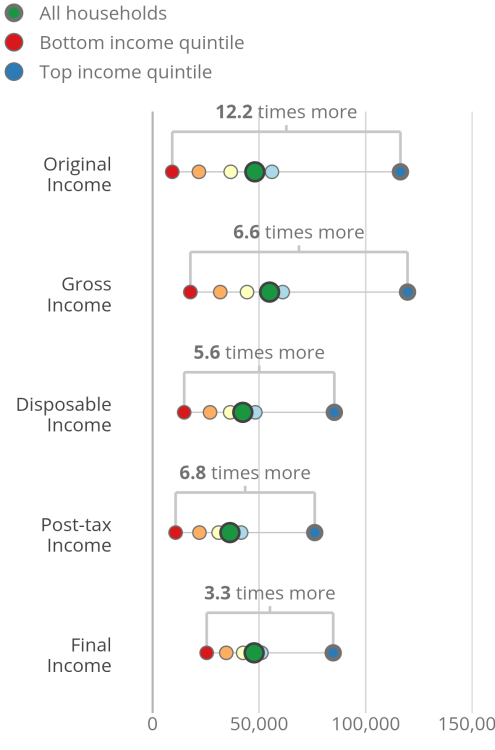
Yep. AFAIK the way you decide a tax is progressive/regressive is to see what overall percentage of income the tax takes, not the headline rate. If the tax takes a greater percentage of income from poorer people then the tax is regressive and there are likely better ways to extract the same amount of money. (assuming you want either a income neutral tax or a progressive tax). It's very difficult to eliminate every regressive tax. What is most important is the overall tax burden (including benefits). You could (for example) make the vat tax less regressive if you provided a low income benefit that approximately canceled out the vat. Despite the 'vibes' the UK tax system is progressive overall (could it be better? Absolutely, but it isn't regressive)
-
That would be money decay by time - effectively inflation. It does incentivise spending quickly rather than saving because it effectively prevents saving. I was suggesting money decay by use. Your £ can sit in the bank forever and not lose value. I wasn't suggesting a bitcoin copy (I have many issues with bitcoin) just illustrating that a digital only currency is possible. Our current £ is becoming more and more digital, I barely use cash now and there are plenty of places that are no cash. The card fees are now equivalent or lower than using cash for a business. Maybe if the UK (or EU and UK) set up an equivalent of MasterCard or visa, that had card fees lower than both but the fees went to the respective treasury. You could even imagine two fees one to your treasury and one the merchants so buying a crepe in Paris would send some tax to the UK and some to France but pie and mash in London would send both sets to UK.
-
🤣 Isn't that analysis based just a testament that poor people don't have much spare money? (I'll ignore zero rated vat for now) Poor person earns 1k a month and spends all of that on stuff that is 20% vat - has paid £200 in vat ie 20% of income Rich person earns 100k a month and spends half of that on stuff at 20%vat - has paid £10,000 in vat ie 10% of their income This forms a core part of the argument for lower vat rates (or even zero) on certain products Poor people spend a lot more of their income on food, energy etc than rich people so the argument goes well should lower rate it. Likewise kids clothes and other things Nobody would claim vat on mink coats, gold watches and diamond tipped canes is a regressive tax on the poor. But if we lower vat on food, that means we lower the tax on fillet steaks, caviar and fois gras. Then we have the difficulty of restaurants. Charging vat on restaurants but not food, but where is the line between a restaurant serving meals and a shop selling food? If a pizza in a restaurant is Vat is a frozen pizza you cook at home vat free? What about a pizza base, block of cheese and a jar of topping? Take away? It all gets complex fast Your simplification already has multiple get outs and exemptions .... What is a personal benefit? Is having physio a personal benefit or good employee care? Is providing tea and coffee in the break room a benefit or good practice? Does your work van need leather upholstery, a second row of seats and alloy wheels? If you are a plumber probably not, a taxi driver then definitely but what if you are a builder who has 3 labourers? I am skeptical of land taxes because when it was conceived in the 1800's USA land was through basis of all wealth. You farmed it or mined it or did some thing that needed space or it's proximity. But now alot of our economy is unteathered from land. Google probably owns less UK land than lidl yet has orders of magnitude more revenue and profit. How does a land tax capture JK Rowlings value and income? I have wondered about inflation as a tax. Government issues currency and the purpose of tax is to drain off that currency so we don't have hyper inflation If the government didn't tax anything and the money entering the economy was larger than the goods and services in that economy we get inflation. So taxes draw off that extra money. Inflation is basically the thing that adjusts the fiat money to the real economy. And it's bad because it destroys savings and makes you stealth poorer. But what if you drew the extra money away as a very small % of transactions- basically a card fee. As there is a link between volume of transactions and GDP the two would scale together. It would be like every £ issued is slowly wearing away with each "use" (transaction). Ironically not a million miles from steamy teas suggestion 🤣.... Though the (I think) critical difference would be the "tax" would be on every single transaction and being very small (I don't (now what level it would need to be to work and if that level would{d be so high as to stop it working). This would make cash (which doesn't "wear out") very attractive. But maybe it could work as a digital only currency. People are very comfortable now with bit coin and the like that has never had a physical existence.
-
Are you proposing *only* to tax wage payments to individuals? Ok if I work for a shop and they pay me £1,000 a month I pay £400 of that to HMRC What if I form a company that provides my labour to another company? Is that taxed? That company pays me a wage of £1 a month and I pay 40p to HMRC. The company provides a house, car, clothes and food for me for free.
-
Right So I've just had some rewiring done. Electrician charged me £800 and provided wire, consumer unit, sockets etc. total value around £500 I pay him £800 and he has to pay £500 to his wholesaler and £320 to HMRC (40% tax). He has now lost £20 for his day's work. If I were to buy the parts directly for £500 and give them to him and he charge me £300 he'd only have to pay £60 in tax and make £240. every single trade would become labour only. Every shop would have to mark up all goods by at least 40% even if they were simply a warehouse/wholesaler. Every single step in a chain will add 40% to the price so a lump of brass for £10 become £14 when it is sold to the machinist, he has to sell that £20 just to break even to the cabinet maker. He in turn has to price that part at £28 to the kitchen show room. They then have to charge that at £40 to the kitchen fitter who charges his client £56 for that brass handle. And that assumes nobody charges anything for their time and overheads that's just the material cost moving through the chain!
-
Ok so you're suggesting VAT/sales tax on every single business with ability no exemptions? This is fine - I believe the French have no threshold and vat exemptions are much less common in Europe anyway. But then you get into discussions about what exactly is a business? How does sole trading work? How do you capture the guy doing an odd job for a neighbour and getting paid to cover materials? Do I have to charge vat on selling my CDs on eBay? Vat on selling your car privately? Vat when you sell your house? The reporting requirements around vat are pretty onerous already - is applying that t{ every single transaction between every single individual really the way to reduce complication and administrative burdens? I'm just saying that simple taxes never stay simple. Every single time you will need to make some sort of exemption or rule to stop your tax having undesirable effects. And those are where the loopholes come in.
-
Sorry I don't follow? Are you (or the op) saying there should one tax (let's say income tax) at a flat rate and no vat, no sales tax, capital gains tax, no IHT just individual income or that there should be multiple taxes but each one has exactly the same rate eg income tax is 20%, vat is 20%, capital gains tax is 20% and so on?
-
And what's considered an individual's income!
-
We can have a simple regime. Every single tax starts simple - then it becomes complicated over time as loop holes are closed and unfair effects are mitigated. VAT is a conceptually simple tax 20% for everything would be simple. But what about food? Kids clothes, books, tampons etc. Do we charge vat on every single business, even someone selling half a dozen bobble hats the knitted as a hobby , or do we have a threshold where you don't have to bother? You end up with high court decisions on whether a Jaffa cake is a biscuit or a cake and small businesses turning down work to avoid a step change in tax as the become vat liable.
-
It is a not unreasonable situation and one that would bankrupt someone if income were taxed instead of profits.
-
You're missing the point. It illustrates why taxing income at a flat rate and not allowing any expenses won't work. There is a reason we tax profits after expenses and not income.


