


sharpener
-
Posts
1492 -
Joined
-
Last visited
-
Days Won
1
Everything posted by sharpener
-
The Grant HPs are re-branded Chofu and IIRC the Chofu manuals online contain rather more detail. Not sure the temp sensors will be thermocouples, IME most seem to be negative coefficient thermistors (Vaillant, Vokera, Viessman). Yours may be different as Grant begins with G not V of course.
-
UV system for borehole water supply - leave running 24x7x365?
sharpener replied to Kuro507's topic in General Plumbing
On the A303 we often see Johnson's Workwear vans taking hotel laundry from London to ?Cullompton to be washed. I imagine the tourist industry in the SW creates a big demand for such services. Low pressure mercury arc. Like a fluorescent tube without the phosphor coating, and with a quartz envelope which transmits UV. -
Occasional leak as well as gush through tundish?
sharpener replied to Andeh's topic in General Plumbing
1. My installers left the expansion vessel with the factory precharge of 2.7 bar which is much too high and I got wild pressure fluctiations bc it was effectively doing nothing. Fortunately without tripping the PRV. You need first to de-pressurise the system, then set the expansion vessel to about 1.2 bar and finally re-pressurise to 1.5 bar when cold, this will allow 80% of its volume free for thermal expansion. You cannot set it correctly while the system is hot or under pressure. 2. If the pressure relief valve in the ASHP outdoor unit is going off it the outflow will go into the condensate drain so you might not notice it. Vaillants have a reputation for doing this, it can also get over the electrics as well, you can easily take the top cover off to check. -
UV system for borehole water supply - leave running 24x7x365?
sharpener replied to Kuro507's topic in General Plumbing
If there is a pump which is controlled by a flow/pressure switch then you could link it to that, providing the lamp is instant start (which our Pentek UV lamp is). Ideally with a bit of run-on time after pump switches off. But I haven't bothered to do this, the system is complex enough already. We are away quite a lot and turn the system off then. There is a 5 micron filter upstream which avoids nasties hiding in the shadow of any dirt particles. And a solenoid valve which prevents downstream migration of any nasties when the lamp is off. I have replaced it once in 17 years, they seem to last more or less indefinitely and the advice to replace annually is IMHO nonsense. Our steriliser is specified for twice the actual flow rate so the dwell time is twice as long as necessary which gives a good margin. Tested for bugs yesterday and all OK. -
?Somethng wrong with the ground floor mixing valve or you have got the connections to it transposed?
-
Happy New Year @AllenCherry How is your hot spring system coming along?
-
Yes, usual feed/expansion. Also at least a Y-strainer on the return, see this FB thread for denial of warranty support if not fitted even for unrelated faults. Distinctly unimpressive.
-
Can the flow temperature be too low?
sharpener replied to JohnnyB's topic in Air Source Heat Pumps (ASHP)
Yes. Ironically when they were replacing the 5000 litre rainwater tank with an underground one it kept floating out of position and it turned out we had an aquifer running through the site. Wouldn't have thought to install it from scratch but previous ppl had done it (rather badly). Can't resist a challenge so have probably spent as much over the 17 yrs on re-engineering it as have saved in water/sewerage charges. And still haven't totally cracked getting the pH up above 6.5. Grey water recycling offers other savings e.g. for flushing loos but the treatment you need to stop it going rank in the storage vessels is supposedly almost as complicated as making rw potable. -
Can the flow temperature be too low?
sharpener replied to JohnnyB's topic in Air Source Heat Pumps (ASHP)
I agree. Rainwater harvesting has a part to play. But it is easy to think it is the complete solution, however the reality is you need 100 sq m of roof even in the wet SW (>1000mm/yr) to meet the needs of two ppl (assuming 146 l/day pp. And not many houses have 50 sq m of roof pp so the scope is quite limited. -
Can the flow temperature be too low?
sharpener replied to JohnnyB's topic in Air Source Heat Pumps (ASHP)
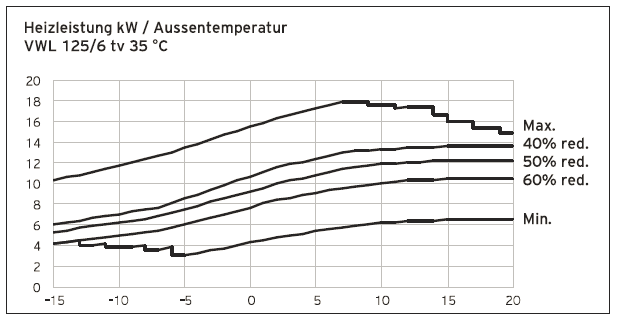
Probably about 1/3 of the rated maximum as under for 12kW Arotherm plus. In practice both are a complicated function of OAT and target flow temp so when these are high and low respectively it could be as much as 1/2 rated o/p.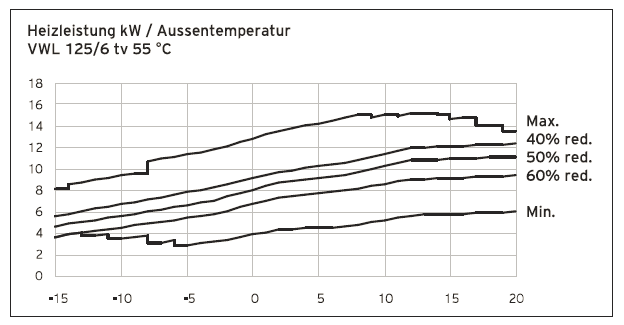
-
Many (?most) HP installations include isolating valves for the outdoor unit in case it needs to be drained down or even swapped out. So better if that is not the only place a PRV is fitted on the primary side. I think from various pix I have seen it is usually sited with the filling loop and pressure gauge. Typically all teed into the return pipework before it goes back out to the HP via the filter, which should be the last thing indoors.
-
And there is a big Mitsi factory somewhere in the Central Belt of Scotland, videos of operations there avail. on youtube.
-
I think you will find the warm-up curve will be spread out over time but the shape will be the same. So the CoP as a function of increasing temp will be identical and the overall efficiency willl be exactly the same.
-
OVO which tariff first before heat pump add on
sharpener replied to connick159's topic in Air Source Heat Pumps (ASHP)
Yes but that is what enables one to recharge batteries and thermal store several times every 24h. Admittedly it needs careful thought on how to program all systems to best advantage. -
Standard calc for 4 beds gives 225 so installer will probably want to fit 250 min. Should be OK for a family if you are happy to top up in afternoon (when Cosy is cheap for 3 hrs anyway).
-
According to this discussion that advice is outdated, and plenty of ppl there say 5kW is compatible with 250 l cyl.
-
L9 error with Mitsubishi ecodan heat pump
sharpener replied to Michel463's topic in Air Source Heat Pumps (ASHP)
Why wouldn't the pump just push the air into the buffer, which presumably has an AAV at the top? -
Ecodan - room temp auto adaptation and multiple zones
sharpener replied to BEJB's topic in Air Source Heat Pumps (ASHP)
Maybe it was done this way deliberately so the flow to zone 2 came preferentially from the return from zone 1, so temp for zone 2 was lower as befits UFH. Problem is to adjust the 3 pumps so that it actually works like this. Try turning zone 1 pump down and/or primary pump up so zone 2 can suck a hotter mix from the LLH. -
Yes or IIRC simply left in the system while running hot as normal for 72 hours, while you get on with something else. Powerflush very fashionable bc it needs expensive equipment and takes time so plumbers can charge more to do it.
-
OVO which tariff first before heat pump add on
sharpener replied to connick159's topic in Air Source Heat Pumps (ASHP)
Good to know, thanks. Is there any publicly available info on this? https://www.hvpmag.co.uk/New-AI-technology-signals-boom-time-for-heat-pump-installers-/18477 First of six paras near bottom of article says "Octopus Energy’s Kraken software already provides optimisation for its Cosy 6 heat pumps, which it manufactures itself, and for Daikin models through that company’s API. Octopus says it is also working to integrate with Mitsubishi, Vaillant, NIBE, and Samsung and hopes to make a series of announcements by this winter." -
OVO which tariff first before heat pump add on
sharpener replied to connick159's topic in Air Source Heat Pumps (ASHP)
Cosy is fit and forget, you do not constantly need to seek out the best times. You can still use it to your advantage: Set target room temp 1 or 2 deg higher 0400 - 0700 and 1300 - 1600 and set back for the first couple of hours of the higher tariff periods. Make sure HW is heated 0400 - 0700 and/or 1300 - 1600 (higher OAT = slightly better CoP) Octopus have an online tariff checker based on yr recent bills which will advise which is better (but not taking account of the above hacks) -
Seems to be, here you are. The supplied neutraliser provides this function with the DS40. Then inhibit with F1. Other products are available but these have served me well in several houses. Current heating system dates from 1995, last cleaned and inhibited in 2015, HP installers were surprised how clean it still was this summer.
- 14 replies
-
- 1
-

-
- ashp
- air 2 water
- (and 3 more)
-
OVO which tariff first before heat pump add on
sharpener replied to connick159's topic in Air Source Heat Pumps (ASHP)
I would read the Ts and Cs very carefully, you are giving them access to your HP's API in order to read its energy usage so they can credit yr account with the difference. The two schemes seem to be inextricably linked, the link says " * You’ll also need to be signed up to our Heat Pump Plus tariff and be an OVO customer." It sounds as though this is a necessary but also sufficient pre-condition for their "nationwide heat pump flexibility trial" as its web page name is actually "heat pump plus trial". Octopus have something similar in the works, I shall study it carefully but am not sure it would be compatible with my battery setup. -
Electrician asked me Q re heat pump
sharpener replied to CalvinHobbes's topic in Air Source Heat Pumps (ASHP)
Fair enough, it's reasonable the electrician should want to check his work before he leaves. At a guess if he turns on the breaker the HP should come on in standby mode and the display should light up, that might be sufficient. Grant HPs are at the simpler end of the range of control options and are often wired up in a standard S-plan config but even so he will have to run it in heating mode to check the thermostat wiring and zone valve functions. Grant person may be happy for him to do this before he visits to configure heating curve etc. Fortunately my spark was an employee of the installers (they were actually a firm of electricians who had branched out by taking on plumbers) so didn't face this issue. He was very good, wiring neat and mains and low voltage all segregated, integration with legacy controls and battery inverter all worked. First time except for one missing perm live connection to UFH controls quickly rectified. -
OVO which tariff first before heat pump add on
sharpener replied to connick159's topic in Air Source Heat Pumps (ASHP)
IME Octopus Cosy is better - I have batteries and so can charge them three times every 24 hours and run the HP off them during peak periods. Off-peak tariffs are comparable. The OVO HP integration AFAIR also potentially gives them control of your HP which I don't like the sound of even if they don't use it to begin with. If you haven't got batteries Tomato is also worth checking, there is a thread about it.