


Crofter
-
Posts
3484 -
Joined
-
Last visited
-
Days Won
11
Everything posted by Crofter
-
Making home-made pod 'mobile' to meet Building Regs criteria
Crofter replied to Grian's topic in Building Regulations
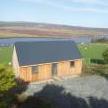
The 'mobility' is inherent to the structure and not its location. You can have a suitable structure located in a courtyard or under power lines etc where no crane could ever reach it- or down the end of a narrow winding track which is cannot physically fit through. The reasoning behind this is that you could have craned it on to the site and then in the intervening years trees can grow, buildings can be added, which box in the mobile unit. It remains legally a portable building though. So on site fabrication is fine. But you do have to have a plausible way of showing that it could be lifted/moved. That means a monolithic structure, not reliant on continuous support from a concrete raft or masonry underbuilding. No dwarf walls- your joists will need to span the full width. Not a problem on a shepherd's hut. In my own case, I built a rectangular 'chassis' from heavy timber. The walls are fixed on top of it, the joists are hung within it, like the rungs of a ladder. The chassis is supported at eight locations but that's pretty arbitrary. In theory you could put slings under it, or jack it up and back a trailer underneath. Total weight of the ~10x5m building is about 10t. If you look at my early blog entries you'll see how it went together. -
Yep it's pretty windy up there! At least you have Nessglaze on hand to fix you up with new windows 🙂
-
I would just foam them, think of all the energy you'll be saving! By the way whereabouts are you located? I lived on Lewis for about eight years so I know it fairly well.
- 6 replies
-
- 1
-

-
- outer hebrides
- windproofing
- (and 1 more)
-
Those sizes look a bit odd. It's generally 4", 5", or 6". Should be a snug fit between sections. Single wall is cheap and throws out a fair bit of heat. But you can't have it within a certain distance of combustibles. Twin wall can be pretty close to combustibles (~2" from memory). Non combustible includes masonry and cement fibre board. It's not rocket science but the rules are there for a reason and the consequences of getting it wrong are pretty bad.
-
There's lots of hype around Small Modular Reactors, but as far as I can tell they've yet to actually prove themselves. It seems a matter of faith that mass production will offset the economies of scale of larger units. Can SMRs be made to fit any site, without the need to access water sources etc? That would be a huge advantage.
-
I've only ever bought cheap stuff from the DIY sheds. I'm aware you can spend more but I'm not sure what you get for your money?
-
Ouch! Is 7 really a realistic value? Another thought- I presume I can work backwards from known energy use and use that as another data point?
-
I could do, but I'm on the other side of the world right now and trying to get ballpark figures.
-
I'm not completely opposed to nuclear, but it's had a long time to prove itself and frankly it hasn't managed to do that, in the UK at least. It seems that other countries (e.g. France, India) have been able to make it work. There's a lot of hype about new types of reactor and small modular reactors, but I remain pretty sceptical. Solar and wind have become almost ridiculously cheap, so it makes sense to maximise that first.
-
Ok thanks for the reminder about Jeremy's spreadsheet. Air tightness clearly has an enormous effect. Unfortunately I have very little idea of just how bad it is in this house. It's a 1970s l bungalow, twin block walls with cavities filled. New 2G/3G windows and doors throughout. Floor is currently pretty draughty (T&G pine boards, suspended). I'm going to improve that as much as I can (probably insulation with a breather membrane stapled underneath). Loft has several layers of glasswool everywhere, must be about 300mm. Any ideas for a number to pull out of the air for ACH for a house like this?
-
Democratic Republic of Congo
-
As longer term users of the forum will be aware, I'm very much inclined to do things myself. I designed and built a small house from the ground up with absolutely minimal outside help. Partly it's because I've struggled to get trades in the past, and partly it's because I'm a cheapskate. Anyway, next project is ASHP for my 70s bungalow. Almost certainly going to go A2A. I've been leaning towards a ducted system but may go with multi split. Obviously a heat loss calculation is required. We just had a new EPC done and I was a bit surprised how superficial it was. If I get a pro to do my HLC, how accurate is it really going to be? Can I attempt this myself? So far I've just run numbers through a 'radsizer' online tool from a radiator supplier, and checked the Heatgeeks' rules of thumb, both of which return a value of around 5.5kw. There are plenty of assumptions in there. In practice I'm going to be installing a 5, 6, or 7kw system, so does it really make all that much difference trying to nail this down perfectly?
-
Exactly the same argument applies to EVs- even if further entirely by gas power stations, they're more efficient than ICE.
-
Removing bricks from fire place to get more heat
Crofter replied to kestrel's topic in Stoves, Fires & Fireplaces
I definitely wouldn't do a double 90⁰ bend. From memory you're only allowed something like 6" total horizontal run, and anyway it would become impossible to sweep the flue after that. Are you absolutely sure there's no rear flue option? Your stove looks like a Charnwood. Mine came with the option of top or rear, but you won't see it without removing the lining bricks inside. (If you do find a rear flue exit, I can sell you my genuine Charnwood rear flue adapter!) 😁 -
Removing bricks from fire place to get more heat
Crofter replied to kestrel's topic in Stoves, Fires & Fireplaces
I found that when my stove was pushed back in to the alcove, the chimney breast itself would get very hot... and leach most of that heat out in to the loft. A lot probably went down in to the foundations too. The chimney breast itself was boarded out with battens and plasterboard- except for under the floor and in the loft of course. It was far more efficient once we pulled the stove out in to the room. -
Removing bricks from fire place to get more heat
Crofter replied to kestrel's topic in Stoves, Fires & Fireplaces
I'm not sure about the structure of that brick work so won't comment on how to safely remove it. But I will say, getting the stove out on to the open will make a huge difference. We fl initially fitted our stove in to the recess created by removing the fire bricks in the fireplace. Used a clay adapter to connect to the chimney. Ran out like that for many years. When we renovated, I pulled the stove out, fitted a proper stainless liner, and boarded over the opening to leave a totally flat wall. Extended the hearth out in to the room and the stove is now free standing. It made a huge difference. The room heats up much quicker. -
Basement heating - Air to Air heat pump?
Crofter replied to getmealemon's topic in Introduce Yourself
Do you want responsive occasional heating, or 'always on' heating? -
I heard that the non f-gas units had worse performance?
-
I've just learned about the existence of intelligent duct controls. I hadn't really considered this before. I had kind of assumed that I would just set the system up with adjustable vents and/or baffles to deliver the required amount of heat to each room and just leave it alone after that. But maybe that's a bit naive.
-
This is one reason why I'm hoping to use a ducted system. It just seems to make sense to have big ducts emitting through grilles at floor level. I'm looking at a maximum airspeed of less than 4mph which hopefully will be barely noticeable.
-
Most people seem to be singing their praises, it's interesting to hear a dissenting voice. Do you remember what specific unit it was, and was it running at full speed most of the time?
-
Was this the conventional split unit with a wall mounted emitter? I wonder if I can find out any information about flow rate/speed to compare with my ducted plan.
-
Good question, I'd imagine it would be similar to the other option which is running it in the cold loft.
-
Solar - Where to start?
Crofter replied to DazRave's topic in Energy Efficient & Sustainable Design Concepts
Good summary, thanks for taking the time to share it. Like you, I'm watching the Octopus situation closely. It would be a game changer if the trial became an option for everybody. -
One of the big advantages I see with A2A is the faster response time. For a house like ours, which is either used by a working family and empty through the day, or at other times used as a holiday let, the current storage heaters are about the worst possible type of heating it could have. I don't think UFH would be the best match either. Anyway, I've got a suspended timber floor and there are limits to the amount of work I'm willing to do.
