


Crofter
-
Posts
3484 -
Joined
-
Last visited
-
Days Won
11
Everything posted by Crofter
-
Scottish government declares national housing emergency
Crofter replied to Guest28's topic in Housing Politics
According to the article that the OP linked at the start, it means that a number of local authorities have declared that the current arrangements are not working, and this has now escalated to a national situation. Fully agree with that. We don't have enough houses for people to enjoy the luxury of owning extra ones that they leave empty. Which is good. The Scottish government have begun to address this. Speaking as the owner of a holiday let, I was pretty amazed how little regulation there was when I first set up business six years ago. I'm not sure what effect the new licensing scheme is having, and it varies between different councils as they are free to implement it how they see fit. What's clearly needed is a balance, the holiday lets bring in tourists who spend money in restaurants etc, but you still need enough housing for everybody else. In my area it's close to impossible for nurses, doctors, teachers etc to find anywhere to live. In a rural area this is a major problem because the nearest available housing is literally hundreds of miles away. -
Scottish government declares national housing emergency
Crofter replied to Guest28's topic in Housing Politics
This is all getting rapidly off topic. Can we talk about houses please? One thing I think is highly relevant is how the balance has changed between owner occupied, private rental, and council/association housing. I saw some interesting figures on this recently but can't seem to find them again. -
Two weeks is a bit optimistic isn't it? You still want moisture content as low as possible. Is your ash suffering from dieback? I planted a few but most of them haven't survived. The mature trees are holding on but clearly not happy ☹️
-
I think that is location dependent.
-
I had to skim a few areas in my own house- chimney breasts and other bits of that size. Used 'easy sand' plaster, and sanded off the worst bumps with mesh. Bloody messy but it did the job. I'd call the final result 'acceptable'...
-
Just because everybody is doing it doesn't mean it's the best way. We were very lucky to find an out of work plasterer who had come up to Skye to do a job for a hotel, but they weren't ready on time. So he was looking for work while he waited, which way perfect timing for us. I had been planning to tape and fill but I couldn't turn down the opportunity and we got a full skim instead. When the SSE guys came to install our meter, they said it was the best finish they had ever seen on a new build.
-
Tape and fill if you forever want to know where every nail and joint are. Otherwise, skim.
-
On full length boards I find an extra pair of hands, or two, helps enormously.
-
With the Octopus trial it seems that you have to actually install your system and then send off your £250 and wait to see what they say. I'm not really in a position to make that commitment. Are inverters and diverters dropping in price too? I know the panels are virtually being given away these days but I'm probably only looking at a small system.
-
I'm seeing grid tied inverters and other kit on eBay at tempting prices. Other than the usual caveats about buying secondhand, is there any reason not to go down this route? E.g. I guess some installers wouldn't be happy fitting secondhand equipment? If I wanted to sign up for export, are there any standards/certifications that I should be looking for?
-
Funny thing is, the whole place recently went through a new EIC and the immersion setup was never mentioned.
-
That's an interesting idea, not really sure where to start though.
-
Of course I could swap out the 3kw immersion element for a smaller one, it's got all night to heat a 200l tank so probably doesn't need to be that big?
-
Funny, it says 13A on it... which it obviously couldn't handle!
-
Ideally I'd be setting it up with a WiFi enabled timer, so that it could run on the E7 off peak rate, and we could turn it back or off when we're away. Not sure how to go about this though.
-
Yup it was running an immersion heater. In theory it should have been sufficient for the current. This bodge only came about because the sparky didn't realise we had two immersions on the tank. I think I'll need to get it done properly...
-
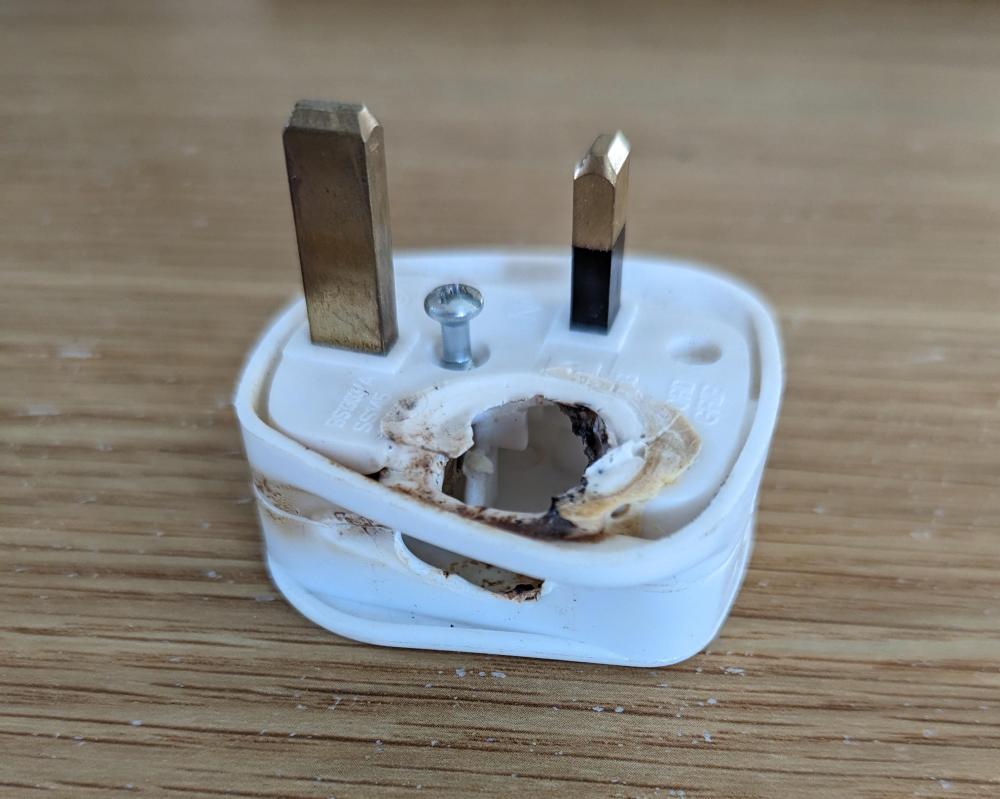
Think I had a close shave here. Plug now replaced and I'm keeping a very close eye on it. Any suggestions for why this would have happened?
-
It's only 16A which explains why we didn't just put the second immersion on it. The CU is right next to the tank and has a couple of spare slots for MCBs so it's probably easiest to just add a new circuit.
-
Back when our cottage was being built, my otherwise very good sparky had a brain fart and was unable to spot that the UVC had two immersions. Consequently we ended up with one circuit wired from the CU (this is used for the upper boost element, with a 30 min timer switch). The bottom element ended up being run off the normal ring main, using a plug in timer. This is obviously far from ideal for a number of reasons. The simple mechanical timer will go out of sync with the off-peak time if it's turned off for any reason (e.g. a power cut). We've also had a couple of timers fail on us- I guess that although they're rated to at least 3kw, they don't actually like running a big current on a daily basis. Anyway I think it's time to upgrade this. 1) can the overnight and boost elements run off the same MCB on the CU? I'm assuming not, otherwise the sparky would have just done that at the time. 2) I see you can get MCBs with built in timers, with battery backup. Looks like a neat solution. Are they any good? 3) In an ideal world, I'd like to have remote control over the immersion, as we are away from the house a lot especially over winter, and we don't really need to keep the tank hot for weeks when the place is empty. We also have guests staying who can have a habit of running away all of the water, so the ability to remotely boost it would be useful (I'd rather have a higher electricity bill than a bad review!). What options do I have for a wifi-enabled timer that will be robust enough to stand up to a 3kw load every day?
-
I disagree. I think it's a knowingly unpopular move led by clear science on particulate emissions. But let's just agree to disagree on this.
-
Wood pellets never made sense. See also, cash for ash in NI
-
Are you talking about a vehicle heater? I've installed a couple of them in boats, they're good and powerful, for occasional use it might be a good idea. Main thing to watch out for is the exhaust which gets seriously hot and needs to be fed out of the building without touching anything flammable.
-
Total Heating Total Control wiring issue
Crofter replied to Ray Shields's topic in Consumer Units, RCDs, MCBOs
We have a house on THTC and we've had to move to OVO now. No word yet on the tariff coming to an end, but I've heard rumours from other parts of Scotland. If they do end it, my problem is that simply switching to E7/E10/standard won't be itself be an option. My heaters are controlled by the time switch, they do not have any timers they I can control. It's not going to be very fair on little old ladies with the same type of installation as me to expect to have to get a sparky to install the necessary timers/controls, out of their own pocket. Hopefully there will be some sort of grant to cover this. -
I do hope it's implemented this way. Our local (SNP) MSP has been pretty critical about this. I wonder how much leeway individual councils will have?
-
Improving living conditions in my mum's damp and humid small bungalow
Crofter replied to minty's topic in Ventilation
The choice of heating system doesn't really affect the humidity (assuming you're not using some sort of open flame gas heater, which will spew out moisture). But the advantage of ASHP, of whichever type, is that they convert one unit of electricity in to three or four units of heat, so compared to basic electric heating you can have the house much warmer. Anything you can do to raise the temperature will help. In theory the air movement of A2A might help eliminate dead spots where damp air can linger. But if you under-spec the A2A you can end up with high airflow rates which will lead to noise and drafts. I'm in the process of planning an A2A install myself but can't report back any actual feedback yet...



