

Crofter
-
Posts
3451 -
Joined
-
Last visited
-
Days Won
10
Everything posted by Crofter
-
So the key phrase seems to be "free-standing solar panels". Googling that brings up news that the Scottish parliament are set to approve an increase to 12m². https://www.savills.co.uk/blog/article/358468/commercial-property/unpacking-changes-to-the-planning-process-for-solar-energy-in-scotland.aspx#:~:text=The%20permitted%20development%20announcement%20in,up%20to%2012%20sq%20m).
-
Does anybody have a link to a definitive source for the 9m² limit? I've come across some reference to a maximum height of 4m and, possibly, maximum 3m in each other dimension. But I'm not sure how authoritative this is, and whether it applies to Scotland.
-
Yes it's an owner occupied croft. I'd forgotten about the three caravans provision- I'll need to look up the details on that, there might be something useful there. I highly doubt that I would get planning permission for any sort of conventional house in this location, so I think the hutting approach, which ought to be a bit more lenient on planning, is the way to go. I doubt I'll actually go as large as 30m², I don't think it's necessary and I want this to be a pretty simple, fast, and cheap project. Having to carry everything on to site by hand up a steep hill will definitely put a limit on how big I want to go! It's a shame that Highland Council are now charging nearly a grand for planning. That's a pretty big dent in the budget 😞
-
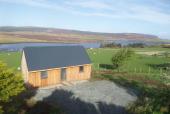
Stick build on site is probably the way I'll go. I could make up panels down at my shed and carry them up, but they'd have to be pretty small or else they'll be too heavy to carry. So it may not be worth it. There's some very steep and narrow sections on the path. I like the idea of DIY borax treated sheep's wool for insulation, and using as much reclaimed and secondhand material as I can. It's basically all the things I wanted to do with the cottage (see profile pic) but was too afraid or constrained to actually do. But because this is entirely for our own use we can build it exactly the way we want. We've also spent the last three years living on a 39ft sailing boat so we're very used to compact spaces and how they work. Shouldn't be any problems with damp if we build on bearers. The ground itself is pretty rocky, with a very shallow layer of soil, and a steep slope.
-
I'm feeling another project coming on. Ten years ago the Scottish Government defined a 'hut' as a small (30m² or less) building designed for intermittent/temporary recreational habitation, built using low impact materials and designs, generally assumed to be off grid and at the end of life removable leaving little trace on its site. They are not subject to building regulations but you do need planning. It's up to individual local authorities to grant planning for huts as they see fit, but the SG was certainly trying to encourage more of them to be built. Anyway. We've got a lovely piece of land up the back behind the house, it's just very rough heather but there's a good view and it's very peaceful up there. I really fancy putting up a hut, entirely for our own use. In the height of summer we could spend short spells up there while renting out our own house, or it could be overspill for when family come to stay. And it would be a great place to get away and indulge in some 'me time', play the guitar, do a spot of writing... I know @Tennentslager has built a hut, but that was on an established site and in a different local authority. I can't find any sort of policy from Highland Council about hutting. Anybody on here have any experience or advice? My proposed site is well outside of the normal building line. It would be a five minute walk up a steep field to reach the hut- zero possibility of vehicle access, which is kind of the point for me. Everything will have to be carried on to the site so no concrete or masonry of any kind. I'd like to design something that blends in to the landscape as much as possible. A turf/heather roof is almost a given, and timber and/or corrugated iron for the walls. I'm wondering if the windows can be set at a slight angle to prevent them from creating obvious reflections. I think my main constraint might be height. I want this hut to sit low to the ground, but all the best small house designs tend to use sleeping platforms. I love the idea of them, but it's pretty hard to wedge in a bed on top of another useable space without the whole thing getting too tall. Any advice, experience, or encouragement welcome!
-
A lot of Nordic houses use quite traditional designs with generous eaves overhangs and steep roof pitches. All of which will protect the wooden cladding and will minimise any water ingress from roof damage. In Scotland we're using similar materials but the fashion is to do away with overhangs completely, and have flatter roof pitches. I've seen some pretty poor quality larch cladding. It's all in the details. Don't bring it down so low that it gets backsplash. Use full boards at openings, don't just cut a bit out of the board and expose end grain. It means that you need to be more careful with your board spacing but it's worth it.
-
I agree, we have too many subsections in general. The forum structure was largely inherited from its predecessor. (Sorry for the thread drift)
-
We have a fairly small turbine (80kw, 46m tip height) 220m from the house. It's a pretty agricultural piece of equipment. In light airs it slowly turns, about 60rpm, and makes a loud 'clunk' on each revolution. In stronger winds you can't hear it at all. It's a bit annoying since it's clearly generating no useful power in those light winds, and a simple software change would probably be enough to eliminate the noise altogether.
-
Typically (see what I did there) the tip height is the highest point that the finished turbine can reach, so tower height plus radius of rotors.
-
If you build without PP,it's possible that you could be forced to demolish it. I don't think you've got any option other than to pause the project while you get PP. Probably not the news you want to hear.
-
Wow has this really been five years!? In the end I took off all the surrounds inside and measured up directly. The local joiner who I asked to check my measurements never showed up so I just had to take the plunge. Everything fitted perfectly. Getting the old windows out was by far the hardest part of the job. A recip saw would have been a huge help. I did try using a multi tool but the depth of cut just isn't there and you only get a few nails done with each blade, at about a fiver a go. The most fun part was turning the kitchen window in to French doors. Very satisfying. A few years prior I wouldn't have dreamt of doing all this work myself but it's amazing what you can do when you just roll up your sleeves and get on with it.
-
Well not to rub it in but currently in the British Virgin Islands. Pretty idyllic until you get to a shop and it's US$12 for a loaf of bread. Fortunately we stocked up on flour in one of the French islands which are less extortionate. Living on the boat for a few years has really shown me how you can live with the minimum of resources. We literally live off sunshine and rainwater. I have a sail for my dinghy and most of the time don't need to use the outboard. So we can go weeks at a time without using any fossil fuels at all. Our main engine is diesel but we don't move that often, and try to only do longer trips on days when we can do the bulk of the journey under sail. Of course, there is some outsourcing going on- we use buses and launderettes, and almost all of the food here is imported.
-
Moody 39 from the late 70s. So a very basic old tub of a thing. With a little lateral thinking it wasn't too hard to find space for 1200w of solar (200w of that charges the old lead acid system which I kept in place as a backup, the main lithium system uses the remaining 1kw)
-
I used to think people were daft to pay the Victron premium. But their prices have come down recently and now that I've got a few bits of Victron gear I completely understand why it's the most popular choice.
-
Yup, that's home, but I'm away travelling on the boat for a few years just now.
-
I've actually had two different ones. The first one was an Epever 3kw which died following when it was switched off whilst running. Should have survived that but sometimes you get unlucky. I replaced it with a Victron 3kva (2.4kw) which was double the price but I didn't want to have a cheap one let me down again.
-
I don't think it's hugely relevant to a house building forum since it's all 12v off grid stuff. But a bit of info about it: 1kw of PV charging 6.6kwh of 12v LiFePO4 batteries via MPPT charge controllers. 3kva inverter to supply the AC loads. This powers all of my domestic systems including fridge, freezer, induction hob, air fryer, electric mini oven, lights, etc etc. I have a gas cooker which is my backup, but I very rarely need that- maybe one day a month on average. The battery cost about £800, the inverter was about £700. MPPTs about £200. Panels and other bits were dirt cheap- eBay, second hand, etc. The secret is that I'm not in the UK- PV works very well in sunny countries, despite what the newspapers tell you 😂
-
Can we tone down the language on here a bit please, totally unnecessary and it's at risk of getting personal.
-
Ah I missed the 200 mile requirement. You'll have to wait a few more years to get that at £5k. As I understand it, modern EVs are seeing very little battery degradation, although much depends on how they're been treated. Don't they give an indication of the battery health? That's something I've seen on adverts, but maybe it's to be taken with a pinch of salt. If I come across as a techno-optimist it's probably because for the past three years I've been living off grid on a boat, powered by PV and lithium. The whole project was about £2k to put together. It's infuriating to see other people not even bothering to explore what this technology can do, and they continue to run generators. Even if you don't give a crap about the environment, or noise, the cost of fuel and servicing alone quickly makes PV+storage the cheapest option. Returning to the original question of using a car as a battery: the prices I see quoted for domestic batteries are very high. I built mine for about £120/kWh. Is anybody using DIY batteries on domestic projects? Are there any hurdles to doing this?
-
Somebody mentioned not being able to buy an EV for £5k. That's not really true, there are Zoes and Leafs in that price range. With the former you need to make sure you're not locked in to a battery lease. And on this first generation of EV you can't expect much range. The main thing preventing EVs appearing at that price point is that they're not old enough yet. If you look at the £10-15k range there are thousands of pretty decent EVs. I'm contemplating an MG5 or a Niro myself. The other point about whether any of this is worth doing, your attitude probably depends on what media you consume. I was quite impressed by some interviews that Hannah Ritchie did, and I'm looking forward to reading her book, which she describes as the product of her journey from climate pessimist to cautious optimist. https://www.penguin.co.uk/books/453652/not-the-end-of-the-world-by-ritchie-hannah/9781784745004
-
There is very little battery recycling happening just now because a) there just aren't that many EVs yet b) they're not at scrapping age yet c) the batteries can be reused in static storage It will eventually become a major industry in its own right. Those working on it are confident they can achieve a 97% recycling rate. Re cobalt, this is already in use in large quantities as a catalyst for fossil fuel refining. Early EVs did need a fair amount of it in the NMC batteries. However newer NMC batteries use substantially less, and more and more manufacturers are switching to LFP which does not contain any cobalt at all (and also has longer lifespan and almost zero chance of thermal runaway).
-
You need counter battens if you have sarking, but a tented membrane draped across the rafters doesn't.
-
I've heard good things about NFU, proper service and prompt payout if you ever need it. I'll give my local guy a call.
-
I'm struggling a bit to find cover. Our house is our primary residence but we also let it out as a furnished holiday let when we're not there. I haven't had trouble with this before, but for whatever reason the company I was with are now saying that its difficult to find an underwriter who will cover this specific circumstance. It seems that most of the specialist holiday home insurers assume that it's a second home, the primary risk being long periods of time unoccupied. I wonder if I'm better approaching a more general insurer and seeing if they will allow me to also let it out? It's probably a long shot but if anybody on here is in a similar position or can suggest a company, that would be really helpful. Insurance must be the most boring thing in the world so anything I can do to tick this off my to do list would be appreciated!
-
Electric powered, Hot water-only system options?
Crofter replied to Chris HB's topic in General Plumbing
What size is your main fuse?
