


Digmixfill
-
Posts
207 -
Joined
-
Last visited
Everything posted by Digmixfill
-
One of possibilities i've pondered is a 47mm lump of wood glued and screwed to the length of both chords. Minimise the gap for P5 and ceiling plasterboard. With all the do's and don'ts of webbed joists i'm not sure if that's allowed? You are allowed to sister them by screwing together, so I don't see why it wouldn't be allowed.
-
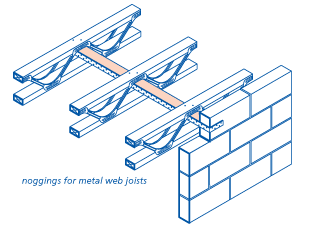
I was surprised. I expected Egger to say that it would be fine if, as you mention, plaster/drywall and skirting are added - reducing the gap. The reply I had was the BDA agrement and a quote from a section: "butt joints shall be staggered and supported by noggins or joists; the particleboards shall be fixed and supported on the perimeter edges of the short-ends by noggins or joists. Although long edges do not require intermediate support between joists, support noggings shall be fixed at floor perimeters where unsupported edges abut a wall" Along with "You are correct in what you say about the short ends falling on the joist, where this is not possible an additional nogging must be fitted to support the short end."
-
I've just ordered the first set of posi joists - more visible progress :) I was planning to use Egger Protect for the first floor, so read the installation guide etc. Had a query regarding short edge support and joist overhang so emailed Egger. I'm going to end up with a 75mm gap between the end joists and the walls - like this snippet stolen from NHBC. Egger say that the short ends of all boards must be supported and have said I would need to install noggins for the gap. My google fu is weak and I can't find any examples on t'web for people doing this. Anyone dealt with this?
-
Suggestions for drilling through steel-concrete-steel sandwich?
Digmixfill replied to Digmixfill's topic in Tools & Equipment
For the win! The steel in railway lines is really hard stuff. I had read online, before I started drilling, that trying to work with anything other than carbide tipped tools would end with me spending time dressing/sharpening the tools. That was very true. I'm sharpening the larger bits after every hole. Do you think a bi-metal hole saw is up to inch thick hard steel? -
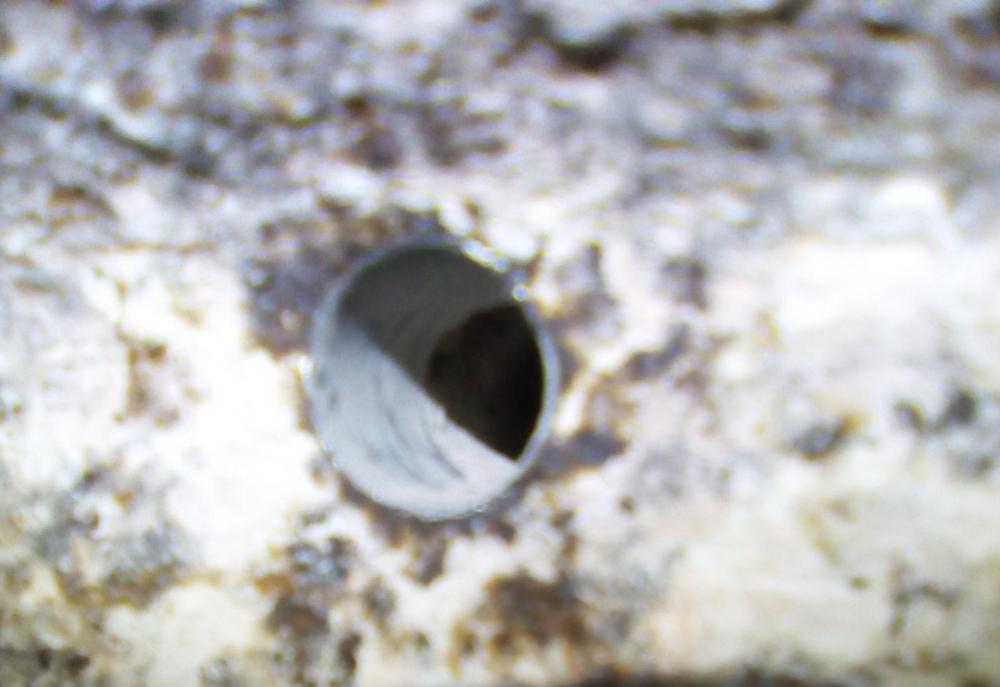
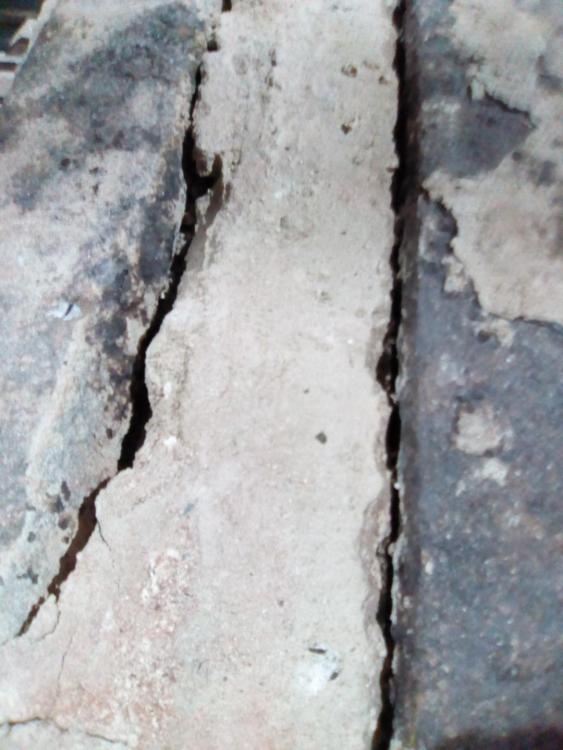
I'm putting a ledger plate on either side of a 9 inch wall. A pair of old railway lines sits exactly where the holes need to be. I've drilled a few holes using cobalt bits 4->8->10->12mm, then switching to masonry for the centre. Then back to cobalt for the rest of the steel. The steel is an inch thick or thereabouts, amd It's buggeringly hard too. A mag drill base won't fit inside the web Any suggestions on how to drill these holes quickly? A hole The sandwich
-
Steel vs Concrete single leaf lintel - benefits of either?
Digmixfill replied to Digmixfill's topic in Heat Insulation
This is one of the things I came across when googling earlier. Where a lintel bridges a cavity I can see the benefit of thermally breaking the lintel. All of my openings are thermally broken at the lintel. All of the inner leaf lintels are single leaf only. Up to now I've put concrete in the internal walls and insulated box lintels in the inner leaf of the external walls. The externals have either been CN71 catnic or brick arches. The wondering about either having a benefit over the other was just something I thought about whilst measuring up earlier. If it doesn't make much difference either way i'll continue as before. -
Steel vs Concrete single leaf lintel - benefits of either?
Digmixfill replied to Digmixfill's topic in Heat Insulation
I'm about to put together an order for quite a few lintels for the rest of my inner leaf. Any real difference between the two types will affect my choices. -
Whilst doing today another random thought lodged itself. Is there any thermal benefit to either a solid concrete lintel or a steel box lintel in the inner leaf of an insulated cavity wall? My google searching keeps turning up entries pertaining to thermal bridging across the cavity, but I haven't yet come across anything comparing thermal properties for the two in a single leaf. Anyone have any thoughts or views on this?
-
Thank you I'm getting neater at blockwork but I'm still sloth like. I'm quite used to the scaffold boards over the wobbly towers - I've not fallen off or spilt any tea yet. Three towers in that room means I can walk the full wall. My plan is to drop the hangers on and bolt up the ledgers and fit the joists. Add the 3 courses of block over the hangers, and then move the towers up over the joists. The corner is going to be a bit like tetris for two courses. The last corner block on the hanger row is bonded over the corner block. I have been trying to avoid coursing both walls and buggering up matching courses with the PUR board. Not sure if I've saved myself any hassle by doing this or not. Our plans specify to fit the windows and doors a particular distance back from the face of the outer brickwork. I *think* it is 50mm, but I've not looked at that part of the plans for a while.
-
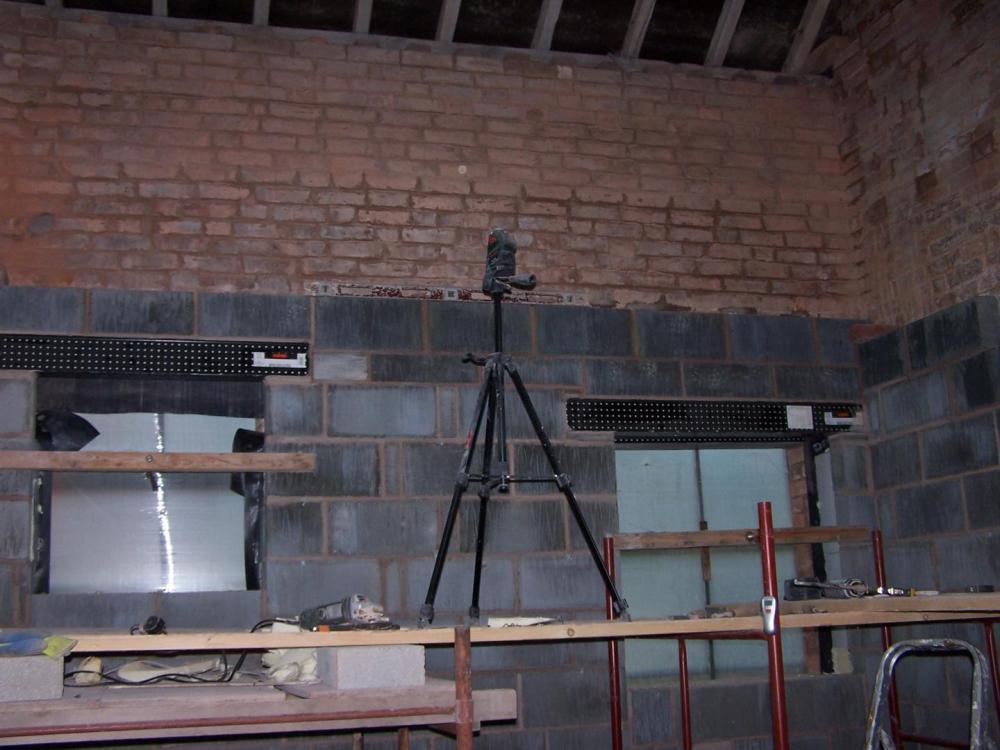
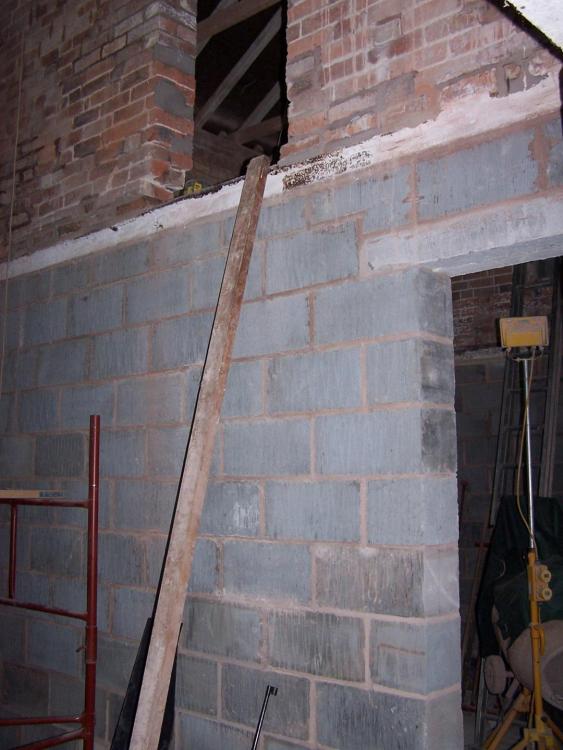
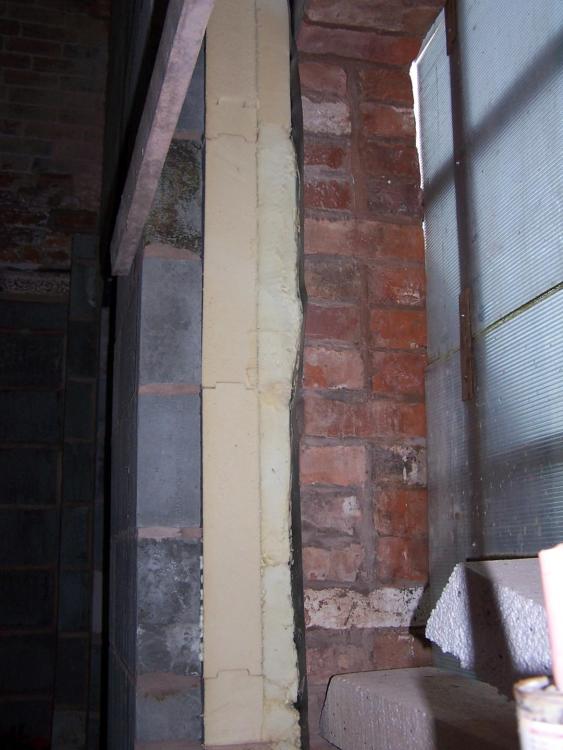
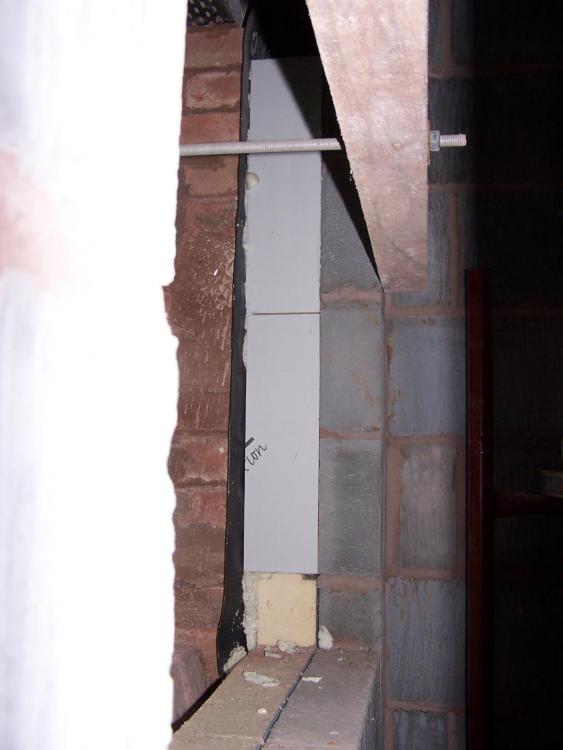
Pictures ? Row where hangers will go. Other side where i'm going to bolt ledger plates either side of the 9 inch internal wall. I've tried two ways of closing the cavity. Cutting the PUR boards flush with the edge and filling the remainder like this. And cutting boards to make a fitted piece face on. This is the better method I think. Hopefully you can see that the cavity gets wider toward the top of the reveals in these pictures.
-
The straight internal wall accentuates the wonk when looking at a doorway or window reveal, but that won't be as obvious when plaster boarded. Other than needing lots of different sized ties it's turning out ok so far. I'm fitting 90mm PUR as I go and might fill the remainder with beads or something else later.
-
Yes, the internal blockwork is tied to the outer 9 inch brickwork with resin bonded ties. You just want to see my naff blockwork don't you I'll go try grab a couple of decent pictures.
-
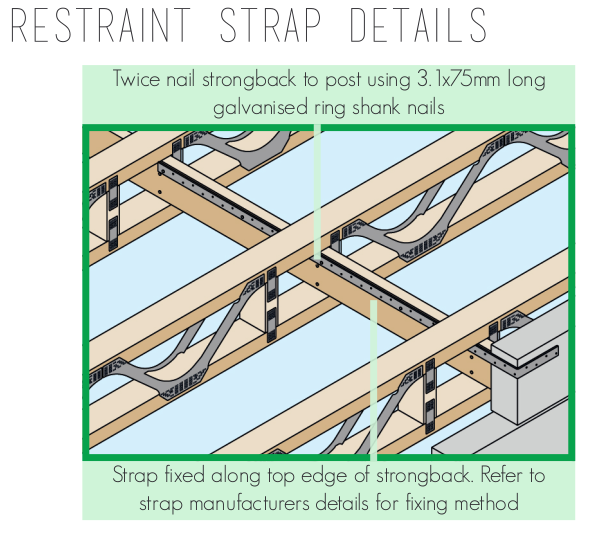
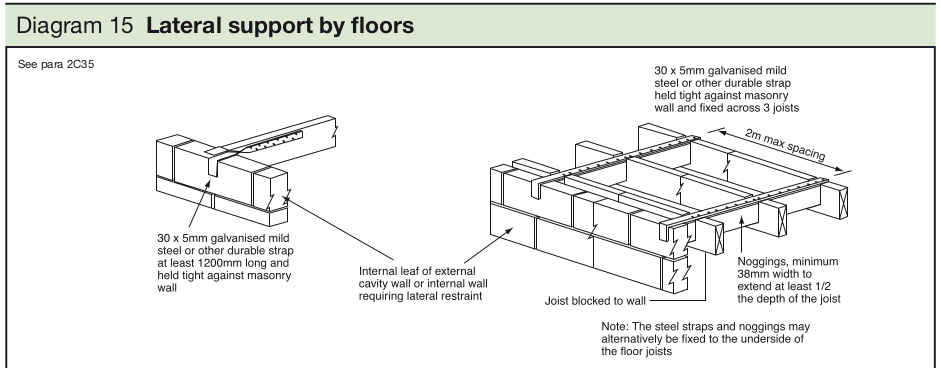
From a webbed joist installation document This would give a restraint strap at the centre of the span.
-
It's time for floor joists in one room of my conversion. I've still to decide if i'm going with webbed joists or solid timber and whilst looking through information for webbed joists I started to confuse myself. Webbed joists for spans that we have will require a strongback across the room. This will have a restraint strap holding it to the blockwork. Timber joists will just have strutting across the room with no requirement for straps at the strutting point. For the purpose of my puzzlement assume a room 3.7m square. This is over the 3m requirement for lateral restraint straps. Part A 2C35 says "Walls should be strapped to floors above ground level, at intervals not exceeding 2m and as shown in Diagram 15." With the timber joists I had thought that I needed to put 2 straps at 1.23m spacings. With webbed joists having a restraint strap at the centre of the span the distance between the strap and each end of the room is 1.85m. Does this mean that no further straps are required for the webbed joists?
-
Looking for ideas for cavity closer for my wonk
Digmixfill replied to Digmixfill's topic in Brick & Block
The first price I came across for the WCF200 was £54 inc VAT - no indication of multiples or a pack, so i'm taking that as each. Apparently that's with 18% off rrp. -
Looking for ideas for cavity closer for my wonk
Digmixfill replied to Digmixfill's topic in Brick & Block
Inner is 100mm celcon. Outer is 235-240mm clay brick. Polypipe WCF200 would do the job nicely, but my they're pricey ? -
Looking for ideas for cavity closer for my wonk
Digmixfill replied to Digmixfill's topic in Brick & Block
Thanks for the suggestions. Food for though with more than one option. A DIY Rockclose type of thing? Are standard closers meant to be fastened to the brickwork? There will one or two places where a 150mm closer probably wont overlap the brickwork on both sides. Are building control ok with this approach? I thought they expected some kind of fire retardation in the closer? -
My new internal walls are going up fairly straight, which means the cavity size in some places varies quite a bit against my wonky outer skin. There are a few places where the cavity is > 165mm wide. Any suggestions for cavity closing my wonk?
-
Did you find that the wall plates locked up easily against the walls with little movement, or did you have to swing on the nuts to lock everything up tight?
-
The wall in the pictures needs hangers both sides. I've considered wall plates either side with a length of M12 studding through the wall in each joist space. Any preferences for individual studding for each side rather than bolting through? The opposite wall will need the studding resin fitted. I bet you're banned from local restaurants now?
-
Thinking a little more about the options. I'd probably have to split the wall plate into at least two parts to allow a punch through for services and whatnot. Wall plate is in the lead so far.
-
I'm going to have to start putting in joist hangers soon. Most of the walls where they need to go are new block, so just placing them in as the wall grows is nice and easy. I have one wall that runs across the building that used to be a large opening. Aeons ago when this thing was built a pair of old railway lines were probably the thing to use, so that's what is in place. I've blocked up under the opening with 215mm aircrete blocks which fit under the lines nicely. The brickwork above is some 235-240mm wide and overhangs the lines. Where i need to fit the hangers for 215-225mm joists leaves the hangers unsupported over the void in the sides of the lines. Attached pictures hopefully give a decent indication of what I've got to play with. So far I've come up with: Drill and bolt through with a timber wall plate either side with extra timber into the line void. Weld lumps of steel into the line void behind each hanger. Thin piece of timber into the void for the length of the line. There is a doorway above the line too, which will probably need saddle hangers if I don't go with a wall plate. Any other ideas on how to deal with this?
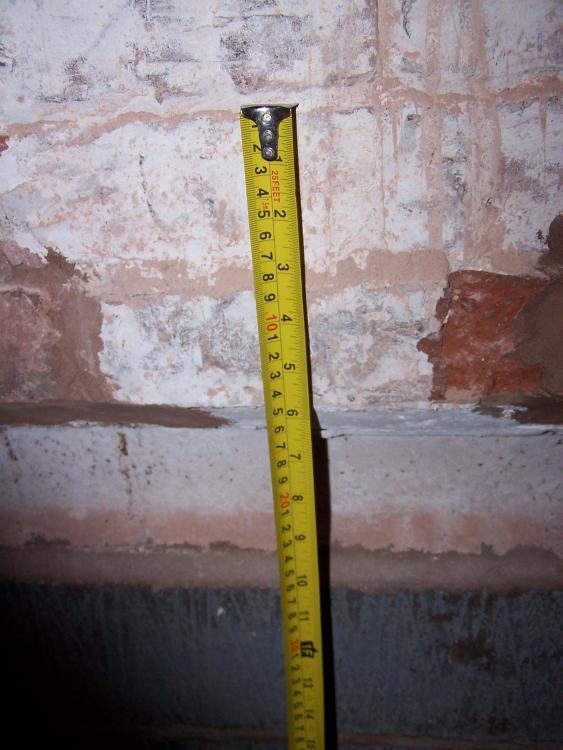
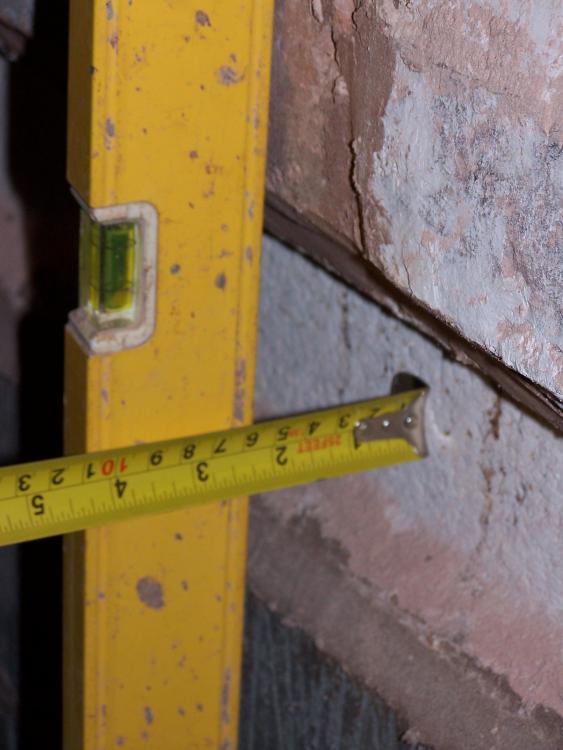
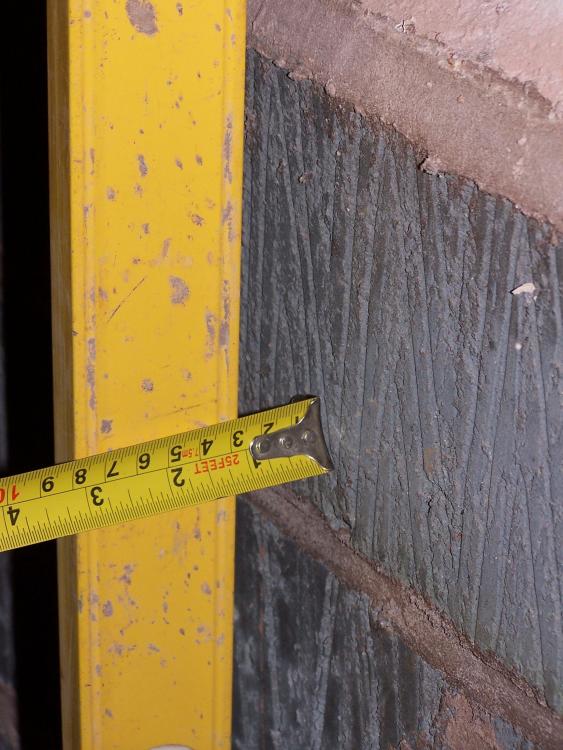
-
Formula for calculating electricity requirement?
Digmixfill replied to Digmixfill's topic in Ground Source Heat Pumps (GSHP)
Glad to see someone sorted out your request :) The site seems unable to send me notifications of replies and I've only just seen this :( -
Do box lintels require padstones?
Digmixfill replied to Digmixfill's topic in RSJs, Lintels & Steelwork
I don't think we have two openings the same size here. The doors will be whatever size we can have made to fit the hole -
Do box lintels require padstones?
Digmixfill replied to Digmixfill's topic in RSJs, Lintels & Steelwork
For this particular opening I've got a 1200mm catnic and the span is 866mm. Regs suggest 100mm bearing minimum for this span, but I thought i'd go 150mm anyhow.





