


Tony K
-
Posts
516 -
Joined
-
Last visited
-
Days Won
1
Everything posted by Tony K
-
I quite like the skill builder YouTube channel, and I'd recommend it to anyone on here wanting to see building work of different types done well. I haven't watched the most recent Skill Builder rant about ASHPs (and it is a rant, partly tounge in cheek by the presenter), but I did watch the last, fairly recent one on the topic in which the presenter is perfectly clear that ASHP work fine in a modern, well insulated house - it's the attempted use of them in the wider, older housing stock he takes issue with.
-
It's approved by building regs already (full plans approved). Why would that be insufficient for UFH? It's an L shape, 5m wide if that makes a difference?
-
You might regret that act of kindness @joe90!
-
The slices of the cake go: Ceramic tiles. Screed with UFH inside. 65mm. PIR insulation 90mm RC slab.
-
@PeterW and @SteamyTea thanks for the detailed advice. My SB will be well insulated, have UFH and good (though not passive standard) air tightness. My research prior to commencement led me to conclude that an ASHP would be a good fit, and I though I remain of that view I can see from your replies that there is a level of detail beyond my understanding which may be critical to the success of the system. Would you expect most good suppliers / installers to apply the level of attention to detail you describe, or is there merit in appointing someone to oversee the optimum configuration of the system? @Dave Jones you plainly feel differently to many others on this subject, but I've no reason to think you aren't saying it as you see it and trying to give me best advice, so thanks.
-
You sound like you've had slightly more negative experiences?
-
That's very useful, thanks.
-
Have to say I don't know. My own SB is small (100m2 single storey). Will that make a difference do you think?
-
I spoke to an environmental health officer I know about ASHPs. He said they can and do cause noise nuisance complaints. Before I opted to use a heat pump I went along and listened to someone's, and it wasn't comparable to a fridge! The best argument I heard was that they aren't used in hot weather when neighbours windows are open, which made sense. I think I'll position it in the corner of the garden if possible, and then look into noise reduction if needed.
-
How far away is yours from the house then?
-
I had considered making one using the stuff from recording studios. No idea if that would work mind you. How quiet is yours then? I thought they were typically 45-55 dB?
-
Anyone tried these? Any good? Expensive? No matter where I put my ASHP it'll be audible to someone, and I'm interested in designing in a sound reducing set up from the outset if it's worth it. I'd be interested in anyone's experience of this technology. Thanks
-
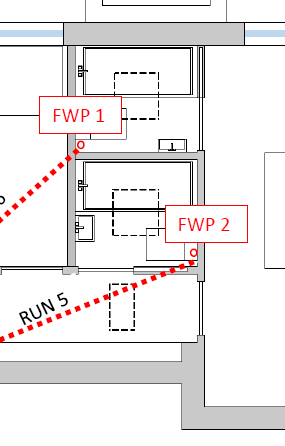
Afternoon all. My SB uses piles and a floating slab, though which foul pipes will take waste water away to the sewer from two small bathrooms: The bathrooms are 1600mm x 1600mm internally. Above the slab will be 90mm insulation and then 65mm screed (in which will live the UFH), plus the finish on top. I am now toying with the best way to arrange the waste pipes, including the best place to put the FWP. The walls are timber studwork, so I could possibly run a pipe from the sink through the wall to the bath and then under the bath, into the wall again, and then connect it to the w/c. Another option some have suggested is that the pipes from sink and bath are run through the screed and insulation, sitting on top of the slab in effect, but my concern is the effect of this approach on the thermal envelope and the UFH. Either way, it seems logical that the FWP should pass through the slab where it can be connected directly to the w/c. I am also giving some thought to installing a channel grate in the floor between the sink and w/c. I am not creating a wetroom, but nobody in my family seems able to have a shower without soaking the floor, so I could factor that in now. If anyone has any pearls of wisdom regarding the best plumbing layout, and the pros and cons of a channel grate I'd be grateful! Cheers
-
It should be as simple as showing them your soakaway design shouldn't it?
-
Recommended foundation method for Clay soil nr trees
Tony K replied to JD44027's topic in Foundations
@JD44027 It was about 40k for the piles, that's 39 piles at about 6-7 metres deep. Then add the cost of the slab. My costings are a bit unique due to my odd site. There's another thread nearby where costs are discussed, so take a look. Good luck! -
Recommended foundation method for Clay soil nr trees
Tony K replied to JD44027's topic in Foundations
I'm on clay with lots of trees and went for steel screw piles, though partly that was due to other logistical factors too. Not cheap, you'll need an engineer to design it and there are only so many firms who do that work. The trees near me are much closer than yours though. Presuming the trees are to be retained, get a soil survey done and an arb survey of the roots, then you can get an engineer to tell you your options regarding foundations. Also consider drainage at the earliest stage. The soil test will tell you if a soakaway is viable or not, and you'll need to know that ASAP. -
It was a pond in winter! I've nowhere to gravity drain it off too but it doesn't matter as I've got the sewer run next to the site and a small pump is more than sufficient. It's just the base of the area. It dries hard enough in some places, but stays mushy in others, suggesting rising moisture. In fact when we literally hover one or two areas dry in the morning they have tiny puddles again by the end of even the hottest day.
-
I doubt I could have a French drain around the house. It's built into the corners of an urban plot, so I've no space outside for it, plus the design has the slab backfilled around the edges in what I think they call a fit and forget arrangement. I will set up a temporary moat drain inside the footprint and try to save the cost of extra hardcore etc.
-
Thanks all. I'll try leveling the surface with the digger and creating a moat around its edges, just inside the excavation walls. I will pump any water away from that moat over the weekend and see if the main surface dries out properly. Then I'll consider extra material and possibly a matting underneath.
-
Thanks @Temp We had considered this option. Not cheap, but might be worth it. A geotextile firm I spoke to this morning didn't have any obvious solution they could offer.
-
I've just had 39 steel screw piles put in for a 100m2 SB on clay in Surrey, came in at about £40k, but beyond a certain point they charge by the linear metre so you'd want to have the ground tested first to have a better idea of final cost. Piling is clever stuff but terribly expensive, so exhaust the possibility of traditional footings first.
-
Evening all. My SB is built into the corners of my small plot, and has required me to excavate the footprint down about 800mm. Inside this area a host of steel screw piles have been inserted, and we are now beginning to create the slab. It's clay soil. The recipe for the slab is 50mm of concrete blinding laid on the soil, then 225mm of cordex (collapsible void former) on top, then the rebar gets attached to the pile heads, before the whole area is filled with concrete. Despite draining the surface several times, and the recent hot weather, the surface remains very boggy. We believe that though the clay is largely impermeable, some small amount of water is getting through - a white line is visible towards the base of the excavation walls which I presume is salt or something. Above the line the clay walls are bone dry, whilst below they are damp. This makes it hard to dry out the surface, and when we walk in it we sink in up to our ankles in places. This makes it hard to progress. We need the blinding to be solid enough to walk about on for a month or so while we build the rest of the slab, but as it stands the blinding will be pushed down into the bog when we walk on it. Possible solutions range from digging a ditch along the side and trying to drain from it, to extra deep blinding, to boarding the area prior to blinding it. One friend has suggested use of some kind of coir matting with crushed concrete over the top, though neither of us has any experience of this. Anyone faced and solved this problem before? Any ideas gratefully received as usual! Thanks
-
Thanks all. I think the conclusion of this is that a hand pulled pallet truck won't do the job. I'll either rent a motorised one or I'll get a decent trolley and get stuck in. Which of these options to go for will be dictated by whether I can get all my bricks, blocks, sand and cement delivered at once (in which case I'll hire the motor pallet truck and shift the lot that day) or, if the materials come in dribs and drabs I'll go for the trolley.
-
Do you say that based on experience of dragging pallets of blocks around? If so I would be very interested in how you got on!

